The Battle of Plassey stands as a watershed moment in Indian history. This seemingly minor skirmish had far-reaching consequences, paving the way for British dominance in the subcontinent. Understanding the Battle of Plassey’s causes, key events, and aftermath provides critical insights into the origins of British rule in India.
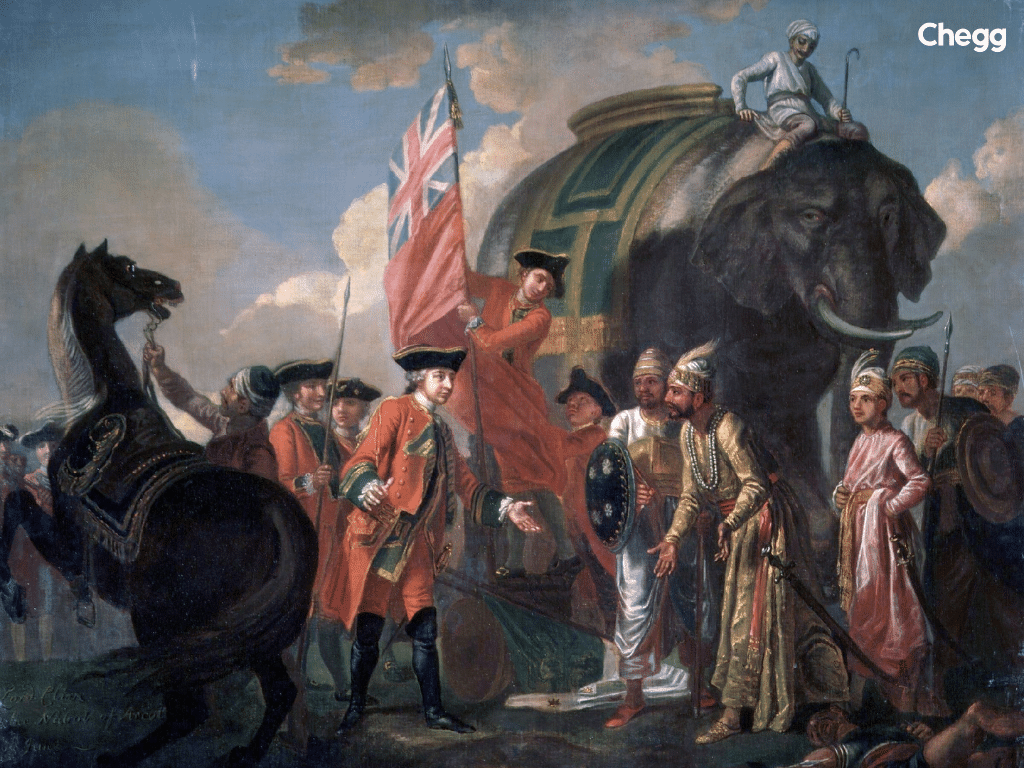
The mid-18th century witnessed the Mughal Empire’s fragmentation, creating power vacuums across India. Under Nawab Alivardi Khan (1740-1756), Bengal operated as a quasi-independent state, generating 12% of global GDP through textiles, shipbuilding, and the opium trade. Murshidabad’s capital rivaled London in wealth, attracting European trading companies. The British East India Company fortified Calcutta illegally, violating Mughal farmans (royal decrees). When Alivardi Khan died in 1756, his 23-year-old grandson Siraj-ud-Daulah inherited a kingdom under siege. The new Nawab faced three immediate threats: British militarization, French expansion at Chandernagore, and treasonous nobles like Mir Jafar. These tensions exploded when Siraj captured Calcutta in June 1756, triggering the Black Hole tragedy – the catalyst for war.
The mid-18th century witnessed the Mughal Empire’s fragmentation. Under Nawab Alivardi Khan (1740-1756), Bengal operated as a quasi-independent state, generating 12% of global GDP through textiles and opium. When Alivardi died in 1756, his grandson Siraj-ud-Daulah inherited a kingdom besieged by:
| Trigger | British Action | Siraj’s Response |
|---|---|---|
| Fortification | Built walls at Fort William | Demanded demolition |
| Trade Abuse | Sold duty-free dastaks illegally | Arrested corrupt officials |
| Asylum | Sheltered Siraj’s enemy Krishna Das | Threatened military action |
The causes of Battle of Plassey were political, economic, and strategic:
Robert Clive exploited the tragedy as propaganda while secretly bribing Siraj’s commander Mir Jafar and banker Jagat Seth to betray the Nawab. This conspiracy made conflict inevitable. After Clive secured these treasonous alliances, the Battle of Plassey date (June 23, 1757) was chosen.
The Battle of Plassey was fought between Robert Clive’s 3,000 EIC troops and Siraj-ud-Daulah’s 50,000-strong army. Yet who won the Battle of Plassey was decided not by numbers but treason:
| Participant | Role & Significance | Outcome |
|---|---|---|
| Siraj-ud-Daulah | Nawab of Bengal. Captured Calcutta after British treaty violations. His imprisonment of EIC captives caused the Black Hole tragedy. | Captured & executed by Miran (Mir Jafar’s son) |
| Robert Clive | EIC commander. Fortified Calcutta illegally, granted asylum to Siraj’s enemies, and masterminded the conspiracy with Mir Jafar. | Became Governor of Bengal; amassed £234,000 fortune |
| Mir Jafar | Swindled by Clive with a fake treaty | Puppet Nawab (1757-1760); bankrupted Bengal |
| Jagat Seth | Merchant. Double agent who negotiated the Clive-Mir Jafar treaty. Demanded a ₹300,000 cut. | Maintained wealth under British rule |
| Rai Durlabh | General. Deserted mid-battle with 15,000 troops after taking Clive’s bribes. | Retained position under Mir Jafar |
| Omi Chand | Siraj’s army chief. Bribed by Clive with promises of Nawabship, 1/3 of Bengal’s army was withheld during the battle. | Siraj’s army chief. Bribed by Clive with promises of Nawabship, withheld 1/3 of Bengal’s army during the battle. |
Pre-1757 Bengal was an Asian superpower:
But vulnerabilities enabled Clive’s plot: dependence on Jagat Seth’s loans, French-British rivalries on its soil, and disloyal nobles. When Siraj restricted EIC trade privileges, the Company funded his uncle’s coup – destabilizing Bengal before Plassey. This context is vital for What is Battle of Plassey UPSC essays on colonial exploitation.
Battle of Plassey summary: On June 23, 1757, near Palashi village
| Phase | Nawab’s Forces (50,000) | British Forces (3,000) |
|---|---|---|
| Pre-Battle | French guns positioned behind mango groves | Clive faked retreat to lure cavalry |
| Monsoon Crisis | Gunpowder soaked (no tarpaulins) | Artillery protected by covers |
| Climax | Mir Jafar/Rai Durlabh held back 35,000 troops | Concentrated cannon fire on exposed flank |
What was the outcome of the Battle of Plassey? British victory with just 22 dead – securing EIC’s political control. This battle of plassey summary reveals how weather and betrayal decided India’s fate.
| Date | Event | Consequence |
|---|---|---|
| Apr 9, 1756 | Siraj becomes Nawab | Inherits Alivardi’s anti-EIC policies |
| Jun 20, 1756 | Black Hole of Calcutta | 64-123 British deaths; propaganda victory for Clive |
| Jan 1757 | Clive recaptures Calcutta | Secures EIC’s base for invasion |
| May 1757 | Treaty of Alinagar signed | Siraj cedes Calcutta; temporary truce |
| Jun 5, 1757 | Secret Clive-Mir Jafar Pact | Guarantees betrayal at Plassey |
| Jun 23, 1757 | Battle of Plassey | British victory in 11 hours |
| Jul 2, 1757 | Mir Jafar installed as Nawab | Pays EIC ₹177 million “reparations” |
| Aug 1757 | Siraj executed in Murshidabad | Mir Jafar’s dynasty begins |
These battle of plassey notes highlight key dates for exam revision. The Battle of Plassey date (June 23) remains among India’s most consequential.
Mir Jafar’s reign (1757-1760) became synonymous with colonial exploitation. His “reparations” to the EIC totaled ₹177 million (£20 million), draining Bengal’s treasury. When he couldn’t pay, the Company seized revenue rights to Burdwan, Midnapore, and Chittagong. 1759 Mir Jafar conspired with the Dutch East India Company to regain independence. Clive’s successor, Henry Vansittart, crushed the Dutch at the Battle of Bedara (Nov 1759) and imposed the Treaty of 1760:
After draining Bengal’s treasury with ₹177M “reparations,” Mir Jafar conspired with the Dutch East India Company to regain power. The British crushed this revolt at Bedara (1759), imposing the Treaty of 1760 which:
This cemented Britain’s economic stranglehold – a critical outcome of the Battle of Plassey.
| Impact Area | Short-Term Effect | Long-Term Consequence |
|---|---|---|
| Economic | Doctrine of Lapse (1848) annexed Indian states | Bengal Famine (1770): 10 million deaths |
| Political | Mir Jafar was installed as a puppet | Formed world’s largest mercenary army by 1805 |
| Military | EIC levies sepoys from Bengal | Formed the world’s largest mercenary army by 1805 |
| Cultural | Persian replaced by English | Macaulay’s education system (1835) |
The battle transformed the EIC from traders to rulers. By 1765, they controlled Bengal’s diwani (revenue system), extracting £1 million annually. This “Drain of Wealth” (identified by Dadabhai Naoroji) funded Britain’s Industrial Revolution while deindustrializing Bengal. Socially, it created a new comprador class of Bengali collaborators.
The significance of battle of plassey transformed Asia:
What was the significance of the battle of plassey for UPSC? It triggered the Regulating Act (1773) and Permanent Settlement (1793) – foundational colonial laws.
For UPSC Aspirants: The Battle of Plassey UPSC focus areas include its role in the Regulating Act (1773) and Permanent Settlement (1793).
Historian William Dalrymple notes: “Plassey was less a battle than a corporate hostile takeover.”
The Battle of Plassey (June 23, 1757) represents history’s most consequential corporate coup. By combining monsoon opportunism, systematic bribery, and psychological warfare, Robert Clive’s 3,000 men defeated a kingdom of 60 million. Its legacy includes the 1770 Bengal Famine and the seeds of the 1857 Revolt. For modern India, Plassey remains the foundational trauma of colonialism – where a trading company’s greed birthed an empire. As the memorial at Palashi reminds us: “Here began the captivity of India.”. For historians and Battle of Plassey UPSC aspirants, this remains the definitive case study in economic imperialism.
Read More:-
The Battle of Hydaspes: Alexander vs Porus
Third Battle of Panipat (1761)
The Battle of Bhima Koregaon Simplified
The Battle of Haldighati on 18 June 1576: A Simple Overview
First Battle of Panipat (1526)
Battle of Buxar (1764): Epic War
The Second Battle of Panipat (1556)
The Battle of Plassey, fought on June 23, 1757, was between the forces of the British East India Company, led by Robert Clive, and the Nawab of Bengal, Siraj-ud-Daulah, along with his French allies. Betrayal by Mir Jafar, Siraj-ud-Daulah’s commander, played a key role in the British victory.
The Battle of Plassey, fought on June 23, 1757, was a decisive conflict between the British East India Company, led by Robert Clive, and the Nawab of Bengal, Siraj-ud-Daulah. The British victory, aided by Mir Jafar’s betrayal, marked the beginning of British colonial dominance in India.
The Battle of Plassey (1757) is famous for marking the start of British colonial rule in India. The battle of Plassey was fought in Bengal to secure trade dominance. With Mir Jafar’s betrayal, the British East India Company won, reshaping India’s future.
The Battle of Plassey (1757) and Battle of Buxar (1764) were key events that established British rule in India, securing Bengal and expanding their dominance.
Siraj lost the Battle of Plassey on June 23, 1757, as a result of being betrayed by Mir Jafar, the leader of Nawab’s army. Following their invasion, the East India Company, led by Robert Clive, gained control of Bengal’s government.
The Battle of Plassey (1757) became famous as it marked the start of British rule in India, showcasing their strategic dominance and altering India’s history.
The Battle of Plassey, fought on June 23, 1757, was between the forces of the British East India Company, led by Robert Clive, and the Nawab of Bengal, Siraj-ud-Daulah, who was supported by his French allies. This clash marked a turning point in Indian history.