Ayushman Bharat Digital Mission (ABDM) is a flagship initiative by the Government of India to digitize healthcare, ensuring secure, paperless access to medical records through tools like ABHA ID and Ayushman Card.
The mission aims to create an integrated digital health ecosystem, enhancing interoperability, efficiency, and transparency across public and private healthcare services.
Key components include ABHA (Health ID), Health Professionals Registry (HPR), Health Facility Registry (HFR), Unified Health Interface (UHI), and Consent Manager, all designed to improve service delivery and patient empowerment.
Benefits include real-time access to health data, improved diagnostics, continuity of care, telemedicine support, and cost-effective treatment.
With over 52 crore ABHA IDs issued and extensive government outreach, ABDM is advancing toward its goal of universal, inclusive, and digitally-enabled healthcare across India.
Table of Contents
India’s healthcare system has long been burdened with fragmentation, inconsistent medical records, and limited access, especially in rural areas. To address these challenges, the Government of India launched the Ayushman Bharat Digital Mission (ABDM), a game-changing initiative to digitize the nation’s healthcare infrastructure. By creating a unified digital health ecosystem, ABDM empowers citizens to access and manage their health records securely and efficiently. It connects patients, healthcare providers, and facilities through a seamless digital network, reducing dependency on paper-based records and improving the quality and reach of healthcare services. Citizens can now use tools like the Ayushman and ABHA cards to simplify their access to medical care.
What is Ayushman Bharat Digital Mission (ABDM)
ABDM full form is Ayushman Bharat Digital Mission. Initially launched as the National Digital Health Mission (NDHM) on 15 August 2020, also noted as the National Digital Health Mission launch date, it was later rebranded better to reflect its alignment with the broader Ayushman Bharat Yojana. Managed by the National Health Authority (NHA), ABDM aims to establish an integrated digital health infrastructure nationwide.
ABDM facilitates the creation of a digital health ID for every citizen, enabling seamless access, sharing, and management of health data. This platform promotes interoperability across different healthcare systems, ensuring transparency and efficiency in health service delivery.
Vision and Objectives of ABDM
ABDM envisions a future where healthcare is accessible, affordable, inclusive, and digital-first.
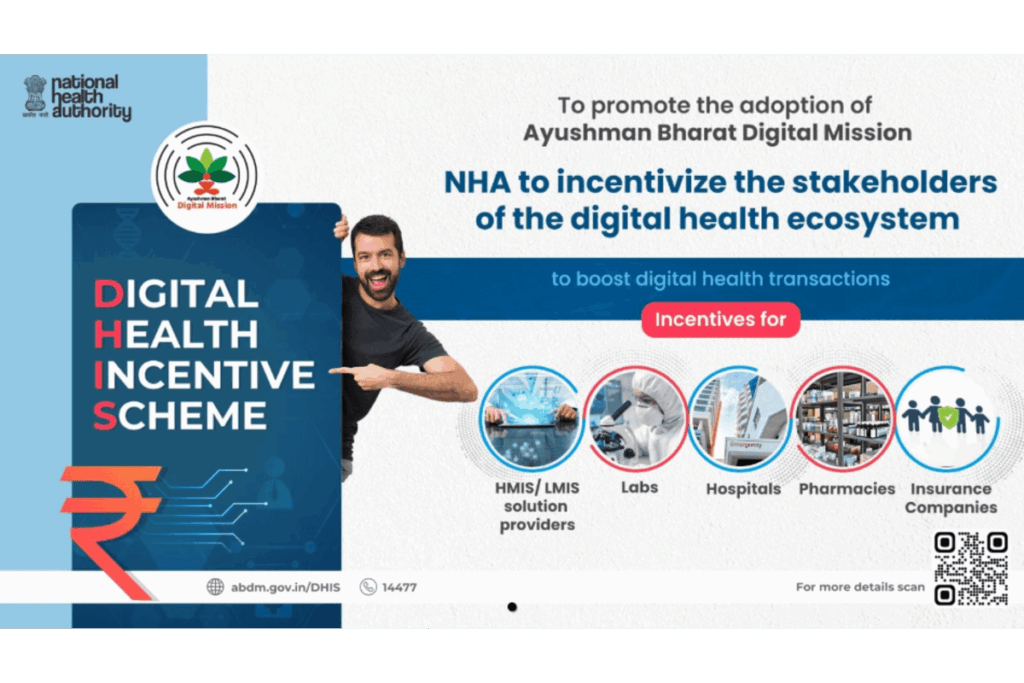
Image source: https://abdm.gov.in/DHIS
Key Objectives:
Empower citizens with digital access to healthcare services.
Ensure interoperability across public and private health ecosystems.
Promote real-time data sharing of health records with patient consent.
Improve the efficiency, quality, and affordability of healthcare.
Facilitate evidence-based planning and policy-making through anonymized health data.
By digitizing healthcare, ABDM seeks to create a secure, trustworthy, and user-friendly ecosystem that benefits both service providers and patients.
Key Components of ABDM
ABDM is composed of several foundational building blocks that form the backbone of India’s digital health infrastructure:
ABHA (Ayushman Bharat Health Account)
A 14-digit unique Health ID that stores a person’s medical records.
Can be created using Aadhaar or a mobile number.
Helps maintain a longitudinal health history, accessible anywhere in the country.
Acts as the digital identity associated with the Ayushman card and can be useful when you Ayushman card apply online.
Healthcare Professionals Registry (HPR)
A comprehensive list of certified healthcare professionals.
Enables patients to verify and locate qualified practitioners.
Supports digital consultation and appointment scheduling.
Health Facility Registry (HFR)
A national directory of public and private hospitals, clinics, and labs.
Facilitates discovery and digital onboarding of health facilities.
Personal Health Record (PHR) System
Offers a secure digital storage space for individual health data.
Allows patients to manage, access, and share their records with consent.
Unified Health Interface (UHI)
A digital network that connects healthcare providers and patients.
Enables booking, teleconsultation, and service discovery through various apps.
Consent Manager
Manages consent for access and sharing of digital health records.
Offers patients complete control over their health data.
Drug & Diagnostic Registries
Standardized databases for drugs, devices, and diagnostics.
Ensures uniformity and authenticity in prescriptions and treatments
How Does ABDM Work?
ABDM operates through a simple yet powerful digital framework:
Citizens create an ABHA ID via the portal or authorized apps.
Health records from hospitals and labs are linked to this ID.
Patients provide a consent token during a visit to grant temporary access to their data.
Doctors can view and update the records in real-time.
Records are securely stored and accessible across facilities.
This consent-based model ensures privacy, security, and transparency, allowing patients to manage their own data using tools such as the ABHA card and their Ayushman card.
Benefits of Ayushman Bharat Digital Mission
ABDM offers numerous advantages that streamline healthcare delivery:
Paperless medical records reduce the risk of loss and duplication.
Continuity of care across different healthcare providers.
Improved diagnostics through a complete medical history.
Boosts telemedicine and remote consultations.
Cost-effective care by eliminating redundant tests.
Informed decision-making by healthcare professionals.
ABDM empowers citizens and simultaneously strengthens the healthcare infrastructure.
Creating an ABHA ID is free, voluntary, and can significantly improve healthcare access.
Data Privacy and Consent Mechanism
ABDM has a privacy-by-design framework to protect sensitive health data:
Consent-first system: Patients control who accesses their data.
Encrypted records ensure data is not misused.
Audit trails log every access to data.
Users can revoke access anytime.
It aligns with the proposed Digital Personal Data Protection Act to ensure legal protection of user data.
Challenges and Criticisms of ABDM
Despite its potential, ABDM faces several hurdles:
Digital divide in rural and underprivileged areas.
Low digital literacy among the elderly and the poor.
Concerns about cybersecurity and data misuse.
Resistance from small healthcare providers to adopting digital systems.
Limited awareness of ABHA benefits among the population.
The government needs sustained awareness, training, and infrastructure efforts to overcome these challenges.
Government Efforts and Current Status (as of 2025)
Milestones Achieved:
Over 52 crore ABHA IDs issued.
2.2 lakh+ health facilities registered.
14 lakh+ professionals enrolled in HPR.
ABHA App has been downloaded over 3 crore times.
Ongoing Government Initiatives:
Integration with PM-JAY hospitals.
Incentives for private healthcare adoption.
Multi-language support and rural outreach campaigns.
Budget allocation under the Digital India Mission.
Comparison: ABDM vs Traditional Healthcare Systems
Parameter
Traditional Healthcare
ABDM–enabled Healthcare
Record Keeping
Paper-based
Digital and cloud-based
Accessibility
Location-specific
Anytime, anywhere
Continuity of Care
Limited
Unified medical history
Privacy & Security
Manual safeguards
Consent-driven, encrypted
Efficiency
Low
High
ABDM and Ayushman Bharat Yojana: How Are They Linked?
While both are part of the Ayushman Bharat umbrella, they serve distinct yet complementary purposes:
Ayushman Bharat Yojana (PM-JAY) provides financial coverage to over 50 crore beneficiaries.
Ayushman Bharat Digital Mission (ABDM) focuses on digitizing the healthcare infrastructure.
Together, they aim to deliver universal health coverage in India.
Future Outlook of ABDM
The future of ABDM is promising and dynamic:
Expansion into rural primary health centers.
Use of AI and machine learning for diagnostics.
Integration with insurance and pharmacy platforms.
Increased focus on telehealth and wearable devices.
Global recognition as a model for digital health in developing countries.
ABDM is poised to play a key role in achieving Sustainable Development Goal 3 (SDG-3): Good Health and Well-being.
Relevance for UPSC/SSC and Other Exams
ABDM is highly relevant for competitive exams and general studies:
Likely Exam Areas:
Government Schemes
Health and Technology
Polity and Governance
Sample Questions:
What is the full form of ABDM?
List components of the Ayushman Bharat Digital Mission.
How does the ABHA card help citizens?
Explain the consent mechanism under ABDM.
Candidates should study ABDM under GS Paper II (Governance) and GS Paper III (Science & Tech).
Conclusion
The Ayushman Bharat Digital Mission is a transformative step toward creating India’s digitally empowered health ecosystem. By enabling secure, transparent, and citizen-centric healthcare, ABDM aligns with the country’s broader goals of inclusivity, efficiency, and universal health access. As digital literacy and infrastructure improve, ABDM has the potential to become a global benchmark in public health innovation.
The main purpose of the Ayushman Bharat Mission is to provide healthcare coverage and financial protection to those without access to healthcare by identifying backward households.
When was the Ayushman Bharat mission launched?
The ABDM was launched on 27th September 2021, creating a robust digital healthcare infrastructure. Allowed the healthcare access from anywhere in the country.
How to apply for the Ayushman Bharat card online?
To apply for an Ayushman Bharat card, an individual would be required to visit the official website mera.pmjay.gov.in. To log in, the mobile number needs to be used to log in via an OTP, which would reroute you to the PMJAY login page.
What are the benefits of ABDM?
The main benefits of ABDM include access to healthcare records from anywhere in India. These health records are encrypted and allow access to the ABDM Electronic medical report.
Who launched the National Digital Health Mission?
Narendra Modi launched the NDHM.
Authored by, Muskan Gupta Content Curator
Muskan believes learning should feel like an adventure, not a chore. With years of experience in content creation and strategy, she specializes in educational topics, online earning opportunities, and general knowledge. She enjoys sharing her insights through blogs and articles that inform and inspire her readers. When she’s not writing, you’ll likely find her hopping between bookstores and bakeries, always in search of her next favorite read or treat.