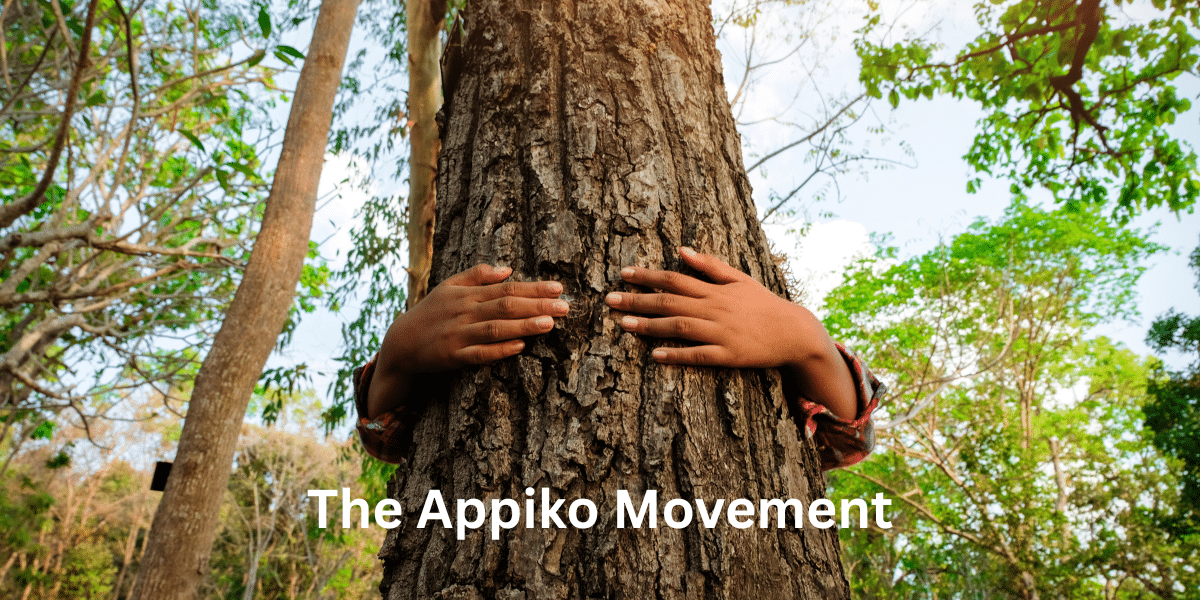
The Appiko Movement was a grassroots forest conservation initiative launched in 1983 in Salkani, Karnataka, in southern India. Inspired by the Chipko Movement of North India, Appiko adapted the powerful act of tree-hugging to the cultural and ecological context of the Western Ghats. The movement began as a response to the rampant deforestation caused by industrial logging and monoculture plantations that severely degraded the region’s rich biodiversity and harmed the livelihoods of forest-dependent communities.
Led by environmentalist Pandurang Hegde, the movement mobilized local villagers, especially women, farmers, and youth, to embrace trees and prevent their felling physically. Their goal was not only to stop deforestation but also to promote afforestation with native species and advocate for the sustainable use of forest resources.
The Appiko Movement became a symbol of people-powered conservation. Using traditional folk art, street plays, and education campaigns, it successfully raised environmental awareness and influenced forest policies. In today’s era of ecological crisis, Appiko serves as a powerful reminder of how collective action at the grassroots can protect nature and preserve livelihoods.
Quick Facts:
| Feature | Detail |
| Started In | September 1983 |
| Location | Salkani village, Karnataka |
| Leader | Pandurang Hegde |
| Slogan | “Ulisu, Belesu, Balasu” (Conserve, Grow, Rational Use) |
The Western Ghats, one of India’s richest ecological zones, faced severe environmental threats during the 1970s and early 1980s. In regions like the Uttara Kannada district in Karnataka, vast tracts of native forests were cleared for industrial logging and monoculture plantations, mainly teak and eucalyptus. This led to massive deforestation, soil erosion, drying up of local water sources, and biodiversity loss. For the local tribal communities and farmers, the consequences were devastating; shrinking forests meant fewer resources for fuel, fodder, food, and medicine, directly impacting their livelihoods.
Forest policies that prioritized timber extraction over ecological balance exacerbated the situation. Sacred groves were destroyed, and traditional forest rights were ignored. As environmental degradation became more visible, local communities began seeking ways to resist.
Inspired by the Chipko Movement in Uttarakhand, where villagers hugged trees to prevent their felling, Pandurang Hegde, a young environmental activist and student of Chipko leader Sunderlal Bahuguna, initiated a similar movement in Karnataka. Recognizing the unique cultural and ecological context of the Western Ghats, he localized the methods and message.
In September 1983, the Appiko Movement was started in Salkani village. Villagers physically hugged trees marked for cutting, halting deforestation through peaceful protest. Hegde focused on empowering local communities, especially women and youth, to become protectors of their forests. As the Appiko Movement leader, he also emphasized education and cultural revival. The movement spread awareness about sustainable living and forest conservation through folk arts, storytelling, and grassroots outreach.
Thus, the Appiko Movement became more than just a protest; it was a call to reclaim traditional forest stewardship and reassert the community’s right to a healthy environment. It remains a powerful example of how local knowledge and collective action can challenge ecological injustice.
The Appiko Movement was built around three core objectives that reflected both the immediate needs of the environment and the long-term vision of sustainable forest management:
This was the most urgent and visible issue facing the forests of the Western Ghats. Rampant industrial deforestation by timber contractors and government-backed projects destroyed ancient tree cover and harmed local ecosystems. The Appiko Movement’s first goal was to halt this destruction by mobilizing villagers to prevent tree felling through nonviolent protest.
Instead of replacing forests with commercial monocultures like teak or eucalyptus, the movement advocated planting indigenous tree species that supported biodiversity, retained soil moisture, and aligned with the local ecological balance. Community-led nurseries were developed to grow native saplings for reforestation efforts.
A key aspect of the Appiko Movement was educating local communities about the sustainable and regenerative use of forest products. Rather than banning forest usage, the movement taught people how to collect fuelwood, fruits, herbs, and other resources in a way that did not harm the ecosystem.
The slogan of Appiko Movement, “Ulisu, Belesu, Balasu” (Conserve, Grow, Use wisely), beautifully encapsulates the movement’s philosophy:
This slogan reflects the key aspect of the Appiko Movement: empowering communities to take responsibility for ecological preservation. These objectives are deeply aligned with modern principles of sustainable development, emphasizing conservation, community participation, and fairness for future generations.
The Appiko Movement evolved rapidly from a localized protest into a widespread environmental campaign that reshaped forest conservation discourse in Karnataka. Its timeline reflects key milestones that blended activism, cultural outreach, and policy influence.
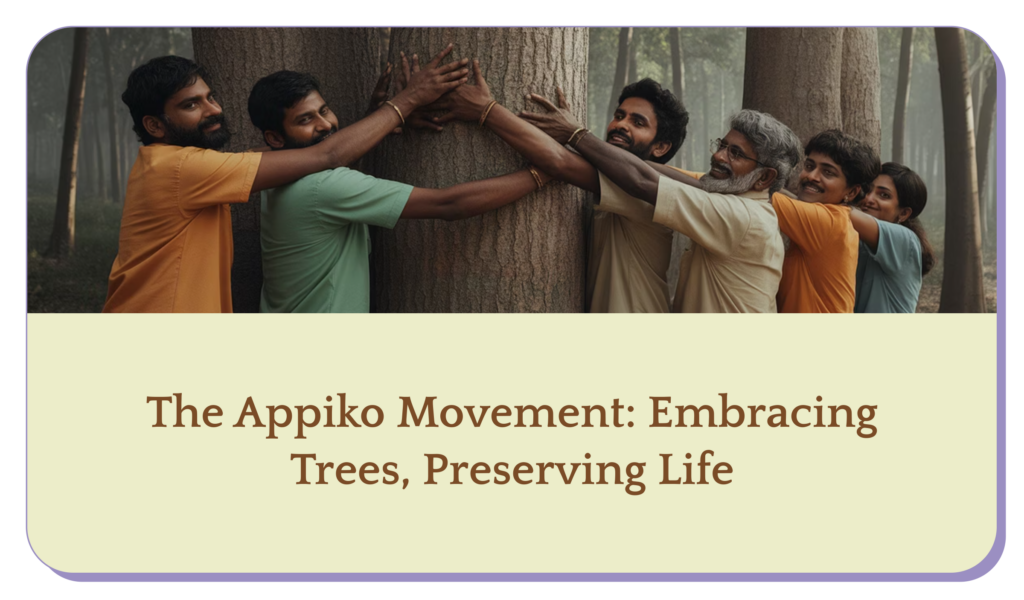
The movement officially began in September 1983 in Salkani village, located in the Uttara Kannada district of Karnataka. Alarmed by the rapid deforestation in the region, villagers led by environmental activist Pandurang Hegde resorted to a powerful act of nonviolent resistance: they hugged the trees marked for felling, physically preventing contractors from cutting them down. This symbolic gesture, inspired by the Chipko Movement in Uttarakhand, became the defining act of Appiko and galvanized local communities into action.
In April 1984, Appiko activists organized a 650-kilometer foot march across eight districts of the Western Ghats to protest deforestation and educate villagers along the route. Using traditional communication forms such as Yakshagana (a Kannada folk dance-drama), street theatre, and slide shows, activists engaged villagers in discussions about the dangers of ecological degradation. This innovative use of cultural media helped bridge the gap between scientific knowledge and rural awareness.
Understanding the importance of youth in sustaining environmental consciousness, the Appiko Movement extended its activities to schools and colleges. Organizers collaborated with local teachers, NGOs, and educational institutions to integrate environmental education into community programs. Students participated in plantation drives, created eco-clubs, and conducted awareness campaigns, ensuring the next generation carried forward the movement’s values.
As the movement gained momentum, it received significant media coverage in regional and national outlets. This visibility created public pressure on the government, prompting it to initiate dialogues with environmentalists. Forest policies were revisited, and the government began exploring community-based forest management approaches, a significant shift from the earlier top-down exploitation model.
The success in Salkani inspired nearby regions such as Sirsi, Yellapur, and Karwar to join the cause. Each village adapted Appiko’s methods to suit its local cultural context, demonstrating the movement’s flexibility and inclusiveness. This decentralized expansion helped sustain its energy and extended its reach across Karnataka’s Western Ghats.
The Appiko Movement’s timeline reveals how a simple act of resistance grew into a multifaceted campaign that combined activism, education, and policy influence, laying the groundwork for modern grassroots environmentalism in India.
The Appiko Movement distinguished itself through its unique blend of nonviolent protest, cultural expression, and grassroots engagement. It went beyond tree-hugging to involve the entire community in forest conservation, making it a true people’s movement.
The power of tree-hugging was at the heart of the movement, directly inspired by the Chipko Movement of Uttarakhand. Villagers, including men, women, and children, physically embraced trees marked for felling, creating a human shield around them. This nonviolent protest sent a strong visual message to authorities and contractors that the community was united in its defense of the forest. It became a symbol of solidarity, sacrifice, and environmental stewardship.
Women played a pivotal role in the Appiko Movement. As primary gatherers of fuelwood, fodder, and water, they were directly impacted by forest degradation. Women from tribal and agrarian communities guarded forest patches, participated in village meetings, and often led the protests. Farmers, too, were active participants, recognizing the link between healthy forests and agricultural sustainability. This deep, community-rooted participation ensured the movement’s resilience.
The movement effectively used local art forms and communication techniques to raise awareness:
The Appiko Movement didn’t just resist forest destruction; it offered alternatives:
This holistic approach integrated protest with sustainable development, turning Appiko into a model for community-driven ecological action.
The Appiko Movement left a lasting legacy on forest conservation in Karnataka and beyond. Its outcomes extended far beyond the initial tree-hugging protests, transforming environmental policies, community engagement, and ecological consciousness.
One of the most significant impacts was seen in forest governance. By the late 1980s, the Karnataka government banned the felling of green trees in several forest areas, particularly in ecologically sensitive zones of the Western Ghats. This policy shift directly resulted from sustained public pressure, grassroots advocacy, and the visibility the Appiko Movement created. It marked a departure from the earlier forest exploitation model toward conservation-oriented planning.
The movement also saw massive afforestation efforts. Between 1984 and 1985, villagers, with the support of NGOs and schools, planted over 1.2 million saplings, many of which were indigenous species adapted to the local ecosystem. This restored degraded land and ensured ecological balance by avoiding harmful monocultures like eucalyptus.
The Appiko Movement influenced state forestry policies to move away from rigid, top-down models. Forest departments began embracing Joint Forest Management (JFM), a strategy that involved local communities in forest planning, protection, and sustainable resource use. This shift acknowledged the traditional ecological knowledge held by forest-dependent communities.
The movement instilled a renewed sense of ownership among local people. Villagers actively monitored forests, resisted illegal logging, and maintained ecological health. Women, in particular, emerged as key custodians of community-managed forest areas.
The movement contributed significantly to conserving the Western Ghats, a UNESCO-recognized biodiversity hotspot. Forest patches saved by Appiko efforts now host rare flora and fauna, which are vital in climate regulation and water conservation.
Appiko gained attention in national environmental discourse and was cited in UN conferences, research papers, and global case studies on sustainable development. Its success reinforced the international relevance of community-driven ecological activism.
| Feature | Chipko Movement | Appiko Movement |
| Region | Uttarakhand (North India) | Karnataka (South India) |
| Started In | 1973 | 1983 |
| Leader | Sunderlal Bahuguna | Pandurang Hegde |
| Language | Hindi | Kannada |
| Slogan | “Ecology is permanent economy” | “Ulisu, Belesu, Balasu” |
| Methods | Tree hugging, foot marches | Tree hugging, folk arts, media |
| Focus | Prevent commercial logging | Promote sustainable forestry |
While both movements share the tactic of tree-hugging, Appiko localized the method to fit southern India’s cultural tools and linguistic traditions. The difference between Chipko and Appiko Movement lies in their approach. Appiko integrated media, education, and artistic performance to broaden participation.
The Appiko Movement is significant in India’s environmental history, shaping forest policy, education, and grassroots activism beyond its origins in Karnataka.
One of Appiko’s lasting legacies is integrating community participation into forest management policies. The movement demonstrated that sustainable conservation is only possible when local people are actively involved. This insight has influenced the adoption of Joint Forest Management (JFM) schemes across India. Moreover, Appiko’s success inspired the incorporation of environmental studies into school curricula, fostering ecological awareness among younger generations and encouraging them to take active roles in forest protection.
Many grassroots organizations focused on forest conservation acknowledge Appiko as a foundational model. Its community-driven approach and cultural engagement have been adapted and replicated in various parts of the country. These NGOs continue to empower local communities and advocate for sustainable forest management using the principles established by the movement.
In recent interviews, Pandurang Hegde, the movement’s leader, stressed the urgent need to reconnect youth with nature. He highlighted new challenges such as consumerism, digital distractions, and urban lifestyles, which are distancing younger generations from the environment. Hegde calls for renewed efforts to revive ecological values rooted in community and tradition, echoing the core principles of Appiko.
Despite progress, forests in India face ongoing threats from urbanization, weakened environmental laws, and political inertia. These challenges underscore the continued relevance of Appiko’s story. It is a potent reminder that mobilized citizens can influence policies and protect natural resources, even against formidable odds.
The Appiko Movement remains a beacon of hope and a blueprint for contemporary environmental activism in India.
The Appiko Movement is a powerful example of people-centric conservation that successfully blended tradition, activism, and education to protect the Western Ghats, one of India’s richest and most fragile ecosystems. From the symbolic act of hugging trees to organizing a 650-kilometer foot march, the villagers demonstrated how collective determination can halt environmental destruction.
By emphasizing conservation, regeneration, and sustainable use of forest resources, the movement laid the groundwork for participatory forest management across India. It proved that grassroots initiatives are not only capable of influencing government policies but also essential for preserving biodiversity and empowering local communities.
Appiko’s legacy inspires environmentalists, policymakers, and youth, reminding us that lasting ecological change comes from the ground up. Its lessons remain relevant today as India and the world face increasing environmental challenges, urging us all to take part in protecting nature for future generations.
In today’s climate crisis era, the key aspect of the Appiko Movement community’s stewardship of nature remains more relevant than ever. Students, activists, and policymakers must draw lessons from this movement to build a greener, more inclusive future.
Also Read:
Panduranga Hegde, an environmentalist from Uttara Kannada district in Karnataka, is renowned for launching the Appiko Movement, a grassroots initiative aimed at conserving trees and protecting the fragile ecosystems of the Western Ghats from deforestation and ecological harm.
The key difference between the Chipko and Appiko movements lies in location and focus. Chipko began in Uttarakhand (1973) to stop government logging, while Appiko started in Karnataka (1983) to protect Kalse forests from industrial exploitation.
The Appiko Movement achieved its three main goals: conserving existing forests, regenerating vegetation on degraded lands, and promoting the sustainable use of forest resources while ensuring the long-term conservation of the region’s natural ecosystems and biodiversity.
The Appiko Movement’s iconic slogan, translated from Kannada as Ulisu (“save”), Belesu (“grow”), and Balasu (“use wisely”), emphasized the need to conserve forests, encourage tree growth, and utilize forest resources in a rational, sustainable, and responsible manner.
Pandurang Hegde started the Appiko Movement in 1983 in Karnataka, India. Inspired by the Chipko Movement, it aimed to protect forests from commercial logging and preserve ecological balance.
The Appiko Movement began in 1983 in Karnataka’s Uttara Kannada district. Inspired by the Chipko Movement, it aimed to protect forests in the Western Ghats. Led by Pandurang Hegde, people hugged trees to prevent deforestation and commercial logging.