To become a police officer after 12th, target state-level constable exams (e.g., UP Police, SSC GD).
Eligibility requires a 12th pass certificate, age 18-25, and meeting physical standards.
For higher ranks like Sub-Inspector, a bachelor’s degree is mandatory.
Stay updated on 2025 recruitment notifications via official state police portals for the best government job opportunities in India. Start physical and exam preparation early.
Table of Contents
“How to become a police officer after 12th?” is a top question among students passionate about serving the nation. Civil Police Officers play a crucial role in maintaining law and order, ensuring citizen safety, and building community trust. For young aspirants, knowing the correct path, from eligibility and exams to training, is essential to entering this noble profession.
According to the Bureau of Police Research and Development (BPRD), India had over 21 lakh sanctioned police posts projected for 2025, with ongoing recruitment at state and central levels. This growing demand highlights exceptional opportunities for dedicated individuals in law enforcement.
Case Example: In 2022, a 19-year-old from Uttar Pradesh cleared the state police constable exam right after 12th grade. With consistent preparation, focus on physical fitness, and guidance from mentors, he secured a position in the police force at a young age. His story inspired many others in his district to pursue a similar path, proving that determination and structured preparation can help students achieve their dreams.
After Class 12, aspirants can appear for state-level constable exams through Public Service Commissions, apply via SSC for Sub-Inspector roles, or aim higher by pursuing a degree and preparing for the UPSC Civil Services Exam to join the prestigious Indian Police Service (IPS). Each path has unique eligibility criteria, competitive exams, and physical standards.
If you are committed to discipline, physical fitness, and serving society, a career in law enforcement can be both fulfilling and impactful.
Career Overview of a Civil Police Officer
Parameters
Details
Eligibility
10+2
Industry
Law Enforcement and Public Safety
Role
Police Constable, Sub-Inspector, Deputy Superintendent, Superintendent, etc.
Starting Salary
INR 4 Lakh
Top recruiters
CISF, BSF, CBI, CRPF
Types of Police Officers
IPS Officer Ranks
Director General of Police
Addl. Director General of Police
Inspector General of Police
Deputy Inspector General of Police
Superintendent of Police
Addl. Superintendent of Police
State Police Service Officers
Superintendent of Police
Addl. Superintendent of Police
Deputy Superintendent of Police
Eligibility for Becoming a Police Officer
Police qualificationrequirements vary based on the post for which you are applying. The following table shows the general requirements for becoming a police officer after 12th grade. However, data may vary for reserved categories or the state of your application.
Position
Police Age limit (in years)
Educational qualifications
Physical requirements
Constable or Head Constable
18-25
10+2
About 155 cm for women and 165 for men
Addl. Superintendent of Police
21-30
Graduation
About 165 cm for men and 150 cm for women
Sub Inspector or Assistant Sub Inspector
20-25
Graduation with at least 50% marks
About 157 cm for women and 170 cm for men
The table does not list the qualifications for some posts. The respective departments are responsible for recruiting people for those posts through promotion.
Salary of Police Officers in India
If you are passionate about joining the police force, you must know its structure. The following are the types of police ranks and salaries of police officers in India.
Different categories of police officers in India are classified under different pay bands. The government of India decides the pay scale of the officers. The seniority and responsibilities of the recruited officer help in making this decision.
Here’s a general overview of the average salary for police officers in India based on experience:
Understanding the steps to becoming a police officer after 12th grade is essential for starting your journey in law enforcement. Begin by meeting the essential qualifications and building a strong foundation for the role’s requirements.
Becoming a civil police officer involves clearing various stages, including exams and assessments. With focus and preparation, you can achieve your goal. Following these steps will guide you through the process of becoming a police officer after 12th grade and help you contribute to maintaining law and order.
Below are the detailed steps on how to become a civil police officer after 12th grade –
Complete your graduation– This is an optional but recommended step. After the 12th, you can only apply for a constable or head constable position, whereas once you’ve graduated, you can apply for a sub-inspector post and other higher positions. If you’re wondering how to become a police officer after the 12th, finishing your graduation can significantly enhance your career opportunities in law enforcement.
Apply for the Police Constable (PC) or Sub-Inspector (SI) exam– The exams are conducted by the state governments or the Union Public Service Commission (UPSC). The PC exam is for the constable post, while the SI exam is for the sub-inspector post.
Clear the physical and written exams- The physical exam tests your stamina and strength, while the written exam tests your knowledge of general science, current affairs, and the police force. The physical exam usually includes a running test, a jumping test, and a lifting test. The written exam usually consists of a multiple-choice test and a descriptive test.
Go through the training– If you clear the exams, you will be called for training at a police academy. The training period is usually 6 months to 1 year. The academy will teach you the basics of police work, such as law enforcement, investigation, and crowd control.
Get posted as a police officer- After completing the training, you will be posted as a police officer in a police station or other law enforcement agency. Your first posting will likely be as a constable. You can then apply for the SI exam after gaining some experience.
Police Ranks that are available as a career path
How to Become a Police Officer After 12th in India?
To become a police officer in India, after passing the 12th, you can apply for the constable post via your state-level recruitment exams as part of how to become a police officer after 12th grade. The alternative way is to complete your graduation and then directly apply for the post of sub-inspector by appearing for exams like CSE, SSC, and state-level police service exams. Candidates must meet Delhi Police Constable qualification requirements, including age, education, and physical standards.
Designation
Eligibility
Entrance Exams
Constable
Age: 18-25 years Educational Qualification: 10+2
State-level police recruitment exams
Head Constable
Age: 18-25 years Educational Qualification: 10+2 or equivalent
State-level police recruitment exams
Police Officer Entrance Exams
Designation
Entrance Exams
Sub-Inspector (SI)
SSC
Deputy Superintendent of Police (DSP)
State Police Service exams
Assistant Commissioner of Police (ACP)
UPSC CSE
Superintendent of Police (SP)
UPSC CSE
Stay Updated on Police Exam Date 2025: Notifications & Trends
The official police exam date 2025 for various states like UP, Bihar, and SSC CPO is yet to be announced. Notifications are expected in the first quarter of 2025. Recent trends show a shift towards online applications and computer-based tests (CBT). Aspirants should monitor official state police recruitment boards and the Staff Selection Commission (SSC) website regularly for the most accurate and timely updates for government jobs in India.
Application Mode: Online via official state police portals.
Exam Mode: Likely Computer-Based Test (CBT).
Crucial Action: Regularly check official websites for authentic police vacancy 2025 news.
Secure Your Career: Sub Inspector Qualification & 2025 Recruitment Guide
The core Sub Inspector qualification across India requires a Bachelor’s degree in any discipline from a recognized university. The standard age limit is 21 to 30 years, with relaxations for reserved categories as per state government rules. Recent trends show increased competition and a focus on computer-based testing (CBT) for the written exam. Notifications for SI recruitment 2025 in forces like UP Police, SSC CPO, and state police are expected to be announced on official websites in the coming months.
Age Limit: Typically 21 – 30 years (Varies by state).
Physical Standards: Specific height, chest, and fitness criteria for male/female candidates.
Selection Process: Written Exam, PET/PST, Document Verification, and Medical Examination.
Key Recruiters: SSC CPO, State Police Boards (e.g., UPPRPB, TSLPRB).
Action Point: Regularly check official state police recruitment portals for the latest 2025 notifications.
Preparation Tips
Preparing for how to become a police officer after 12th requires dedication, strategy, and consistency. From improving physical fitness to developing mental aptitude, these tips will guide you toward success. Follow these steps to strengthen your preparation and achieve your dream of becoming a police officer.
Stay Physically Fit: Physical fitness is crucial for becoming a police officer after 12th grade. Incorporate regular exercise, strength training, and endurance activities into your routine to meet the required physical standards.
Enhance General Knowledge: Stay updated with current affairs and develop your knowledge of laws and regulations. Regular reading will help you excel in exams on how to become a police officer.
Practice Problem-Solving: Analytical and reasoning skills are key to success. Solve puzzles, take mock tests, and practice logical reasoning to prepare effectively for how to become a police officer after 12th.
Focus on Communication Skills: Effective communication is vital. Work on your verbal and written skills to perform well during interviews and assessments while preparing for how to become a police officer.
Maintain Discipline and Consistency: Discipline is the foundation of this career. Consistent efforts, time management, and focus will help you stay on track in your journey to becoming a police officer.
If you’re wondering how to become a DSP or SI, understanding how to become a police officer after 12th grade is essential. This guide covers all the steps and requirements to kickstart your career in law enforcement. To become a Junior Grade Police Constable, you must pass your 12th-grade exams and qualify for the entrance tests designed for the role. These tests evaluate your physical fitness, reasoning ability, and general awareness, which are crucial for performing effectively as a police officer.
Learning how to become a police officer after 12th grade opens up opportunities for a long and fulfilling career in the police force. As an Indian Police Officer, you will play a vital role in maintaining law and order, protecting citizens, and upholding justice. By understanding the steps involved in becoming a police officer, you can prepare effectively and achieve your dream of serving the nation with dedication and integrity.
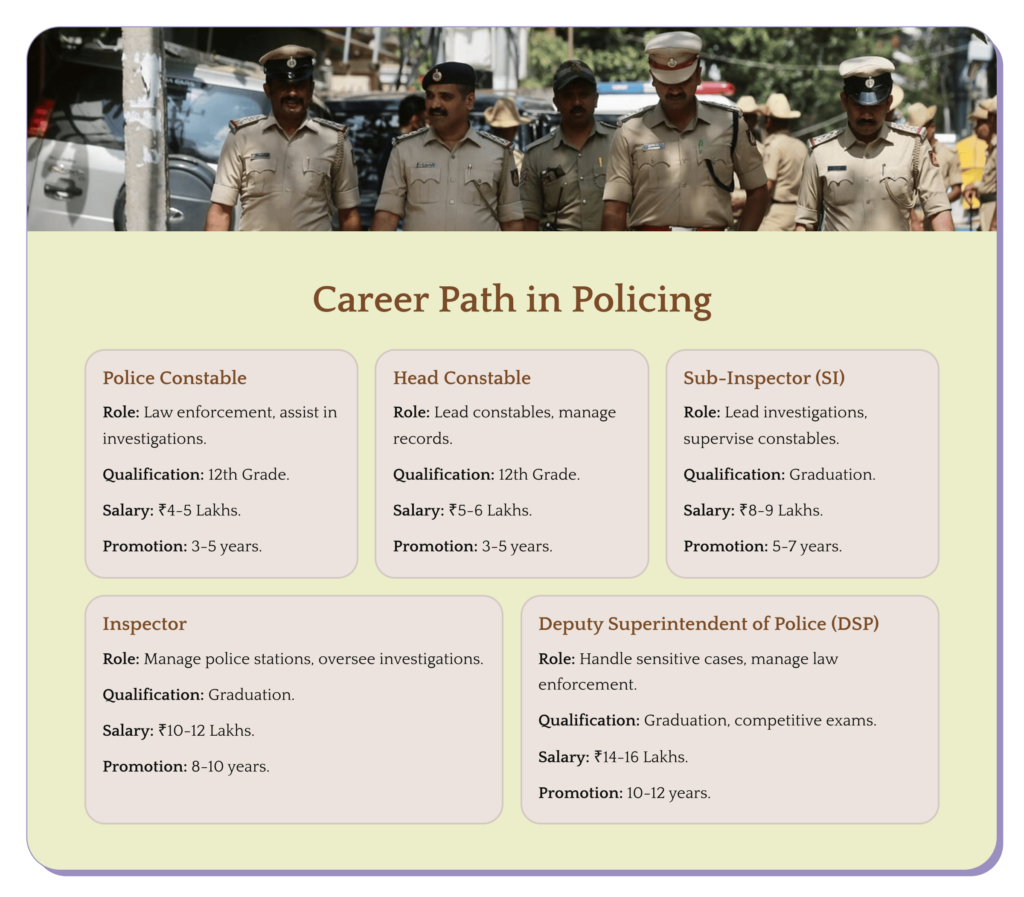
Furthermore, you can get promoted to the following posts as per your caliber-
Superintendent of Police
Deputy Inspector General of Police
Inspector-General of Police
Addl. Director General of Police
Director-General of Police
A police officer is also qualified to become a CBI Officer. Police officers have one of the most reputable jobs in the country. This guide summarizes how to become a police officer after 12th grade. Explore the opportunities available through Delhi Police Recruitment and kickstart your career in policing.
Becoming a police officer in India is a respected and achievable career option, especially with the right planning and preparation. For students wondering how to become a police officer after 12th, there are clear pathways available. You can apply for entry-level positions, such as constable, through exams like SSC GD or state police recruitment boards. These roles offer a solid foundation and a decent starting salary. Graduation is necessary for those aiming for higher-ranking positions like sub-inspector or IPS officer, followed by competitive exams such as the SSC CPO or the UPSC Civil Services Examination. Regardless of the role, candidates must meet physical standards and demonstrate communication, problem-solving, and decision-making skills.
With India’s growing need for committed and capable law enforcement professionals, a career in the police force offers stability, respect, and the opportunity to serve and protect society. Students can build a meaningful and rewarding career in this field with the right mindset and consistent effort.
To become a police officer after 12th grade in India, you can take one of the following routes – 1. State or Provincial Recruitment exams such as SSC 2. UPSC exam for the IPS role Where you must have an undersanding of “Criminology, Police Science, Psychology, Sociology, Public Administration, or Law”.
What is the minimum age requirement to become a police officer in India?
To become a police officer in India, you must be at least 21. However, the lower age limits vary for different positions. If you’re wondering how to become a police officer after 12th grade, it’s essential to check the specific eligibility criteria for the role you’re interested in.
What are the physical requirements to become a police officer in India?
The physical requirements for becoming a police officer in India vary. The upper and lower limits are decided based on the state of your application and the post. If you aim to become an IPS officer, your height as a woman must be at least 150 cm. On the contrary, men must be at least 165 cm tall. If you’re looking into how to become a police officer after 12th grade, be sure to meet these physical criteria for your desired position.
How to become an officer after 12th?
To become a police officer after 12th, pursue a graduation degree (any stream). Then, clear competitive exams like state-level SI (Sub-Inspector) or the UPSC IPS for higher ranks. Key eligibility includes being 21+ years old and passing physical, written, and medical tests. This is the definitive path to a commanding officer career in Indian police forces. Start preparing early for the best government job opportunities.
Which course is best for police after 12th?
The best course for a police career after 12th is a Bachelor’s degree. While any stream works, B.A. in Criminology, Political Science, or LL.B. are highly advantageous. They build a strong foundation for competitive exams like UPSC IPS or state-level Police Sub-Inspector (SI) recruitment. This is the optimal academic path for a high-ranking police job in India.
Can a 12th pass join the police?
Yes, a 12th pass can join the police in many regions, but specific eligibility criteria may vary by location. It’s advisable to check the local police recruitment guidelines for detailed requirements.
How to become SI in police after 12th?
To become an SP (Superintendent of Police) after 12th, start by clearing competitive exams. Pursue a graduation degree (any stream). Then, crack the UPSC Civil Services Exam (CSE) and opt for the IPS (Indian Police Service). Success in the UPSC CSE, followed by rigorous training at Sardar Vallabhbhai Patel National Police Academy, leads to the esteemed SP post. Focus on academics and current affairs from now.
What is a PC salary?
A PC (Police Constable) salary in India is a state-subject, varying by location. The starting in-hand salary typically ranges from ₹33,000 to ₹44,000 per month after deductions. This is based on the 7th Pay Commission, including: Basic Pay: ₹21,700 – ₹29,200 (Level-3 Pay Matrix) Dearness Allowance (DA): Revised periodically for inflation. House Rent Allowance (HRA): City-specific (8%-24% of basic pay). Other Allowances: Travel (TA), Uniform, and Risk allowances. Total annual CTC for a constable can be between ₹4.5 – ₹6.5 lakhs, depending on the state’s government job policies, making it a stable career.
Authored by, Gagandeep Khokhar Career Guidance Expert
Gagandeep is a content writer and strategist focused on creating high-performing, SEO-driven content that bridges the gap between learners and institutions. He crafts compelling narratives across blogs, landing pages, and email campaigns to drive engagement and build trust.