


When an employee decides to leave an organization, it marks not just the end of a professional relationship but also an opportunity for valuable learning. This is where the exit interview comes into play. Conducted by HR professionals or managers, an exit interview is a structured conversation with a departing employee that helps organizations understand their reasons for leaving, gather feedback, and improve workplace culture.
In 2025, as companies focus more on employee experience and retention, the exit interview process has evolved into a strategic tool. It’s no longer a mere formality but a critical part of talent management and organizational growth.
In this ultimate guide, we’ll explore what is an exit interview, its purpose, benefits, common questions, and best practices to conduct it effectively.

An exit interview is a formal meeting or survey conducted when an employee leaves an organization, either voluntarily or involuntarily. The goal is to gather honest feedback about their overall experience, work environment, and reasons for resignation.
Simply put, if you’re wondering what is exit interview, it’s a process that helps HR teams identify areas for improvement in company culture, management, and policies. The insights from these interviews often guide retention strategies and help prevent future attrition.
The exit interview meaning revolves around understanding the employee’s journey what motivated them, what challenges they faced, and what the company can do better. It’s a two-way conversation that allows the organization to reflect and improve continuously.
Exit interviews help organizations understand why employees are leaving,whether it’s due to poor management, lack of growth, low compensation, or toxic culture. This data is crucial for identifying patterns and making informed changes to reduce future attrition.
Departing employees are often more candid than current ones. Exit interviews provide a rare opportunity to capture authentic insights about team dynamics, leadership effectiveness, and company policies that may not surface through regular feedback channels.
By analyzing trends from exit interviews, companies can refine their employee retention strategies. This might include enhancing training programs, reworking onboarding, offering better career paths, or addressing workload issues ultimately reducing costly turnover.
Exit interviews signal that the organization values feedback even at the end of the employee lifecycle. When handled professionally, they can leave a positive last impression, increasing the chance that former employees speak well of the company or even return in the future (boomerang employees). A respectful and transparent employee exit interview ensures the departing employee leaves on a positive note, helping maintain the organization’s reputation.
5. Protect the Organization from Legal or Ethical Risks
If a departing employee discloses unethical practices, harassment, or compliance issues during an exit interview, it gives the company a chance to investigate and address these concerns proactively helping reduce liability and improve the workplace for others.
An exit interview is a crucial step in the employee offboarding process. It provides valuable insights into workplace culture, management practices, and areas for improvement. A well-structured interview process ensures that departing employees feel heard, enabling organizations to refine their retention strategies.
An effectively designed exit interview process guarantees feedback that is relevant and actionable. The following are the essential steps:
Once an employee has formally resigned, HR should inform them about the exit interview and schedule it at a convenient time, ideally during their final week. Exit interviews can be conducted face-to-face, virtually, or through an exit interview survey depending on the organization’s size and resources.
Tip: Allow enough time for reflection but avoid scheduling it on their last day when emotions may be high.
Decide whether the interview will be face-to-face, virtual, or written (survey-based).
Prepare a consistent set of structured questions covering:
Tip: Keep the tone neutral and constructive.
Create a safe and respectful environment where the employee feels comfortable sharing honest feedback.
The interviewer typically an HR professional should:
Tip: Emphasize confidentiality and that feedback will be used for organizational improvement.
Record the key points either manually or through digital tools.
Then, analyze for trends or red flags such as:
Tip: Use spreadsheets, dashboards, or HR software to track patterns over time.
Summarize findings (without naming employees) and present them to relevant departments or leadership.
This enables the company to:
Tip: Focus on recurring themes rather than isolated comments.
Ensure all exit formalities like final paycheck, asset return, and references are handled smoothly.
Thank the employee for their time and contributions. A respectful exit can turn a former employee into a future advocate or even a rehire.
An exit interview benefits organizations by allowing them to get candid feedback from exiting employees. By asking the right questions, employers learn about workplace strengths and areas that require improvement. An adequately designed interview process guarantees that feedback is gathered meaningfully, resulting in beneficial organizational changes.
Purpose: Understand the core reason for resignation.
Sample Answer:
“I’ve enjoyed my time here, but I’ve accepted a position that offers more opportunities for career advancement and a better alignment with my long-term goals in product development.”
Purpose: Highlight what’s working well within the organization.
Sample Answer:
“I appreciated the autonomy I was given to lead projects, and the team culture was genuinely collaborative. The flexibility and trust made a big difference in my day-to-day satisfaction.”
Purpose: Identify job-specific or structural pain points.
Sample Answer:
“At times, there was a lack of clarity in role expectations, especially when collaborating across departments. This occasionally led to duplicated efforts or project delays.”
Purpose: Gather feedback on leadership and team dynamics.
Sample Answer:
“My manager was supportive and gave constructive feedback, but there were times when more proactive communication or regular check-ins would have helped in setting clearer priorities.”
Purpose: Evaluate how well-equipped employees feel in their roles.
Sample Answer:
“Mostly yes, but I think our software systems could benefit from upgrades. Some internal tools were outdated, which slowed down processes and affected productivity.”
Purpose: Assess employee wellness and workload.
Sample Answer:
“Overall, the work-life balance was fair. However, during peak seasons, the workload became overwhelming due to understaffing in the team.”
Purpose: Understand how recognition and motivation are handled.
Sample Answer:
“While team achievements were acknowledged, individual contributions weren’t always recognized unless someone actively advocated for themselves. A more structured recognition program might help.”
Purpose: Identify gaps in career progression and development.
Sample Answer:
“I felt that promotions were limited and not always based on merit. Despite consistently strong performance, I didn’t see a clear path forward in my role.”
Purpose: Gauge long-term brand perception and possible rehire interest.
Sample Answer:
“Yes, I’d be open to returning if there’s a role that better fits my growth goals and if some of the internal communication issues are addressed.”
Purpose: Encourage constructive feedback for organizational growth.
Sample Answer:
“I’d suggest investing more in training for mid-level managers, as they play a key role in employee retention. Also, more transparent internal communication could boost morale and engagement.”
Depending on company policies, there are several ways to conduct an employee exit interview:
Description: Conducted in person, usually between the departing employee and an HR representative or manager.
Best For: Building rapport, allowing for open dialogue, and reading non-verbal cues.
Pros: Personal, engaging, more insightful
Cons: Time-consuming, limited by location
Description: Conducted over the phone, often when in-person meetings aren’t possible.
Best For: Remote employees or quick, scheduled discussions
Pros: Flexible, less intimidating for some
Cons: Lacks body language and tone clarity
Description: Conducted via platforms like Zoom or Microsoft Teams, combining visual and verbal communication.
Best For: Remote teams or hybrid workplaces
Pros: Visual engagement, convenience
Cons: Dependent on internet quality and tech comfort
Description: A structured digital form or questionnaire emailed to the departing employee.
Best For: Standardizing data collection across many exits
Pros: Efficient, easy to analyze, anonymous options
Cons: Less detailed feedback, no real-time follow-up
Description: The employee writes their responses to exit questions via email or a printed form.
Best For: Employees uncomfortable with verbal interviews or requiring privacy
Pros: Allows thoughtful reflection, easy to document
Cons: No opportunity for dialogue or clarification
From an employee’s perspective, an exit interview for employees can feel intimidating. However, it’s an opportunity to share constructive feedback professionally.
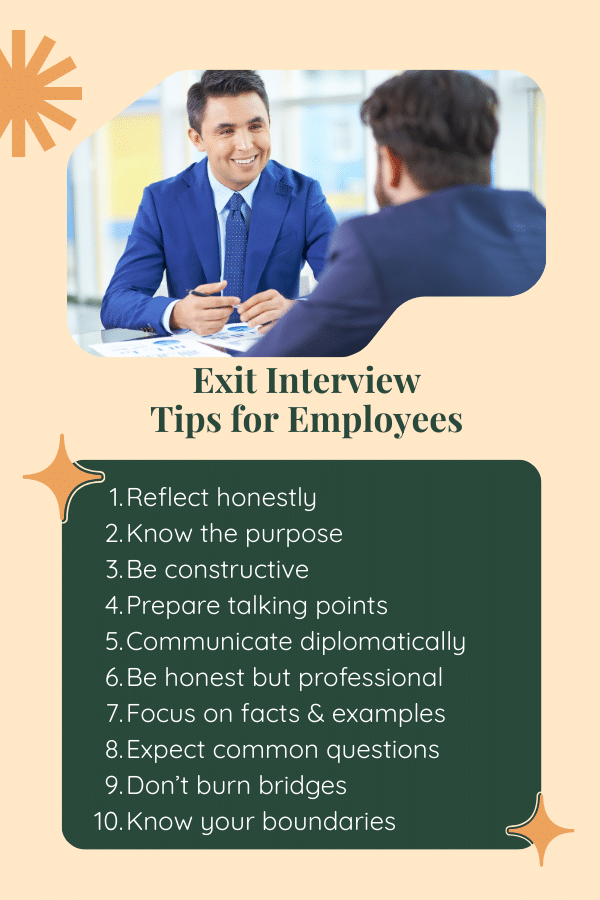
Before the interview, take time to evaluate your overall experience—both positive and negative. Think about your role, team, management, company culture, and what ultimately led to your decision to leave. Clarity helps you communicate constructively.
Understand that exit interviews are not performance reviews—they’re an opportunity to share insights that can help improve the organization. Treat it as a professional conversation, not a venting session.
You may have frustrations, but avoid turning the exit interview into a complaint session. Focus on providing specific, actionable feedback that the company can use to improve.
Tip: Use “I” statements and stay objective.
Write down 3–5 key areas you want to touch on, such as:
Think about how to share criticism without sounding accusatory. For example:
“My manager was terrible.”
“I struggled with the lack of regular feedback and would have appreciated more communication.”
Honesty adds value—but avoid personal attacks or gossip. Keep the tone respectful, especially if you’re discussing colleagues or leadership. Remember: how you exit speaks volumes.
If you’re pointing out a problem, back it up with examples instead of generalizations. This makes your feedback more credible and easier for HR to act on.
Here are some common exit interview questions to include:
Even if you’re unhappy, stay courteous and professional. You never know when you might cross paths with former colleagues—or even return to the company in a different role.
Remember, you’re not obligated to answer every question. If something feels inappropriate or uncomfortable, it’s okay to politely decline or redirect the conversation.
For employers, showing appreciation for the employee’s contributions during the employee exit interview creates goodwill and encourages honest participation.

Both parties play an essential role in ensuring the exit interview is productive. Here are some exit interview tips for employees and employers:
Choose a time that’s convenient for the departing employee—ideally during their final week, not their last day. This allows for a calmer, more reflective discussion without the distractions of last-minute tasks or emotions.
Hold the interview in a quiet, neutral, and confidential setting (or a secure virtual space). Employees are more likely to share honest feedback when they feel safe and respected.
Let the employee know the interview is optional. Forcing participation can lead to guarded or insincere responses. A voluntary tone encourages genuine, thoughtful feedback.
Prepare a consistent list of questions to ensure comparability across exit interviews, but leave room for open-ended discussion. Flexibility often leads to insightful and unexpected feedback.
Listen without interrupting, judging, or defending. Use open body language, maintain eye contact, and show empathy. Active listening helps build trust and encourages deeper responses.
If the employee shares negative feedback about managers, policies, or culture, stay professional. Your role is to gather insights, not justify company actions. Defensive behavior can shut down honest dialogue.
Make it clear that feedback will be kept confidential and shared only in aggregate or anonymized form. This reassurance helps employees speak freely, especially about sensitive issues.
Document important points during or immediately after the interview. Accurate records are crucial for identifying patterns, acting on feedback, and ensuring organizational accountability.
Look at feedback across multiple exit interviews to identify recurring themes—like poor management, limited growth, or burnout. Avoid overreacting to isolated comments unless they indicate serious issues.
Share actionable insights with relevant leaders and teams—without naming individuals. More importantly, demonstrate that the feedback is being used to improve policies, training, or workplace culture.
The benefits of exit interview extend beyond feedback collection. Here’s why every organization should prioritize it:
In short, conducting an exit interview is a win-win for both employers and employees.
A well-executed exit interview is much more than a goodbye formality—it’s a strategic learning opportunity. By understanding what is an exit interview, its purpose, and the right exit interview questions, companies can build a stronger, more inclusive workplace.
For HR professionals, mastering how to conduct an exit interview ensures they capture authentic feedback that drives real change. For employees, it’s a chance to leave gracefully and share insights that benefit future team members.
In 2025, organizations that leverage the benefits of exit interview insights are the ones leading the way in employee satisfaction, employee retention, and overall culture transformation.
Read more:
Participating in an exit interview allows you to provide valuable feedback that can help improve the organization’s work environment, policies, and practices. Your insights can contribute to positive changes and potentially enhance the experience for future employees.
For optimal results, exit interviews should be conducted within two weeks before or after the employee’s departure. Conducting them too early or too late may result in less accurate or reflective feedback.
It’s advisable that someone from HR or a neutral third party conducts the exit interview, rather than the employee’s direct manager. This approach helps ensure that the departing employee feels comfortable sharing honest feedback without concerns about potential bias or repercussions.
Yes, exit interviews should be confidential to encourage openness. However, it’s important to clarify the extent of confidentiality, as some information may need to be shared with relevant departments to address systemic issues.
Common mistakes include asking leading or loaded questions, showing emotional reactions during the interview, and emphasizing certain answers over others. Such practices can skew the feedback and undermine the purpose of the interview.