When it comes to landing your dream job, submitting just a resume isn’t always enough. Employers often want both a resume and a cover letter, but many candidates aren’t sure how these documents differ or why both are important. Understanding the unique role each plays can help your application stand out in a crowded job market.
A resume gives a brief overview of your qualifications, work experience, and skills. A cover letter lets you tell your story and explain why you are the right fit for the role. Knowing how to create and use each document effectively can help you make a strong first impression and improve your chances of getting noticed by recruiters. In this guide, we will outline the key differences between a cover letter and a resume and show you how to use both to your advantage.

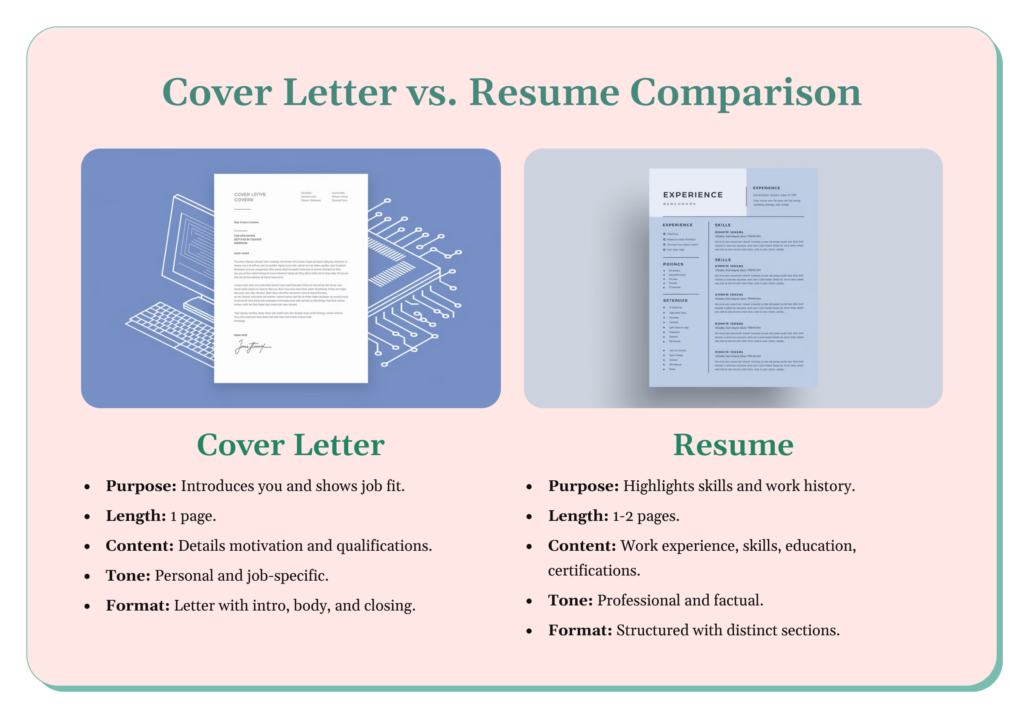
The cover letter vs resume debate is one of the most talked-about topics in job seekers’ forums. Both your resume and cover letter are essential components of your job application, with the resume showcasing your qualifications and the cover letter highlighting your motivation and fit for the role. A resume supplies the candidate’s qualifications, work history, and skills. Still, the cover letter better personalizes the introduction of the candidate and how or why the candidate is perfect for the role.
A job cover letter is an individual pitch to a specific hiring manager. A good cover letter supplements your resume with a personal narrative and expresses your interest in the position. While a resume acts as a dry qualification of your application, cover letters allow you to include your personality in your expression of interest in that role.
A well-written cover letter serves multiple purposes:
An engaging cover letter for freshers attached to an application shows the person behind the application. It explains something of your passion and fit for the role of a hiring manager beyond your qualifications. Therefore, a well-written cover letter can boost your chances of an interview by making a powerful first impression.
While a resume and cover letter are essential in a job application, they serve distinct purposes that complement each other.
Knowing the difference between a cover letter and a resume is fundamental in creating a well-rounded job application. The key difference in a cover letter vs resume is that the cover letter adds a personal touch to your application, while the resume focuses on your skills and work history. Proper alignment of the two documents will allow you to be distinguished and invited for an interview.
| Aspect | Resume | Cover Letter |
| Content | Lists job experience, education, skills, and certifications (in bullet points). | A tailored introduction, explanation of relevant experiences, and a closing statement (in paragraphs). |
| Purpose | Summarizes qualifications and work history to showcase skills and experience. | Provides a personalized narrative to explain why you’re applying for the job and why you’re the right fit. |
| Formatting | Structured with headings, sections, and bullet points. Typically 1-2 pages long. | One-page narrative with an introduction, body, and conclusion. |
| Tone | Formal and concise, focusing on facts and avoiding unnecessary words. | Conversational, highlighting enthusiasm and personality. |
| Length | Typically 1-2 pages, with bullet points for easy scanning. | One page, written in full sentences and paragraphs. |
| Style | Focused on brevity and factual presentation. | More expressive, using first-person language to build a connection. |
This table highlights the core distinctions between a resume and cover letter. While the resume is structured for easy scanning, the cover letter lets you connect with hiring managers on a more personal level, helping you stand out in a competitive job market.
Some job applications require a letter of application specifically. This typically happens in places where communication skill or leadership prowess is an essential requirement to the job posting. For example, marketing or public relations-related jobs, managers, or other writing positions entail a cover letter to determine qualification and the skill to communicate oneself toward the employer.
When applying for such roles, a well-crafted cover letter can strengthen your application by:
Even if not explicitly required, submitting a cover letter for job applications can set you apart from other candidates, especially in competitive fields.
In some cases, submitting a resume alone may be sufficient, particularly when:
Your resume will speak for itself in these cases, showcasing your qualifications and experience. However, including a cover letter when optional can still enhance your application, primarily if you can provide a strong reason for your interest in the company.
A strong resume is critical in this highly competitive job world. Strong and straightforward are keywords that should define the nature of your resume. Organize it well and customize it for every job application. Here are the things that must be included.
A cover letter lets you add a personal touch and explain why you’re an excellent fit for the role. Here’s how to structure your letter effectively:
These best practices will make your resume and cover letter tailored, professional, and compelling.
A poorly constructed resume can harm your chances of landing an interview. Here are common mistakes to avoid:
While a cover letter is your opportunity to showcase your personality, avoid these common pitfalls:
Avoiding these mistakes can significantly affect the effectiveness of your resume and cover letter.
Led a team of 5 marketers, increasing brand engagement by 40%.
Managed digital ad campaigns, generating $200K+ in revenue.
I am excited to apply for the Marketing Manager position at [Company Name]. With 5+ years of experience in digital marketing, I have successfully led campaigns that boosted engagement by 40% and increased revenue by $200K.
At ABC Company, I managed a team of marketers, driving innovative strategies that improved brand awareness. I thrive in data-driven environments where I can apply my SEO, content strategy, and digital advertising expertise.
I am eager to bring my analytical mindset and leadership skills to [Company Name]. I welcome the opportunity to discuss how my background aligns with your company’s goals. Please get in touch with me at [Phone Number] or [Email] to arrange a conversation.
Sincerely,
John Doe
The resume and cover letter are essential parts of your job application process. While the resume is a structured summary of your qualifications, work experience, and skills, the cover letter gives it a personal touch. The resume is factual, allowing employers to assess your qualifications quickly. In contrast, the cover letter lets you express enthusiasm for the role and explain why you’re the perfect fit for the company.
A personal touch. The resume is factual, allowing employers to assess your qualifications quickly. In contrast, the cover letter lets you express enthusiasm for the role and explain why you’re the perfect fit for the company.
A resume and a well-crafted cover letter create a comprehensive application. The resume provides scope for the work experiences, and the cover letter gives focus and personality. They paint a description of your qualifications, passion, and commitment, which much increases your chances of getting an interview and eventually winning the job. When preparing for a job application, knowing how to balance a cover letter vs resume ensures you highlight both your professional qualifications and personal motivations effectively. So always use both of these documents to leave a good impression!
Mastering the skill of writing a strong cover letter and an effective resume can make a big difference in your job search. Your resume shows your qualifications and achievements. Your cover letter lets you highlight your personality, passion, and how well you fit the role and company.
Understanding what each document is for and customizing them for every application can greatly boost your chances of grabbing an employer’s attention. Spend time perfecting your resume and cover letter. This effort can help you get interviews and move forward in your career. Remember, these documents work together to create a strong first impression that can lead to new opportunities.
Evaluate numerous career choices to choose the right career path for yourself. Dive into our guide on Career Advice.

A cover letter complements a resume and highlights your personality, motivation, and suitability for the job. However, it does not replace the resume. Each document serves a different role in the hiring process.
No, a CV is a detailed list of qualifications and experience. A cover letter is a personal note that explains interest and fit for a job.
No, a resume lists your skills and experience. A cover letter explains your interest and how you fit the role. Both are separate documents.
Yes, some recruiters read cover letters. They often do this to assess motivation, communication skills, and cultural fit. However, others might mainly concentrate on the resume.
A cover letter is usually 250 to 400 words long and fits on one page.
No, a CV and a cover letter should be separate documents. Each one serves a different purpose in the application.
CV stands for Curriculum Vitae.
No, a cover letter cannot replace a resume. It adds to the resume by showing your interest and fit for the role.
The cover letter comes first. After that, include the CV or resume.