

Summary
- Data annotation for autonomous vehicles means labelling raw sensor data, camera video, LiDAR scans, radar returns, so a self-driving car’s perception software can learn to recognise real objects on the road.
- Most vendors in this space describe themselves the same way: expert reviewers, rigorous quality checks, fast turnaround. That language alone does not tell a buyer anything verifiable.
- Five questions actually separate vendors: who reviews the labels, how edge cases get handled, whether sensor streams are checked together, how quality gets measured, and what a faster or cheaper quote changes.
- A 2020 Waymo research paper built one of the field’s most cited driving datasets specifically because scenario diversity, not raw data volume, is what makes a dataset useful.
- One unreviewed edge case does not cause a single mistake. It teaches a model the same blind spot every time a similar scene appears.
Two data annotation vendors can both report a 98% internal quality score on the same batch of autonomous-vehicle footage. They can still hand you training data that teaches a perception model two different things about the same half-hidden cyclist. The score tells you the vendor checked its own work. It does not tell you what the model actually learned from it.
I spend a good part of my work at Chegg in exactly that gap. It sits between what a data annotation vendor claims and what a buyer can verify before committing to a pilot. Data annotation for autonomous vehicles is a crowded, heavily marketed category right now. Most of what is written about it explains how annotation works. Far less of it explains what to compare once you are choosing between two or three vendors who all describe themselves the same way. This piece covers both: briefly what the work involves, then in more depth what a buyer should be checking before signing anything.
What data annotation for autonomous vehicles actually means
Data annotation for autonomous vehicles is the work of labelling raw sensor data. That means camera video, LiDAR point clouds (the 3D maps a LiDAR sensor builds from laser pulses bouncing off nearby objects), and radar returns. The goal is to let a perception model, the part of a self-driving car’s software that interprets what its sensors are seeing, learn to recognise real objects. A pedestrian stepping off a kerb. A cyclist merging into a lane. A delivery van double-parked ahead. A reviewer, or a model with a person checking its output, outlines each object and attaches a label to it. That label is what the software actually learns from, not the raw pixels or laser points underneath it.
The mechanics of how a reviewer checks a single LiDAR scan, or reconciles two sensors that disagree about the same object, are their own detailed subject. LiDAR and 3D Point Cloud Annotation and Sensor Fusion, Explained both go into that specifically, down to what a reviewer checks frame by frame. What this piece covers sits a layer above that. Once you accept that the basic mechanics look broadly similar across vendors, what should actually separate one annotation provider from another in a buyer’s eyes?
Why every vendor sounds the same
Every vendor selling data annotation for autonomous vehicles says some version of the same three things: expert reviewers, rigorous quality checks, fast turnaround. Claiming all three costs a vendor nothing. None of those words tell a buyer how a reviewer actually behaves when a cyclist is three-quarters hidden behind a parked van. They don’t say whether a finished dataset was reviewed scene by scene, or as isolated, disconnected frames. A buyer comparing two shortlisted vendors on sales language alone is comparing marketing copy, not data quality.
What to actually compare across vendors
These five checks are the kind of specific, verifiable questions a vendor’s marketing page cannot answer for you.
Who actually reviews the labels
Ask who reviews a label before it is counted as final. Ask what their real background is in driving or automotive perception, not only annotation work generally. A reviewer who has spent real time around traffic, construction zones, and pedestrians behaving unpredictably catches an inconsistent label faster than a reviewer trained only on a generic annotation tool. This is the most underexplained part of most vendor pitches.
How edge cases and rare scenarios get handled
Most of driving is routine: a clear lane, a straightforward stop, a pedestrian waiting for a signal. The scenarios that matter most for safety are the rare ones, the edge cases a model sees too infrequently to learn from automatically. A vehicle double-parked at an angle. A pedestrian who starts crossing against the signal. An object that doesn’t immediately fit a known category. A Waymo research team built one of the field’s most cited driving datasets partly because a smaller, less varied dataset was not enough to generalise reliably. The team described their dataset as fifteen times more diverse than the largest comparable public dataset available at the time, by their own diversity metric (Sun et al., 2020). The lesson for a buyer isn’t that specific number. It’s that diversity of scenario, not sheer volume of frames, is what a vendor should be able to show evidence of, not just claim.
Whether sensor streams get reviewed together
A real autonomous vehicle rarely relies on one sensor in isolation. The nuScenes dataset, one of the standard public references in this field, pairs six cameras, five radars, and one LiDAR unit for full 360-degree coverage. Its scenes are annotated across 23 object classes and eight separate attributes per object (Caesar et al., 2020). If a vendor reviews camera footage and LiDAR scans as two separate jobs handled by two separate teams, ask how, or whether, those labels ever get reconciled against each other. Sensor Fusion, Explained covers what a reviewer checks when two sensors disagree about the same moment. For a buyer, the short version is simpler: ask whether disagreement between sensors gets caught at all, or whether it only surfaces once a model has already trained on it.
How annotation quality gets measured
Any vendor can report an internal accuracy or agreement score. Ask what that score is really measuring. Is it agreement between two independent reviewers labelling the same frame, agreement against a fixed reference set, or a reviewer simply checking their own earlier work? Those three measure genuinely different things. Only the first two tell you anything about whether the labels would hold up to an outside check.
Turnaround and cost, and what the trade-off buys you
A faster turnaround and a lower cost per frame are both real, legitimate things to ask about. They are also the two numbers easiest for a vendor to optimise at the expense of review depth. Ask what changes about the review process itself, not only the price, when a project needs to move faster. A vendor who can answer that specifically, rather than just promising speed and quality together, is telling you something real about how the work gets done.
None of these five questions have one single right answer. What they share is this: a vendor who already knows the answer, without needing to go check, is probably doing real review work. A vendor who has to go find out probably isn’t.
A worked example: the same frames, two vendors
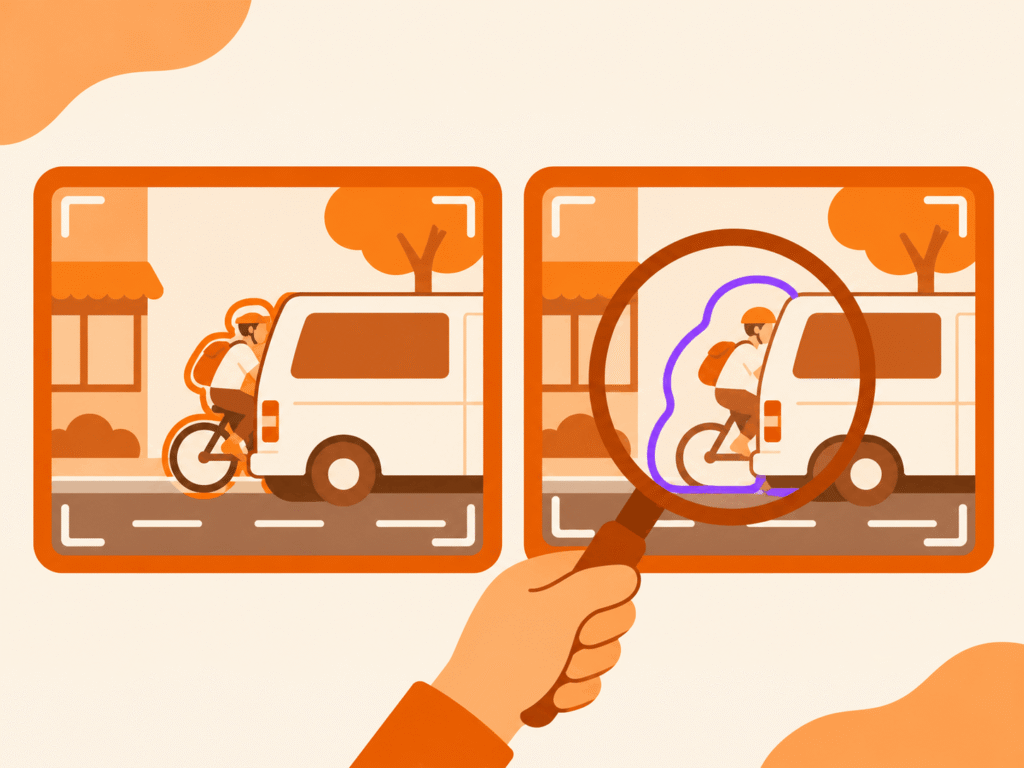
Picture a buyer piloting two vendors on the same 500 frames of urban driving footage before committing to either one. Frame two-fourteen shows a cyclist mostly hidden behind a parked delivery van, only the front wheel and handlebar visible. One vendor’s reviewer labels the visible wheel and handlebar as a cyclist, flags the frame as a partial-occlusion case, and adds a short note for the modelling team. The other vendor’s reviewer, working faster and without the same context on why it matters, either skips the object as too small to label confidently or marks it under a generic “object” category instead of “cyclist.” Neither choice is dishonest. But a model trained on the second vendor’s version never learns that a visible wheel and handlebar behind a van is a cyclist about to become fully visible. Multiply that one frame by the thousands of similar partial-occlusion moments in a real dataset, and the model doesn’t fail once. It fails the same way, in the same blind spot, every time a cyclist is partly hidden behind a parked vehicle.
Where annotation fits in the bigger training-data picture
Data annotation for autonomous vehicles is one stage in a longer pipeline, not the whole of it. Before footage ever reaches a reviewer, it has to be captured from real test drives or a simulated environment. What “Robotics Data Collection” Actually Means covers that capture stage in more general terms, across teleoperation and sensor logging more broadly than just the automotive case. Once annotation is finished, the labelled result becomes what most people mean when they search for autonomous vehicle training data: the real examples a perception model learns from. Each camera frame, LiDAR scan, and radar return carries the label a reviewer attached to it. An autonomous vehicle is also one concrete example of what researchers call embodied AI: artificial intelligence that has to act in the physical world, not just answer questions about it. What Is Embodied AI, and What Training Data Does It Actually Need? covers that broader category, including how simulation and real demonstrations both feed into training data for physical systems generally.
How Chegg approaches data annotation for autonomous vehicles
The five comparison points above aren’t a sales script at Chegg — they’re the actual standard reviewers are held to. Reviewers working on autonomous-vehicle data are matched to the task by real background. Sensor streams get checked against each other rather than signed off in isolation. Edge cases get flagged with enough context that a modelling team can see why a judgement call was made, not only what the final label is. That is the same review discipline behind our 3D point cloud annotation work and our sensor fusion review process. Here, it’s applied to the specific decisions a buyer is trying to make before a pilot even starts. It’s part of the same standard we apply across AI Data Services generally, not a special case built for one industry.
Key takeaways
- Data annotation for autonomous vehicles means labelling raw sensor data, camera video, LiDAR scans, radar returns, so a perception model learns to recognise real objects on the road. The mechanics look similar across vendors; what differs is the review behind it.
- Vendor marketing language (expert reviewers, rigorous QA, fast turnaround) is nearly identical across the category. Real comparison needs more specific questions than that.
- Five things actually separate vendors: who reviews the labels, how edge cases get handled, and whether sensor streams are checked together. Also real: how quality gets measured, and what a faster or cheaper quote changes about the review itself.
- Diversity of scenario matters more than raw volume. A dataset with more routine frames is not automatically a better training set than one with better edge-case coverage.
- A single unreviewed edge case, like a partially hidden cyclist labelled inconsistently, does not just cause one mistake. It teaches the model the same blind spot every time a similar scene appears.
FAQs
What is data annotation for autonomous vehicles?
Data annotation for autonomous vehicles is the process of labelling raw sensor data: camera video, LiDAR point clouds, and radar returns. The goal is to let a self-driving car’s perception software learn to recognise real objects on the road. A reviewer, or a model with a person checking its output, outlines each object and attaches a label, such as pedestrian or cyclist. That label is what the software actually learns from.
What is autonomous vehicle training data?
Autonomous vehicle training data is the labelled output of the annotation process: camera frames, LiDAR scans, and radar returns, each one carrying the label a reviewer attached to it. It is distinct from raw sensor logs, which have not yet been reviewed or labelled. It’s also distinct from a synthetic dataset generated inside a simulation, which still needs the same kind of review before it can be trusted for training.
What is the difference between data annotation and data labelling for self-driving cars?
In practice, the two terms are used interchangeably across most of this industry, including by many vendors themselves. Where a distinction does get drawn, “labelling” sometimes refers narrowly to attaching a category name to an object. “Annotation” covers the fuller task: outlining the object’s exact shape, attaching attributes like direction of movement, and resolving disagreements across sensors. For a buyer, the practical difference rarely matters. What matters is the review process behind whichever term a vendor uses.
How much does data annotation for autonomous vehicles cost?
Cost depends on sensor type, review depth, and how rare the scenarios in a batch are. A straightforward highway frame costs less to review properly than a cluttered urban intersection with several partially hidden objects. Rather than comparing a single cost-per-frame number across vendors, ask what is actually included in it. How many reviewer passes. Whether sensor streams are cross-checked. How edge cases are handled. Two very different quotes can represent two very different levels of review.
How do you evaluate a vendor for autonomous vehicle data annotation?
Ask five things. Who actually reviews the labels, and what their background is. How edge cases and rare scenarios get handled. Whether sensor streams are reviewed together rather than in isolation. How quality is actually measured. And what changes about the review process, not only the price, when a project needs to move faster. A vendor who can answer each of these specifically is telling you something real about how the work gets done
Which sensors does autonomous vehicle data annotation cover?
Most autonomous vehicle data annotation covers three sensor types: camera video, LiDAR point clouds, and radar returns. A real self-driving car combines all three. The more useful question for a buyer isn’t which sensors a vendor supports. It’s whether labels across those sensors are checked against each other, rather than reviewed as separate, disconnected jobs.