

Summary
- Sensor fusion combines what multiple sensors report about the same moment into one picture, and the real risk isn't any single sensor failing, it's two sensors quietly disagreeing while each looks fine on its own.
- A sync gap as small as forty milliseconds between a camera and an IMU can introduce a ten-metre position error in the combined estimate.
- Calibration drift and ordinary sensor noise can look identical in a single frame; the real tell only shows up across a sequence.
- A systematic disagreement between sensors should be flagged upstream for recalibration, not patched frame by frame.
- Chegg's robotics and multimodal reviewers are trained specifically to check cross-sensor agreement, not just each sensor's own accuracy.
Take a camera and an IMU that are off-sync by forty milliseconds, and the position they report for the same object can be out by ten metres. That’s not a faulty sensor. Both devices can be working exactly as designed and still hand a model two different realities for the same instant, because they were never lined up to the same clock in the first place. That’s the real problem with sensor fusion training data: not collecting enough of it, but catching the moment two or three sensors quietly stop agreeing with each other.
I’ve spent enough time around robotics and autonomous-vehicle training data to know most people picture sensor fusion as more sensors stacked on top of each other, camera plus LiDAR plus radar, all pointed at the same scene. That’s true as far as it goes. What it misses is the actual work: making sure what each of those sensors reports actually lines up, in time and in space, before anyone trusts the combined picture enough to train a model on it.
What sensor fusion actually is
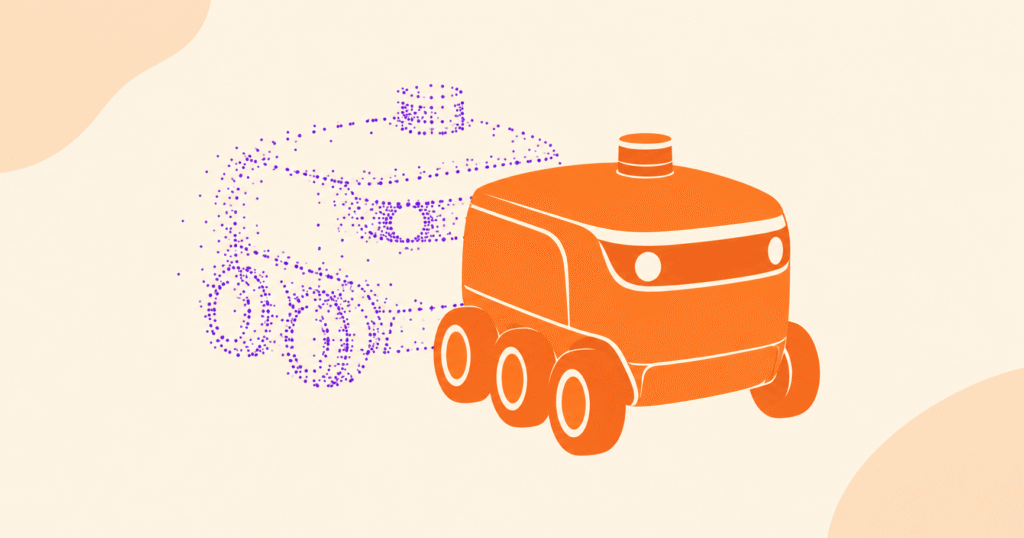
Sensor fusion is the process of combining what two or more sensors report about the same moment into one agreed-upon picture, instead of treating each sensor’s output as its own separate guess. A self-driving car’s camera might see a roughly car-shaped object ahead. Its LiDAR reports a cluster of points at a specific distance. Its radar reports something moving at a certain speed. None of those three reports is the full answer by itself. Fusion is the step that decides they’re all describing the same object, and produces one combined estimate of what it is, where it is, and how fast it’s moving.
It works the way your own senses do, without you noticing the seams. You don’t experience sight, balance and touch as separate reports your brain reconciles afterwards; you experience one continuous sense of where you are. Sensor fusion is the engineering version of that reconciliation, done explicitly, because the sensors involved don’t do it for themselves.
This piece picks up where Chegg’s broader look at robotics data collection leaves off. That piece defines sensor fusion at the point of capture: aligning camera, LiDAR or depth data, and a robot’s own sense of its joint positions, into one synchronised stream while it’s being recorded. What happens after that, once the data exists and someone has to decide whether it’s actually trustworthy, is a different problem, and it’s the one this article is about.
Why fused data is harder to trust than any single sensor’s data
A single sensor’s data can be wrong in ways that are relatively easy to reason about: too dark for the camera, too far for the LiDAR to return enough points, too much electrical noise on the radar. Fused data introduces a failure mode that doesn’t exist for any sensor on its own. Each sensor’s reading can look completely normal in isolation and still be wrong once you put it next to the others, because the problem isn’t with any individual reading. It’s with whether the readings actually belong together.
Two things have to be true for a fusion step to be trustworthy. The sensors have to agree on when something happened, called temporal synchronisation, making sure every sensor’s reading is timestamped to the same real-world instant, not just stored in the same file. And they have to agree on where things are relative to each other, called calibration, making sure the system knows exactly how each sensor is positioned and angled compared to the others and to the vehicle or robot itself. Get either one wrong and the fused output can look clean, a tidy bounding box, a confident speed reading, and still describe something that never actually happened.
A 2021 review of sensor and sensor fusion technology in autonomous vehicles put it plainly: calibration is the foundation block of the whole system, and has to be correct before fusion or obstacle detection can work at all (Yeong et al., 2021). It isn’t an optional refinement on top of a working system. Skip it, or let it drift, and everything built on top of it inherits the error.
When the clocks are off: temporal synchronisation
Every sensor in a fused system is also a small computer with its own processing delay, so even sensors that start out perfectly in sync drift apart as data moves through the pipeline. A camera frame might be timestamped the instant it’s captured, while the LiDAR point cloud for what should be the same moment actually finishes processing a few dozen milliseconds later. If nothing corrects for that gap, the system ends up treating two slightly different moments in time as though they were one.
Researchers studying synchronisation in robotic systems found that when a camera and an IMU were off by forty milliseconds, the resulting position error in the combined estimate could reach ten metres (Liu et al., 2021). The same research found that how much timing error a system can tolerate depends heavily on speed: at five metres per second, roughly walking pace for a robot, object detection could absorb around 270 milliseconds of sync error before accuracy noticeably dropped. At forty metres per second, motorway speed, that tolerance fell to about 34 milliseconds, roughly an eighth as much. The faster something moves, the less room there is for the sensors describing it to disagree about when.
What a reviewer actually checks here isn’t the raw timestamp on a file; most capture systems label those correctly. It’s whether an object’s position across sensors behaves the way it should if the data were genuinely synchronised. A pedestrian the camera places in one spot, while the LiDAR, for what’s logged as the same instant, places a stride further back, isn’t automatically bad data. It might be a genuinely fast-moving pedestrian. But if that same offset shows up consistently, frame after frame, in the same direction, that’s not noise. That’s a clock problem, and it needs to be flagged upstream rather than quietly corrected frame by frame, because the same lag will keep reappearing on every object the sensors capture until someone fixes it at the source.
Get this wrong at scale and the model doesn’t just learn one bad position. It learns the lag itself as though it were real physics, and reproduces the same trailing offset on every fast-moving object it sees once deployed.
When the sensors don’t agree on where they are: calibration and disagreement
Synchronisation is about when. Calibration is about where. Even with timestamps perfectly aligned, sensors have to agree on their own position and angle relative to each other, down to a fraction of a degree, or the combined picture starts drifting apart the further an object is from the vehicle or robot.
The same 2021 review includes a plain example of what this looks like in practice: a radar sensor, mounted several degrees off from its correct orientation, produced a run of false-positive detections five to seven metres from the vehicle before the misalignment was corrected (Yeong et al., 2021). Nothing was wrong with the radar itself. It was reporting exactly what it was built to report. The problem was that the system no longer knew precisely where the radar was pointed, so it misplaced everything the radar saw.
This is the judgement call a reviewer makes constantly on fused robotics and multimodal data: when a camera places an object at one point and the LiDAR or radar places the same object at a noticeably different point, is that genuine sensor noise, the ordinary, bounded disagreement every sensor has, or is it calibration drift, a systematic error that will keep showing up the same way until it’s fixed? The two can look similar in a single frame. Across a sequence, they look nothing alike. Noise wanders. Drift is consistent, and consistently in one direction.
Mistake the second for the first, and a reviewer ends up annotating around a problem that should have been flagged for recalibration, frame after frame, while the actual fault never gets fixed.
A worked example
Say a delivery robot’s dataset includes a sequence where a cardboard box sits on a loading dock. In most frames, the camera, LiDAR and IMU-derived position estimate agree closely enough that a reviewer barely has to think about it. But across one ten-second stretch, the LiDAR consistently places the box about fifteen centimetres further left than the camera does, the same fifteen centimetres in every frame, not a wobble that varies from one frame to the next.
A reviewer with no real process might treat this as five or six separate annotation problems and nudge each frame’s label to split the difference. That’s the wrong fix. A consistent, same-direction offset across an entire sequence is the signature of calibration drift, not noise, and patching it frame by frame hides the actual fault rather than fixing it. The right call is to flag the whole sequence, and likely the whole capture session, for a calibration check, not to quietly average the two sensors’ readings and move on.
The distinction matters because of what the model does with each version. Patch it frame by frame and the model never sees the problem; it just learns slightly blurred, inconsistent object boundaries. Flag it and get the underlying calibration fixed, and every other sequence captured in that same session, not just the one a reviewer happened to notice, gets corrected too.
What this means for evaluating a vendor
Point cloud and LiDAR annotation is mostly about judgement calls on a single sensor’s data. Fused, multi-sensor data adds a layer on top of that: judgement calls about whether multiple sensors’ versions of the same reality can actually be trusted together. These are the questions worth asking once a project’s already settled on outsourcing this work; if that decision itself isn’t made yet, the general outsourcing trade-offs apply here too, same as for any other annotation type.
- How do you confirm that timestamps across sensors in a fused sequence correspond to the same real-world instant, not just the same file or the same frame number?
- When two sensors disagree about the same object’s position, how does your team tell ordinary sensor noise from calibration drift?
- Who gets notified when a disagreement turns out to be systematic, and does that trigger a fix upstream, or does it just get patched in the frames where someone happened to catch it?
- What happens to a sequence where the disagreement can’t be resolved with confidence? Is it annotated anyway, or held back?
None of these are really about any single sensor’s accuracy. They’re about whether anyone is actually checking what happens once those sensors are supposed to agree, which is the part a spec sheet for any individual camera or LiDAR unit will never tell you.
How Chegg approaches this
My team at Chegg treats fused sensor data as its own review category, not an extension of single-sensor annotation. Reviewers working on robotics and multimodal projects are trained specifically to check cross-sensor agreement: whether a sequence’s timing holds up across every sensor involved, and whether a positional disagreement between sensors looks like ordinary noise or a drift pattern that needs to go back upstream rather than get patched in place. The same human-in-the-loop review that matters for single-sensor annotation matters here too, just applied to the relationship between sensors rather than to any one of them.
That distinction is the one that actually protects a training set. A calibration fault that’s quietly patched frame by frame stays hidden and keeps degrading every dataset captured in that session. One that’s caught, flagged and traced back to its source gets fixed once, for every frame affected, not corrected piecemeal by whoever happens to be reviewing that day. That’s the standard Chegg’s review process holds fused sensor data to: not just whether each sensor’s reading looks right on its own, but whether the whole picture they’re all supposed to agree on actually does.
Key takeaways
- Sensor fusion fails in a way no single sensor does: each reading can look correct on its own and still be wrong once set against the others, because the problem is agreement, not accuracy.
- Timing matters more than it looks. A forty-millisecond gap between a camera and an IMU can introduce a position error of ten metres, and how much timing error a system can absorb shrinks fast as speed increases.
- Calibration drift and ordinary sensor noise can look identical in a single frame. The real tell is across a sequence: noise wanders, drift is consistent and stays in the same direction.
- A systematic disagreement between sensors should be flagged upstream for recalibration, not quietly corrected frame by frame, because patching it in place hides the fault instead of fixing it.
- The real question for any fused dataset isn’t whether each sensor works. It’s whether anyone is actually checking what happens once they’re all supposed to agree.
FAQs
What is sensor fusion?
Sensor fusion is the process of combining what multiple sensors, typically cameras, LiDAR, radar and IMUs in robotics and autonomous-vehicle work, report about the same moment into one combined, more reliable picture, rather than treating each sensor’s output separately.
What’s the difference between sensor fusion and data fusion?
Data fusion is the broader term for combining data from any set of sources, sensors or otherwise. Sensor fusion is the specific case where those sources are physical sensors capturing the same real-world environment, which is what this article and most robotics or autonomous-vehicle discussions mean by the term.
How does sensor fusion work?
Each sensor captures its own reading of the same scene, the system corrects for each sensor’s own internal errors, then aligns the readings in time and space and combines them, often with an algorithm like a Kalman filter, into a single estimate that’s generally more accurate than any one sensor’s reading alone.
What is temporal synchronisation in sensor fusion?
It’s the part of sensor fusion that deals with time rather than position: confirming that every sensor’s reading was actually captured at the same real-world moment, rather than just filed under the same frame number. A gap of only a few dozen milliseconds between two sensors can throw off the combined result once their readings are merged.
Can a sensor fusion calibration error be fixed after the data is already collected?
Partially. A reviewer can flag, and in some cases correct, an individual frame, but a systematic calibration fault usually needs to be traced back and fixed at the source, since it will keep reappearing across every sequence captured in that session until it is.
What sensors are most commonly fused in robotics and autonomous vehicles?
Cameras, LiDAR, radar and IMUs are the most common combination. Cameras provide colour and texture, LiDAR and radar provide distance and speed with different strengths and weaknesses, and IMUs track the platform’s own motion, each compensating for what the others can’t capture on their own.