
Summary
- Live-stream moderation is a different problem from reviewing a video after it's recorded, because there's no queue holding the content back from an audience.
- A review queue works everywhere else because waiting is free. Live video removes that: the audience is watching while the broadcast runs, not after a reviewer approves it.
- The workflow that fits live content runs in the opposite order from most moderation: automated detection flags first, and a human reviewer makes the fast call after.
- A worked example walks through what a flagged livestream actually looks like, from the first automated flag to the final decision.
- The real test of a live-stream moderation vendor is how fast a flag reaches a human and how that decision actually gets made, not what the sales page claims.
A gaming streamer is mid-match when a guest jumps into the voice call. The guest says something that could be a genuine threat, or a dark joke landing badly. Either way, it’s already playing live to everyone watching. Nobody on the platform’s side can act before that happens. That’s the one fact that makes live stream moderation a genuinely different job from reviewing a video after it’s been uploaded. There’s no queue standing between the content and the audience. Whatever is going to catch a problem has to work while the broadcast is still running, not afterwards.
Most content moderation has one thing live content doesn’t: time. A flagged comment, a reported photo, a recorded video pulled down after review, can all sit for a while before anyone reviews it. Live video removes that buffer completely. I’ve written separately about why video is harder to moderate than text or image, covering duration, frame order and audio. This piece is about what happens once that same hard-to-moderate format also can’t wait for a reviewer to get to it.
What live-stream moderation actually means
Live-stream moderation is the ongoing review of video, audio and chat while a broadcast is still going out to an audience. That’s different from reviewing something after it’s been recorded and stored. It covers gaming streams, live shopping, creator broadcasts, and video calls opened up to a wider audience. Anywhere a platform lets someone go live in real time, the same problem applies. Some people call the same practice real-time content moderation. It’s really the more general term for the same constraint: catching a problem on time, not catching it well after the fact.
I’ve covered the general video-moderation problem separately, why video is harder to moderate than text or image, which comes down to duration, frame order and audio. Live-stream moderation inherits every one of those problems. It adds one more on top: there’s no point where the footage sits safely unseen, waiting for a human to get to it.
Why the review queue breaks down for live content
A review queue is exactly what it sounds like. Flagged or newly posted content sits in a list, in the order it arrived, until a reviewer opens it and makes a call. It’s the backbone of most moderation programmes, for comments, photos and recorded video. Almost none of that content causes harm by sitting there for a few minutes first. A queue works because waiting is free. Nobody but the system has actually seen the content yet.
Live video breaks that assumption completely. The audience is watching while the broadcast runs, not after a reviewer approves it. A flagged comment that sits in a queue for ten minutes before anyone reads it hasn’t caused any additional harm in those ten minutes. Ten minutes of a live broadcast that should have been cut is ten minutes an audience actually watched. Researchers studying Twitch’s volunteer moderators have described this plainly: the synchronicity and ephemerality of live-streaming communities pose unique moderation challenges (Cai, Wohn & Almoqbel, 2021).
Put another way, a review queue assumes the clock starts when someone opens the item. Live content starts the clock the moment the broadcast begins. Everything downstream of that, detection, escalation, the decision to cut a feed, has to happen inside a far smaller window than any queue-based process was ever built for.
The workflow live stream moderation actually forces
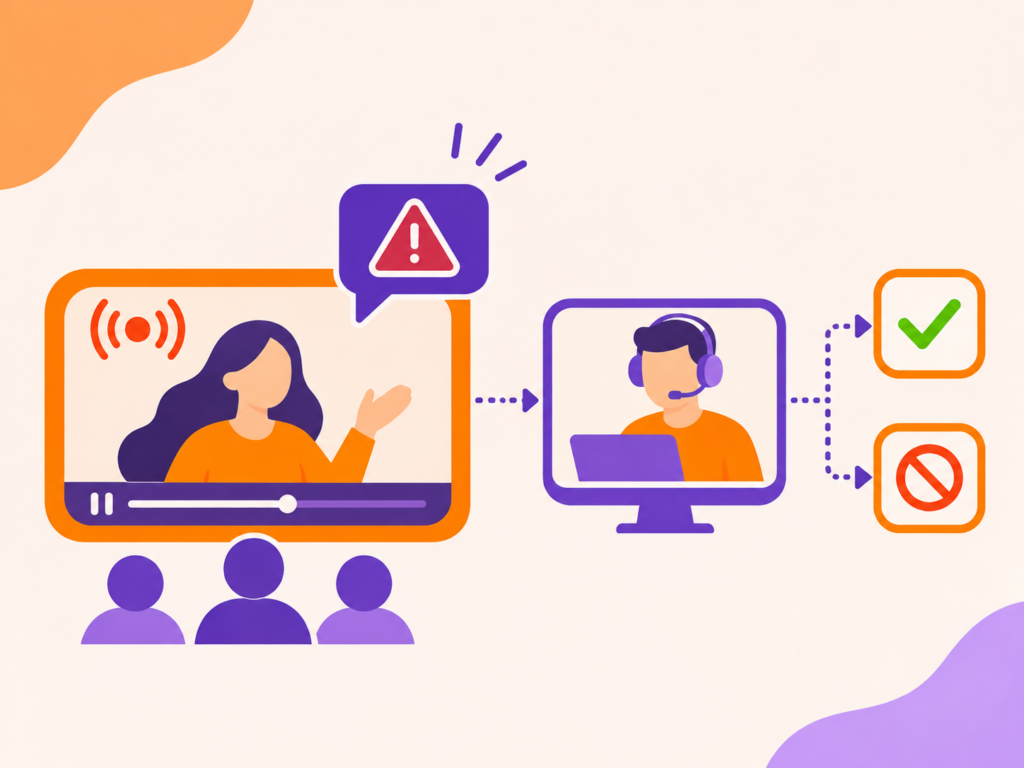
Most moderation, including video moderation once a clip is recorded, puts a human reviewer in front of the content before anything is confirmed as a violation. That’s manageable when the content isn’t going anywhere. Live content can’t wait for that. The workflow that actually fits a broadcast runs in the opposite order. Automated detection goes first, scanning the feed continuously while it’s live. A human reviewer only gets pulled in once something is flagged as likely to need a decision.
That’s not a shortcut taken because human review is expensive. It’s the only order that fits inside the time a live broadcast actually gives you. A 2025 audit of Twitch’s own AutoMod system put this directly. Newer forms of real-time engagement, like users commenting on a livestream, exert additional pressures on the latency expected of such moderation systems (Shukla et al., 2025). The system has to make a first call in something close to real time, before a person has even seen the flag.
What the automated layer actually has to catch
In practice this means continuously reading three separate streams at once, none of which gets a second look before reaching an audience:
- The video itself, for anything visual that breaks platform rules.
- The audio, including anything said on a shared call.
- Chat or comments running alongside the stream, which often moves faster than either of the other two.
The detection layer’s job is to flag anything that looks likely to be a violation fast enough that a human has time to act before real damage is done.
What human escalation actually looks like
Once something is flagged, a trained reviewer has to make a judgement call in seconds, not minutes. They can let the stream continue, mute a specific section of audio, or end the broadcast outright. That’s a narrower, faster decision than reviewing a recorded clip, where a reviewer can pause, rewatch a section, and take the time a full judgement actually deserves. Live escalation trades some of that care for speed. That’s exactly why the automated first pass has to hand a reviewer the right cases, not every case.
Where leaning too hard on automation goes wrong
Automated-first doesn’t mean automation-only, and the same Twitch audit is a useful warning about why. It found that AutoMod blocked up to 89.5% of benign examples that used sensitive words in pedagogical or empowering contexts (Shukla et al., 2025). In other words, it flagged ordinary, non-harmful speech far more often than it flagged real harm. Tune a filter the other way, to stop over-blocking creators, and the same kind of system can miss the live threat it exists to catch. By then it’s already reached an audience. Either failure is a review-process problem, not a one-off bad call. It keeps recurring until the escalation step is built to correct what the automated layer gets wrong in both directions.
Delay itself can be a deliberate part of the design, not just an accident of review time. One recommendation for livestreaming platforms is to build in a short broadcast delay for unverified accounts. That gives moderators and automated tools enough time to act before a wider audience sees anything. Adding that kind of friction during a heightened moment is one of the more useful levers a live platform actually has (ADL, 2023).
A worked example: one flagged livestream, start to finish
Say a creator goes live for a Q&A session and a guest joins the call partway through. Three minutes in, the guest says something that could be a genuine threat of violence, or could be a dark joke delivered badly. The audio-monitoring layer flags it within seconds, based on the specific language used. It routes the moment straight to a human reviewer rather than waiting for anyone to report it.
The reviewer who picks it up doesn’t get the luxury of watching the whole broadcast in context first. They get roughly fifteen seconds of audio either side of the flagged moment. They have to decide almost immediately: is this a real threat that needs the stream cut now, or language that reads badly out of context? If the call is genuinely unclear, it escalates again, to someone with more authority to pull the stream rather than guess.
Compare that with how the exact same ambiguous line would be handled in a recorded video. A reviewer there can rewatch the full clip and check what the guest says five minutes later. They can take the time to get the call right, because nobody outside the review team has seen it yet. The live reviewer doesn’t get that version of the decision. They get the version where speed is itself part of the judgement.
Get this wrong in either direction and the cost is immediate, not theoretical. Cut a stream too aggressively on a bad joke and a creator loses their broadcast, and some of their audience’s trust in the platform’s judgement along with it. Let a real threat run because a reviewer waited too long to decide, and it’s already played out to everyone watching live, with no way to take that back afterwards.
Deciding how to resource this
Most platforms building this out face the same early decision: build detection and escalation in-house, or bring in a team that already runs this kind of review. That’s the broader question of whether outsourcing content moderation makes sense at all.
For live content specifically, the choice between a self-serve software layer and a fully managed service matters more than it does for anything queued. The gap between software alone and software paired with trained human escalation shows up the moment something real gets flagged, not sometime later. A detection tool that scores well in a demo still needs a human on the other end who can make a fifteen-second call correctly. That’s the part a software licence alone doesn’t include.
What to ask a vendor about live-stream moderation
Most vendors will say they moderate live content. The real test is what happens in the seconds after something is flagged, not what the sales page claims:
- How much time passes, on average, between a violation happening on screen and a human reviewer seeing the flag?
- Who makes the call to cut a stream, mute audio, or let it continue, and how fast can they actually act once the flag arrives?
- Does detection cover video, audio and chat at the same time, or only one of the three?
- What happens to the false positives, the benign content the system over-flags, and who corrects that pattern once it shows up?
None of these are really about how advanced the underlying model sounds on a call. They’re about whether the seconds between a flag and a decision are actually accounted for, which is the one thing a review-queue-based moderation programme never had to solve.
How Chegg approaches this
Live-stream moderation gets treated at Chegg as a timing problem first and a content problem second. Reviewers working escalations are trained specifically for fast, partial-context calls, not the fuller review a recorded clip allows. Automated flags are calibrated and checked against real outcomes, not left to run untouched once they’re switched on.
That’s the same calibration discipline behind the social media moderation work Chegg does at platform scale generally. Here, it’s applied to the one content type where the review window is measured in seconds rather than minutes or hours. It sits alongside the rest of the AI Data Services work Chegg does: data labelling and annotation, model evaluation, and human-review judgement. Automated systems still need that judgement at the other end.
Key takeaways
- Live content has no review queue. Whatever catches a problem has to work while the broadcast is still running, not after it ends.
- The workflow that actually fits a live broadcast runs in the opposite order from most moderation. Automated detection goes first, and a human reviewer is pulled in only once something is flagged.
- A 2025 audit of Twitch’s AutoMod found it can block the large majority of benign content in some contexts. Live chat still adds real latency pressure of its own, which is why automated-first can’t mean automation-only.
- A live escalation call gets a fraction of the context a recorded-clip review gets. Speed is part of the judgement, not separate from it.
- The real test of a live-stream moderation vendor is what happens in the seconds after a flag, not what the sales page claims about combining AI and human review.
FAQs
What is live-stream moderation?
Live-stream moderation is the review of video, audio and chat while a broadcast is actively going out to an audience, rather than after it’s recorded and stored. It covers gaming streams, live shopping, creator broadcasts and any platform feature that lets someone go live in real time.
How is live-stream moderation different from video moderation generally?
Video moderation generally is about format: duration, frame order and audio make a recorded clip harder to review than text or an image. Live-stream moderation adds a separate constraint on top of that: time. A recorded clip can sit safely unseen until a reviewer gets to it. A live broadcast can’t, which is why the review workflow itself has to change, not just move faster.
Can AI moderate a livestream on its own?
Not reliably, and not safely as the only layer. Automated detection has to run first on live content, simply because there’s no time for a full human review before anything airs. But a 2025 audit found that an over-tuned automated filter can block the large majority of benign speech in some contexts. The same filter can still miss real harm in others. Automated detection buys time. It doesn’t replace the human decision at the end of it.
How fast does live content moderation actually need to be?
Fast enough that a human reviewer can act before meaningful exposure happens, which in practice means seconds, not minutes. The decision itself, whether to cut a stream, mute audio or let it continue, also has to happen in roughly that same window. That’s a different standard from reviewing a recorded video at a normal pace.
What happens when a livestream gets flagged?
An automated system flags the moment as likely to need a decision and routes it to a human reviewer. The reviewer usually gets a short window of surrounding audio or video for context, not the full broadcast. They decide quickly whether to let the stream continue, mute a section, or end it. If the call is genuinely unclear, it escalates to someone with more authority.
What should I ask a live-stream moderation vendor before trusting them with it?
Ask how much time passes between a violation happening and a human seeing the flag. Ask who actually makes the call to cut a stream, and how fast they can act. Ask whether detection covers video, audio and chat together. Ask what happens to the content the system over-flags. Specific answers to those separate a real live-moderation process from a general moderation pitch with live streaming added to the feature list.