
Summary
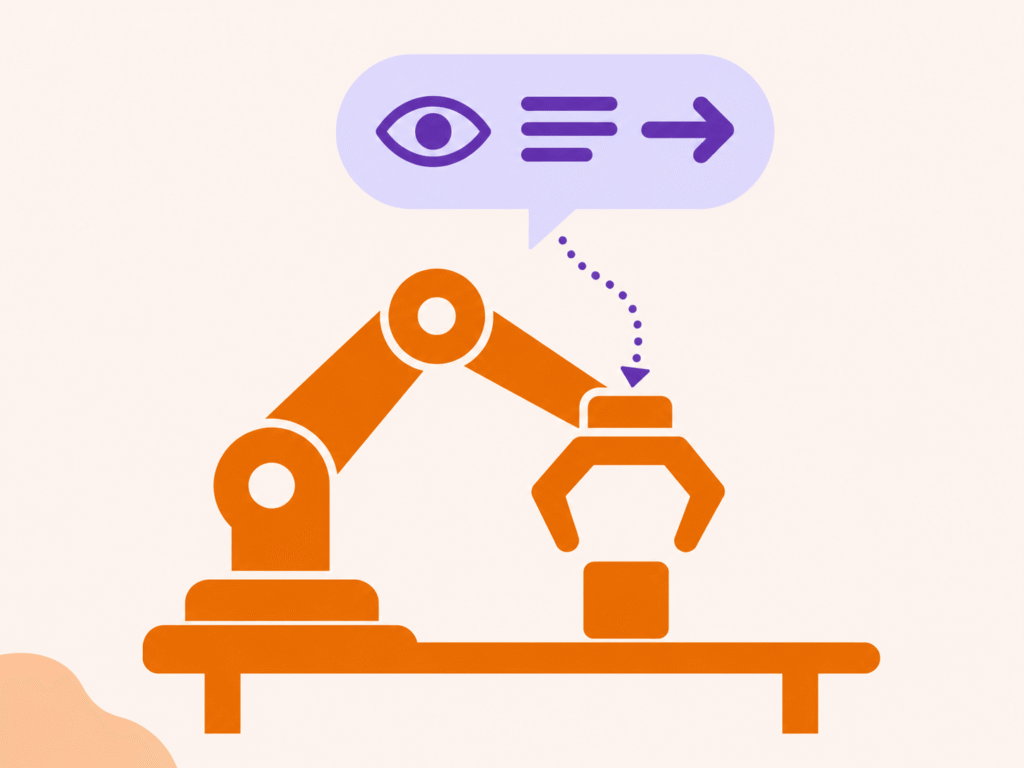
- A vision-language-action (VLA) model takes in a camera feed and a natural-language instruction and outputs the physical motion needed to carry it out.
- Its training data has to connect three things to the same moment in time: what the robot saw, what it was told, and the trajectory it actually followed.
- Most of that data starts with teleoperation, a person operating the robot directly, with the instruction captured alongside the recording.
- A reviewer checks instruction precision, timing alignment, consistency across operators, and whether ambiguous scenes are actually disambiguated before a demonstration is trusted.
- An unreviewed, vaguely captioned demonstration does not cause one mistake. It teaches the model to repeat the same wrong association every time a similar scene appears.
A warehouse robot hears an instruction: pick up the blue tote and set it on the conveyor. Three totes sit on the shelf. Only one is blue. The robot looks, picks the right one, and places it where it was told. That is what a vision-language-action model, or VLA model, is built to do. It takes in a camera feed and a natural-language instruction. It outputs the physical motion the instruction calls for. Training one to do that reliably takes a very specific kind of data. Not just labelled images, and not just text. It takes thousands of examples where what the robot saw, what it was told, and what it actually did are recorded together, on the same timeline.
I review this kind of data for a living, and the mistakes that matter rarely look dramatic. A caption that is slightly too vague. A demonstration where the instruction and the action drift out of sync by half a second. This piece explains what a vision-language-action model is, in plain terms. Then it covers the part most explainers skip past in a single sentence. What training data it actually needs, how that data gets collected and reviewed, and what a buyer should ask before trusting a vendor with it.
What a vision-language-action model actually is
A vision-language-action model is a type of AI model built to connect three things in a single system. What it sees, what it is told to do, and the physical action it should take in response. You will also see it written as vision language action model, without the hyphens. Both point to the same thing. Unlike a typical AI model that only reads and writes text, a VLA model’s output is motion: a gripper closing, a wrist rotating, a mobile base turning down an aisle.
Google DeepMind researchers put the term to wide use in 2023 with RT-2. It is a model trained to treat a robot’s actions as if they were just another kind of word. Each action gets predicted the same way a language model predicts the next word in a sentence (Brohan et al., 2023). That design choice, actions as tokens, is part of why VLA models generalise better than robots programmed with fixed, hand-written rules. The model is not following an if-this-then-that script. It is predicting a response the way it would predict the next line of text, based on everything it has seen before.
Since then, the field has moved quickly. OpenVLA is a widely used open-source VLA model that researchers can download and fine-tune themselves. pi-0, built by Physical Intelligence, is another model often cited as a strong open baseline. A vision-language-action model is one specific architecture inside the broader embodied AI category: AI systems that learn by acting in the physical world rather than only processing text or images. Embodied AI, explained covers that broader category, and the four kinds of data it trains on. This piece goes one level deeper, into the specific data a VLA model’s instruction-following behaviour actually depends on.
The three things a VLA model’s training data has to connect
Most AI training data pairs one input with one label: a photo tagged “cat”, a sentence tagged “positive”. A vision-language-action model’s training data is built differently. Every usable example has to connect three things at the same moment in time. What the camera saw. What instruction was given. What the robot physically did in response, tracked step by step as a trajectory, the path the robot’s arm or base actually follows while carrying out the task.
Get any one of those three wrong and the example teaches something false. A camera frame with no matching instruction is just footage. An instruction with no matching action is just a sentence. An action paired with a vague or mismatched instruction causes the most damage. The model learns to connect the wrong words to the wrong motion. It then repeats that mistake with total confidence every time a similar instruction comes in.
How vision-language-action training data actually gets collected
Most of this data starts with teleoperation. A person operates the physical robot directly, often through a handheld controller, a VR headset, or a matched leader-follower arm. The robot logs every camera frame, joint position, and instruction tied to the task as it happens. What “robotics data collection” actually means covers teleoperation in more depth, including what a reviewer checks before a demonstration is trusted at all.
No single robot, or single lab, generates enough variety on its own. A 2023 collaboration across 21 research institutions pooled more than a million real robot demonstrations into one shared dataset. It spans 22 different robot types, specifically because diversity of this kind, not raw volume, is what lets a model generalise (O’Neill et al., 2023). OpenVLA, the open-source model named earlier, was trained on 970,000 of those demonstrations (Kim et al., 2024).
For a VLA model specifically, someone also has to supply the instruction text itself. That might be the operator, or a separate annotator reviewing the recording afterwards. Either way, the wording has to be clear enough to actually describe what is happening in that specific demonstration, not a generic label reused across dozens of clips. Camera data alone often is not enough to ground a precise instruction either. A command like “pick up the cup behind the bowl” depends on the model understanding depth and spatial relationships, not just colours and shapes on a flat image. LiDAR and 3D point cloud annotation covers how that kind of spatial data gets checked, scan by scan, which matters more for VLA training than most explainers mention.
What a reviewer actually checks before a demonstration is trained on
This is the part that decides whether a dataset is actually usable. It is also the part most explainers leave out entirely. A reviewer working on vision-language-action data checks four things on every demonstration before it is added to a training set.
Instruction precision
Is the written instruction specific enough to actually describe the demonstration? Or could it apply to several different actions equally well? “Move the arm” describes almost nothing. “Reach for the mug’s handle, then tilt it before lifting” describes one specific thing.
Timing alignment
Does the logged action actually line up with the instruction at the right moment, frame by frame? Or did the recording drift? A demonstration where the gripper closes half a second before the instruction says to grab anything teaches the model the wrong cause and effect.
Consistency across operators
Different teleoperators tend to word the same task differently. Left unreviewed, that inconsistency teaches a model that two different phrasings mean two different things, when they do not. A reviewer normalises this before it reaches training.
Language grounding in ambiguous scenes
When a scene has two similar objects, does the instruction actually say which one was meant? Does the recorded action match that choice? This is where review work matters most, and where it is easiest to get wrong.
Picture a team building a kitchen-assistant robot. A teleoperator records a demonstration for the instruction “pick up the small cup”. Two cups sit on the counter, nearly the same size, one slightly smaller. The operator reaches for the larger one by mistake. The recording captures that action, tagged to that instruction, exactly as given. If that pair goes into the training set unreviewed, the model does not learn one wrong grab. It learns that “small cup”, said in a scene with two similar cups, means reach for the one that looks bigger. Get that kind of mismatch wrong at scale, and the model does not make one mistake. It repeats the same wrong association every time a comparable scene shows up afterwards. A reviewer who checks the frame against the instruction catches this early. Without that check, the bad example is weighted exactly the same as a hundred correct demonstrations. A count of how many demonstrations exist never catches it on its own.
What to ask a vendor about vision-language-action training data
Any vendor can say their robotics data is reviewed. A few specific questions actually separate real review from a label on a slide:
- Who reviews an instruction-action pair before it is added to a training set? Do they understand the physical task well enough to catch a mismatch like the cup example above?
- How is timing alignment between an instruction and a logged action actually checked, rather than assumed from the recording software working correctly?
- Is instruction wording normalised across different operators, or does every teleoperator’s own phrasing go straight into the dataset unchanged?
- When a scene has more than one similar object, how does the reviewer confirm the instruction and the action genuinely agree on which one was meant?
- Is there a record of why a specific demonstration was corrected or excluded, or does the dataset only show the final, cleaned-up version?
None of these are really about how much data a vendor can collect. They are about whether anyone is actually checking that the words and the motion agree, demonstration by demonstration, before a model ever learns from either one.
How Chegg approaches vision-language-action training data
At Chegg, reviewing vision-language-action data means putting someone who understands the physical task, not just annotation generally, on every instruction-action pair. That happens before it is ever counted as trustworthy. It is the same discipline behind 3D point cloud annotation and robotics data collection more broadly. A reviewer who can tell a representative demonstration from an edge case. Someone who treats a vague instruction as a problem to fix, not a detail to wave through.
The questions in the checklist above are the same ones Chegg’s reviewers are expected to be able to answer about their own work, not just ask of someone else’s. Data annotation for autonomous vehicles walks through a similar comparison exercise for a different robotics vertical. It is a useful read if a buyer is evaluating more than one kind of physical AI data at once. The standard does not change by sensor type or by robot. Someone who actually understands the task has to check the work before a model learns from it. The AI Data Services hub has more on how that review process runs across the rest of Chegg’s AI Data Services work.
Key takeaways
- A vision-language-action (VLA) model connects vision, language, and action in one system. It takes in a camera feed and an instruction, and outputs the physical motion to carry it out.
- Training data for a VLA model has to tie three things to the same timestamp: what the robot saw, what it was told, and the trajectory it actually followed. Named models worth knowing include RT-2, OpenVLA, and pi-0.
- Most of this data starts with teleoperation, a person operating the robot directly, with the instruction text captured alongside the demonstration.
- A reviewer checks instruction precision, timing alignment, consistency across operators, and whether ambiguous scenes are actually disambiguated, before a demonstration is trusted.
- An unreviewed, vaguely captioned demonstration does not cause one mistake. It teaches the model to repeat the same wrong association every time a similar scene appears.
FAQs
What is a vision-language-action model?
A vision-language-action (VLA) model is a type of AI model that takes in a camera feed and a natural-language instruction, and outputs the physical action needed to carry it out. It connects what it sees, what it is told, and what it does, in a single system, rather than handling perception and control as separate steps.
What is the difference between a VLA model and a vision-language model (VLM)?
A vision-language model (VLM) processes images and text and produces more text in response: a description, an answer, a label. A vision-language-action model takes that same kind of input and adds a physical output, motor commands or a trajectory a robot actually follows. A VLA model is often built by taking a VLM and training it on robot demonstration data as well.
What training data does a vision-language-action model need?
It needs paired examples that connect a camera feed, a natural-language instruction, and the robot’s recorded action, usually logged as a timestamped trajectory, all tied to the same demonstration. Most of it comes from teleoperation, with the instruction text and spatial sensor data added alongside the recording.
How is vision-language-action training data collected?
Most of it is collected through teleoperation. A person operates the physical robot directly, often with a VR headset or a matched controller arm. The robot logs its camera feed, joint positions, and the instruction it was given. Reviewers then check that the instruction, the timing, and the action genuinely agree before the demonstration is added to a training set.
What is the difference between embodied AI and a vision-language-action model?
Embodied AI is the broader category: any AI system that learns by acting in a physical environment rather than only processing text or images. A vision-language-action model is one specific architecture inside that category, built specifically to turn a camera feed and a language instruction into a physical action.
How do you evaluate a vendor for vision-language-action training data?
Ask who reviews each instruction-action pair and whether they understand the physical task. Ask how timing alignment is checked, whether instruction wording is normalised across operators, and how ambiguous scenes with similar objects are handled. Ask for a record of what was corrected or excluded, not just the final cleaned-up dataset.