Exploring the Battle of Hydaspes offers invaluable insights into Indian history. Fought between a Greek and Indian king, this battle explains cultural, historical, and military contexts. The Alexander vs Porus war occurred in present-day Pakistan at the Jhelum River.
Alexander triumphed against the Pauravnas and defeated Porus. He annexed more areas from Punjab. But his legacy doesn’t end there. Alexander’s interest in the Indian subcontinent refined Indian military training and introduced Greek cross-culture.
Alexander the Great had always dreamt of conquering the world. He wanted to establish an empire with undisputed military power. After annexing the Persian empire, he set his ambitions on Asia. His ventures were shaped by the Aegean Sea straddling Greece and Turkey and the sea route connecting Asia to Europe. This eventually led to the famous Battle of Hydaspes, where Alexander faced King Porus in a decisive confrontation. The battle of Hydaspes was a key moment in Alexander’s campaign, showcasing his tactical brilliance. The outcome of the battle of Hydaspes further cemented Alexander’s reputation as an unstoppable conqueror as he continued his expansion into Asia. The battle of Hydaspes contributed to the domino effect of Alexander’s military success.
After he conquered the first Persian empire, then called the Achaemenid Empire, he was also driven to conquer India. This was because the end of the Achaemenid Empire covered some parts of the Indus River Basin. He thought conquering India would complete his ambition of capturing the Asian continent.
When Alexander reached India in 327 BC, King Porus flanked him. Alexander decided not to venture into the wilderness of India and set camp by the banks of the Hydaspes River. He made the offer to Porus to ally with him. Porus refused him and prepared to battle.
By May 327 BC, Alexander the Great had set sights on a new frontier: India. The land of the “Hindus,” as the Persians called them, beckoned with tales of untold wealth and prosperity. Fueled by these legends and the belief that India marked the world’s edge (conquering it would make him a true world ruler), Alexander led his army towards the northwest of the Indian subcontinent.
Porus held an unshakeable resistance in the Alexander vs Porus conflict. They first confronted each other as Alexander passed the Hindu Kush Mountain range. The Indian kings defended this move. However, it soon became clear that they were unprepared to match the Greek forces.
After he annexed and fortified the region of Bactria (Greek for Afghanistan), he moved to the kingdom of Paurava (Punjab). Named after his kingdom, Porus was also called the King Purushottam. He was the only significant opponent that Alexander fought against in this region.

The epitome of cordial war rulers is seen in the Battle of Hydaspes. Alexander took the honourable road and made an offer of alliance. King Porus refused and trained for battle. Alexander’s respect for Porus’s defiance grew. He proceeded to form alliances with Ambhi Kumar, King of Taxila. He rallied against Porus with allied forces by his side.
Porus assumed ranks in the southern bank, whereas Alexander did in the north of Hydaspes River. Porus’s defenses stood undeterred against Alexander’s attempts to cross. Even for their massive army of Alexander, the speed and depth of the Jhelum River proved to be a hard feat. Thus, Alexander was forced to keep his attacks and consider an alternative approach.
The Battle of the Hydaspes took place in 326 BCE on the banks of the Hydaspes River (now Jhelum River in Punjab, Pakistan).The Hydaspes River prevented the war from happening sooner. The monsoon season peaked in its depth and pace. Plus, Alexander’s arrival time was not on his side. He invaded India in the middle of the monsoon season. He acted fast and called upon his allies for water transport vessels.
Unfortunately for Alexander, Porus’ army was stationed on the other side. While he waited for the monsoon season to end, he scoured the land for alternative entry points. He was counting on the element of surprise to overthrow Porus.
The Greeks did their research on Indian warfare, geography, and weather. Previous invasion attempts of Persian kings offered Macedonians the insights they needed. To leave nothing up to chance, Alexander left with his entire force. He didn’t just waltz in with his Macedonian army; the Hellenic League Army and the Balkan Mercenaries stood shoulder-to-shoulder. Furthermore, he convinced Indian and Persian allies to join in his victory.
Alexander’s army recorded 45,000 Macedonian soldiers, including the cavalry and the infantry. Porus entered the battlefield with over 30,000 manpower and 1,000 chariots. Besides, Porus had an advantage over the Macedonian army his war elephants. Elephants were included in the Hydaspes war to overrun the opponents.
However, Alexander’s wit came to his rescue. Because he recognized that horses naturally feared larger animals, he devised tricks to frighten the elephants. He used his cavalry to scare off the horses.
Alexander vs. Porus was no surprise to either force. They regarded and studied each other’s military extensively. The greatest defenses that contributed to Porus’ tactics were the Hydaspes River and his armed elephants.
The intensive Battle of Hydaspes depicted the rise and fall of two bravest kings in the fourth century. Let’s closely evaluate the events leading to Alexander’s victory.
The Battle of Hydaspes was part of Alexander’s grand vision for Asia. In India, he glimpsed defeat but still won. Behind such an overturned victory are unmatched military skills built on flawless timing and stealth strategies.
On the battlefield of Hydaspes, Alexander split his army. A small chunk of the military faced Porus under Craterus’s leadership. He commanded the central part of his army to a Ford 27 km away. It wasn’t long before Porus understood Alexander’s strategy. Flanked with his cavalry, he marched to the river. His infantry was the heart of his formation. The elephant troops were stationed at the front.
Alexander’s formation took a different course and took an unexpected shape. His heavy infantry assembled in a Phalanx in the middle. He sought to self-direct the right-wing cavalry. Coenus led the left-wing cavalry, going in an outflanking ride on the rear end of the hill.
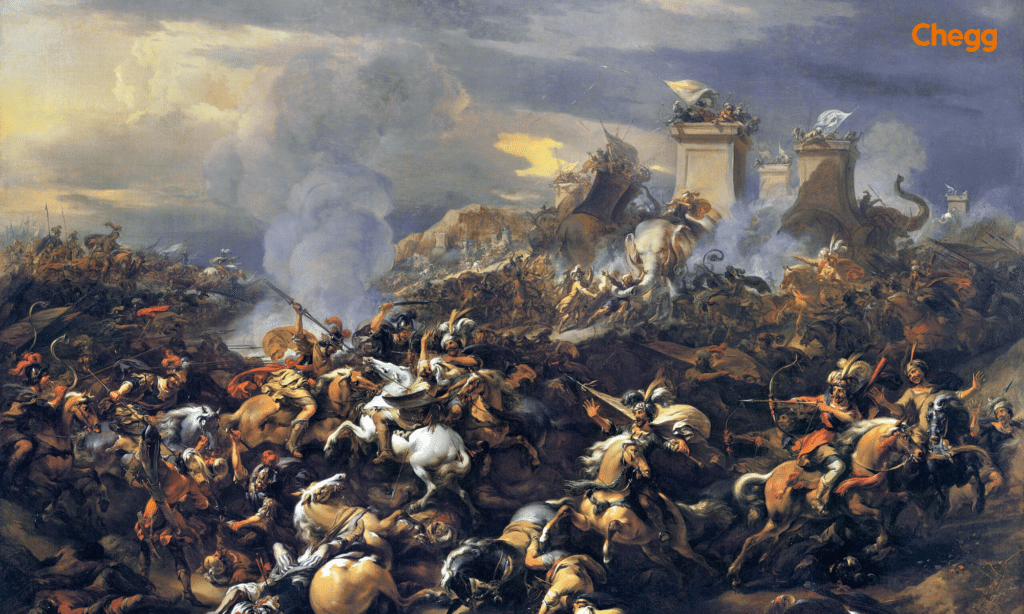
Alexander never lost sight of his opponent’s valor in his endless pursuit of territorial conquests. Underestimating his enemy’s credibility was not one of Alexander’s shortcomings. He recognized the full-fledged scope of the Indian army. So did King Porus. The Indian troops of striking elephants managed to break the center phalanx formation. Although Alexander ultimately defended himself against them, the Indian infantry came next. Porus was a fast-thinker to overwhelm Alexander’s wits. His further efforts to infiltrate Porus’s infantry were futile on horses.
It looked bleak for Alexander until Coenus reappeared. Alexander exploited the Indian cavalry and ambushed the infantry. Soon after, the outcomes of the Hydaspes war became painfully obvious to Porus. He led his troops into a defensive, surrendering formation.
Porus held his resistance to the very end. However, he knew when to admit defeat after giving his all. He reiterated his military faults. The elephants slowed him down, and his infantry required more planning. The Battle of Hydaspes taught Porus the importance of a stable infantry and high-mounted archers.
His comrades found an alternative route as Alexander waited for the monsoon to end. He spotted a river division roughly 27 km upstream of the banks. He positioned most of his army at this wooded place far from the original camp. During the Battle of Hydaspes, he planned to trick Porus into believing he drove into the battlefield with all his military might. In reality, most of his army was ready to surround the Porus army from the other side.
Six thousand soldiers invaded on foot, while another 5,000 mounted horses. Creterus, his general, led this force. He was under Alexander’s order to stay put unless Porus directed his entire troops on Alexander. The Hydaspes war came to a noble end after Alexander successfully caught Porus off-guard.

Alexander vs Porus ended in the former’s victory. When Alexander discussed the next steps with Porus, his response did not disappoint him. He said, “Treat me with the same dignity as a king would another.” Alexander respected Porus’s wishes and returned his lands.
After the Hydaspes war, Alexander annexed two cities around the battlegrounds. He claimed the Nicaea part of the battlefield to mark his success. The second one was on the opponent’s side. He called it the Alexandria Bucephalus after his loyal steed.
The Nanda Dynasty played an important role in the Hydaspes battle. Alexander tried to encroach the bounds of the Nanda Empire. This empire was the fifth dynasty emerging in northern India. His army ill-received this venture. Spent on endless campaigns and suspicious of confronting Indian military forces, they insisted they head west from Hyphasis. It is debatable whether there was mutiny or mere unrest in the army. Regardless, Alexander conceded. On their way back, they marched south and secured the Indus banks.
Porus’s loss in the battle of Hydaspes is due to Alexander’s strategic moves and the Macedonians. India’s military shortcomings at the time resulted in their demise. India’s infantry, cavalry, and troops fell short and were incompetent against the Greeks.
Libertising Porus to rule his kingdom aligned with Alexander’s policies. It said that he would make efforts to bring stability among local rules. He would find a way to include local rulers in recently conquered regions.
Alexander secured the west borders of the Hypasdes River. His vision to persist eastward didn’t sit well with his military forces. The army was still wounded from the blows of the Hydaspes war. The army was homesick, crippled under the local rulers’ defense, and sought a cooler climate.
Although victorious, the Macedonian army was burnt out. India’s competitive forces took a toll on the Macedonian military, which was still recovering while administering campaigns. Consequently, it is collectively called a mutiny. Some suspect that the Nanda Army’s grand size deterred them. Others say they were merely homesick after the extensive Battle of Hydaspes.
Alexander was puzzled when his Army General, Coenus, conveyed the soldier’s conviction. He annexed tribes on the lower Indus river banks before turning back. Then, they all headed back to the safe camps of Macedon.
The Battle of Hydaspes only fueled Alexander’s drive. He abandoned his pursuit eastward and detoured to the west. Down the Jhelum or Hypasdes River, Alexander defined his boundary. The Mallians and Oxydracin tribes chose to ignore the invaders despite their massive army size. Alexander commanded his army into the Malian Empire. He set up his camp at Acesinea and the base at Hydratois.
Following the Mallian campaign, a weary Alexander pressed on with his troops southward. Their ultimate goal: the Indian Ocean. The sheer number of soldiers necessitated a two-pronged approach. While some embarked on a maritime voyage, others followed by land, facing the harsh realities of overland travel.
The journey home was an arduous one. The harsh conditions claimed the lives of many soldiers. It wasn’t until 323 BC that the remaining troops finally stumbled back into Babylon, a shadow of the mighty army that had set out years ago.
Tragically, this hard-won return was overshadowed by an unknown fate. Alexander’s days were numbered, and he would soon succumb to illness, leaving the legacy of his conquests forever etched in history.
Like most historical events, the question of “who won the Battle of Hydaspes” relies on interpretations. Long answer short, Alexander won the Hydaspes war against King Porus. The Jhelum River witnessed this battle in present-day Pakistan.
Porus went down in history as a legendary warrior of India. He relentlessly defended his boundaries. Ultimately, Alexander outsmarted him into believing the opponent had camped. Porus put his survival second to protecting his legacy. The exceptional military forces in the battle of Alexander vs Porus are studied even today.
At Hydaspes, Alexander’s conquest ventures were piqued. He conquered the Persian Empire and headed to the Indian subcontinent. Porus put up a great fight to cease Alexander’s invasion. This led to the legendary Battle of Hydaspes. It significantly influenced Indian culture and politics. Historians trace Greco-Buddhist art to the war at Hydaspes. Indian military strategies were modified after the Hydaspes War. The Maurya Empire revised military training and made it mandatory before stepping onto the battlefield. This inspired the formation of the legendary chariot corps in the Mauryan Empire.
Read More:-
In 326 BC, Alexander the Great secured a hard-fought victory over King Porus at the Battle of the Hydaspes. Despite facing formidable resistance and incurring heavy losses, Alexander’s brilliant tactical maneuver a surprise river crossing that flanked the Indian forces proved decisive. Following his win, he absorbed the region into his empire and reinstated the valiant Porus as a regional governor.
The River Hydaspes, known today as the Jhelum River, was at the center of the Battle of Hydaspes in 326 BCE between Alexander the Great and King Porus. The battle took place on its banks in present-day Pakistan.
The Battle of Hydaspes can be traced to 326 BCE during Alexander the Great’s invasion of India. It occurred after the conquest of the Achaemenid Empire and before his army refused to advance further east. It marks a significant event in ancient Indian history, near the River Jhelum in present-day Pakistan.
Indeed, the Battle of Hydaspes occurred in 326 BCE between Alexander the Great’s forces and King Porus of the Paurava kingdom in the Indian subcontinent.
Porus’ wife was Laachi, the Princess of the Dasyu Kingdom, who later became Queen of the Paurava Kingdom. She was the daughter of Mahanandini and Arunayak and sister of Sumer. Laachi was both Porus’ love interest and wife and became the mother of their son, Malayketu.
Chandraketugarh, located in West Bengal, India, is thought to have been the capital of the Gangaridai. It is believed that the formidable Gangaridai army, boasting a force of 4,000 elephants, played a crucial role in compelling Alexander to retreat from India.
During the Battle of Hydaspes in 326 BCE, Porus’s son was killed while leading troops against Alexander the Great. Later accounts suggest that Porus’s other son, Malayketu, avenged his father’s assassination by killing Eudemus, a Greek general who had betrayed and murdered Porus.
The Battle of the Hydaspes River
The Battle of the Hydaspes River was fought by Alexander in July 326 BC against king Porus (possibly, Paurava) on the Hydaspes River (Jhelum River) in the Punjab, near Bhera. The Hydaspes was the last major battle fought by Alexander.