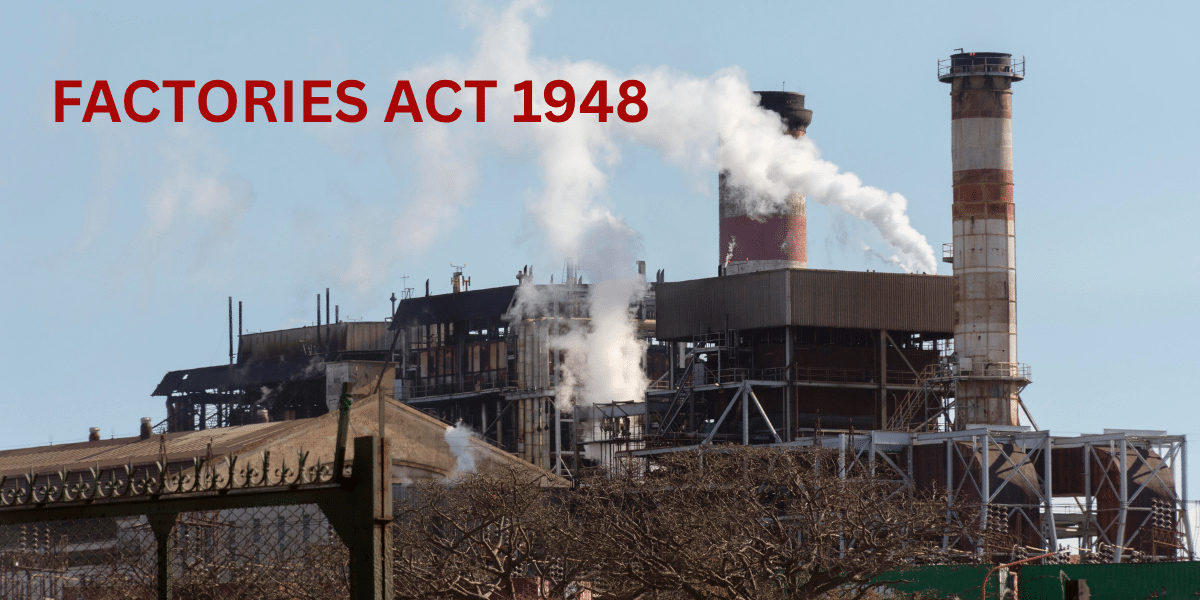
Following independence, India chose a mixed-economy structure. Encouragement was given to both the public and private sectors. This approach was complemented by various legislative measures, including the Factories Act 1948, which aimed to regulate factory labor conditions and ensure workers’ welfare.
The Factories Act 1948 is a key labor law in India designed to regulate working conditions in factories and protect workers’ health, safety, and welfare. It lays down standards for workplace safety, ventilation, sanitation, and working hours, and ensures the provision of essential welfare facilities such as canteens, restrooms, and creches. The Act defines the responsibilities of factory occupiers, mandates proper training and supervision, and requires factories to be registered and licensed before starting operations. It also includes penalties for violations, aiming to safeguard workers from industrial and occupational hazards while promoting a safe and fair working environment.

The government classified industrial parts into four types:
Globalization helped industries grow. This increased industry number further raised the need for worker safety. It proved the significance of the Indian Factories Act 1948. The act also reduced the number of accidents and exploitation occurring in factories.
They modified the definition and provisions of the Factories Act 1948 multiple times, keeping the law relevant despite changing times. Even now, this act is crucial.
The Factories Act 1948 defines what constitutes a “factory” under its regulations. Here’s a breakdown:
A place qualifies as a factory if it meets EITHER of these conditions:
Important Exclusions:
Understanding these criteria can help you determine whether a specific workplace is subject to the Factories Act.
The Indian Factories Act of 1948 laid down regulations for better working conditions. Before 1948, many acts mentioned work culture. Let’s learn about it.
The Indian Factories Act 1948 originated during the Industrial Revolution. The Factory Act of 1881 was the first to investigate the working conditions of minors. It created policies such as child labor, working hours, vacations, and rest periods. This law had no significant impact.

It resulted in the passage of the Factory Act 1891. The verdict addressed factory registration and stated that factories had to report on their actions. This statute addressed the working conditions of women and children. After 1891, they introduced the Factories Act 1948, which underwent further evolution and amendments in 1987, 1996, and 2014.

The Act of 1881 was introduced under the leadership of Lord Ripon. In July 1881, they enforced this act across British India.
Its main clauses were as follows:

Following these two acts, they introduced the Factory Act of 1934. It mentioned some crucial issues like safety, health, hygiene, etc.; however, it failed to address the path to do the same. It called for more comprehensive industrial regulation, leading to the introduction of the Factories Amendment Bill in 1948. The official definition of the Factories Act 1948 came into force in 1949.
The Factories Act came into force in 1949. However, the failure and success of the predecessor act to 1948 played an influential role in the final design of the Factories Act 1948. Some other factors that shaped the Act include:
The excessive exploitation of factory workers was one of the primary reasons for the 1948 Act.
The act understood the importance of industrial growth for a country. This understanding helped create an environment that could boost the industry’s growth and productivity.
Workers’ welfare was an essential factor in shaping the act’s provisions. That is why they introduced provisions like leaves, holidays, and working hours.
The various objectives of the Factories Act 1948 made it mandatory for factories to maintain a certain standard of cleanliness, hygiene, and safety. A safe and healthy environment helped increase workers’ productivity. It was also helpful in enhancing the efficiency of factories. Furthermore, the number of accidents and fatalities has decreased.
The Factories Act 1948 notes that anyone over 18 shall not work more than 48 hours. Additionally, they should get proper rest and holidays. It was to overcome the overexploitation problem.
Under the Factories Act 1948, a factory is any premises with ten or more workers. Such organizations should follow some important provisions to ensure workers’ safety.
General provisions include the installation of suitable rest, meals, and bathroom facilities in factories. If you would like to have a copy of the Factories Act, you may download it from the link below.
Factories must work in hygienic conditions to ensure the safety and health of workers. They must have adequate air, lighting, temperature, and ventilation, which are also vital.
Provisions like maintenance of machinery and safety equipment were added for extra security.
The Factories Act, 1948, requires employers to provide proper training, information, and instruction to all workers regarding health, safety, and the correct use of machinery. This ensures that employees understand workplace hazards and know how to protect themselves and their colleagues.
They have regularly amended the definition of the factory under the Factories Act 1948 to keep it updated with modern needs.
The implementation of the Factories Act in India transpired after the 1951 general elections for the Legislative Assembly of States and Union Territories within the Indian Union, officially taking effect on June 15, 1951. Subsequent amendments to the Factories Act 1948 occurred in 1951, 1960, 1961, and 1972. These modifications extended to the corresponding Rules of 1951, 1960, and 1961. In 1965, the Factories Act was applied to the newly formed States, a measure facilitated by the Chief Secretaries of these States.
Notably, the Factories Act applies exclusively to specific factories that employ ten or more workers, encompassing apprentices within this scope.
Read more:-
Although they introduced the Bill for the Factories Act 1948 in the same year, it came into effect in 1949. However, post-independent India saw a bunch of other labor reforms in addition to the Factories Act of 1948. While the Factories Act of 1948 was a foundational step toward regulating workplace safety and working hours in industrial settings, it was soon followed by several other key legislations.
These included the Minimum Wages Act, 1948, Industrial Disputes Act, 1947, Employees’ State Insurance Act, 1948, and the Employees’ Provident Funds Act, 1952 each addressing critical aspects of labor rights such as fair wages, social security, and conflict resolution. Together, these laws laid the groundwork for a more equitable and regulated labor system in independent India.
The Minimum Wages Act, 1948 is a landmark piece of legislation in India that aims to protect workers from exploitation by ensuring they receive fair and adequate compensation for their labor. Introduced shortly after independence, the Act empowers the government to set minimum wage rates for various industries and types of employment. It plays a crucial role in promoting social justice by establishing a legal framework that safeguards the financial well-being and dignity of workers, particularly those in the unorganized sector.
This act aimed to provide social security to workers. It launched pensions as well as insurance schemes. Although introduced for public welfare, implementing all these acts was not always smooth. It faced some challenges. Some of them are:
The Factories Act 1948, a landmark legislation in India, has undergone several significant amendments to adapt to changing industrial realities and prioritize worker safety and health. Here’s a concise overview of the key amendments:
Post-Bhopal Safety Focus: The Bhopal gas tragedy highlighted the need for stricter regulations. This amendment, along with the Environment (Protection) Act of 1986, introduced a new chapter on hazardous procedures, imposed stricter restrictions, and established harsher penalties for violations.
In the decade of industrial regulations, they introduced the Factories Act of 1948, the Minimum Wages Act, the Industrial Disputes Act, and many more. Each aimed to create a more equitable industrial landscape in the country. For example, the Factory Act of 1948 helped improve workers’ conditions. In addition, it improved society in several ways. First, it reduced the number of accidents. Second, it improved the growth of industries. Such steps build public trust and improve the overall economy of a country. The Act ensures workers’ non-exploitation, promoting social justice and equality. It has helped reduce the gap between employees and workers by creating a system of respect and compliance.
The Factories Act, 1948 sets standards for health, safety, welfare, and working conditions in factories employing 10+ workers with power or 20+ without power, regulating working hours, prohibiting child labour, ensuring welfare facilities, and enforcing compliance through licensing, records, and penalties.
Some primary provisions of the Factories Act of 1948 are limiting the work hours of workers, allowing them to take proper leaves, and providing access to a thriving work environment.
Yes, the Factories Act of 1948 helped workers work in a better and safer environment. Their wages improved, and so did their work balance, improving their productivity.
A worker can work up to 4 hours extra each day, with a weekly cap of 12 hours (48 hours monthly). If the department grants an exemption, there’s a further limit of 75 hours per quarter, as per Section 65.
Form 32 under the Factories Act is a statutory register used to record the inspection book maintained by every factory as required under Section 112 of the Factories Act, 1948. It contains details of official inspections carried out by Factory Inspectors, including the date, observations, compliance instructions, and remarks. This form helps authorities monitor whether the factory is meeting legal requirements related to health, safety, welfare, and working conditions. Every factory must keep Form 32 updated and readily available for inspection to ensure compliance and avoid penalties.
The Factories Act, 1948 doesn’t have “rules” as part of the main Act it contains sections (like Section 7, Section 14, etc.). However, many states issue Rules under the Act, which expand on the sections. Typically:
Rule 7 under the state-specific Factories Rules often deals with Health, Safety, or Welfare measures for example, cleanliness, maintenance, or employee facilities.
Exact content can differ slightly depending on the state (like Maharashtra Factories Rules, Gujarat Factories Rules, etc.).
The Factories Act, 1948, sets clear limits on working hours:
Maximum Hours of Work-
Daily: 9 hours (including overtime)
Weekly: 48 hours
Spread over a day: No worker shall work more than 9 hours in a day.
Weekly Holiday: Every worker must get at least one day off per week (Section 51).
Overtime:
If workers work beyond 48 hours per week or 9 hours per day, they must be paid overtime at twice the ordinary rate of wages.
Rule 4 is part of state-specific rules. In general:
Rule 4 in many state Factories Rules refers to the appointment of inspectors or notice of the factory to authorities.
In some states, it specifies how factories must be registered and notified under the Act to the Chief Inspector or state authorities.
So, Rule 4 usually deals with administrative compliance, like notifying the government when a factory starts operations.