The 105 Amendment of Indian Constitution, officially known as the Constitution (One Hundred and Fifth Amendment) Act, 2021, restored the power of State governments to recognize socially and educationally backward classes (SEBCs), including Other Backward Classes (OBCs).
This amendment was passed in response to the Supreme Court’s 2021 ruling that the 102nd Amendment had stripped States of this power.
The amendment was swiftly passed by both Houses of Parliament and received Presidential Assent on August 18, 2021.
Table of Contents
The 105 Amendment of Indian Constitution (August 18, 2021) is a significant change aimed at protecting the rights of States to identify and classify Socially and Educationally Backward Classes (SEBCs), commonly referred to as Other Backward Classes (OBCs). This amendment was passed to clarify and restore the powers of State and Union Territory governments after the Supreme Court’s interpretation of the 102nd Amendment (2018) had limited these powers. By amending Articles 338B, 342A, and 366, the 105th Amendment ensures that both the Central and State governments can maintain their own lists of SEBCs for reservation in education and employment.
This amendment strengthens India’s federal structure and safeguards the principle of social justice by allowing States to respond to the unique needs of their communities. Let’s explore the 105th Amendment Act in detail.
Before going further, let us see how many amendments are in the Indian Constitution. Since its first enactment in 1950, there have been 106 total amendments. The Indian Constitution underwent recent amendments from 2019 to 2025, with the latest one made on 28 September 2023.
Historical Background of Important Amendments of Indian Constitution
The 105th Amendment to the Indian Constitution came into force in 2021. It was part of the 127th Constitutional Amendment Bill. Below is a discussion of some of its most essential points.
In 2019, the Maharashtra government gave the Maratha Quota 16% reservation; however, the court reversed this decision for two reasons.
It was more than the reservation limit set in the historic Indira Sawhney case.
According to the Supreme Court’s second justification, the state could no longer provide OBC reservations under the 102nd Amendment.
The 102nd Amendment Act of 2018 gave the National Commission for Backward Classes (NCBC) constitutional status by stating that the President and central government would maintain the list of Backward Classes, which the states eventually lost their authority to hold.
The 105th Amendment to the Indian Constitution was passed, restoring the state government’s jurisdiction to identify socially and economically disadvantaged groups.
The 102nd Amendment added Article 338 B and Article 342 A, which gave the NCBC constitutional status and the Central Government the power to maintain the OBC list.
In 2021, the 105th Amendment of the Indian Constitution came into effect. It was part of the 127th Constitutional Amendment Bill. The 102nd Amendment Act of 2018 granted the National Commission for Backward Classes (NCBC) constitutional validity. The 105th Amendment restored the state government’s authority to identify socially and economically disadvantaged groups. The 102 Amendment introduced Articles 338B and 342A, granting constitutional standing to NCBC and empowering the Central Government to maintain the OBC list.
Important Dates and Events Leading to the 105th Amendment of the Indian Constitution
1. Mandal Commission Report (1980)
Event: The Mandal Commission, established in 1979, submitted its report in 1980.
Significance: Recommended reservations for OBCs in jobs and education, influencing future amendments and legal battles, including the 105th Amendment Act.
2. Supreme Court Judgment in Indra Sawhney Case (1992)
Date: November 16, 1992
Event: Upheld Mandal Commission’s recommendations, introduced a 50% cap on reservations, and excluded the “creamy layer” of OBCs.
Significance: Set legal precedents that influenced the 105th Amendment of the Indian Constitution.
3. Maharashtra SEBC Act (2018)
Date: November 30, 2018
Event: Maharashtra law provided reservations for Marathas under SEBC.
Significance: Highlighted the need for a constitutional amendment to clarify states’ powers in determining SEBCs.
4. Supreme Court Judgment in Maratha Quota Case (2021)
Date: May 5, 2021
Event: Struck down the Maharashtra SEBC Act, stating that states couldn’t identify SEBCs after the 102nd Amendment.
Significance: Demonstrated the need for the 105th Amendment of the Indian Constitution to restore states’ powers.
5. Introduction of the 105 Amendment of the Indian Constitution Bill (2021)
Date: August 9, 2021
Event: Introduced in the Lok Sabha.
Significance: Aimed to amend the Constitution to restore states’ power to identify SEBCs.
6. Passage of the 105th Amendment of the Indian Constitution Bill (2021)
Date: August 10-11, 2021
Event: Passed by Lok Sabha and Rajya Sabha.
Significance: Demonstrated broad consensus and urgency.
7. Presidential Assent (2021)
Date: August 18, 2021
Event: The President gave assent, making it official.
Significance: Restored states’ power to identify and notify SEBCs.
These events collectively highlight the legal and legislative journey leading to the 105th Amendment, ensuring states retain their authority to address socioeconomic needs effectively.
Events leading to the 105th Amendment of the Indian Constitution
In May 2021, the Supreme Court delivered its judgment on the Jaishri Laxmanrao Patil v. Chief Minister, Maharashtra case. In November 2018, Maharashtra designated the Maratha community as SEBC, granting higher education and public employment preferences. This law faced challenges, mainly because the 102nd Constitutional Amendment had curtailed states’ authority to recognize SEBCs. The Court, by a 3:2 majority, concurred and reversed the rule.
The majority stressed a literal interpretation of the amended Constitution, with no parliamentary intent to remove state authority in recognizing SEBCs. Political outrage at this decision led national and state parties to push for restoring state power.
Requesting a review, the Union’s plea to retain SEBC status for many villages was denied on June 28. Consequently, the Union filed the 127th Constitutional Amendment Bill in August, later becoming the 105th Civil Amendment Act.
Need for the 105th Constitutional Amendment Act
The Bill seeks to restore state governments’ prior jurisdiction to recognize OBCs who are socially and educationally disadvantaged. The Union government states that the purpose of the 105 Amendment of the Indian Constitution Act is to create a Central List exclusively used by the Central Government and its institutions. It has nothing to do with state lists of retarded classes or state governments’ ability to label a community retarded.
About 671 OBC communities would benefit from the measure as they would have lacked access to reservations in commercial and educational institutions if the state list were eliminated. This measure promotes social empowerment. Furthermore, it displays our government’s commitment to safeguarding marginalized populations’ justice, opportunity, and dignity.
Provisions of the 105 Amendment of the Indian Constitution
After the passage of the 102nd Amendment, the legal landscape witnessed a significant shift with the Supreme Court’s decision regarding the Maharashtra government’s law granting the Communal and Economically Backward Classes status to the Maratha community. The landmark case, Jaishri Laxmanrao Patil v. Chief Minister of Maharashtra, concluded in May 2021.
In November 2018, the Maharashtra state assembly enacted legislation designating Marathas as SEBC (Socially and Educationally Backward Classes), providing preferential treatment in higher education and public employment. However, the constitutional validity of this statute was challenged, citing the 102nd Constitutional Amendment, which seemingly curtailed the state’s authority in recognizing SEBCs. The Supreme Court, in a 3:2 majority decision, agreed and overturned the rule.
The majority, emphasizing a literal interpretation of the amended Constitution, departed from parliamentary records indicating no intention to strip states of their SEBC recognition powers. Surprisingly, in the political landscape, this decision garnered support from national and state parties for restoring state authority.
Faced with the potential loss of SEBC status for numerous communities, the Union government swiftly requested a review of the decision. However, on June 28, the Court upheld its verdict. Subsequently, in August, the Union government introduced the 127th Constitutional Amendment Bill, which later materialized into the 105 Amendment of the Indian Constitution Act. This legislative development reflects the evolving dynamics of constitutional interpretations in the Indian legal framework.
Key Points of the 105 Amendment of Indian Constitution
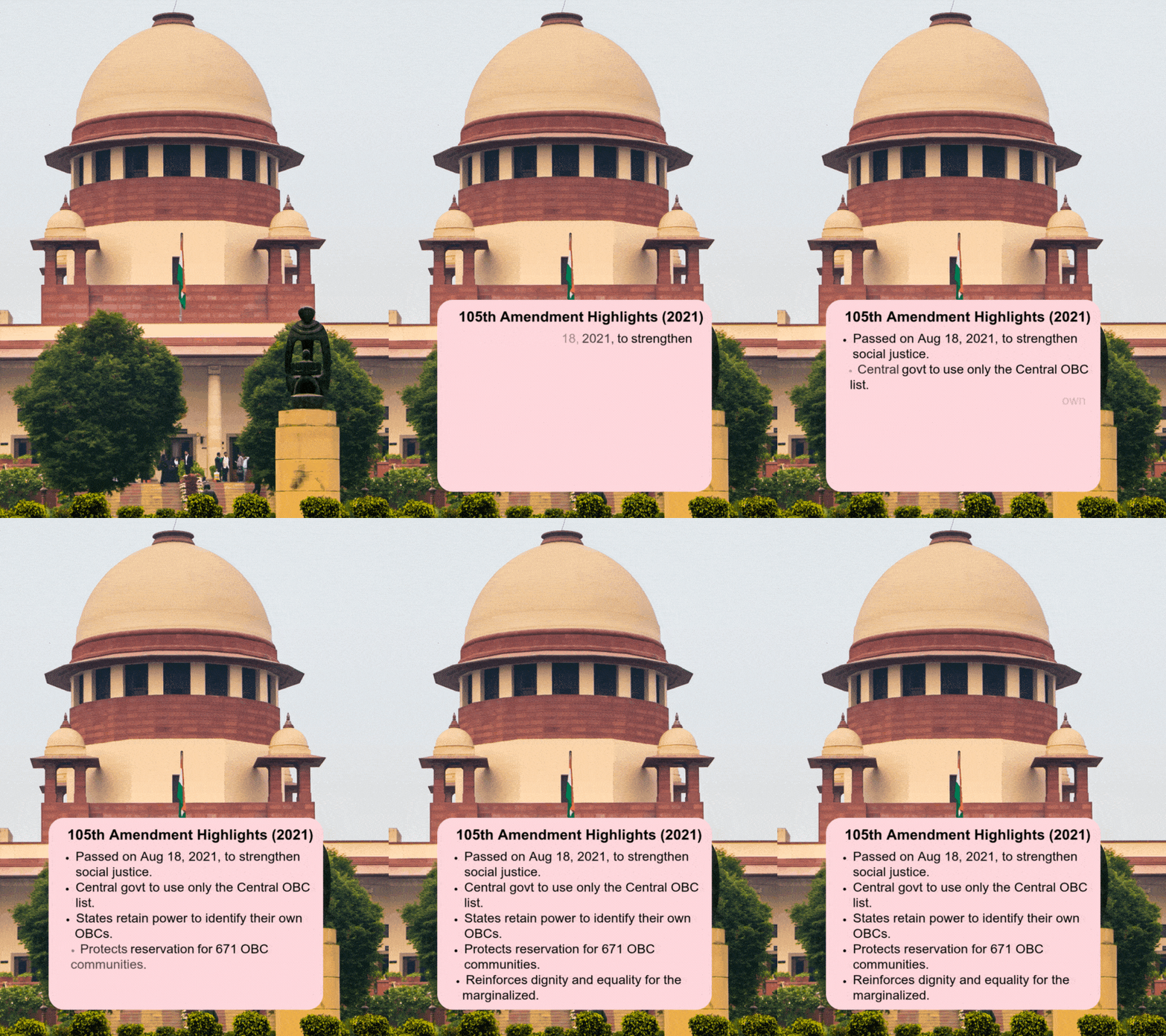
The 105 Amendment of Indian Constitution was ratified on August 18, 2021. The following describes the significance of this amendment:
Article 105 Amendment of Indian Constitution focuses on advancing social liberation and empowerment.
The 105th Amendment to the Indian Constitution ensures that the central government and its connected institutions will only use the central list.
It had no relation to State Lists of Socially Retarded Classes or the authority of State governments to designate a community as backward.
The bill would help about 671 OBC communities because these OBC classes would not have been able to access reservations in jobs and educational institutions if the state list had been canceled.
Article 105 does not interfere with state governments’ ability to label a community as socially disadvantaged.
Additionally, it demonstrates the government’s unwavering commitment to preserving equality, opportunity, and the dignity of marginalized communities.
It also reflects our government’s dedication to ensuring the underprivileged’s dignity, equality, and justice.
The Corrective Course of the 105 Amendment of Indian Constitution
Seeking a solution, the Union government asserted the 102nd Amendment applied exclusively to the Central government and its institutions. It aimed to grant the Union government the authority to designate SEBCs.
Crucially, it contained no clause that would have taken away State governments’ ability to name SEBCs
Every political party agreed that the States should restore their power immediately.
They unanimously moved to overturn the Supreme Court’s decision.
Consequently, both chambers of Parliament presented and passed the 105 Amendment of Indian Constitution with unanimous consent.
Not a single member of the Lok Sabha voted against Article 105
Consequently, Parliament returned the clauses that give States the power to recognize SEBCs.
Important Amendment of Indian Constitution
The 105th Amendment to the Indian Constitution primarily aimed to restore the power of state governments to identify and designate socially and Educationally Backward Classes (SEBCs). This amendment modified Article 342A (Clauses 1 and 2) and added Clause 3, along with Articles 366 and 338B amendments.
Restored State Authority: States regained the power to identify and designate socially and Educationally Backward Classes (SEBCs).
Reversed Supreme Court Ruling: Overturned the Maratha reservation case (2021) verdict, which limited SEBC identification to the Central Government.
Strengthened Reservation System: Ensured that state-specific backward classes continued to receive reservation benefits in education and employment.
Clarified Legislative Authority: Resolved confusion caused by the 102nd Amendment (2018) by confirming that both the Centre and States have authority over SEBC lists.
Protected Regional Social Justice Policies: Allowed states to frame policies tailored to local socio-economic conditions without relying on the Central Government’s list.
Importance of the 105 Constitutional Amendment Act, 2021
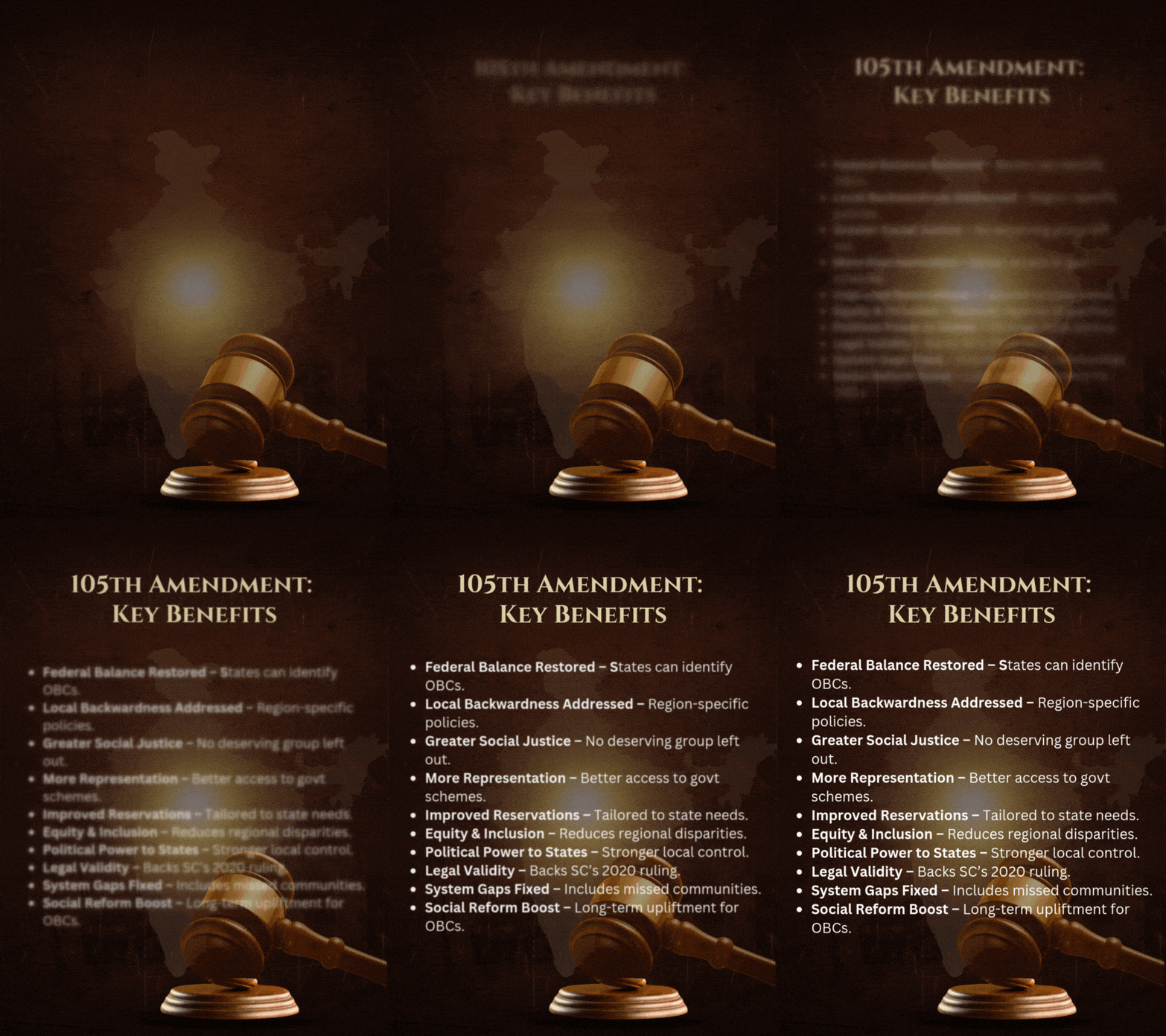
1. Restoration of Federal Balance
The 105th Amendment restores the power of states to identify their OBCs, which were previously centralized. This empowers state governments to make decisions based on regional socio-economic conditions, strengthening the federal structure of India.
2. Empowering States to Address Regional Backwardness
States can now accurately identify and address backwardness within their borders. This ensures that welfare policies and reservations are tailored to meet the specific needs of OBCs in each region, making them more relevant and effective.
3. Ensuring Greater Social Justice
By allowing states to determine their own OBC lists, the 105th Amendment ensures that social justice is better served locally, ensuring no deserving community is left out of affirmative action policies.
4. Increased Representation in Government Programs
The amendment ensures OBC communities are more accurately represented in government schemes and reservation policies, facilitating better access to education and employment opportunities.
5. Improved Access to Reservation and Welfare Schemes
States now have the authority to offer reservations in education, employment, and political representation to OBCs based on their specific needs, ensuring better support and welfare for backward communities.
6. Promoting Equity and Inclusivity
The amendment fosters a more inclusive society by promoting equity, allowing states to identify backward communities accurately and ensure they benefit from targeted welfare programs that address regional disparities.
7. Political Significance
The 105th Amendment empowers states politically, especially in regions with significant OBC populations. This decentralization enhances local governments’ role and gives them more control over policies to benefit OBCs.
8. Legal and Constitutional Relevance
The 105th Amendment aligns with the 2020 Supreme Court ruling, which clarified that the power to identify OBCs should rest with states. This ensures the amendment’s legal validity and strengthens decentralized governance in India.
9. Addressing Gaps in the OBC System
Before the amendment, many state-specific backward communities were left out of the central OBC list. The amendment allows states to include such communities, addressing disparities and gaps in the system.
10. Long-Term Impact on Social Reforms
The amendment lays the groundwork for long-term social reforms by enabling states to craft more targeted policies that improve education, employment, and economic opportunities for OBC communities. This leads to better outcomes for social and economic development.
Constitutional Provisions for Identification of OBCs
The Indian Constitution provides several provisions for identifying and welfareing Other Backward Classes (OBCs). These provisions ensure social justice, equal opportunities, and affirmative action to uplift OBCs across the country.
1. Article 15(4) – Special Provisions for Backward Classes
Article 15 prohibits discrimination based on caste, but Article 15(4) allows the state to make special provisions for the advancement of socially and educationally backward classes (SEBCs). This provision provides a legal foundation for identifying OBCs and their inclusion in affirmative action policies, such as reservations in educational institutions and government jobs.
2. Article 16(4) – Reservation in Public Employment
Article 16(4) empowers the state to reserve positions in public employment for OBCs to ensure they have access to government jobs and employment opportunities. The provision aims to correct historical injustices by facilitating the participation of backward classes in public services.
3. Article 46 – Welfare of Backward Classes
Article 46 directs the state to promote the welfare of Scheduled Castes (SCs), Scheduled Tribes (STs), and OBCs. It emphasizes the importance of providing adequate opportunities for education and employment to improve their socio-economic status. The state must take steps to uplift these communities and reduce inequality.
4. The Mandal Commission (1980)
The Mandal Commission, established in 1979, played a pivotal role in defining and identifying OBCs in India. The commission recommended that 27% of government jobs be reserved for OBCs based on social and educational backwardness. It categorized OBCs as those groups that were not covered by the SC and ST categories but were still economically and socially disadvantaged.
The commission’s recommendations led to the first systematic identification of OBCs, laying the foundation for affirmative action policies targeting them.
5. National Commission for Backward Classes (NCBC)
Article 338B of the Constitution, added by the 102nd Amendment in 2018, established the National Commission for Backward Classes (NCBC). The commission is tasked with investigating and making recommendations regarding including communities in the OBC list.
The NCBC plays a significant role in identifying OBCs at both the central and state levels. It examines communities’ social and economic backwardness and recommends their inclusion or exclusion from the OBC list based on a thorough assessment.
6. The 105th Constitutional Amendment (2021)
The 105th Amendment of 2021 restored the power of states to identify OBCs, which had been transferred to the central government. This amendment ensured states could independently compile their lists of OBCs and make region-specific decisions on reservations and welfare programs.
It reinforced states’ autonomy in determining the needs of their backward communities, ensuring that affirmative action policies are more localized and relevant to specific socio-economic conditions.
7. Supreme Court Rulings
The Supreme Court has made several important rulings regarding the identification of OBCs. In the Indra Sawhney Case (1992), the court upheld the 27% reservation for OBCs but introduced the concept of the “creamy layer,” excluding wealthier OBC members from benefiting from reservations.
The court also clarified that reservations for OBCs should not exceed 50% of the seats in educational institutions and jobs to maintain fairness for other communities.
8. Criteria for Identifying OBCs
The identification of OBCs is typically based on social and educational backwardness. This includes poor access to quality education, low income, and social marginalization.
The Supreme Court introduced the creamy layer concept, which excludes affluent members of OBCs from benefiting from reservations. The creamy layer is defined based on income and other socio-economic criteria.
9. State-Specific Lists
While the central government maintains a list of OBCs for central government jobs and educational institutions, individual states also preserve their lists based on regional backwardness. This allows states to cater to the specific needs of local communities that might not be included in the central list.
10. Impact of Identification
The identification of OBCs has had a significant impact on their social and economic upliftment. It has facilitated access to education, healthcare, employment, and political representation. However, the identification process has been contentious, with some communities seeking inclusion in the OBC list and others opposing it.
Judicial Context: The Maratha Reservation Case (2021)
The 105th Amendment of the Indian Constitution cannot be understood without looking at the landmark case of Jaishri Laxmanrao Patil vs Chief Minister, Maharashtra (2021), commonly known as the Maratha Reservation Case.
Background of the Case
In 2018, Maharashtra introduced a law granting 16% reservation for Marathas in education and public employment.
This law was challenged in the Supreme Court on the grounds that it breached the 50% reservation ceiling set by the Indra Sawhney vs Union of India (1992) judgment.
The case was heard by a five-judge constitutional bench.
Supreme Court Judgment
In May 2021, the Court struck down the Maratha quota, declaring it unconstitutional as it violated the 50% cap.
More importantly, the Court interpreted the 102nd Constitutional Amendment (2018) to mean that only the President and the central government had the power to identify Socially and Educationally Backward Classes (SEBCs).
This interpretation effectively took away the States’ authority to recognize OBCs/SEBCs for their own reservation policies.
How It Led to the 105th Amendment
The judgment raised serious concerns about federalism and state autonomy.
To restore States’ powers, Parliament passed the 105th Constitutional Amendment Act, 2021.
The amendment clarified that both the Centre and the States have the authority to identify and maintain lists of OBCs/SEBCs for reservation in jobs and education.
Key Takeaway
The Maratha Reservation Case directly triggered the 105th Amendment, as it highlighted the need to correct the imbalance created by the 102nd Amendment and reaffirmed the States’ role in protecting the rights of backward classes.
105 Amendment of Indian Constitution UPSC
The 105th Amendment of the Indian Constitution is a crucial topic for the UPSC Current Affairs section. Enacted in 2021, it is the most recent constitutional amendment, making it highly relevant for UPSC Prelims and Mains. Aspirants should rely on standard textbooks and NCERTs for a solid understanding.
The 105th Amendment of the Indian Constitution restored the power of State Governments to identify Socially and Educationally Backward Classes (SEBCs), a role initially granted under the 102nd Amendment. However, in May 2021, the Supreme Court ruled that States lacked this authority, prompting widespread demand for its reinstatement. Responding swiftly, Parliament passed the 105th Amendment of the Indian Constitution in three days, with both the Lok Sabha and Rajya Sabha approving it in August 2021.
This amendment underscores the significance of federalism and social justice in India’s governance framework.
Conclusion
The 105th Constitutional Amendment Act, 2021, stands as a pivotal legislative measure that definitively restores state power, reinforcing the nation’s federal structure. Enacted primarily to nullify a Supreme Court ruling, this critical amendment re-establates the authority of state governments to identify and designate Socially and Educationally Backward Classes (SEBCs) within their jurisdictions. This corrective action was undertaken to address widespread demands for preserving States’ rights in India’s affirmative action policy. Consequently, the 105th Amendment holds immense significance for competitive exams like the UPSC, as it underscores a fundamental commitment to social justice, equality, and the empowerment of vulnerable communities across India.
What is the 105th constitutional Amendment act upsc?
The 105th Constitutional Amendment Act, 2021 restores the states’ power to identify and prepare their own list of socially and educationally backward classes (SEBCs). Passed by the Indian Parliament in August 2021, this amendment was enacted to clarify that both the Central and State Governments can maintain separate OBC lists after the Supreme Court’s Maratha reservation judgment.
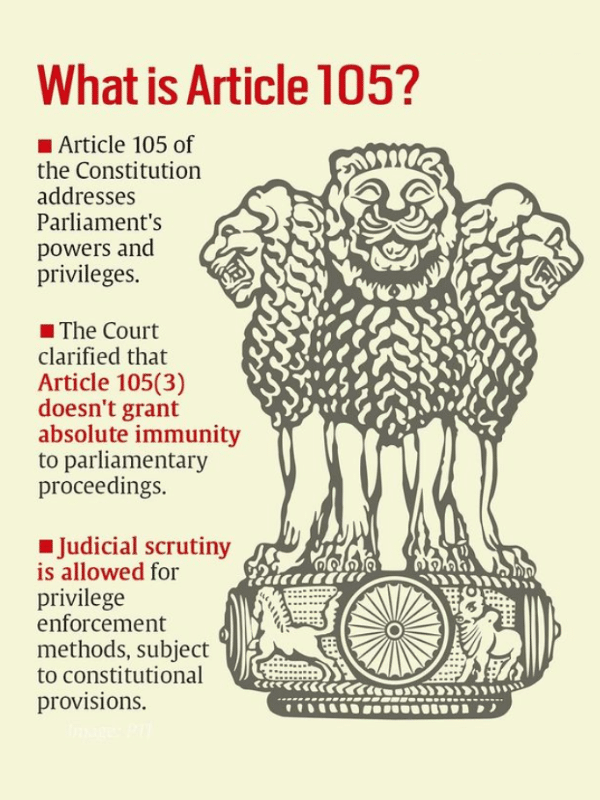
What is Article 105 of the Indian Constitution?
Article 105 of the Indian Constitution defines the powers, privileges, and immunities of Parliament, its members, and committees, ensuring smooth functioning and protecting parliamentary proceedings.
Which articles were changed by the 105th Amendment?
Articles 342A, 366, and 338B of the Indian Constitution are amended by the 105 Constitutional Amendment Act to provide that the President may designate socially and educationally disadvantaged classes for the Central Government’s Central List.
What is the 106th Amendment Act?
The 106th Amendment Act, still under consideration, proposes reserving 33% of seats in the Lok Sabha (lower house of parliament), state legislative assemblies, and the Delhi legislative assembly for women. This aims to increase female representation in Indian politics.
How many times has the Indian Constitution been amended?
As of right now, the Indian Constitution has undergone 105 amendments.
Which Indian Constitutional Amendment was approved in 2022?
On December 14, 2022, during the Parliament’s ongoing Winter Session, the Rajya Sabha unanimously approved the Constitution (Scheduled Castes and Scheduled Tribes) Order (Second Amendment) Bill, 2022.
What is the 107th Amendment of the Indian Constitution?
As of mid-2025, there is no 107th Amendment. Only 106 amendments have been enacted so far
What is the 104th Constitutional Amendment Act?
Passed in 2020, the 104th Amendment extended SC/ST seat reservations in the Lok Sabha and State Assemblies until 25 January 2030, while abolishing the reserved seats for the Anglo-Indian community
Authored by, Muskan Gupta Content Curator
Muskan believes learning should feel like an adventure, not a chore. With years of experience in content creation and strategy, she specializes in educational topics, online earning opportunities, and general knowledge. She enjoys sharing her insights through blogs and articles that inform and inspire her readers. When she’s not writing, you’ll likely find her hopping between bookstores and bakeries, always in search of her next favorite read or treat.