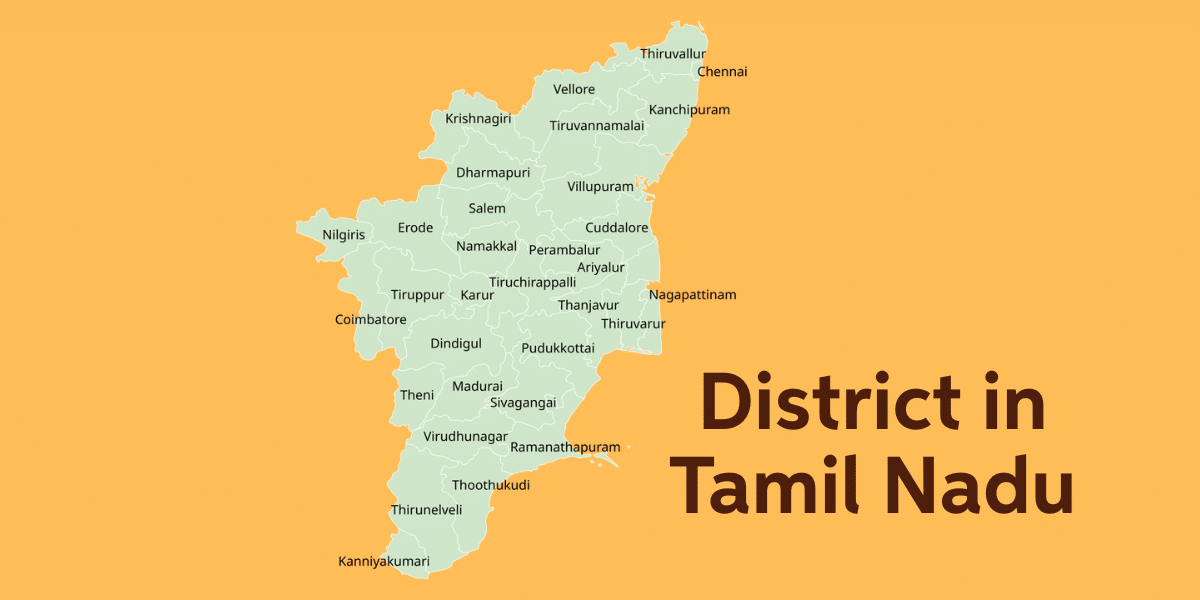
Tamil Nadu is divided into 38 districts as of 2025, following several administrative reorganizations in recent years. If you’re wondering how many districts in Tamil Nadu, especially for academic or competitive exam preparation, this topic is highly relevant. From Chennai’s bustling metropolis to Tenkasi’s scenic landscapes, each district has its unique administrative and cultural identity. This blog provides the latest district count, key facts, historical insights, and recent updates on Tamil Nadu’s evolving district map.
As of 2025, there are 38 districts in Tamil Nadu. This number has seen changes over the years due to administrative restructuring and the creation of new districts to improve governance and development.

Before we dive deeper into how many district in Tamil Nadu, let’s understand what a district is:
Districts play a crucial role in the organization and governance of Tamil Nadu. Here’s why they matter:
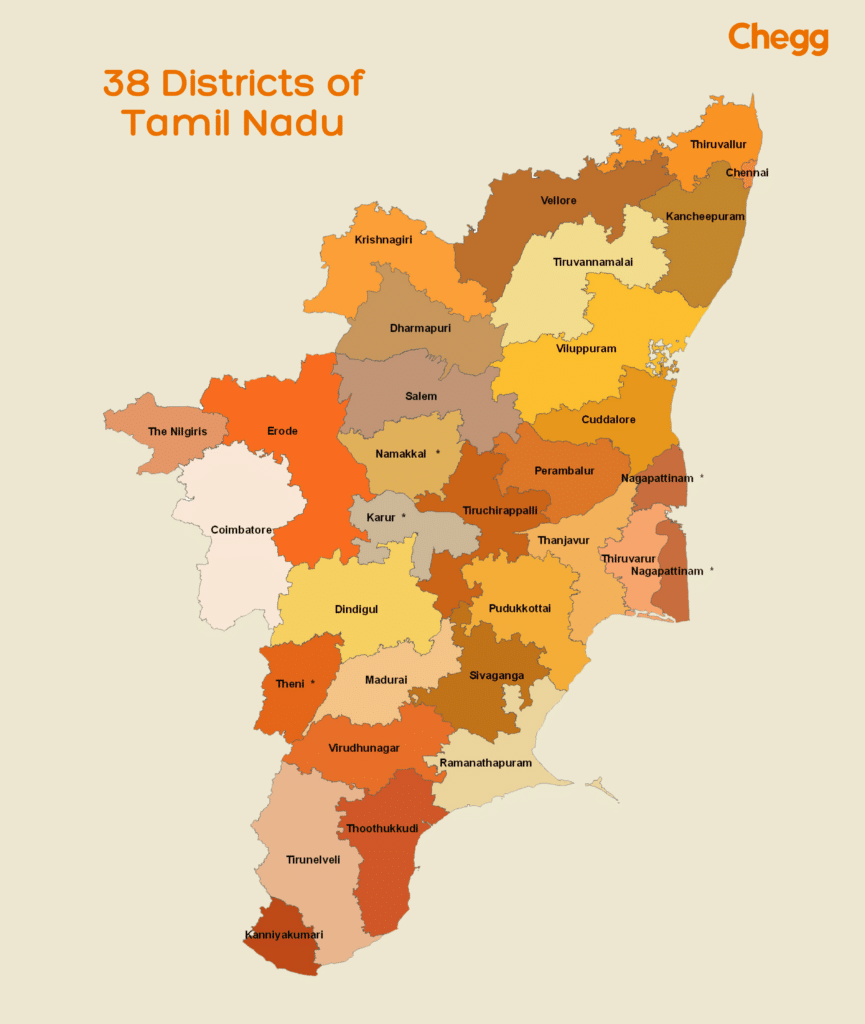
Now that we know how many districts in Tamilnadu, let’s explore some geographical features of the state:
The number of districts in Tamil Nadu has evolved. Initially, there were only a few districts during the British colonial period. However, after India gained independence, the state government began reorganizing these districts for better administration and development.
This continuous restructuring reflects the state’s efforts to decentralize administration and ensure government services reach even the most remote areas.
To answer the question, “How many district in Tamilnadu 2025?” in detail, let’s look at the complete list of 38 districts as of 2025:
| S.No | District Name | District Head Quarters | Area (Sq.Km) | Population (as per Census 2011) |
|---|---|---|---|---|
| 1 | Ariyalur | Ariyalur | 2,027.567 | 7,54,894 |
| 2 | Chengalpattu | Chengalpattu | 2,802.642 | 25,56,244 |
| 3 | Chennai | Chennai | 462.259 | 46,46,732 |
| 4 | Coimbatore | Coimbatore | 4,950.675 | 34,58,045 |
| 5 | Cuddalore | Cuddalore | 3,869.978 | 26,05,914 |
| 6 | Dharmapuri | Dharmapuri | 4,735.657 | 15,06,843 |
| 7 | Dindigul | Dindigul | 6,289.143 | 21,59,775 |
| 8 | Erode | Erode | 6,035.958 | 22,51,744 |
| 9 | Kallakurichi | Kallakurichi | 3,440.837 | 13,70,281 |
| 10 | Kancheepuram | Kancheepuram | 1,800.172 | 11,66,401 |
| 11 | Karur | Karur | 3,022.331 | 10,64,493 |
| 12 | Krishnagiri | Krishnagiri | 5,414.416 | 18,83,731 |
| 13 | Madurai | Madurai | 3,846.378 | 30,38,252 |
| 14 | Mayiladuthurai | Mayiladuthurai | 1,237.063 | 85,632 |
| 15 | Nagapattinam | Nagapattinam | 1,458.969 | 16,16,450 |
| 16 | Kanniyakumari | Nagercoil | 1,729.270 | 18,70,374 |
| 17 | Namakkal | Namakkal | 3,573.394 | 17,26,601 |
| 18 | Perambalur | Perambalur | 1,836.566 | 5,65,223 |
| 19 | Pudukottai | Pudukottai | 4,847.773 | 16,18,345 |
| 20 | Ramanathapuram | Ramanathapuram | 4,243.135 | 13,53,445 |
| 21 | Ranipet | Ranipet | 2,234.320 | 12,10,277 |
| 22 | Salem | Salem | 5,205.000 | 34,82,056 |
| 23 | Sivagangai | Sivagangai | 4,086.000 | 13,39,101 |
| 24 | Tenkasi | Tenkasi | 2,916.130 | 14,07,627 |
| 25 | Thanjavur | Thanjavur | 3,396.570 | 24,05,890 |
| 26 | Theni | Theni | 3,066.000 | 12,45,899 |
| 27 | Thiruvallur | Thiruvallur | 3,444.229 | 37,28,104 |
| 28 | Thiruvarur | Thiruvarur | 2,161.000 | 12,64,277 |
| 29 | Thoothukudi | Thoothukudi | 4,621.000 | 17,50,176 |
| 30 | Area (sq.Km) | Tiruchirappalli | 4,407.000 | 27,22,290 |
| 31 | Thirunelveli | Thirunelveli | 3,842.370 | 16,65,253 |
| 32 | Tirupathur | Tirupathur | 1,792.920 | 11,11,812 |
| 33 | Tiruppur | Tiruppur | 5,186.340 | 24,79,052 |
| 34 | Tiruvannamalai | Tiruvannamalai | 6,191.000 | 24,64,875 |
| 35 | The Nilgiris | Udagamandalam (Ootacamund) | 2,452.500 | 7,35,394 |
| 36 | Vellore | Vellore | 2,222.094 | 16,14,242 |
| 37 | Viluppuram | Viluppuram | 3,725.540 | 20,93,003 |
| 38 | Virudhunagar | Virudhunagar | 4,288.000 | 19,42,288 |
The creation of new districts, such as Chengalpattu, Tenkasi, and Mayiladuthurai, results from the state’s commitment to administrative efficiency and better governance. These districts were carved out of larger districts to ensure local administrations could more effectively manage resources and provide services to the population.
Tamil Nadu’s total districts vary widely in geography, culture, and economy. Let’s explore some key features:
Tamil Nadu’s districts range from coastal areas like Chennai and Thoothukudi to hilly regions like Nilgiris and Dindigul. The state’s geographical diversity is reflected in its climate, natural resources, and agricultural practices.
Each district in Tamil Nadu has its unique cultural identity, shaped by its history, language, and traditions. For instance, Madurai is famous for its ancient temples, while Kanyakumari is known for its scenic beauty and religious significance.
The economy of Tamil Nadu’s districts varies greatly. Chennai, Coimbatore, and Tiruppur are industrial hubs, while districts like Thanjavur and Nagapattinam are known for their agricultural output, particularly in rice production.
| Region | Districts in Tamil Nadu |
|---|---|
| Central | Ariyalur, Karur, Nagapattinam, Perambalur, Pudukkottai, Thanjavur, Tiruchirappalli, Tiruvarur, Mayiladuthurai |
| Western | Coimbatore, Dharmapuri, Erode, Krishnagiri, Namakkal, Salem, The Nilgiris, Tiruppur |
| Southern | Dindigul, Kanyakumari, Madurai, Ramanathapuram, Sivagangai, Tenkasi, Theni, Thoothukudi, Tirunelveli, Virudhunagar |
| Northern | Chennai, Chengalpattu, Cuddalore, Kallakurichi, Kanchipuram, Ranipet, Thirupattur, Tiruvallur, Tiruvannamalai, Viluppuram, Vellore |
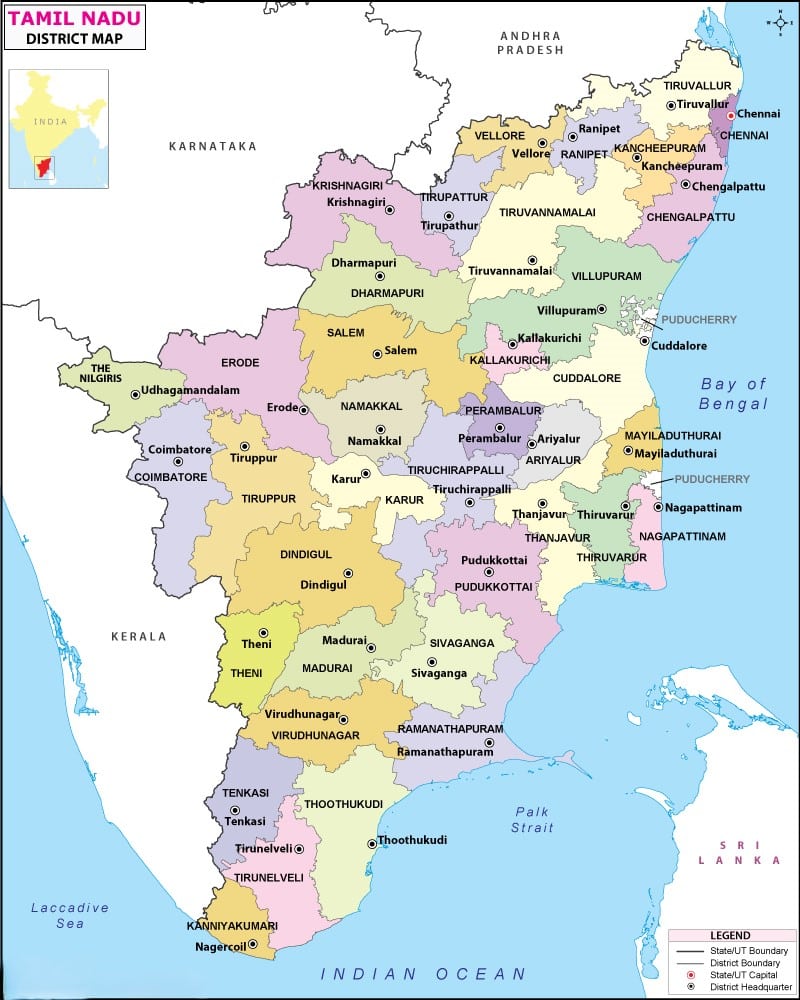
Understanding how many district in Tamilnadu becomes more manageable with a visual representation. Here is the Tamil Nadu District Map with its 38 total district in Tamilnadu.
To put the number of districts in Tamil Nadu into perspective, let’s compare it with some other Indian states:
As you can see, Tamilnadu’s total district (38) is in the middle range compared to other states.
The most recent changes to the number of total district in Tamilnadu happened in 2019 and 2020. Here’s what you need to know:
These changes brought the total number of districts in Tamilnadu to 38, the current count as of 2025.
Tamil Nadu is divided into multiple districts, which are divided into several subdivisions, such as divisions, taluka, etc. This unique administrative structure is crucial in improving the state’s governance.
District collectors head all 38 districts in Tamil Nadu. Other officials, like revenue officers, work under the guidance of a magistrate only.
Further, dividing the districts into subdivisions makes administration easy and convenient. The head of the division-level administrative structure is a collector or a revenue officer.
A tehsildar is the head of a taluk. Furthermore, he gets assistance from other officials like deputy tahsildars and revenue inspectors.
The revenue inspector heads Firkas, which is a further subdivision of taluks.
It comprises a Village Administrative officer responsible for village accounts, revenues, and more.
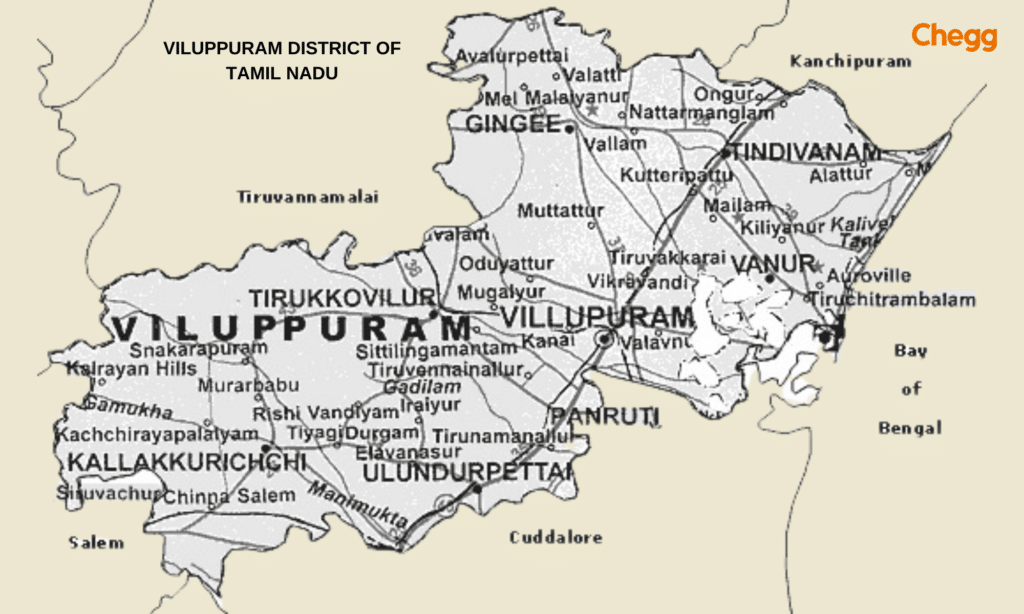
Viluppuram is the largest district in Tamil Nadu, with an area of around 7194 sq. Kms. Viluppuram was a part of Cuddalore until 1993. Their associated history also explains the cultural similarity between the two districts. Viluppuram is the largest district in Tamil Nadu and has many subdivisions. It has 2 divisions, 9 taluks, and 928 revenue villages.

Contrary to Villupuram, Chennai is the smallest district in Tamil Nadu. It covers an area of around 426 sq. Kms. Additionally, Chennai is not only the capital city of the state but is also a metropolis and a culturally rich land. This smallest district in Tamil Nadu and has a total population of 67,48,026. It has 3 divisions, 16 taluks, and 122 villages. Earlier, known as Madras Patnam, Chennai had Kancheepuram as its capital.
Dindigul is the second-largest district in Tamil Nadu, with an area of over 6266.64 sq. km. It was previously part of the Madurai district and was separated from it in September 1985. The region is well known for its iron ore and its fantastic quality. It also has a manufacturing unit. Additionally, the area is reputed for its leather tanning skills. Textiles like silk from Chinalapatti make a mark all over the country.
Regarding Tamil Nadu’s Governance, the role of districts cannot be overstated. These administrative units consist of divisions, taluks, freaks, and villages and are responsible for their adequate functioning.
The district officers ensure that the benefits of these programs rightly reach the needy for their development and the state as a whole.
The District Collector heads district-level administration and performs several vital duties.
The process of creating how many district in TamilNadu involves several steps. The state government evaluates population density, geographical area, administrative convenience, and local demand. Once a decision is made, the new district is officially notified through a government order.
Understanding the district structure in Tamil Nadu is essential for better navigation, planning, and regional awareness. Knowing how many district in Tamilnadu helps individuals grasp the state’s administrative setup, making travel and location-based decisions easier. It also aids students, businesses, and policymakers explore opportunities across different regions. With 38 districts, Tamil Nadu’s diverse landscape and development make it a key area of study for geography and governance.
Understanding the district structure makes understanding how a state is governed easier. It can also help understand the different divisions’ roles and powers.
Understanding the district structure can increase citizens’ awareness, leading to higher participation in local-level planning and development programs.
Understanding the district structure can help an individual know the government, its plans, and policies in detail. Such information and awareness can prove quite beneficial in decision-making. For instance, one can choose better representatives and officers.
Knowing the district structure can help an individual appreciate their state’s history. By understanding the changes in district boundaries and the factors responsible for the same, one can know about the state’s evolution and development. This can also help increase patriotism and appreciation for one’s state.
As of 2025, Tamil Nadu has 38 districts that have evolved to meet the state’s growing administrative and developmental needs. Understanding the number of districts in Tamil Nadu is essential for students like you who are exploring India’s geography and governance.
Each of these 38 districts plays a vital role in shaping Tamil Nadu’s cultural, historical, and economic identity. From bustling urban centers to serene rural landscapes, they reflect the state’s diversity and progress.
Whether you’re preparing for exams or simply expanding your knowledge, learning about the total districts of Tamil Nadu will enhance your understanding of its administrative structure and regional significance, helping you stay informed about one of India’s most dynamic states.
Read More:
As of 2025, there are 38 districts in Tamil Nadu.
The latest district 38 district in Tamil Nadu is Mayiladuthurai, which was formed in 2020.
Before 2020, Tamil Nadu had 33 districts. The number increased to 38 due to creating five new districts between 2020 and 2025.
The new 7 districts in Tamil Nadu include:
1. Chengalpattu
2. Tenkasi
3. Tirupattur
4. Ranipet
5. Kallakurichi
6. Mayiladuthurai
7. Tirunelveli.
Regarding area, Villupuram is the largest district in Tamil Nadu, with 7194 km2.
Chennai is the smallest district in Tamil Nadu by area, covering about 426 square kilometers. It’s also the most densely populated district in the state, with an estimated population of 7,139,630.
13 districts in Tamil Nadu have a coastline along the Bay of Bengal.
The 38th district of Tamil Nadu is Mayiladuthurai. It was carved out of the Nagapattinam district and officially declared a separate district on December 28, 2020. Known for its rich cultural heritage and temples Mayiladuthurai plays key in preserving Tamil traditions and attracting religious tourism.
As of now, Tamil Nadu has 38 districts, not 39. The latest and 38th district is Mayiladuthurai, formed in December 2020. Some central districts include Chennai, Coimbatore, Madurai, Tiruchirappalli, Salem, and Thanjavur. Each district is unique in culture, economy, and geography, contributing to the state’s overall development. There is currently no 39th district officially announced.
The second-largest district in Tamil Nadu by area is Erode. It covers an area of approximately 5,722 square kilometers, following Chengalpattu, which is the largest. Erode is known for its textile industry, turmeric production, and scenic landscapes, making it a significant contributor to the state’s economy and cultural identity.