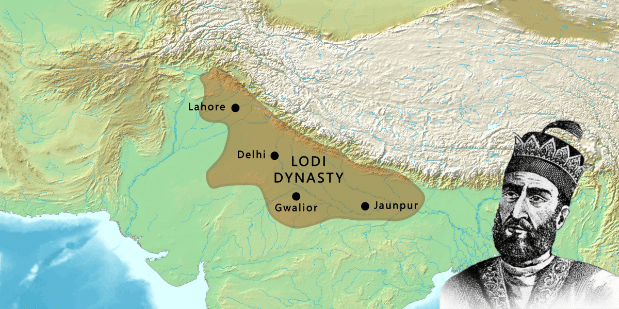
The Lodi Dynasty holds a unique and pivotal place in the history of the Indian subcontinent. As the last rulers of the Delhi Sultanate and the first Afghan dynasty to command the throne of Delhi, their 75-year reign from 1451 to 1526 was a period of intense transition. Emerging from the political chaos that followed Timur’s devastating invasion, the Lodi’s were a bridge between the crumbling power of the old Sultanate and the dawn of the magnificent Mughal Empire.
Though their rule was relatively brief, the Lodi’s left an indelible mark. They not only introduced Afghan rule to India but also pioneered significant administrative, military, and architectural innovations that would influence subsequent empires. This was a dynasty of contrasts, of pragmatic nation-builders and rigid autocrats, of cultural patrons and stern enforcers of orthodoxy. This is the story of their rise, their consolidation of power, and their ultimate, dramatic fall at the hands of a new conqueror.
| Aspect | Details |
|---|---|
| Religion | Islam (Sunni) |
| Founding Ruler | Bahlul Khan Lodi |
| Notable Rulers | Bahlul Khan Lodi, Sikandar Lodi, Ibrahim Lodi |
| Capital | Delhi |
| Period of Rule | 1451 – 1526 |
| Region | Northern India |
| Major Contributions | Administrative reforms, infrastructure development, promotion of Persian literature and arts |
| Notable Events | Battle of Panipat (1526), marking the end of the Lodi Dynasty |
| Successor Dynasty | Mughal Empire |
| Cultural Achievements | Flourishing of Persian literature, Ghazal, Sufi poetry |
| Economic Initiatives | Enhancements in trade and agriculture |
To understand the rise of the Lodi Dynasty, one must first appreciate the fractured state of the Delhi Sultanate in the 15th century. The once-mighty Sultanate, which had dominated much of India, was a shadow of its former self. The critical blow had come in 1398 with the brutal invasion of Timur (also known as Tamerlane). A Turko-Mongol conqueror, Timur’s forces sacked Delhi, massacring its population and carrying away immense wealth. The Tughlaq dynasty, which then ruled Delhi, was shattered, its authority completely undermined.
In the wake of this destruction, the Sultanate disintegrated. Ambitious governors and local chieftains declared their independence, and powerful new kingdoms emerged, such as the Sharqi Sultanate of Jaunpur in the east and various Rajput states in the west.
The dynasty that immediately preceded the Lodis, the Sayyids (1414–1451), were unable to reverse this decline. They were rulers in name only, their effective control barely extending beyond the walls of Delhi and its immediate surroundings. They were constantly fending off rebellions and struggling for survival. It was in this power vacuum, where the authority of a central ruler was weak and the land was ripe for a new, unifying force, that the Afghan Lodis made their bid for the throne.

Bahlul Khan Lodi was the founder of Lodi dynasty. He was a promising leader and handled difficult political situations effortlessly and was a Pashtun noble who founded the Lodi dynasty in 1451. He emerged as a significant figure in shaping the destiny of the Indian continent. There were many different regions with changing politics in North India before the Lodi Dynasty.
Bahlul Khan Lodi wanted to unite all the powers and make things stable again. He started his way of ruling, which was inherited from his ancestors. This decision greatly impacted India’s history and made him rule for a long time. Some of his key contributions are-
Bahlul Khan Lodi was a great ruler and an Afghan noble. He seized the throne of the Delhi Sultanate with the help of military campaigns and ruled over Northern India for a very long time.
Bahlul Khan Lodi made efforts to strengthen the central authority of the Delhi Sultanate. He made reforms like introducing a more efficient revenue system and implementing more control over provincial governors.
Bahlul Khan Lodi ruled until his last breath in 1489. He handed over the sultanate to his son Sikandar Lodi and uplifted the Lodi empire regarding art, literature, government, agriculture, and climatic conditions. He made many architectural buildings during his rule over the Dynasty.
Sikandar Lodi, Bahlul’s son, is widely regarded as the most capable ruler of the dynasty. A brilliant and disciplined administrator, he centralized power and built the institutional framework of the empire.
The dynasty’s downfall came swiftly under its final ruler, Ibrahim Lodi. Unlike his predecessors, Ibrahim was arrogant and autocratic, alienating the powerful Afghan nobility by treating them as mere subjects rather than partners. His reign was wracked by internal rebellions from resentful nobles.
His high-handedness led to his defeat at the hands of Rana Sanga of Mewar at the Battle of Khatoli (1518). The final betrayal came when Daulat Khan Lodi, the governor of Punjab, and Ibrahim’s own uncle, Alam Khan, invited Babur, the Timurid ruler of Kabul, to invade India and overthrow him.
His defeat in 1526 was a turning point in Indian history, paving the way for Mughal rule in India.
In 1526, Ibrahim Lodi’s massive army met Babur’s small but highly disciplined force at Panipat. Despite being vastly outnumbered, Babur’s innovative use of gunpowder, field artillery, and superior cavalry tactics crushed the Lodi forces. Ibrahim Lodi was killed on the battlefield, marking the end of both his dynasty and the Delhi Sultanate.
Though their rule ended in defeat, the Lodis left an enduring architectural legacy. The tombs and mosques in Delhi’s Lodi Gardens, featuring innovations like the double dome, are testaments to their building prowess. They established a foundation of governance and administration that was adopted and refined by the Mughals, who would go on to build one of India’s greatest empires.
The Lodi dynasty’s decline stemmed from a combination of internal conflicts and external pressure.
Ibrahim Lodi expanded the empire across Northern India, covering major regions like Delhi, Agra, Jaunpur, and Lahore. The empire stretched from Bengal in the east to Punjab in the west, dominating the Indo-Gangetic plains.
This administrative structure helped the Lodi rulers manage their vast empire efficiently.
The rulers of the Lodi Empire governed significant regions and key cities in India. Among the prominent cities within the Lodi Empire were Delhi, Agra, Jaunpur, and Lahore. The control over these cities demonstrated the Lodi Empire’s influence throughout the Indo-Gangetic plains. This was an important trade route and administrative center.
Delhi and Agra also served as the empire’s capital and cultural centers. This showcased their strong influence on art and culture. Hence, Agra and Delhi contributed significantly to the Lodi Dynasty’s economic, cultural, and political growth.
The Lodis, like their predecessors, claimed lineage from the Abbasid Caliphate, the then-dominant power in the Muslim world. They used this connection to bolster their legitimacy.
The Lodi Dynasty’s reign was a blend of religious conservatism and political pragmatism. While they promoted Islam, they also employed non-Muslim officials and left behind a rich architectural heritage.
As we move toward the contribution of this dynasty, we can see that despite ruling for a short time, the rulers were far-reaching in their approaches. Their ability to see through difficulties, adapt to diverse societies, and contribute to various cultures and governance showed their composite nature. The Lodi dynasty also faced challenges in ruling during the last ruler.
The Lodi dynasty encountered both inner and outer challenges that put their governing skills to the test. But guess what? They did not just survive – they thrived! Amid these tough times, the rulers of the Lodi dynasty managed to make some impressive contributions to art, architecture, and agriculture.
The Lodi Dynasty was a crucial, if short-lived, chapter in Indian history. They rose from the ashes of a broken Sultanate, unified northern India under the first Afghan regime, and established administrative and architectural precedents that would last for centuries. Bahlul Lodi’s political pragmatism, Sikandar Lodi’s administrative genius, and the architectural wonders they left behind are their enduring contributions.
However, their story is also a cautionary tale. The internal strife and arrogance that plagued Ibrahim Lodi’s reign fatally weakened the empire from within, leaving it vulnerable to a new, ambitious power. Their fall at Panipat was not just the end of a dynasty but the end of the entire Delhi Sultanate, paving the way for the rise of the Mughals, who would go on to build one of the most magnificent empires the world has ever seen. The Lodis were the final, flickering flame of the Sultanate before the dawn of a new imperial age.
Read More-
The Lodi Dynasty, which emerged in the late 15th century, is like a colourful thread in the rich fabric of Indian history. Lodi’s dynasty became the destiny of Northern Delhi and shaped the politics between the Sayyid dynasty and the mighty Mughal Empire.
The rulers had their fair share of challenges during their reign. They had to deal with both problems inside their kingdom and threats from nearby powers. These difficulties put the Lodi rulers to the test, and unfortunately, their dynasty came to an end. This paved the way for the rise of the mighty Mughal Empire.
The Delhi Sultanate ended with the death of Ibrahim Lodi, and it was replaced by the Mughal Empire.
Sikandar Lodhi, the son of Bahlol Lodhi, served as the second ruler of the Lodi Dynasty for the time period 1489 to 1517.
The Lodi dynasty was defeated by Babur, the founder of the Mughal Empire. In the First Battle of Panipat in 1526, Babur’s forces decisively defeated the army of the last Lodi ruler, Ibrahim Lodi. This event marked the end of the Delhi Sultanate and the Lodi dynasty’s rule, ushering in the beginning of Mughal dominance in India.
The Lodi dynasty was founded by Bahlul Khan Lodi in 1451, not 1941. An Afghan noble, he established the dynasty after taking control of the Delhi Sultanate from the Sayyid rulers, becoming the first Afghan to rule it. Bahlul Lodi expanded his empire through military campaigns and diplomacy, consolidating Afghan power in northern India to build a stable kingdom.
The two most notable kings of the Lodi dynasty were its founder, Bahlul Lodi, and his son, Sikandar Lodi. While Bahlul was a great ruler who established the empire, Sikandar is recognized for significantly strengthening its administration and agriculture. He also promoted art and literature, uplifting the empire’s cultural and political standing during his reign from 1489 to 1517.