

Choosing the right engineering course is crucial for students aspiring to build careers in technology and innovation.
A common question, every engineering aspirant has in their mind while choosing between the two courses is, “What is the difference between BE and BTech? or “Is BE and BTech Same?”. B.E. (Bachelor of Engineering) and B.Tech (Bachelor of Technology) are both undergraduate degrees in engineering; however, there is a difference. B.E. includes more theory and the fundamentals of engineering and engineering science, while B.Tech is more focused on the application of technology and skills.
This article will explore the BE and BTech differences, covering their course details, eligibility, types of specializations, best colleges, and major differences. By the end, you will clearly understand the difference between BE and BTech and which course suits your career aspirations better. With 1.4 million students appearing for the JEE exams in a single day, the popularity of engineering courses in India is undeniable. However, before diving into this competitive field, students must understand the key differences between BE and BTech programs to make an informed choice.
Students often confuse these two courses and wonder if BE and BTech are the same. But no, these two courses are different; you will learn about their differences here. So, let’s get started and know the differences between these courses.
Bachelor of Engineering (BE) is a four-year undergraduate degree focused on theoretical knowledge and engineering fundamentals. It emphasizes scientific concepts and analytical skills, preparing students for research and development roles.
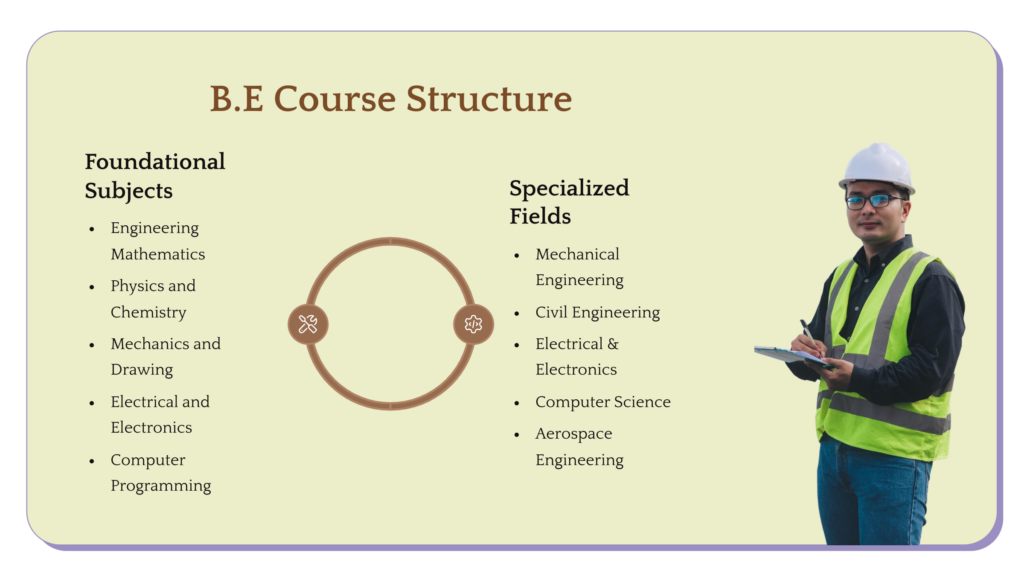
The BE degree strongly emphasizes theoretical concepts, making it ideal for students interested in academics, research, or core engineering fields.
Bachelor of Technology (BTech) is a four-year undergraduate degree focusing more on practical application and industry-oriented training. It is designed to equip students with hands-on experience in technology and innovation.

BTech programs include internships, industrial training, and project-based learning, making them more industry-relevant.
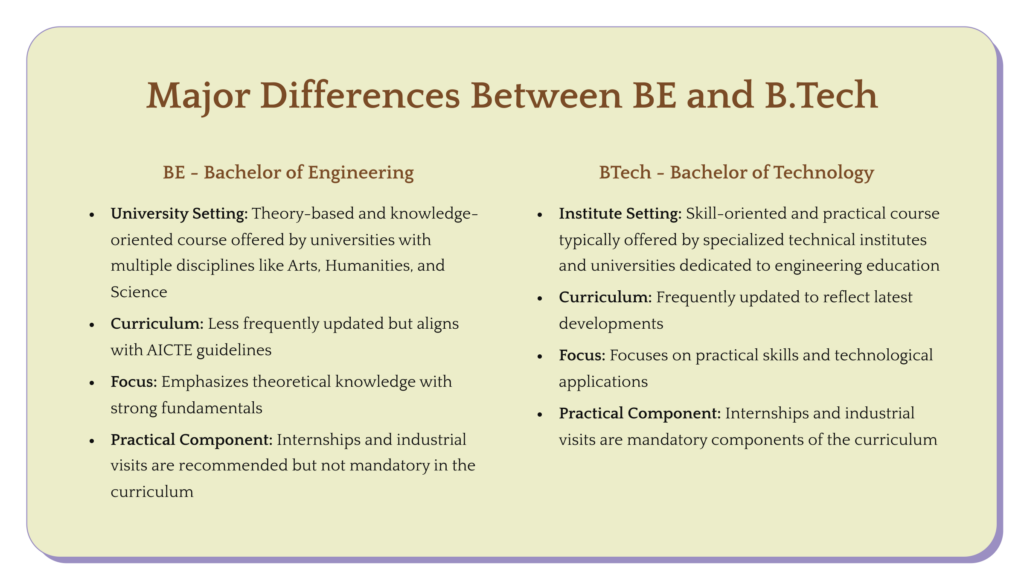
Let us discuss the major differences that make BE and BTech different from each other.
Recommended Read:
A Bachelor of Engineering (B.E.) and a Bachelor of Technology (B.Tech) in Computer Science may lead to the same job outcomes, but the fundamental difference lies within the educational philosophy and curriculum focus of these degrees.
| Characteristic | BE in Computer Science | BTech in Computer Science |
| Nature of Degree | More theoretical and conceptual | More practical and application-based |
| Curriculum Focus | More emphasis on engineering fundamentals | More emphasis on technology and innovation |
| Focus | Focus on scientific principles and logic | Focus on contemporary technologies, tools, and software |
| Lab & Project Work | Less labs or hands-on work | More labs, internships, and live projects |
| Offered By | Most often traditional universities | Most often technical institutes (IITs, NITs) |
| Governing Body | Typically affiliated to the University Grants Commission (UGC) | Typically comes under All India Council for Technical Education (AICTE) |
| Employability Value | Considered more academic | Considered more job-ready and industry-relevant |
We know both degrees are similar in terms of eligibility and career outcomes, understanding the admission process for BE (Bachelor of Engineering) and BTech (Bachelor of Technology) is pivotal for students. Lets see how the BE and BTech admission processes in 2025.
Students must fulfill the following requirements in order to pursue B.E. or B.Tech. degree:
The following entrance test test must be taken by students in order to be admitted into B.E. or B.Tech programs.
Getting into BE and BTech programs requires clearing national, state, or university-level entrance exams. The All India Council for Technical Education (AICTE) and the National Board of Accreditation (NBA) regulate these programs, ensuring quality education and standardised admission procedures. Below are some of the key entrance exams for BE and BTech admissions in 2025.
Conducted by the NTA, this is the primary entrance exam for admissions to NITs, IIITs, and GFTIs for BE and BTech courses.
Only candidates qualifying for JEE Main can appear for this exam, which is required for admission to IITs offering BTech programs.
A state-level entrance exam for Maharashtra, providing admissions to engineering colleges offering BTech programs.
Conducted by BITS Pilani, this exam is for students seeking admission into integrated BE/BTech courses at BITS campuses.
A university-level exam by Vellore Institute of Technology (VIT) for admissions to BTech programs across its campuses.
Students should pick an entrance exam based on their preferred institute, specialisation, and state-level admission policies. It’s essential to check application deadlines, exam patterns, and eligibility criteria well in advance to secure a seat in a top engineering college.
| Aspect | BE(Bachelor of Engineering) | BTech(Bachelor of Technology) |
|---|---|---|
| Course Focus | Theory and pure engineering fundamentals Applied theory | teaching skills relevant to industry |
| Curriculum Updates | Updated periodically, but remains theory-based courses | Regular updates account for the developments in technology |
| Specialisation Areas | Traditional engineering areas for example; Civil, Mechanical, and Electrical | New and emerging fields; AI, Data Science, and Cybersecurity |
| Internships & Training | Internships are emphasized in the later semesters | Integrated from the early years of the course |
There are several misconceptions about BTech and BE. Students aspiring for any of these courses must not pay attention to any of these courses. A few of these misconceptions are as follows:
Here are the best jobs and their salaries after BE vs. BTech programs.
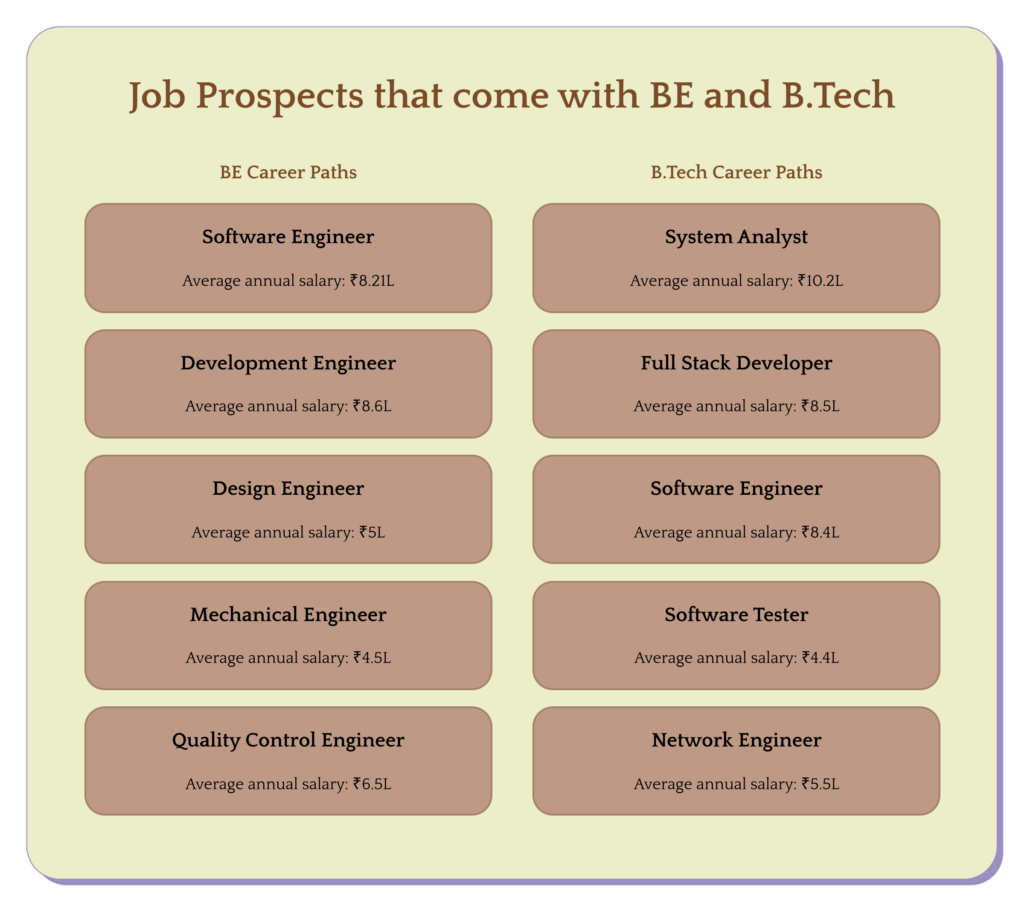
BTech graduates have Full-Stack Development, Software Testing, System Analysis, and Network Engineering opportunities, while BE graduates can find roles as Design, Mechanical, and Quality Control Engineers. Software and Development Engineer roles are available for both, with comparable salaries.
Recommended Read: Explaining a Career Gap after B.Tech

Choosing between BE and BTech depends on your preferences and career aspirations:
Both BE and BTech are excellent degrees with strong career opportunities. The key difference lies in their approach to learning—BE is more theory-oriented, while BTech emphasizes practical training. Understanding the difference between BE and BTech helps students make informed choices that align with their career aspirations.

Making major career decisions is not easy. Researching and reviewing every aspect requires a lot of time and effort. I hope this article has helped you understand the difference between BE and BTech, which can help you decide. Remember to choose the course that matches your interests, skills, and career goals and will positively excel in your career.
Read more: Career Advice to Choose from Numerous Career Choices for the Right Career Path for Yourself.
The difference between BE and BTech is quite clear based on various prospects. Some of the differences between these courses are:
1. BE is a theory-based course, whereas BTech is practical-based
2. Internships and industrial visits are compulsory in BTech but not in BE
3. The BE curriculum is not updated frequently, whereas the BTech curriculum changes often
Yes, there is a salary difference between these two courses. Both courses educate and make the students job-ready; it depends on the job role and how much one earns. However, the average salary for a BE graduate is 2 LPA, whereas BTech graduates make 8 LPA.
Students often get confused between these branches of engineering while choosing their course. However, there is a difference between BE and BTech. BE strengthens the learner’s theoretical knowledge, while BTech teaches practical engineering.
After you complete your BE or BTech, there are many scopes, and it all depends upon your skills, knowledge, and hard work. You can apply for job roles like:
1. Software Engineer
2. Design Engineer
3. Software Developer
4. Development Engineer
5. System Engineer
Yes, both B.E. and BTech offer programs with specific specializations. BE offers Mechanical Engineering, Civil Engineering, Electrical and Electronics Engineering, Computer Science Engineering, and Aerospace Engineering specializations. BTech specializes in Artificial Intelligence and Machine Learning, Cybersecurity and Blockchain Technology, Robotics and Automation, and Bioinformatics.
Both B.E. (Bachelor of Engineering) and BTech (Bachelor of Technology) are undergraduate engineering degrees, and the “best” one depends on individual career goals and preferences
A Bachelor of Engineering (BE) degree typically spans four years and is structured around a core curriculum of foundational engineering principles, mathematics, and sciences, along with specialized subjects within the chosen engineering discipline.
Core Subjects: Engineering Mathematics, Physics and Chemistry, Engineering Graphics and Design.
A Bachelor of Technology (BTech) degree program typically spans four years and is structured around core engineering principles alongside specialized subjects based on the chosen branch. The first year generally focuses on foundational subjects like mathematics, physics, and chemistry, which are common to all engineering specializations.