
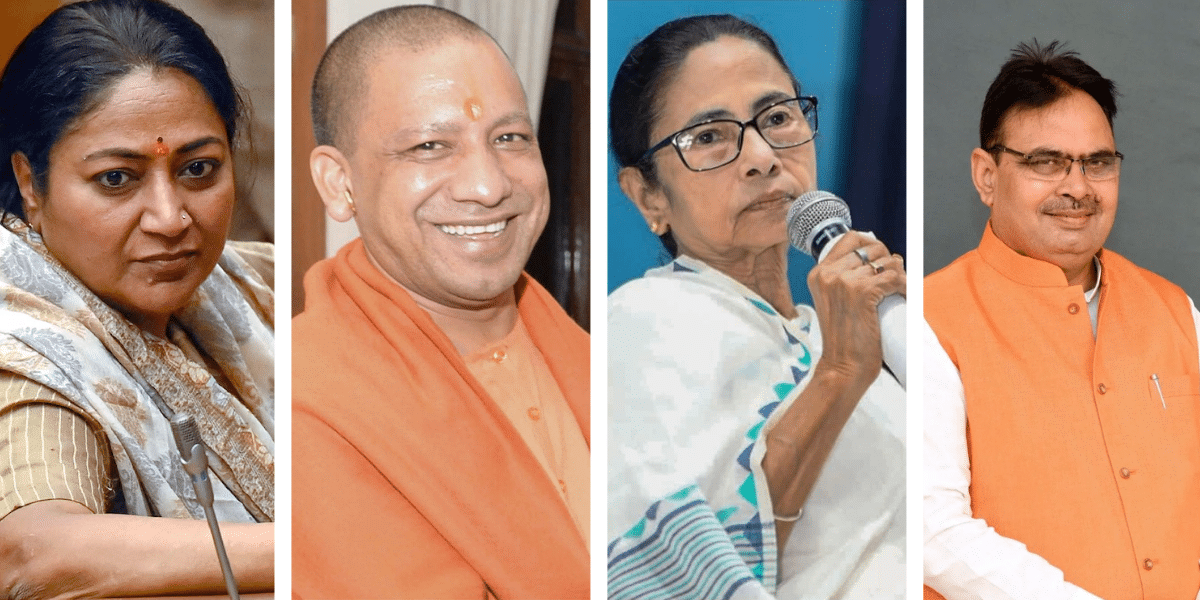
Chief Minister of all states is a term that every student, aspirant, and general knowledge enthusiast should be familiar with. In India’s federal system, each state and union territory is governed by a Chief Minister, who serves as the head of the state government. The Chief Minister plays a crucial role in shaping policies, implementing laws, and ensuring the smooth functioning of the administration at the state level. They link the central government and their respective states, overseeing development projects, managing public welfare programs, and addressing local issues that impact citizens’ daily lives.
For competitive exam aspirants like UPSC, SSC, and other state-level exams, knowing the chief minister of all states is essential. It helps exam preparation and enhances civic awareness, allowing citizens to understand governance and political leadership better. Staying updated about Chief Ministers equips individuals to engage meaningfully in discussions about India’s political landscape, quizzes, and interviews while promoting informed citizenship.

A Chief Minister (CM) is the elected head of the government in an Indian state or union territory with a legislative assembly. As per Article 164 of the Indian Constitution, the Governor of a state appoints the Chief Minister, who then forms the council of ministers to aid and advise in governance. The Chief Minister holds the highest executive authority in the state and is responsible for implementing laws and policies passed by the state legislature.
The role of a Chief Minister is multifaceted. They oversee the day-to-day administration, formulate development plans, manage public welfare schemes, and coordinate with the central government on matters of national importance. The CM also plays a vital role in legislative functions, such as introducing bills, guiding debates, and ensuring smooth law-making processes in the state assembly.
The powers of a Chief Minister include recommending appointments, controlling the state bureaucracy, directing financial resources, and maintaining law and order. They act as the chief spokesperson of the state government and represent the state in interactions with the central government.
It is essential to note the distinction between a Chief Minister and a Governor. While the CM is an elected official responsible for executive functions, the Governor is the ceremonial head appointed by the President of India. The Governor acts on the advice of the Chief Minister and the Council of Ministers, whereas the CM exercises real political power within the state.
| State | Chief Minister | Party | Tenure/Assumed Office |
|---|---|---|---|
| Andhra Pradesh | Nara Chandrababu Naidu | Telugu Desam Party (TDP) | June 12, 2024 |
| Arunachal Pradesh | Pema Khandu | Bharatiya Janata Party (BJP) | May 29, 2019 |
| Assam | Himanta Biswa Sarma | Bharatiya Janata Party (BJP) | May 10, 2021 |
| Bihar | Nitish Kumar | Janata Dal (United) (JD(U)) | January 28, 2024 |
| Chhattisgarh | Vishnu Deo Sai | Bharatiya Janata Party (BJP) | December 13, 2023 |
| Goa | Pramod Sawant | Bharatiya Janata Party (BJP) | March 19, 2019 |
| Gujarat | Bhupendra Patel | Bharatiya Janata Party (BJP) | December 12, 2022 |
| Haryana | Nayab Singh Saini | Bharatiya Janata Party (BJP) | March 12, 2024 |
| Himachal Pradesh | Sukhvinder Singh Sukhu | Indian National Congress (INC) | December 10, 2022 |
| Jharkhand | Hemant Soren | Jharkhand Mukti Morcha (JMM) | November 27, 2024 |
| Karnataka | Siddaramaiah | Indian National Congress (INC) | May 20, 2023 |
| Kerala | Pinarayi Vijayan | Communist Party of India (Marxist) (CPI(M)) | May 20, 2021 |
| Madhya Pradesh | Mohan Yadav | Bharatiya Janata Party (BJP) | March 2024 |
| Maharashtra | Devendra Fadnavis | Bharatiya Janata Party (BJP) | July 2023 |
| Manipur | President’s Rule | – | February 13, 2025 |
| Meghalaya | Conrad K. Sangma | National People’s Party (NPP) | March 2023 |
| Mizoram | Zoramthanga | Mizo National Front (MNF) | December 15, 2018 |
| Nagaland | Neiphiu Rio | Nationalist Democratic Progressive Party (NDPP) | March 7, 2018 |
| Odisha | Naveen Patnaik | Biju Janata Dal (BJD) | March 5, 2000 |
| Punjab | Bhagwant Mann | Aam Aadmi Party (AAP) | March 16, 2022 |
| Rajasthan | Ashok Gehlot | Indian National Congress (INC) | December 17, 2018 |
| Sikkim | Prem Singh Tamang | Sikkim Krantikari Morcha (SKM) | December 2019 |
| Tamil Nadu | M.K. Stalin | Dravida Munnetra Kazhagam (DMK) | May 7, 2021 |
| Telangana | K. Chandrashekar Rao | Bharat Rashtra Samithi (BRS) | December 13, 2018 |
| Tripura | Manik Saha | Bharatiya Janata Party (BJP) | March 8, 2022 |
| Uttar Pradesh | Yogi Adityanath | Bharatiya Janata Party (BJP) | March 19, 2017 |
| Uttarakhand | Pushkar Singh Dhami | Bharatiya Janata Party (BJP) | March 23, 2022 |
| West Bengal | Mamata Banerjee | All India Trinamool Congress (AITC) | May 20, 2011 |
| Union Territory | Chief Minister | Party | Tenure/Assumed Office |
|---|---|---|---|
| Delhi | Rekha Gupta | Aam Aadmi Party (AAP) | February 2025 |
| Jammu & Kashmir | Omar Abdullah | National Conference (NC) | March 2025 |
| Puducherry | N. Rangasamy | Indian National Congress (INC) | May 7, 2021 |
Note: As of September 2025, Manipur is under President’s Rule, and Andaman & Nicobar Islands, Chandigarh, Dadra and Nagar Haveli and Daman and Diu, Lakshadweep, and Ladakh do not have elected Chief Ministers.
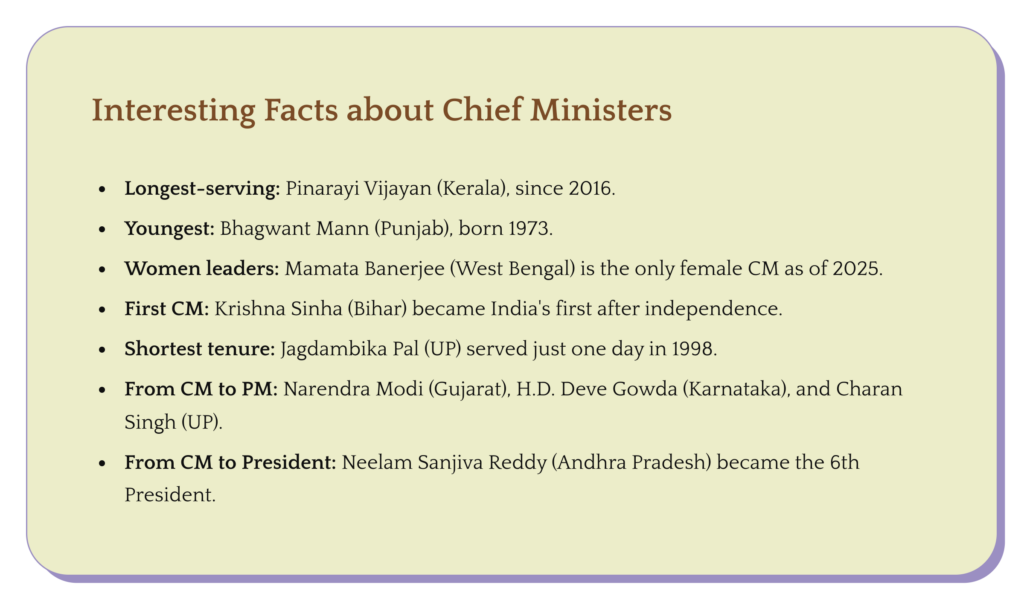
India has seen some remarkably young leaders rise to the position of Chief Minister. Pema Khandu of Arunachal Pradesh became the youngest CM in 2016 at 37, while Devendra Fadnavis assumed office in Maharashtra at 44. Their early rise demonstrates how youth leadership is increasingly shaping state politics.
Some Chief Ministers have served exceptionally long tenures, leaving a lasting impact on their states. Naveen Patnaik of Odisha has been in office since 2000, making him the longest-serving CM in India. Similarly, Jyoti Basu of West Bengal served for over 23 years, steering his state through multiple political and economic changes.
Although fewer in number, women Chief Ministers have made significant contributions to governance. Mamata Banerjee of West Bengal and Sheila Dikshit of Delhi have been prominent leaders who have implemented major urban development, education, and social welfare reforms. Their leadership continues to inspire greater female participation in politics.
Many Chief Ministers are recognized for their unique contributions and development initiatives. Yogi Adityanath in Uttar Pradesh has focused on infrastructure and law and order reforms. M.K. Stalin in Tamil Nadu emphasizes healthcare and welfare programs. Nitish Kumar of Bihar is known for substantially improving governance, education, and public services.
These interesting facts highlight the diversity, talent, and leadership qualities among India’s Chief Ministers. Including such insights adds uniqueness and value for readers, quiz enthusiasts, and competitive exam aspirants, making remembering notable leaders and their contributions easier.
The Chief Minister is the elected head of a state government and plays a pivotal role in administration and governance. Appointed by the Governor, the Chief Minister is usually the majority party’s leader in the state legislative assembly. Their tenure, responsibilities, and reappointment depend on the assembly’s confidence, making them central to state politics and governance. Understanding the appointment and tenure of Chief Ministers is essential for grasping India’s federal structure.
Article 164 of the Indian Constitution governs the appointment of a chief minister (CM). After state legislative assembly elections, the Governor invites the majority party leader or coalition to form the government. The Governor formally appoints this leader as the Chief Minister, who then selects the council of ministers to assist in governance. While the Governor’s role is mainly ceremonial, this appointment is crucial to ensure a stable government.
The chief minister tenure is generally five years, aligning with the term of the state legislative assembly. There is no restriction on the number of terms a person can serve, as long as they maintain the assembly’s confidence. If the government loses majority support, the Chief Minister must resign. In such cases, the Governor may appoint another leader or impose President’s Rule if no viable alternative exists.
Besides executive responsibilities, the Chief Minister plays a vital role in the state legislative assembly. They guide legislative agendas, introduce bills, oversee law-making processes, participate in debates, and answer members’ queries. This ensures that the assembly functions efficiently and that policies are implemented effectively.
Understanding the appointment of CM and the chief minister’s tenure provides insight into India’s constitutional and political framework. It highlights the balance of power between elected leaders and constitutional authorities, which is essential for effective governance.
To keep the article fresh and relevant, here are the most recent updates regarding Chief Minister of all states:
These recent changes highlight the dynamic nature of state politics in India. Regular updates ensure readers stay informed about shifts in leadership across states and union territories.
Also Read: List of Governor General of India
Being aware of the chief minister of all states holds great significance, especially for students, competitive exam aspirants, and citizens interested in governance. For aspirants of UPSC, SSC, state-level PSCs, and other competitive exams, questions about the current Chief Ministers are frequently asked in the general awareness section. Updated knowledge of the chief minister of all states helps candidates score better in exams and perform well in interviews, quizzes, and group discussions.
Beyond examinations, understanding who the Chief Ministers are is crucial for grasping India’s political structure and governance. Since Chief Ministers are the real executive heads of their states, they shape development policies, manage administration, and influence national politics through intergovernmental relations. Knowing them allows individuals to follow political developments more closely, analyze leadership styles, and understand the decision-making process at the state level.
This awareness fosters civic responsibility for citizens. By staying informed about state leadership, people can hold their governments accountable, evaluate performance, and engage meaningfully in democratic processes. Thus, keeping track of Chief Ministers is not only a matter of exam preparation but also an essential part of being an informed and responsible citizen.
The Chief Minister holds a crucial position in India’s federal system, acting as the head of the state government and driving development, policy implementation, and administration. Knowing about the chief minister of all states is essential for students, competitive exam aspirants, and informed citizens who wish to understand the country’s political and governance structure. This knowledge not only aids in exam preparation but also provides insights into the leadership shaping each state’s progress.
Since appointments, resignations, and cabinet reshuffles occur frequently, staying updated with the latest list of the chief minister of all states is vital. Regularly checking this information ensures accuracy and awareness, especially for those preparing for UPSC, SSC, banking, and other competitive exams. Bookmarking this page and sharing the updated list of the chief minister of all states with peers or fellow aspirants can be highly beneficial. It ensures that everyone remains informed about the dynamic political landscape and the leaders steering India’s diverse states.
The Chief Minister is pivotal in India’s federal system, serving as the head of a state government and playing a key role in administration, policy-making, and development. Understanding the chief minister of all states is crucial for students, competitive exam aspirants, and informed citizens who wish to grasp the workings of India’s political and governance framework. Knowledge of state leadership not only aids in exam preparation for UPSC, SSC, banking, and other competitive exams but also provides a deeper insight into the decision-making processes that shape each state’s growth and welfare initiatives.
Since appointments, resignations, and cabinet reshuffles occur frequently, staying updated with the latest list of the chief minister of all states is essential. Regularly checking this information ensures accuracy and keeps readers aware of the current political landscape. Bookmarking the page and sharing it with peers or fellow aspirants can be highly beneficial, helping everyone stay informed. Awareness of state leadership strengthens civic knowledge, encourages meaningful participation in political discussions, and promotes a better understanding of India’s diverse and dynamic governance system.
Here are the Chief Ministers of India’s 28 states as of 2025: Key leaders include Y.S. Jagan Mohan Reddy (Andhra Pradesh), Nitish Kumar (Bihar), Mamata Banerjee (West Bengal), Yogi Adityanath (Uttar Pradesh), and M.K. Stalin (Tamil Nadu). Most states are led by BJP or Congress-affiliated CMs.
India has 28 states and 8 Union Territories. Three Union Territories—Delhi, Jammu & Kashmir, and Puducherry—have elected Chief Ministers. So, currently, there are 31 Chief Ministers in India, representing the 28 states and 3 Union Territories with legislative assemblies.
As of June 2025, the Union Cabinet of India comprises 31 Cabinet Ministers, 5 Ministers of State with Independent Charge, and 36 Ministers of State, totaling 72 members. The Cabinet Ministers head key ministries, including Defence, Home Affairs, Finance, External Affairs, and Railways. Notable figures include Prime Minister Narendra Modi, Finance Minister Nirmala Sitharaman, Defence Minister Rajnath Singh, and Home Minister Amit Shah. Refer to the official National Portal of India for a complete list of ministers and their portfolios.
Before Narendra Modi, the Prime Minister of India was Dr. Manmohan Singh. He served as the Prime Minister from 2004 to 2014, leading the United Progressive Alliance (UPA) government for two consecutive terms.
As of June 2025, the Bharatiya Janata Party (BJP) has Chief Ministers in several Indian states, including Uttar Pradesh, Gujarat, Madhya Pradesh, Karnataka, Haryana, Assam, Himachal Pradesh, and Uttarakhand. The BJP leads in states that hold a majority or form the government.