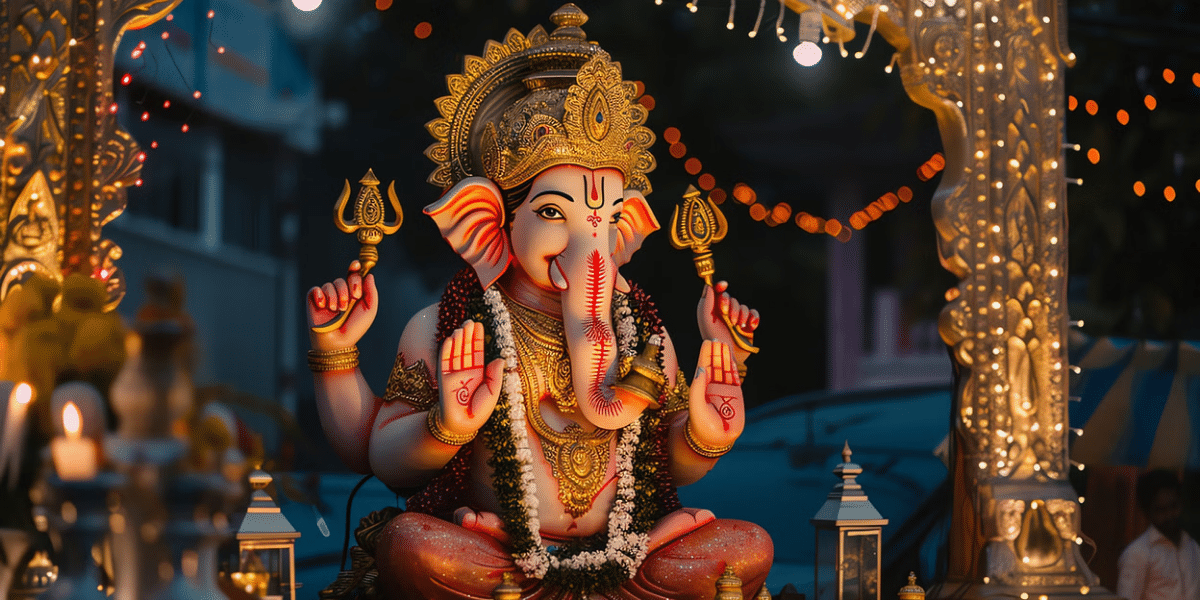
Why we celebrate Ganesh Chaturthi is rooted in devotion to Lord Ganesha, the remover of obstacles and harbinger of wisdom and prosperity. The festival marks his birth and symbolizes new beginnings, spiritual growth, and the eternal cycle of creation and dissolution.
People celebrate Ganesh Chaturthi by installing beautifully crafted idols of Ganesha in homes and public pandals, performing daily pujas, offering modaks and durva grass, and finally immersing the idol in water (Visarjan) as a reminder of life’s impermanence. While it is observed across India, Maharashtra, Karnataka, Andhra Pradesh, and Goa celebrate it with exceptional grandeur.
In this article, we’ll explain why Ganesh Chaturthi is celebrated, its rituals, cultural importance, and even its modern eco-friendly practices that give the festival continued relevance today.

Ganesh Chaturthi, one of the most widely celebrated Hindu festivals, is rooted in mythological tradition and historical significance. The festival honors Lord Ganesha, the remover of obstacles and the harbinger of wisdom, prosperity, and new beginnings.
According to Hindu mythology, Goddess Parvati created Lord Ganesha from sandalwood paste to guard her while she bathed. When Lord Shiva returned and was denied entry by Ganesha, he became enraged and beheaded the boy. To console a grief-stricken Parvati, Shiva restored Ganesha’s life by placing an elephant’s head on him, making him the elephant-headed deity worshipped today. This divine birth story is one of the main reasons Ganesh Chaturthi is celebrated: to honor Lord Ganesha’s creation and rebirth.
Early mentions of Ganesha’s worship appear in the Puranas, particularly the Mudgala Purana and Ganesha Purana, emphasizing his role as the lord of beginnings and remover of obstacles. These references established the religious foundation for his annual worship during Chaturthi in the Bhadrapada month (August–September).
During the Maratha Empire, Chhatrapati Shivaji Maharaj promoted Ganesh worship to inspire nationalism and unity among his people. The tradition of public celebrations symbolized strength and collective identity.
Centuries later, during India’s freedom struggle, Lokmanya Bal Gangadhar Tilak revived Ganesh Chaturthi in 1893. He transformed private household worship into large public gatherings to unite Indians across castes and communities against British colonial rule. This gave the festival social and political significance, turning it into a symbol of cultural pride and resistance.
Today, Ganesh Chaturthi is celebrated for two main reasons:
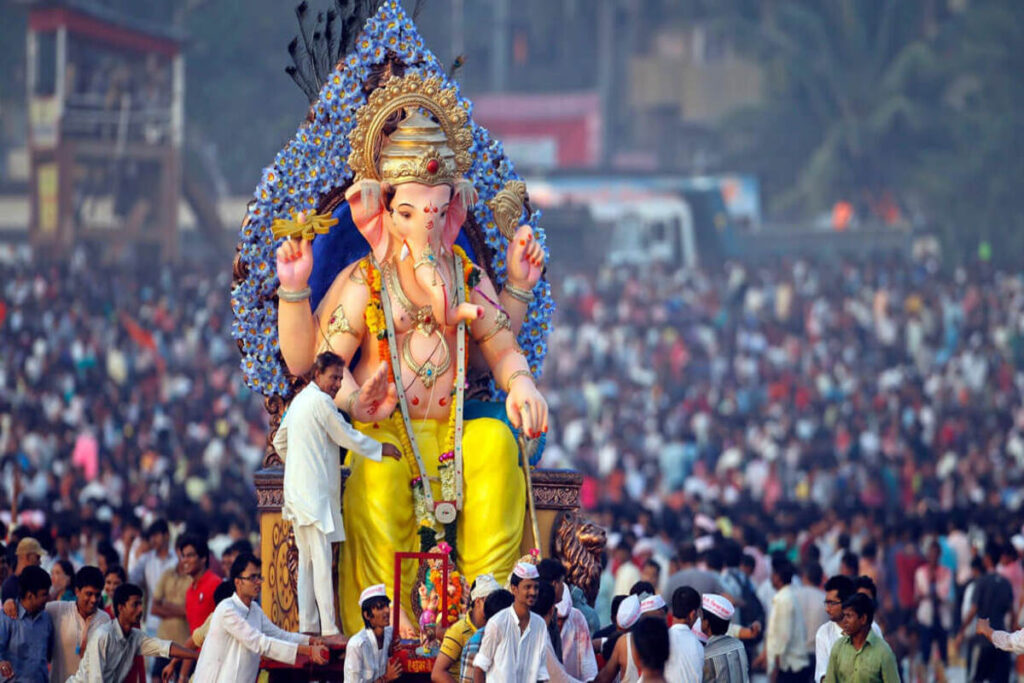
Ganesh Chaturthi, also known as Vinayaka Chaturthi, marks the birth of Lord Ganesha, the beloved elephant-headed deity who is worshipped as the remover of obstacles (Vighnaharta) and the god of wisdom, prosperity, and good fortune.
Lord Ganesha is invoked in Hindu tradition at the start of all rituals, journeys, and new ventures. Devotees believe worshipping him during Ganesh Chaturthi removes hurdles, grants wisdom, and ensures success. This makes the festival a devotional occasion and a spiritual practice for seeking strength in life’s endeavors.
Every aspect of Ganesha’s form carries deep symbolism:
Ganesh Chaturthi falls on the fourth day (Chaturthi) of the Hindu month of Bhadrapada (August–September), coinciding with the beginning of the harvest season. This timing symbolizes renewal, abundance, and fresh beginnings. People install clay idols of Ganesha in homes and community pandals, seeking blessings for prosperity, peace, and harmony.
The earliest mention of Ganapati is found in the Rigveda (Shloka 2.23.1 and 10.112.9), though his classical form evolved later in the Puranas. The mythological story of his creation by Goddess Parvati and revival by Lord Shiva established him as a deity of divine wisdom.
Here is the Shloka 2.23.1 from the Rigveda:
ग॒णानां॑ त्वा ग॒णप॑तिं हवामहे क॒विं क॑वी॒नामु॑प॒मश्र॑वस्तमम् ।
ज्ये॒ष्ठ॒राजं॒ ब्रह्म॑णां ब्रह्मणस्पत॒ आ न॑: शृ॒ण्वन्नू॒तिभि॑: सीद॒ साद॑नम् ॥
The English translation is as follows:
“We invoke the Brahmaṇaspati, chief leader of the (heavenly) bands; a sage of sages; abounding beyond measure in (every kind of) food; best lord of prayer; hearing our invocations, come with your protections, and sit down in the chamber of sacrifice.”
Here is the Shloka 10.112.9 from the Rigveda:
नि षु सी॑द गणपते ग॒णेषु॒ त्वामा॑हु॒र्विप्र॑तमं कवी॒नाम् ।
न ऋ॒ते त्वत्क्रि॑यते॒ किं च॒नारे म॒हाम॒र्कं म॑घवञ्चि॒त्रम॑र्च ॥
The English translation is as follows:
“Lord of the companies (of the Maruts), sit down among the companies (of the worshippers), they call you the most sage of sages; without you nothing is done in the distance; have in honour, Maghavan, our great and various adoration.”
| Aspect | Details |
|---|---|
| Date | 27 August 2025 (Wednesday) |
| Chaturthi Tithi | Begins: 26 Aug, 1:54 PM • Ends: 27 Aug, 3:44 PM |
| Puja Muhurat (Madhyahna) | 27 Aug: ~11:05 AM – ~1:40 PM |
| Moon-sighting to Avoid | 26 Aug: 1:54 PM – 8:29/8:48 PM27 Aug: 9:28/9:33 AM – 8:57/9:21 PM |
| Visarjan (Ananta Chaudas) | 6 September 2025 (Saturday) |
| Festival Duration | Approximately 10 days |
Ganesh Chaturthi is celebrated with devotion, rituals, and community spirit. Depending on family and regional traditions, the festival lasts one to ten days.

The celebration begins with Ganesh Sthapana, the ceremonial installation of Lord Ganesha’s idol. Devotees bring home or set up community idols, usually made of clay, and place them on decorated altars or pandals. The installation is performed during an auspicious muhurat, often accompanied by mantras, Vedic hymns, and rituals to invoke Lord Ganesha’s presence.
Throughout the festival, devotees perform:
The festival concludes with Ganesh Visarjan, the immersion of the idol in a river, sea, or artificial water tank. This symbolizes the cycle of creation and dissolution, reminding devotees of life’s impermanence and the belief that Ganesha returns to Mount Kailash to his parents, Shiva and Parvati.
The Visarjan procession is marked by chants of “Ganpati Bappa Morya, Pudhchya Varshi Lavkar Ya” (“O Lord Ganesha, come again early next year).
While Ganesh Chaturthi is celebrated across India, rituals differ regionally:
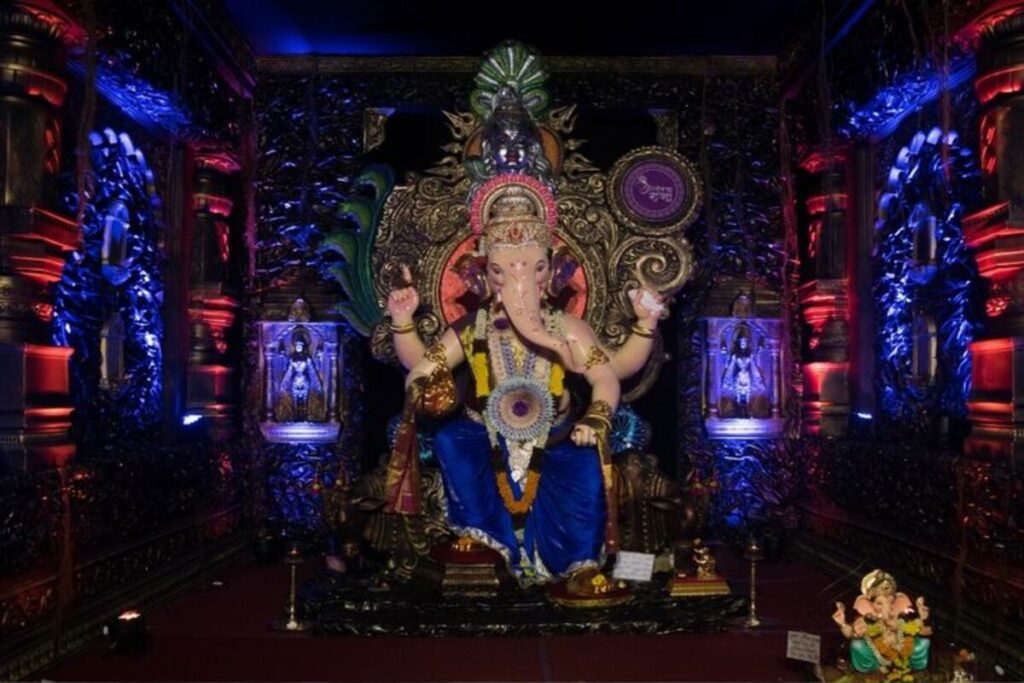
Ganesh Chaturthi is not just a religious festival but a cultural, social, and unifying celebration that brings people together across communities and geographies.
One of the most striking features of Ganesh Chaturthi is the installation of public pandals (temporary stages), where large idols of Lord Ganesha are placed for collective worship. These pandals often feature:
These community gatherings foster social unity, inclusivity, and cultural pride, turning the festival into a people’s celebration beyond religious boundaries.
Ganesh Chaturthi acquired political and nationalist significance in the late 19th century when Lokmanya Bal Gangadhar Tilak transformed it into a public festival. In 1893, Tilak encouraged large community gatherings around Ganesh idols to:
Through this revival, Ganesh Chaturthi became a symbol of resistance, unity, and cultural identity, playing a vital role in the freedom struggle.
Over time, Ganesh Chaturthi has spread far beyond Indian borders, carried by the diaspora:
This global presence highlights Ganesh Chaturthi’s role as a cultural bridge, uniting communities worldwide in devotion and festivity.
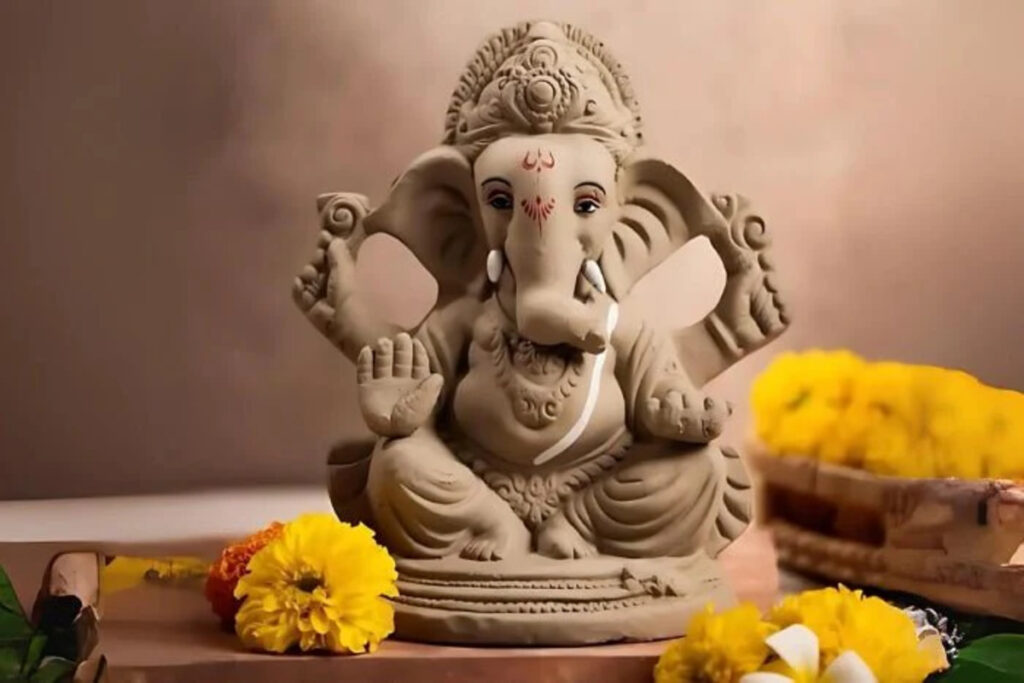
Environmental concerns have brought a new dimension to Ganesh Chaturthi celebrations in recent years. While the festival symbolizes devotion and community spirit, traditional practices, especially idol immersion, have raised ecological challenges.
Mass-produced idols made of Plaster of Paris (PoP) and chemical paints have been popular for decades due to their affordability and vibrant appearance. However, they pose significant risks:
In response, there has been a growing shift towards eco-friendly Ganesh idols, including:
To encourage sustainable celebrations, government bodies and NGOs have launched various programs:
Cities like Mumbai, Pune, Hyderabad, and Bengaluru have been at the forefront of promoting green Ganesh Chaturthi, with rising adoption among households and housing societies.
Ganesh Chaturthi is about rituals, devotion, and delicious traditional foods prepared as naivedyam (offerings) to Lord Ganesha. Each dish carries cultural and symbolic significance, reflecting abundance, prosperity, and joy.
These foods add joy, sweetness, and a sense of community feasting to Ganesh Chaturthi celebrations.
| Name | One with mouse as a charioteer |
|---|---|
| Akhuratha | One with mouse as charioteer |
| Alampata | Ever eternal Lord |
| Amit | Incomparable Lord |
| Anantachidrupamayam | Infinite and Consciousness |
| Avaneesh | Lord of the whole world |
| Avighna | Remover of obstacles |
| Balaganapati | Beloved child-like God |
| Bhalchandra | Moon-crested Lord |
| Bheema | Huge and Gigantic |
| Bhupati | Lord of the Gods |
| Bhuvanpati | God of the Gods |
| Buddhinath | God of wisdom |
| Buddhipriya | Knowledge bestower |
| Buddhividhata | God of wisdom |
| Chaturbhuj | Four-armed Lord |
| Devadeva | Lord of all Lords |
| Devantakanashakarin | Destroyer of evils |
| Devavrata | One who accepts all penances |
| Devendrashika | Protector of all Gods |
| Dharmik | One who gives charity |
| Dhoomravarna | Smoke-hued Lord |
| Durja | Invincible Lord |
| Dvaimatura | One who has two mothers |
| Ekaakshara | One syllable Lord (OM) |
| Ekadanta | One-tusked Lord |
| Ekadrishta | Single visioned Lord |
| Eshanputra | Son of Lord Shiva |
| Gadadhara | One with the mace |
| Gajakarna | Elephant-eared |
| Gajanana | Elephant-faced Lord |
| Gajananeti | Elephant-faced God |
| Gajavakra | Trunk of the elephant |
| Gajavaktra | One with elephant mouth |
| Ganadhakshya | Lord of all Ganas |
| Ganadhyakshina | Leader of all celestial bodies |
| Ganapati | Lord of all Ganas |
| Gaurisuta | Son of Goddess Parvati |
| Gunina | One with all virtues |
| Haridra | Golden-colored |
| Heramba | Mother’s beloved son |
| Kapila | Yellowish-brown |
| Kshipra | One who is easy to appease |
| Lambakarna | Large-eared Lord |
| Lambodara | Huge-bellied Lord |
| Mahabala | Extremely strong |
| Mahaganapati | Supreme Lord |
| Maheshwaram | Lord of the universe |
| Mangalamurti | All auspicious Lord |
| Manomay | Conqueror of hearts |
| Mrityuanjaya | Conqueror of death |
| Mundakarama | Abode of happiness |
| Muktidaya | Bestower of eternal bliss |
| Musikvahana | One who rides on mouse |
| Nadapratithishta | Lover of music |
| Namasthetu | Destroyer of evils |
| Nandana | Lord Shiva’s son |
| Nideeshwaram | Bestower of wealth |
| Omkara | Symbol of Om |
| Pitambara | Wearer of yellow garments |
| Pramoda | Lord of happiness |
| Prathameshwara | First among all Gods |
| Purushamruth | Ancient eternal God |
| Rakta | One who is red-hued |
| Rudrapriya | Beloved of Lord Shiva |
| Sarvadevatman | Accepter of all gods |
| Sarvasiddhanta | Bestower of skills |
| Sarvatman | Protector of the universe |
| Shambhavi | Son of Parvati |
| Shashivarnam | Moon-colored Lord |
| Shoorpakarna | Large-eared Lord |
| Shuban | All auspicious Lord |
| Shubhagunakanan | Master of all virtues |
| Shweta | Pure white |
| Siddhidhata | Bestower of accomplishments |
| Siddhipriya | Giver of success |
| Siddhivinayaka | Giver of success |
| Skandapurvaja | Elder brother of Skanda |
| Sumukha | Auspicious face |
| Sureshwaram | Lord of Lords |
| Swaroop | Lover of beauty |
| Tarun | Young Lord |
| Uddanda | Nemesis of evils |
| Umaputra | Son of Goddess Uma |
| Vakratunda | Curved trunk Lord |
| Varaganapati | Bestower of boons |
| Varaprada | Granter of wishes |
| Varadavinayaka | Bestower of success |
| Veeraganapati | Heroic Lord |
| Vidyavaridhi | Ocean of wisdom |
| Vighnahara | Remover of obstacles |
| Vighnaraja | Lord of obstacles |
| Vighnarajendra | King of obstacles |
| Vighnavinashanaya | Destroyer of obstacles |
| Vigneshwara | Lord of obstacles |
| Vikat | Huge and Gigantic |
| Vinayaka | Supreme leader |
| Vishwamukha | Master of the universe |
| Vishwaraja | King of the world |
| Yagnakaya | Accepter of all sacrifices |
| Yashaskaram | Bestower of fame |
| Yashvasin | Beloved and ever popular |
| Yogadhipa | Lord of meditation |
Understanding why we celebrate Ganesh Chaturthi helps us recognize its deep religious, cultural, and social significance. This festival marks the birth of Lord Ganesha, the remover of obstacles and the god of wisdom, prosperity, and success. Devotees celebrate it passionately, seeking his blessings for new beginnings and a prosperous life. The festival also fosters unity, bringing communities together through grand processions, rituals, and eco-friendly celebrations. By understanding its importance, we can truly embrace the essence of Ganesh Chaturthi and carry forward its teachings of wisdom, humility, and righteousness in our daily lives.
Read More:-

Chaturthi Tithi is associated with Lord Ganesha. On this day, Lord Ganesha eliminates all obstacles from the path and brings success, prosperity, and pleasure into people’s lives.
The big belly of Ganesha depicts total acceptance and generosity. His lower hand depicts the invitation to bow down and symbolizes that one day, all people will dissolve into the earth. His upper hand depicts his protection.
People worship Ganesha for a good destiny, positive karma, and new beginnings. He is associated with prosperity and well-being and is believed to bring good luck and auspicious beginnings. Hindu people can lead a spiritual life by following him.
Ganesh Chaturthi is celebrated to honor Lord Ganesha, the remover of obstacles and god of wisdom, prosperity, and new beginnings. It marks his birth and involves prayers, rituals, and visarjan, symbolizing devotion, renewal, and the cycle of creation and dissolution.
Ganesh Chaturthi has been celebrated since the era of Chhatrapati Shivaji Maharaj (1630–1680), who promoted it to encourage Hindu traditions in the Maratha Empire. However, Bal Gangadhar Tilak revived it as a public festival in 1893 to unite people during India’s freedom struggle.
Ganpati Visarjan marks Lord Ganesh’s return to Mount Kailash after the festival. It symbolizes the temporary nature of life and teaches detachment, as Ganesh’s idol is immersed in water, signifying his departure and the cyclical nature of creation and dissolution.