The Upanishads are foundational philosophical texts in Hinduism that encapsulate the spiritual essence of the Vedas. Derived from the Sanskrit words upa (near), ni (down), and shad (to sit), the term “Upanishad” symbolizes a student receiving profound knowledge at the feet of a teacher.
The Upanishads are the concluding sections of the Vedas, collectively known as Vedanta, meaning “the end of the Vedas.” This title reflects both their chronological placement and their more profound philosophical significance. Unlike the earlier Vedic texts, which emphasize rituals, sacrifices, and external worship, the Upanishads introduce a profound shift toward inner realization, self-inquiry, and the nature of ultimate reality.
Central to their teachings is the concept of Atman (the inner self) and Brahman (the universal consciousness), asserting their essential unity. This introspective approach marked a turning point in Indian spiritual thought, laying the groundwork for various schools of philosophy and practices such as yoga, meditation, and Jnana Yoga. The Upanishads continue to inspire seekers with their timeless wisdom on consciousness, liberation, and the pursuit of truth.

They emerged during the Late Vedic period (circa 800–300 BCE), a time of profound transformation in ancient India. Society was evolving beyond the rigid ritualism of early Vedic practices, and philosophical inquiry began to take center stage. As the limitations of sacrificial rites became apparent in answering life’s more profound questions, spiritual seekers and sages turned inward.
Historically, these signify a departure from polytheistic worship toward a monistic or non-dualistic worldview. Instead of invoking multiple gods for worldly desires, these texts delve into abstract questions: What is the self (Atman)? What is the universal reality (Brahman)? Is the world real or an illusion (Maya)? They assert that Atman and Brahman are one, and realizing this unity is the key to Moksha, or spiritual liberation.
It holds immense significance in shaping Indian thought. They became the philosophical core of Vedanta, the “end of the Vedas.” They inspired the development of primary Indian philosophical schools such as Advaita (non-dualism) by Adi Shankaracharya, Vishishtadvaita (qualified non-dualism) by Ramanuja, and Dvaita (dualism) by Madhvacharya. These interpretations reflect different understandings of the Upanishadic teachings, highlighting their richness and depth.
Moreover, they have had a lasting impact beyond religious boundaries. Their universal questions: Who am I? What is the nature of reality? What is the purpose of life? Continues to resonate with philosophers, spiritual seekers, and scholars globally. In literature and history, the Upanishads remain timeless in their pursuit of truth, consciousness, and ultimate freedom.
Read More: Evolution of Vedic Practices
The Upanishads emerged as the final part of the Vedas, marking the transition from ritual-based practices to philosophical inquiry. They are often referred to as Vedanta (“the end of the Veda”) because they appear at the end of Vedic texts and represent the ultimate spiritual knowledge.
A frequently asked question in the study of Vedic literature is: How many Upanishads are there? The answer is both straightforward and nuanced. While more than 200 Upanishads are known to exist today, 108 are traditionally recognized in the Hindu philosophical canon. This recognized list is found in the Muktika Upanishad, a unique text in which Lord Rama imparts knowledge to Hanuman, referencing these 108 Upanishads as spiritually significant.
Out of these 108, a select group of 10 to 13 are considered the Principal or Mukhya Upanishads, primarily because Adi Shankaracharya and other classical philosophers extensively commented upon them. These core texts form the philosophical foundation of Vedanta and include:
Some traditions also include Shvetashvatara, Kaushitaki, and Maitri Upanishads among the principal texts due to their depth and influence. In addition to this classification, Upanishads are also grouped thematically.
The Upanishads are not uniform texts but a vast collection of philosophical writings developed over centuries. To make them easier to study, scholars and traditions have grouped them in two main ways:
With this context in mind, let’s examine the complete list of 108 Upanishads per the Muktika Upanishad.
These deal with broad philosophical and spiritual teachings.
| No. | Upanishad |
|---|---|
| 1 | Isha |
| 2 | Kena |
| 3 | Katha |
| 4 | Prashna |
| 5 | Mundaka |
| 6 | Mandukya |
| 7 | Taittiriya |
| 8 | Aitareya |
| 9 | Chandogya |
| 10 | Brihadaranyaka |
| 11 | Shvetashvatara |
| 12 | Kaushitaki |
| 13 | Maitri |
| 14 | Subala |
| 15 | Jābāla |
| 16 | Paingala |
| 17 | Kaivalya |
| 18 | Vajrasuchi |
| 19 | Śatyayaniya |
| 20 | Hamsa |
| 21 | Aruni |
| No. | Upanishad |
|---|---|
| 22 | Atharvashiras |
| 23 | Atharvashikha |
| 24 | Kaivalya (Shaiva) |
| 25 | Rudrahridaya |
| 26 | Kalagnirudra |
| 27 | Dakshinamurti |
| 28 | Skanda |
| 29 | Sarabha |
| 30 | Brhajjabala |
| 31 | Ganapati |
| 32 | Nrisimhatapaniya |
| 33 | Nrisimhapurvatapaniya |
| 34 | Rudrakshajabala |
| 35 | Bhasmajabala |
| No. | Upanishad |
|---|---|
| 36 | Narayana |
| 37 | Narasinha |
| 38 | Hayagriva |
| 39 | Gopalatapaniya |
| 40 | Krishnatapaniya |
| 41 | Ramatapaniya |
| 42 | Vasudeva |
| 43 | Avyakta |
| 44 | Tarasara |
| 45 | Garuda |
| 46 | Kali-Santarana |
| 47 | Mahopanishad |
| 48 | Sita |
| 49 | Aniruddha |
| No. | Upanishad |
|---|---|
| 50 | Devi |
| 51 | Tripura |
| 52 | Bhavanopanishad |
| 53 | Saubhagyalakshmi |
| 54 | Sarasvati-rahasya |
| 55 | Bahvricha |
| 56 | Annapurna |
| 57 | Tripuratapini |
| 58 | Adityahridaya |
| 59 | Sita (Shakta) |
| 60 | Sundarī |
| 61 | Rāmatapaniya (Shakta version) |
| 62 | Savitri |
| 63 | Parabrahma |
| 64 | Kundika |
| 65 | Sharada |
| 66 | Yoni |
| 67 | Devi-gita |
| 68 | Lalitopakhyana |
| 69 | Mahalakshmi |
| No. | Upanishad |
|---|---|
| 70 | Yogatattva |
| 71 | Yogashikha |
| 72 | Yogakundali |
| 73 | Varaha |
| 74 | Trisikhi-brahmana |
| 75 | Dhyana-bindu |
| 76 | Brahmavidya |
| 77 | Tejobindu |
| 78 | Nadabindu |
| 79 | Amritabindu |
| 80 | Atmabodha |
| 81 | Mandalabrahmana |
| 82 | Hamsa |
| 83 | Turiyatita |
| 84 | Paramahamsa |
| 85 | Shandilya |
| 86 | Pashupatabrahmana |
| 87 | Advayataraka |
| 88 | Yoga-chudamani |
| 89 | Omkarabrahmana |
| No. | Upanishad |
|---|---|
| 90 | Aruni |
| 91 | Kundika |
| 92 | Jābāla |
| 93 | Paramahamsa |
| 94 | Brahma |
| 95 | Naradaparivrajaka |
| 96 | Asrama |
| 97 | Kathashruti |
| 98 | Yajnavalkya |
| 99 | Shatyayani |
| 100 | Avadhuta |
| 101 | Turiyatita |
| 102 | Bhikshuka |
| 103 | Maitreya |
| 104 | Sannyasa |
| 105 | Laghu-sannyasa |
| 106 | Pindopanishad |
| 107 | Nirvana |
| 108 | Muktika |
This rich thematic variety reflects the diversity and inclusivity of Indian spiritual traditions, making them accessible and meaningful to seekers across different philosophical and devotional paths. Despite their numbers, the unifying goal of all Upanishads remains the same: guiding the seeker toward self-realization and liberation.
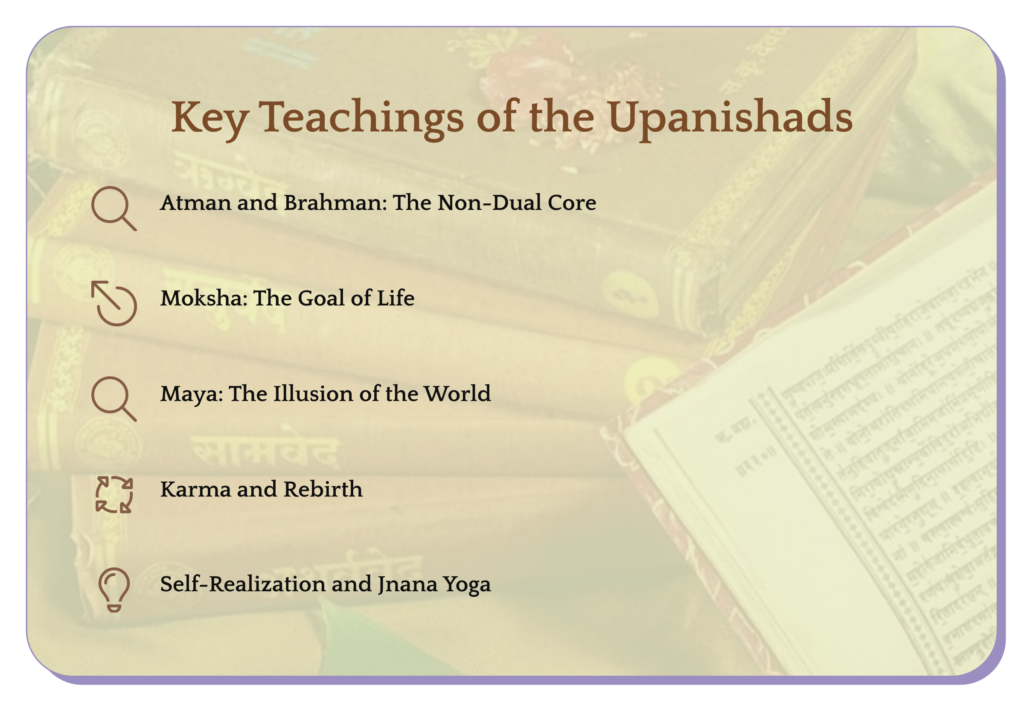
The central teaching of the Upanishads is the identity of Atman (the individual self) with Brahman (the universal soul or supreme consciousness). This concept of non-duality (Advaita) suggests that the essence of every being is not separate from the cosmos but one with it. The realization that “Tat Tvam Asi” (“Thou art That”) from the Chandogya Upanishad symbolizes this unity and the dissolution of the illusion of separateness.
Unlike earlier Vedic texts that emphasize ritual for divine favor, the Upanishads propose Moksha, or liberation, as the highest aim of human life. Moksha is achieved not by sacrifices but through self-knowledge (Atma-Jnana), understanding one’s true, eternal nature. Liberation ends the cycle of birth and death (Samsara) and unites the soul with Brahman.
Read More: Moksha in Jainism and Buddhism
The material world (Maya) is seen as a deceptive veil hiding the eternal truth. According to the Upanishads, the world is impermanent and ever-changing, and those who remain attached to it stay ignorant. Recognizing the illusory nature of worldly existence is crucial for spiritual awakening.
The Upanishads uphold the principle of Karma, which states that every action has consequences, shaping one’s current and future lives. The soul continues its journey through rebirth (Punarjanma) until it attains liberation. This belief reinforces ethical living and introspection.
The path to truth lies in self-inquiry, meditation, and conscious awareness, a practice known as Jnana Yoga (the path of knowledge). The Upanishadic method of “Neti Neti” (“Not this, not this”) from the Brihadaranyaka Upanishad teaches seekers to negate everything that is not the Self, ultimately arriving at the pure, undivided reality within.
The Principal Upanishads, also known as Mukhya Upanishads, are the core philosophical texts that laid the foundation for Vedanta and have shaped the spiritual and metaphysical outlook of Indian philosophy. These Upanishads present a unique perspective on the nature of the self, reality, and liberation. Below are five major Upanishads and their core teachings:
The Chandogya Upanishad, one of the oldest and largest Upanishads of the Sama Veda, explores meditation, cosmic order, and the essence of existence. Its core teaching is the Mahavakya “Tat Tvam Asi” (“Thou art That”), which highlights the unity of Atman (soul) and Brahman (universal consciousness). The Upanishad inspires seekers to realize oneness through contemplation, knowledge, and righteous living.
As the largest and most philosophical of all Upanishads, the Brihadaranyaka Upanishad, from the Shukla Yajur Veda, dives deep into metaphysical speculation. It explores profound ideas such as the nature of the Self, consciousness, death, and liberation (Moksha). One of its key concepts is the method of “Neti Neti” (“Not this, not this”), a process of eliminating everything that is not the true self to arrive at the eternal Atman. It highlights that the truth is beyond names, forms, and thoughts.
This poetic and philosophical dialogue between Nachiketa, a young seeker, and Yama, the god of death, explores the soul’s eternal nature. The Katha Upanishad addresses life’s core dilemma: preya (the pleasant) and shreya (the good). It teaches that understanding the imperishable self leads to overcoming fear and achieving immortality.
Associated with the Atharva Veda, the Mundaka Upanishad differentiates between Apara Vidya (lower, ritualistic knowledge) and Para Vidya (higher, spiritual knowledge). The text denounces blind ritualism and calls for direct realization of the self. It uses powerful metaphors, like the two birds on a tree, to illustrate the relationship between the individual and the supreme soul.
Despite being the shortest, the Mandukya Upanishad is immensely influential. It focuses on the analysis of Om (Aum) and the four states of consciousness:
Turiya, the transcendent state, is seen as the ultimate realization of Brahman beyond mind and matter.
These Upanishads offer a comprehensive vision of spiritual evolution, making them indispensable for anyone seeking the inner truth of existence.
Read More: Swami Vivekananda’s contribution to Vedanta
Although the Upanishads are primarily philosophical texts rather than how-to guides, they have profoundly influenced spiritual practices centered on self-realization, consciousness, and inner transformation. These practices emphasize direct experience over ritual and form the basis of many modern spiritual traditions.
One of the most enduring practices from the Upanishads is meditation, primarily through silent contemplation and the chanting of the sacred syllable “Om,” considered the sound of ultimate reality. The Mandukya Upanishad presents “Om” as a symbol encompassing all states of consciousness, culminating in Turiya, pure awareness.
The Upanishadic method of Neti-Neti (“Not this, not this”) invites practitioners to mentally negate everything that is not the true self, body, mind, thoughts, and emotions, to arrive at the pure Atman (soul).
Ethical conduct is another key takeaway. The Upanishads promote Vairagya, or detachment from material desires, and emphasize virtues such as truthfulness, simplicity, humility, and self-discipline. These values form the moral foundation for spiritual seekers and are integral to the lifestyle of monks and ascetics in various traditions.
The Upanishads are the cornerstone of Jnana Yoga, the path of knowledge. This path encourages constant inquiry into the nature of the self with questions like “Who am I?” or “What is the ultimate reality?” Seekers move toward self-realization and liberation through study, contemplation, and insight (Moksha).
These Upanishadic practices are deeply woven into yogic systems, monastic disciplines, and modern spiritual retreats. They emphasize inner awareness over external ritual and are as relevant today as they were thousands of years ago.
The Upanishads offer a beacon of timeless wisdom rooted in introspection, self-realization, and inner peace in a world increasingly overwhelmed by chaos, consumerism, and constant distraction. These ancient texts encourage seekers to look beyond external appearances and transient material pursuits, guiding them toward discovering the eternal truth within.
At the core of the Upanishadic philosophy is the profound teaching that Atman (the individual self) is not separate from Brahman (the ultimate, unchanging reality). This realization dissolves the illusion of separateness and unveils the unity that underlies all existence. The path to this awakening lies not in rituals or dogma, but in deep inquiry, ethical living, meditation, and the fearless pursuit of truth.
The Upanishads continue to resonate across generations because they address universal questions: Who am I? What is the nature of reality? What is the purpose of life? In doing so, they offer metaphysical insights and practical guidance for leading a life of meaning, balance, and clarity.
For students, thinkers, and spiritual seekers alike, the Upanishads remain an inexhaustible source of transformative knowledge, from ignorance to enlightenment, from division to unity.
Classification of the 108 Upanishads:
Mukhya (Principal) Upanishads – 10
Sannyasa Upanishads – 19
Yoga Upanishads – 17
Samanya (General) Upanishads – 25
Vaishnava Upanishads – 14
Shaiva Upanishads – 14
Shakta Upanishads – 9
The Upanishads are a collection of over 200 texts written between 800 and 500 BCE. Initially, the ideas in the Upanishads were passed down through the spoken word. These Sanskrit teachings break away from the Vedic religion before them, emphasizing ritual and ceremony.
The Upanishads have no author; they were composed by various ancient Indian sages. While some, like the Shvetashvatara Upanishad, name their seers, most are anonymous, with contributions from figures like Yajnavalkya, Aruni, Shvetaketu, and possibly Vyasa.
The Vedas focus on rituals and ceremonies (Karma-Kanda), while the Upanishads, part of the Vedas’ Jnana-Kanda, emphasize spiritual inquiry, exploring the soul, reality, and liberation. This marks a shift from external worship to internal philosophical understanding.
Atman is a Hindu term meaning ‘soul’ or ‘spirit.’ Depending on context, it can refer to the body, mind, or soul, but it primarily signifies the eternal soul that undergoes rebirth in the life cycle.
The Vedas are not credited to one author but to ancient rishis who received divine revelations. These sages composed various hymns, making the Vedas a collective compilation of spiritual knowledge passed down through generations over a long period.