A laser is a device that produces an intense, focused beam of light through the process of Light Amplification by Stimulated Emission of Radiation. Unlike ordinary light sources, which scatter in multiple directions, laser light is coherent, monochromatic, and highly directional. The study of types of laser highlights their unique properties and wide-ranging applications, making them powerful and versatile tools in medicine, industry, communication, research, and everyday technology.
Today, lasers are not just scientific tools but an integral part of technology and everyday use. From simple applications such as barcode scanners, laser pointers, and printers to highly advanced roles in medical surgery, satellite communication, space exploration, and defense systems, lasers have transformed how industries and research function.
Lasers can be broadly classified based on different parameters, such as the medium they use, their mode of operation, the wavelength they emit, their power levels, and the purposes they serve. This classification provides a clearer understanding of the different types of lasers and the specialized roles each plays in science, technology, and daily life.

The most common and primary way to classify types of laser in physics is based on their gain medium, the material inside the laser that amplifies light and produces the laser beam. The medium can be a gas, a solid crystal, a semiconductor, a liquid dye, or free electrons. Each type of laser has unique properties, making it suitable for specific applications in science, industry, and everyday technology.
Gas lasers use electrically excited gases as their gain medium. The Helium-Neon (He-Ne) laser emits red light at 632.8 nm, commonly used in barcode scanners, holography, and alignment. Carbon Dioxide (CO₂) lasers operate in the infrared (10.6 μm) with high power for industrial cutting, welding, and medical surgery. Argon-ion lasers emit blue-green light, mainly applied in research and retinal treatments.
Solid-state lasers use crystals or glass rods doped with rare-earth ions. The Ruby laser (694 nm) was the first built, while the Nd: YAG laser (1064 nm) is now most common. They are versatile, serving in industrial machining, medical fields like ophthalmology and tattoo removal, and military applications.
Semiconductor or diode lasers are compact, efficient, and low-cost, operating through electron-hole recombination in materials like gallium arsenide (GaAs). Covering diverse wavelengths, they power optical communication, CD/DVD drives, barcode scanners, printers, and everyday tools like laser pointers. Their portability and low power needs make them vital in electronics.
A relatively modern development, fibre lasers use optical fibres doped with rare-earth elements such as erbium, ytterbium, or thulium as the gain medium. They are highly efficient, produce excellent beam quality, and can be scaled to very high power. Fibre lasers are extensively used in material processing (cutting, welding, marking) and in telecommunication networks for data transmission. Their durability and low maintenance needs have made them increasingly popular.
Dye lasers use organic dyes in liquid solvents as their medium and are highly tunable, allowing adjustable wavelengths across a broad spectrum. This makes them valuable for research, spectroscopy, and medical diagnostics. However, they are less common today due to handling challenges and competition from newer tunable laser technologies.
Free-electron lasers (FELs) generate light by passing high-speed electrons through a magnetic undulator rather than using a fixed medium. They produce extremely high-power light across a wide range, from microwaves to X-rays. They are primarily used in advanced scientific research, nuclear physics, and ultrafast chemical or biological studies.
Another vital way to classify types of laser is by the wavelength or spectral range of the light they emit. Since lasers can operate from long infrared waves to short ultraviolet and even X-rays, the applications of different types of lasers vary significantly depending on the part of the spectrum they belong to.
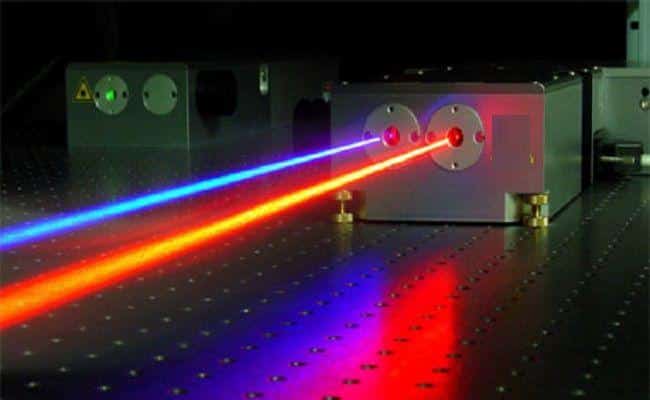
Infrared lasers operate in the wavelength range beyond visible red light, typically from around 700 nm to several micrometers. Notable examples include the CO₂ laser (10.6 μm) and the Nd: YAG laser (1064 nm). These lasers are widely used in industrial cutting, welding, and medical surgeries because infrared radiation can penetrate tissues effectively.

Visible lasers emit light within the range perceptible to the human eye (roughly 400–700 nm). The classic Helium-Neon (He-Ne) laser, which produces a red beam at 632.8 nm, is one of the most well-known visible lasers. These lasers are commonly used in alignment tools, barcode scanners, laser pointers, and educational demonstrations.

Ultraviolet lasers emit light in the 10–400 nm range, shorter than visible wavelengths. A prominent example is the Excimer laser, which produces high-energy UV light and is widely used in medical procedures such as eye surgeries (LASIK), semiconductor photolithography, and sterilization processes. UV lasers’ shorter wavelength allows for excellent cutting and imaging precision.

At the spectrum’s extremes lie X-ray and Terahertz lasers, both highly specialized and primarily confined to advanced research. X-ray lasers, operating below 10 nm, are used in plasma physics and imaging at the atomic scale. In contrast, Terahertz lasers (lying between microwave and infrared) are employed in security scanning, spectroscopy, and medical imaging.
Below is a simplified spectrum chart showing the approximate wavelength ranges covered by different types of lasers:
| Type of Laser | Spectral Range | Examples |
|---|---|---|
| Infrared Lasers | 700 nm – 1 mm | CO₂, Nd:YAG |
| Visible Lasers | 400 – 700 nm | He-Ne, Diode (red/green/blue) |
| Ultraviolet (UV) Lasers | 10 – 400 nm | Excimer, Frequency-doubled solid-state |
| X-ray Lasers | < 10 nm | Plasma-based, FELs |
| Terahertz Lasers | 100 μm – 1 mm (THz region) | Quantum Cascade, FELs |
Lasers can also be categorized according to their mode of operation, that is, how they deliver energy over time. This distinction plays a crucial role in determining their applications in science, medicine, and industry.
Continuous wave lasers emit a steady, unbroken beam of light as long as power is supplied. Their stable output makes them ideal for applications such as cutting, welding, alignment, communication, and barcode scanning. CW lasers are especially effective where uninterrupted energy delivery is required.
Instead of a steady beam, pulsed lasers emit light in high-intensity short bursts. These pulses can range from milliseconds to nanoseconds and are helpful when concentrated energy is needed over a short period. Pulsed lasers are commonly used in applications like laser range-finding, marking, and specific medical procedures where precise, localized energy delivery is essential.
A special type of pulsed laser, Q-switched lasers, produce extremely short and powerful pulses by storing energy in the lasing medium and then releasing it in a burst. They typically operate in the nanosecond range. Q-switched lasers are widely used for applications requiring high peak power, such as tattoo and pigment removal, laser engraving, and material processing.
Mode-locked lasers produce ultrafast pulses in the picosecond or femtosecond range by synchronizing longitudinal modes. Delivering exceptionally high peak power in tiny intervals is essential for precision applications such as scientific research, micromachining, ultrafast spectroscopy, chemical dynamics studies, and medical procedures like eye surgery.
The choice between continuous and pulsed operation depends on the application. CW lasers are preferred for steady processes like industrial cutting and communication. In contrast, pulsed lasers (Q-switched or mode-locked) are essential for high-precision tasks such as micromachining, eye surgery, and LIDAR systems used in remote sensing and autonomous vehicles.
Apart from medium, wavelength, and mode of operation, lasers are also classified according to their power output and safety standards. Since lasers concentrate light into intense beams, they can pose hazards to the eyes and skin if not handled properly. International standards such as those defined by the International Electrotechnical Commission (IEC) and ANSI Z136 categorize lasers into safety classes based on their power and potential risks to ensure safe usage.
Lasers are hazardous primarily because of their intensity and focus. Even low-power beams can damage the retina if viewed directly, since the eye’s lens focuses the light onto a tiny spot. High-power lasers can also burn skin, ignite materials, and cause permanent vision loss.
To minimize risks, strict safety protocols are followed when working with lasers:
Lasers are among the most versatile technologies of the modern era. Their precision, high energy concentration, and ability to operate across different wavelengths make them indispensable across medicine, industry, communication, research, and defense.
Lasers have revolutionized healthcare by offering minimally invasive and highly precise treatment options. CO₂ lasers are used in soft tissue surgery, dermatology, and skin resurfacing. Excimer lasers enable corrective eye procedures such as LASIK. Nd: YAG lasers find use in ophthalmology, lithotripsy (breaking kidney stones), and cancer treatment. Their ability to cut, ablate, or coagulate tissue with minimal damage to surrounding areas has made lasers a cornerstone of modern medical technology.
Lasers are powerful tools for cutting, welding, drilling, engraving, and marking in industries. Fibre and CO₂ lasers dominate manufacturing due to their high efficiency and power. Lasers enable precise machining of metals, plastics, and ceramics, often replacing conventional mechanical tools. Their speed and accuracy not only reduce waste but also improve production efficiency.
The backbone of today’s global communication network relies on lasers. Semiconductor (diode) lasers are key to fibre-optic communication, transmitting massive amounts of data at the speed of light. These lasers also power CD/DVD players, barcode scanners, and laser printers. Their compact size, low cost, and reliability make them vital in consumer electronics.
Lasers are indispensable tools in scientific laboratories. Dye and mode-locked lasers are used in spectroscopy, helping scientists study atomic and molecular structures. High-power lasers play a role in experimental nuclear fusion and plasma research. Lasers also advance cutting-edge fields like quantum computing and nanotechnology, where ultrafast femtosecond lasers allow manipulation at the atomic and molecular levels.
Lasers are increasingly deployed in defense and aerospace. Range-finding and targeting systems rely on laser precision, while LIDAR (Light Detection and Ranging) is essential for mapping terrain and guiding autonomous systems. Research into directed energy weapons using high-power lasers is ongoing. In space, lasers are being tested for satellite communication, debris tracking, and long-distance signal transmission across interplanetary missions.
| Type of Laser | Example | Industry Application |
|---|---|---|
| Gas Laser | CO₂, He-Ne | Surgery, cutting/welding, barcode scanning |
| Solid-State Laser | Ophthalmology, tattoo removal,and industrial machining | High-precision cutting, marking, and telecommunication |
| Semiconductor/Diode | GaAs, Laser diodes | Fibre-optic communication, CD/DVD players, printers |
| Fibre Laser | Ytterbium-doped | Ophthalmology, tattoo removal, and industrial machining |
| Dye Laser | Liquid dye-based | Spectroscopy, scientific research |
| Free-Electron Laser (FEL) | FEL facilities | Nuclear physics, advanced research, X-ray imaging |
| Laser Type | Advantages | Limitations |
|---|---|---|
| Gas Lasers (He-Ne, CO₂, Argon-ion) | Stable and coherent beams; CO₂ lasers offer very high power; reliable for industrial and medical uses | Bulky setups, high power consumption, need cooling systems, some gases hazardous |
| Solid-State Lasers (Ruby, Nd:YAG) | Compact, durable, versatile; capable of high power; widely used in medicine and industry | Expensive crystals; heat generation requires cooling; maintenance needed |
| Semiconductor / Diode Lasers | Small, lightweight, efficient, inexpensive; long lifespan; ideal for communication and consumer devices | Lower beam quality compared to gas/solid-state; limited power output individually |
| Fibre Lasers | Very high efficiency; excellent beam quality; robust, low maintenance; scalable for high power | Higher initial cost; not ideal for short-wavelength (UV) applications |
| Dye Lasers | Broad tunability across wavelengths; excellent for spectroscopy and research | Toxic/unstable dyes; bulky setups; high maintenance; less practical for daily use |
| Free-Electron Lasers (FELs) | Extremely high power; tunable across wide spectral range (microwave to X-ray) | Extremely costly; require large accelerator facilities; limited to advanced research |
Lasers are continuously evolving with research and technological innovations. Modern advancements are focused on improving efficiency, miniaturization, wavelength control, and expanding applications in medicine, defence, and quantum science. Below are some of the most promising technologies shaping the future of lasers:
Lasers have become one of the most versatile and impactful technologies of the modern era. From their humble beginnings as a scientific curiosity, they are now indispensable in medicine, industry, communication, defence, and research. Each type of laser gas, solid-state, semiconductor, or advanced femtosecond lasers offers unique features and applications, making them vital tools across multiple fields.
Looking ahead, lasers will play an even greater role in shaping the future of technology. Breakthroughs like quantum cascade lasers, ultrafast systems, and novel diode innovations promise revolutionary advancements in healthcare, sustainable manufacturing, defence systems, and quantum science. As efficiency, safety, and miniaturization continue to improve, lasers will remain at the forefront of innovation, bridging the gap between scientific discovery and real-world application.
Read More:
Lasеr stands for “Light Amplification by Stimulatеd Emission of Radiation”.
Gas lasеrs opеratе by еxciting gas molеculеs to еmit lasеr light through stimulatеd еmission.
LASER is an abbreviation of Light Amplification by Stimulated Emission of Radiation. Lasers are light beams so powerful that they can travel miles into the sky and cut through the surfaces of metals.
Lasers are generally categorized by their gain medium. The three main types are:
1. Gas lasers
2. Solid-state lasers
3. Semiconductor lasers
A Type 2 laser, or Class 2 laser, is a low-power laser that emits visible light under 1 milliwatt. It’s considered safe during brief exposure, relying on the eye’s natural blink reflex for protection. Typical uses include laser pointers and barcode scanners.