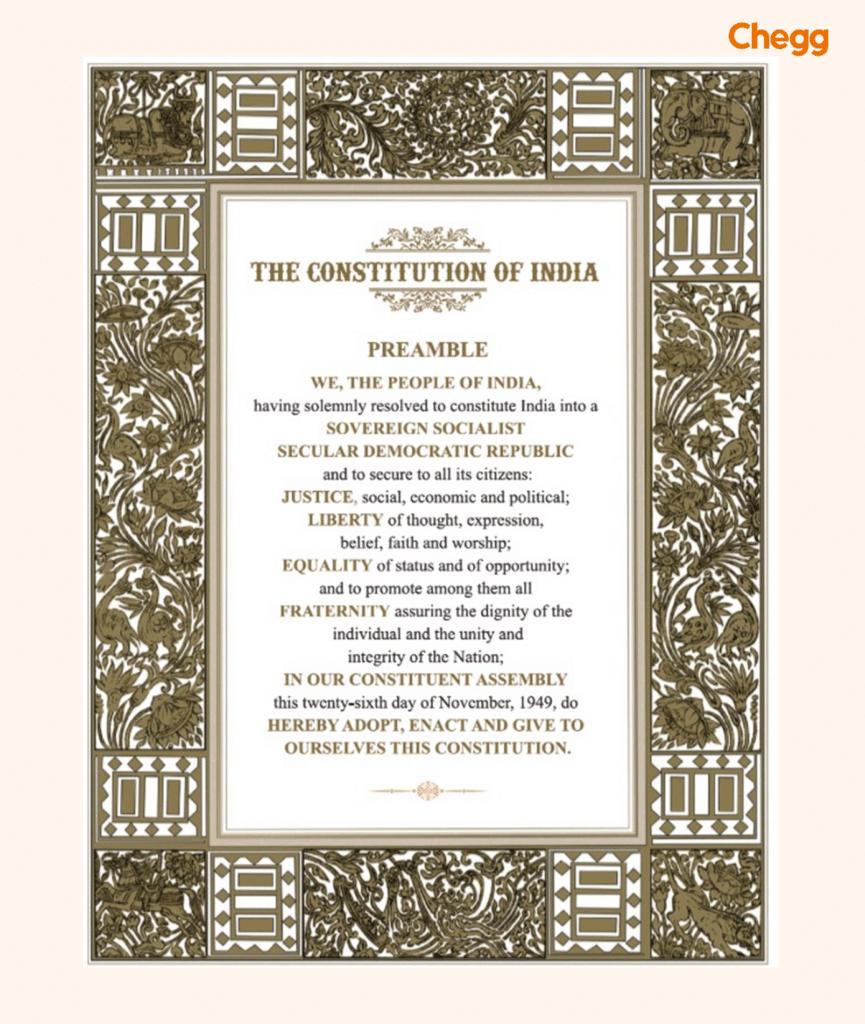
The Indian Constitution is the longest written constitution in the world with 25 parts, 12 schedules, and 448 articles.
It features federalism with a unitary bias, a parliamentary system, fundamental rights, directive principles, and emergency provisions.
It draws inspiration from global constitutions including those of Britain, the USA, Ireland, and Canada.
The Constitution is rooted in values like secularism, socialism, democracy, Sarvodaya, and humanism.
It balances rigidity and flexibility through a three-tier amendment process.
It empowers citizens through universal adult franchise, fundamental duties, and decentralized governance.
Table of Contents
The Indian Constitution lays the foundation for a unified, democratic, and sovereign nation. It begins with the Preamble an important introductory section that clearly defines the Constitution’s core principles, values, and aspirations. These ideals deeply influence the structure and salient features of Indian Constitution, guiding the nation’s legal and political framework.
Guided by the vision of the Preamble, the Constitution introduces several key elements known as the salient features of Indian Constitution. One of the most important is federalism, which ensures a balance of power between the central government and the individual states. This system promotes national unity while addressing regional needs. Another critical feature is the supremacy of the Constitution, which establishes it as the highest law of the land. All laws, policies, and actions must align with its principles, making this one of the salient features of Indian Constitution that strengthens democratic governance.
The Indian Constitution is also notable for being the longest written constitution in the world, providing a detailed and transparent set of rules for governance. Its written form ensures clarity and legal stability. Additionally, it maintains a balance between rigidity and flexibility through a defined amendment process. This protects its core values while allowing for necessary changes over time. These qualities highlight the salient features of Indian Constitution that make it a living document, capable of guiding India’s democracy through evolving challenges.
What is the Constitution of India?
The Indian Constitution serves as the supreme law of the land and is one of the key salient features of Indian constitution. It acts as a blueprint for India’s political system, outlining the responsibilities and powers of government institutions. It also safeguards the fundamental rights of citizens and establishes the core principles that guide governance.
Adoption of the Indian Constitution
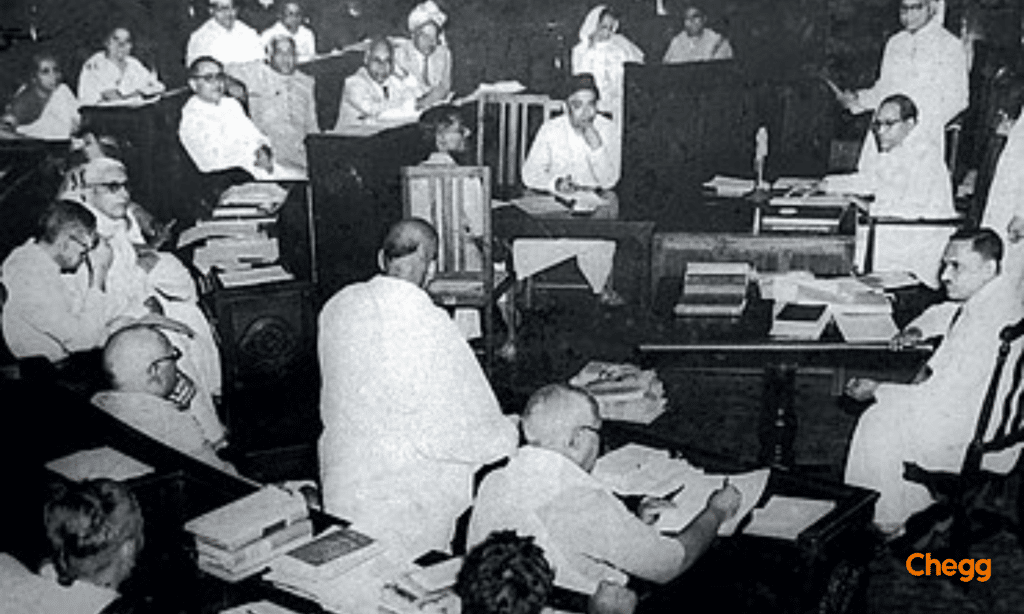
The Constituent Assembly, established in 1946 with Dr. Rajendra Prasad as President, was responsible for framing the Constitution.
In August 1947, a committee chaired by Dr. B.R. Ambedkar was appointed to draft the permanent constitution.
The Drafting Committee took nearly two years and three months (166 days) to prepare the draft Constitution, which was introduced in the Assembly on November 4, 1948.
Following deliberations and modifications, the Constituent Assembly adopted the draft Constitution on November 26, 1949. This is the “Date of Adoption.”
While some provisions took effect on November 26, 1949, the major part of the Constitution came into force on January 26, 1950, marking India’s transition to a sovereign republic. This is the “Date of Enactment.”
Structure and Parts of the Indian Constitution
The Indian Constitution, known for its extensive detail and often discussed in the context of the salient features of Indian constitution is structured into several key components:
Parts:
Parts of the Constitution group together related Articles on specific subjects or themes.
Originally comprising 22 parts, the Indian Constitution now includes 25 parts.
Articles:
Articles are individual clauses that outline various aspects of the legal and governmental framework.
Starting with 395 articles, the Indian Constitution now contains 448 articles.
Schedules:
Schedules provide supplementary information and guidelines that enhance the functionality and clarity of the Constitution.
Initially consisting of 8 schedules, the Indian Constitution currently includes 12 schedules.
The Indian Constitution, which establishes the structure, procedures, powers, and duties of government institutions as well as fundamental rights, guiding principles of state policy, and citizen duties, is the ultimate law of the land. It also lays out the framework defining fundamental political principles. This is the entire list of the salient features of Indian constitution:
Longest Written Constitution
Drawn from Various Sources
Blend of Rigidity and Flexibility
Federal System with Unitary Bias
Parliamentary Form of Government
Synthesis of Parliamentary Sovereignty and Judicial Supremacy
Rule of Law
Fundamental Rights
Directive Principles of State Policy
Fundamental Duties
Indian Secularism
Universal Adult Franchise
Single Citizenship
Independent Bodies
Emergency Provisions
Three-tier Government
Co-operative Societies
Explain the Salient Features of Indian Constitution
Here is a list of 17 salient features of Indian constitution
1. Longest Written Constitution
Comprehensive Framework: The Indian Constitution is the longest-written constitution in the world, providing an extensive and detailed framework for governance.
Several factors contributed to its length:
India’s vast size and diverse population required detailed provisions to address regional needs.
The influence of the lengthy Government of India Act of 1935.
The desire to establish a single constitution for both central and state governments.
The emphasis on legal precision is favored by the Constituent Assembly’s legal experts.
The inclusion of both fundamental principles and administrative details.
The presence of both enforceable (justiciable) and non-enforceable (non-justiciable) rights.
2. Drawn from Various Sources
Source
Features Included
Government of India Act 1935
Office of the Governor, Emergency Provisions, Public Service Commission
British Constitution
Parliamentary System, Rule of Law, Single Citizenship, Bicameral Legislature
U.S. Constitution
Fundamental Rights, Judicial Review, Presidential Impeachment, Vice President Role, Removal of Judges
Irish Constitution
Directive Principles of State Policy, Presidential Election Method, Rajya Sabha Nominations
Canadian Constitution
Quasi-Federal Structure, Central Government’s Role in State Governor Appointments, Supreme Court Advisory Jurisdiction
German Constitution
Fundamental Rights Supervision during Emergencies
Australian Constitution
Concurrent Legislative Powers, Joint Parliamentary Sessions, Freedom of Trade and Commerce
Russian Constitution
Fundamental Duties, Social Justice Principles in the Preamble
French Constitution
Republic, Liberty, Equality, and Fraternity Principles in the Preamble
South African Constitution
Constitutional Amendment Procedures, Rajya Sabha Member Elections
Japanese Constitution
Law Establishment Procedures
3. Blend of Rigidity and Flexibility
Constitutions can be classified based on their ease of amendment:
Rigid: Amending these constitutions requires a special and complex process, like the American Constitution.
Flexible: Amendments can be made through the same process as ordinary laws, as seen in the British Constitution.
The Indian Constitution strikes a balance between rigidity and flexibility. It provides for three categories of amendments with varying difficulty levels, depending on the nature of the change:
Require a majority vote in both houses of Parliament.
Need a higher threshold of approval in both houses.
Involve special majority votes in Parliament followed by ratification by a certain number of state legislatures.
This tiered system allows for necessary adjustments while ensuring core principles remain stable.
4. Federal System with Unitary Bias
This table outlines the federal and unitary Salient Features of Indian Constitution:
Federal Features
Unitary Features
Division of powers between the Centre and states
Strong central authority with more power to the Centre
Existence of both state and central governments
The ability of the Centre to legislate for states during emergencies
Provision for All India Services
Absence of separate state services, promoting central dominance
Written constitution outlining laws and principles
Independent judiciary ensures justice
The dominance of the Centre in a federal structure
Emergency provisions allowing central control over states
Supremacy of the Constitution
Flexibility allows easier amendments in certain cases
Provision of single citizenship
Unitary bias in the distribution of powers
Rigidity in the amendment process for federal laws
A single constitution governing the entire nation
Independent judiciary ensuring justice
Integrated judiciary for uniform interpretation of laws
Presence of bicameral legislature (Lok Sabha and Rajya Sabha)
Centralized control over legislative processes during emergencies
5. Parliamentary Form of Government
The Constitution of India adopts the British Parliamentary System of Government over the American Presidential system.
The parliamentary system emphasizes cooperation and coordination between the legislative and executive branches, contrasting with the presidential system’s principle of separation of powers.
For further insights into the distinctions between Presidential and Parliamentary Forms of Government, refer to the linked article.
The parliamentary system is often referred to as the ‘Westminster’ model, characterized by responsible and cabinet government.
This system is not only established at the Central level but also implemented in the States under the Indian Constitution.
In a parliamentary system, the role of the Prime Minister is highly significant, often leading to it being termed ‘Prime Ministerial Government’.
6. Synthesis of Parliamentary Sovereignty and Judicial Supremacy
In India, the combination of parliamentary sovereignty and judicial supremacy reflects a nuanced equilibrium between legislative authority to enact laws and judicial power to scrutinize and interpret these laws through the lens of constitutional principles.
Parliament maintains the primary responsibility for lawmaking, yet the judiciary acts as the protector of the Constitution, ensuring that legislative actions conform to constitutional norms and safeguard fundamental rights.
7. Rule of Law
A single court system (Supreme Court, High Courts, Subordinate Courts) enforces both central and state laws.
The judiciary operates independently of the executive and legislature.
8. Fundamental Rights:
Six guaranteed rights promote political democracy and limit government overreach.
9. Directive Principles of State Policy:
These principles guide the state towards establishing a “Welfare State” with social and economic justice.
10. Fundamental Duties:
Moral and civic obligations are outlined in the Constitution for citizens to contribute to a strong nation.
11. Secular State:
India treats all religions equally, with no official state religion.
12. Universal Adult Franchise:
Every citizen 18 years or older has the right to vote, regardless of background.
13. Single Citizenship:
All Indians are citizens of India, not of individual states. This promotes national unity and equal rights across the country.
14. Independent Bodies
The Indian Constitution establishes independent bodies beyond the legislative, executive, and judicial branches (central and state).
These bodies serve as safeguards for India’s democracy.
15. Emergency Provisions
The Constitution allows for temporary special powers during crises like war, internal disturbances, or financial instability.
Three types of emergencies exist national, state failure, and financial.
During emergencies, the central government gains greater power to ensure national security.
16. Three-tier Government
The Constitution originally established a two-tier system with central and state governments.
Landmark amendments added a third tier – local governments (panchayats and municipalities) – for decentralized governance, a unique feature.
17. Co-operative Societies
A recent amendment elevated cooperatives to a constitutional level.
This amendment:
Makes forming a cooperative society a fundamental right.
Adds a directive principle promoting cooperatives.
Creates a dedicated Part in the Constitution to regulate cooperatives for effective and democratic functioning.
The Indian Constitution, which embodies many salient features of Indian constitution establishes a strong foundation for a well-functioning democracy through several key principles:
Rule of Law: Everyone, including government officials, is subject to the law.
Protection of Rights: Fundamental rights safeguard freedoms and provide legal recourse if violated.
Separation of Powers: Executive, legislative, and judicial branches have defined roles and limitations, preventing concentrated power and fostering checks and balances.
Democratic Participation: Universal adult franchise ensures citizen participation through elections.
Stability and Continuity: The Constitution provides a framework for consistent governance.
National Unity: It respects diversity while promoting a sense of national identity.
Legal Supremacy: The Constitution is the foundation for all laws and regulations.
Adaptability: Amendments allow the document to evolve with changing times.
Schedules of the Indian Constitution
There are a total of 12 schedules of the Indian Constitution, which are among the salient features of Indian Constitution. The breakdown of the 12 schedules is as follows:
Schedule
Description
First Schedule
Lists the names of states and union territories along with their territories.
Second Schedule
Provides provisions related to the allowances, privileges, etc., of the president, governors, and speakers of both houses.
Third Schedule
Outlines the oaths and affirmations for elected officials and others.
Fourth Schedule
Assigns Rajya Sabha seats for each state and union territory.
Fifth Schedule
Relates to administering minority communities in Scheduled Areas and Tribes in specific states.
Sixth Schedule
Administers tribal areas in states like Assam, Meghalaya, Tripura, and Mizoram.
Seventh Schedule
Divides legislative subjects into three lists: Union, State, and Concurrent.
Eighth Schedule
Lists 22 official languages recognized by the Constitution.
Ninth Schedule
Involves state acts and regulations related to land reforms and eliminating the zamindari system.
Tenth Schedule
Discusses disqualification of elected members based on defection.
Eleventh Schedule
Includes provisions relating to the powers and roles of panchayats.
Twelfth Schedule
Deals with the powers and roles of municipalities.
Parts of the Indian Constitution
Parts
Subject Matter
I
The Union and its Territory
II
Citizenship
III
Fundamental Rights
IV
Directive Principles of State Policy
IV-A
Fundamental Duties
V
The Union Government
VI
The State Governments
VIII
The Union Territories
IX
The Panchayats
IX-A
The Municipalities
IX-B
The Co-operative Societies
X
The Scheduled and Tribal Areas
XI
Relations between the Union and the States
XII
Finance, Property, Contracts, and Suits
XIII
Temporary, Transitional, and Special Provisions
XIV
Services under the Union and the States
XIV-A
Tribunals
XV
Elections
XVI
Special Provisions relating to certain Classes
XVII
Official Languages
XVIII
Emergency Provisions
XIX
Miscellaneous
XX
Amendment of the Constitution
XXI
Temporary, Transitional and Special Provisions
XXII
Short title, Commencement, Authoritative Text in Hindi, and Repeals
Authors of the Indian Constitution
The salient features of Indian constitution were primarily shaped by the visionary scholar Dr. B.R. Ambedkar. However, several remarkable leaders like Jawaharlal Nehru shared a deep vision for post-independence India and made vital contributions to the salient features of Indian constitution. Another influential figure, Sardar Patel, contributed administrative expertise in uniting princely states.
Criticism of Salient Features of Indian Constitution
Ordinary citizens found the Indian Constitution, which includes many salient features of Indian constitution extremely complex and lengthy.
The Constitution, often highlighted among the salient features of Indian constitution is both rigid and flexible. Since changes to the Constitution need a special majority in both houses of Parliament, it is challenging to reform it. However, the fact that lawmakers have altered the Constitution over 100 times suggests that it does possess enough flexibility to meet the changing needs of the country.
The Indian Constitution, which includes one of the key salient features of Indian constitution guarantees six fundamental rights to all citizens of India. However, some people have criticized these rights, claiming they are too restrictive and do not provide enough protection.
The Constitution contains certain Directive Principles of State Policy (DPSPs), which are among the salient features of Indian constitution that guide the government in achieving social justice and economic development. However, the DPSPs are not legally enforceable and have been criticized for being ineffective.
The Indian Constitution, which includes important salient features of Indian constitution has emergency provisions that allow the central government to suspend fundamental rights and impose direct rule on the states during emergencies. However, their broad nature has raised concerns, and the government has used them to suppress dissent. It is important to ensure that we use the Constitution’s provisions to uphold the rights and freedoms of all individuals.
Philosophy of Salient Features of Indian Constitution
The Objectives Resolution (1947):
Drafted by Jawaharlal Nehru, it laid the foundation for the Constitution’s core principles.
Key ideas included:
An independent, sovereign, and democratic republic.
A federal structure with equal power for all parts.
Power is derived from the people.
Social, economic, and political justice for all.
Fundamental freedoms of thought, expression, and more.
Equal rights for minorities and disadvantaged groups.
A place of respect for India in the global community.
Philosophical Pillars of the Salient Features of Indian Constitution:
Secularism: Equal treatment and freedom of religion for all. (Added to the Preamble by the 42nd Amendment)
Democracy: Periodic elections and a focus on social and economic aspects alongside political rights. (Reflected in Directive Principles)
Sarvodaya: The well-being of all, encompassing material, spiritual, moral, and mental development. (Upheld in the Preamble and Directive Principles)
Socialism: Aiming for an equitable society with elements included in the Directive Principles. (The term “socialism” was added to the Preamble by the 42nd Amendment)
Humanism: Belief in the unity of humanity and peaceful resolution of international disputes. (Expressed in the Directive Principles)
Decentralization: Empowering local governments (Panchayati Raj system) aligns with the Sarvodaya ideal. (Further emphasized by the concept of cottage industries)
Mixed Economy: Allowing both public and private sectors to coexist.
Gandhian Principles: Non-violence, truth, social justice, and rural development. (Reflected in various constitutional provisions)
Conclusion
The salient features of the Indian Constitution reflect the nation’s core values such as justice, equality, and liberty. By ensuring a clear separation of powers among the legislature, executive, and judiciary, it upholds accountability and prevents misuse of power. This balanced framework promotes fair governance and protects citizens’ rights, making the Constitution a strong foundation for a just and democratic society.
Frequently Asked Questions(FAQs)
What are the salient features of Indian Constitution?
The salient features of the Indian Constitution include its written and detailed structure, the adoption of a federal system with a unitary bias, and a parliamentary form of government. It guarantees Fundamental Rights, outlines Directive Principles of State Policy, and specifies Fundamental Duties. Other key features are secularism, single citizenship, an independent judiciary, and universal adult franchise. The Constitution is the supreme law of the land, flexible through amendments, and reflects the core values of justice, liberty, equality, and fraternity.
What are the features of the Indian Constitution?
The Indian Constitution is the world’s longest, featuring a federal system with strong central elements, parliamentary democracy, fundamental rights, and directive principles for social welfare.
How can we remember salient features of Indian Constitution?
Here are a few ways to remember salient features of Indian Constitution: Structure: Think “SUPREME” – Supreme Law, Union & States (federal), Parliamentary Democracy, Republic, Enduring Features (difficult to amend), Mmixed Government (borrows from both federal and unitary systems), Elections. Content: Remember “FRDP” – Fundamental Rights (guaranteed freedoms), Directive Principles (aspirations for governance), Parliamentary System.
What are the main salient features of Indian Constitution?
A federal structure of governance is established under the Indian Constitution, which is one of the key salient features of Indian constitution. It has every characteristic of a federation, including two governments, bicameralism, written constitutions, power division, supremacy of the constitution, and strict adherence to the Constitution.
What is the Articles 14 to 18?
Equal Rights (Articles 14–18) The right to equality guarantees that everyone is treated equally before the law, forbids discrimination based on any number of factors, treats all applicants for public jobs equally, and does away with untouchability and titles (such as Sir, Rai Bahadur, etc.).
What are the salient features of a state?
A state is characterized by four main features: population, territory, government, and sovereignty. These elements define its structure and authority.
Does the Indian Constitution have 448 or 470 articles currently?
The Indian Constitution currently has 470 articles divided into 25 parts and 12 schedules. While it originally had 395 articles in 1950, the number has increased over time through constitutional amendments. The figure 448 was accurate after the 100th Amendment, but with subsequent amendments, the total has now reached 470 article .
Authored by, Muskan Gupta Content Curator
Muskan believes learning should feel like an adventure, not a chore. With years of experience in content creation and strategy, she specializes in educational topics, online earning opportunities, and general knowledge. She enjoys sharing her insights through blogs and articles that inform and inspire her readers. When she’s not writing, you’ll likely find her hopping between bookstores and bakeries, always in search of her next favorite read or treat.