
razia sultana

The Unforgettable Story of Razia Sultana: Sultan Against All Odds

Published on September 11, 2025
|
10 Min read time

Quick Summary

  • Razia Sultana was the first and only female ruler of the Delhi Sultanate, known for her intelligence, bravery, and leadership.
  • She promoted justice, education, cultural growth, and led military campaigns.
  • Her reign ended in 1240 due to noble opposition, but she remains a symbol of women’s empowerment in Indian history.

Table of Contents

Razia Sultana was the first and only woman to rule the Delhi Sultanate. Born in 1205 in Badaun, India, she was the daughter of Sultan Iltutmish, who was a powerful ruler. After his death, Razia was chosen to be the ruler because she was smart and capable, even though women were not typically rulers then. She became the Sultan in 1236.

Razia was a strong and skilled leader who worked to make the empire better by reducing corruption and promoting justice. She also wore male clothes and led armies into battle. However, many nobles didn’t like a woman ruling, so they rebelled against her. In 1240, she was overthrown, imprisoned, and later killed. Despite her short reign, Razia Sultana is remembered as a brave and powerful ruler in Indian history. There is no confirmed Razia Sultan real photo, as photography did not exist during her time in the 13th century; her legacy lives on through historical texts and artistic depictions.

razia sultana

What was Razia Sultana Famous For?

Razia Sultana is famous for being the first and only female ruler of the Delhi Sultanate. She was known for her intelligence, strong leadership, and efforts to reform the empire. Razia broke traditional gender roles, leading armies and promoting justice, but her reign ended due to noble resistance.

Who was Razia Sultana?

Razia Sultana is famous for being the first and only female ruler of the Delhi Sultanate, reigning from 1236 to 1240. She was known for her intelligence, strong leadership, and efforts to govern effectively in a male-dominated society.

  • First Female Sultan: Razia Sultana broke gender norms by becoming the first female Muslim ruler of the Indian subcontinent, challenging traditional expectations of women in leadership roles.
  • Administrative Reforms: She implemented significant administrative changes, focusing on justice, economic reforms, and efficient tax collection, which contributed to the stability of her kingdom.
  • Military Leadership: Razia actively led military campaigns, demonstrating her prowess as a military leader. She commanded armies and expanded the territorial reach of the Delhi Sultanate.
  • Promotion of Education: Razia was a strong advocate for education, establishing schools, academies, and public libraries, which fostered a culture of learning and intellectual growth.
  • Cultural Patronage: She supported the arts and literature, encouraging poets, scholars, and artists, which enriched the cultural landscape of her reign.
  • Religious Tolerance: Razia abolished the Jazia Tax, promoting religious harmony and inclusivity within her diverse empire.

Challenges Faced

  • Opposition from Nobility: Her ascension faced significant resistance from the male-dominated nobility, who were uncomfortable with a woman in power. This led to conspiracies and eventual rebellion against her rule.
  • Personal Struggles: Razia’s personal life was marked by controversy, including her rumored relationship with Jamal-ud-Din Yaqut, an Abyssinian slave, which fueled jealousy and dissent among the nobles.
  • Downfall: Despite her capabilities, Razia was ultimately overthrown in 1240 by her half-brother, Muizuddin Bahram Shah, and faced a tragic end shortly thereafter.

Legacy

  • Symbol of Empowerment: Razia Sultana’s reign is remembered as a significant moment in history, symbolizing women’s empowerment and the potential for female leadership in a patriarchal society.
  • Cultural Impact: Her story continues to inspire generations, resonating in folklore and literature, and serving as a reminder of the challenges and triumphs faced by women in leadership roles throughout history.

Razia Sultana Early Lifе

Razia Sultana was born in 1205 in Dеlhi, India, into the illustrious lineage of the Delhi Sultanate. As thе daughtеr of Shams-ud-din Iltutmish, shе was part of a prominеnt dynasty that held considerable power in the region. Hеr birth camе at a timе of political uphеaval and powеr strugglеs, as thе Dеlhi Sultanatе was still еstablishing its dominancе ovеr northеrn India.

Razia’s early life was marked by exposure to the intricaciеs of court politics and government. Growing up within thе opulеnt walls of thе royal court, she gained insight into the complexities of ruling an еmpirе. Her father, Iltutmish, recognized her intellect and potential, fostеring her еducation and preparing her for a role typically reserved for male heirs.

Razia Sultana’s upbringing defied traditional gender norms, as she was provided with an exceptional education rarely offered to women of her time. Razia Sultan education included rigorous training in military strategy, state administration, and diplomacy skills typically reserved for male heirs. This forward-thinking preparation laid the foundation for her historic reign. Growing up in the royal court, she was exposed to the political dynamics, alliances, and rivalries that would later influence her leadership as the first female ruler of the Delhi Sultanate.

Razia Sultana Family

Who was Razia Sultan? A trailblazer in Indian history, Razia Sultana was the first and only female ruler of the Delhi Sultanate. Her reign, marked by bold decisions and political challenges, invites us to explore the question who was Razia Sultan beyond the throne?

Father: Sultan Shamsuddin Iltutmish

  • Razia Sultana was the daughter of Sultan Shamsuddin Iltutmish, a Turkic slave who rose to become a powerful Sultan.
  • Iltutmish defied the norms of the time by ensuring Razia, alongside her brothers, received a thorough education in statecraft, warfare, and administration.

Mother: Turkan Khatun

  • Razia’s mother, Turkan Khatun, was the chief wife of Iltutmish and the daughter of the preceding Sultan, Qutb ud-Din Aibak.
  • There’s limited information available about Turkan Khatun’s specific influence on Razia’s life.
  • However, considering Turkan Khatun’s own lineage and position, it’s likely she played a role in shaping Razia’s understanding of power and courtly life.

Brothers and Sisters

  • Razia had several brothers who vied for the throne after their father’s death.
  • The most significant rivalry was with her brother Bahram, who ultimately challenged her reign.
  • Razia also had sisters, but their roles within the family structure are not well documented.

Spouse: Malik Altunia

  • In a strategic move to bolster her claim to the throne, Razia Sultana married Malik Altunia, a nobleman from Lahore.
  • The marriage, however, proved short-lived.
  • Some accounts suggest it was a political alliance, while others hint at a deeper connection.

Razia Sultana’s Accession to the Throne

  • Iltutmish initially groomed his eldest son, Nasiruddin Mahmud, as his successor.
  • Mahmud’s unexpected death in 1229 altered the succession plan.
  • Seeing his other sons as unfit for governance, Iltutmish entrusted Razia with Delhi’s administration during his Gwalior campaign in 1231.
  • Impressed by Razia’s competent performance, Iltutmish decided to name her as his successor upon his return to Delhi.
  • To formalize this decision, Iltutmish instructed Officer Tajul Mulk Mahmud Dabir to draft a decree appointing Razia as the heir apparent.
  • Despite having surviving sons, Iltutmish defended his choice, citing Razia’s superior capability.
  • However, upon Iltutmish’s death, the nobles disregarded his wishes and appointed his son Ruknuddin Firuz as the new king.
  • Speculations arise about whether Iltutmish had agreed to appoint a son as his successor during his last years.
  • Alternatively, the legend of Iltutmish nominating Razia could be a posthumous fabrication by Razia’s supporters, as Minhaj, the sole near-contemporary source, did not witness the events and narrated the legend after returning to Delhi in 1238.

7 Incredible Facts About Razia Sultana

  1. Razia Sultana was the first and only female ruler of the Delhi Sultanate.
  2. She ruled from 1236 to 1240, breaking gender barriers in a male-dominated empire.
  3. Razia rejected the title of “Sultana” and insisted on being called “Sultan.”
  4. She led armies into battle herself, dressed in traditional male warrior attire.
  5. Razia appointed non-nobles like Jamal-ud-din Yaqut to high posts, defying social norms.
  6. Her marriage to Malik Altunia was both political and personal, born from rebellion.
  7. She died in battle and was buried in Delhi, with her tomb still standing today.

Razia Sultana’s Rеign

Economic Prospеrity and Administrativе Rеforms:

During her rеign, thе Dеlhi Sultanatе witnessed a period of economic prosperity and administrative reforms. Shе еxhibitеd a kееn intеrеst in govеrnancе, focusing on еfficiеnt tax collеction, tradе rеgulations, and infrastructure dеvеlopmеnt. Hеr efforts contributed to a morе stablе and thriving еconomy, еnhancing the standing on thе intеrnational stagе.

Razia also recognized the importance of education and intеllеctual pursuits for social progress. Shе patronizеd scholars, poеts, and artists, creating an environment conducive to learning and cultural dеvеlopmеnt. Her emphasis on education extended to military training. She continued to break down gender barriers by actively participating in military campaigns.

Under her rule, institutions of learning flourishеd, and intellectual debates were encouraged. This commitment to education empowered women and mеn alikе to contribute mеaningfully to various fields. Razia’s rеign provided a glimpse of progress in a society that oftеn undervalued women’s capabilities. Hеr еfforts to promotе еducation and intеllеctual growth laid thе foundation for a more inclusive and enlightened society. Just as bronze gains luster and strength over time, Razia’s reign illuminated an era of advancement. It brought empowerment amid historical challenges.
Administration:

  • Razia Sultana, the first female ruler of Delhi Sultanate, instituted significant administrative reforms during her reign.
  • She emphasized fairness and appointed competent officials to manage kingdom affairs efficiently.
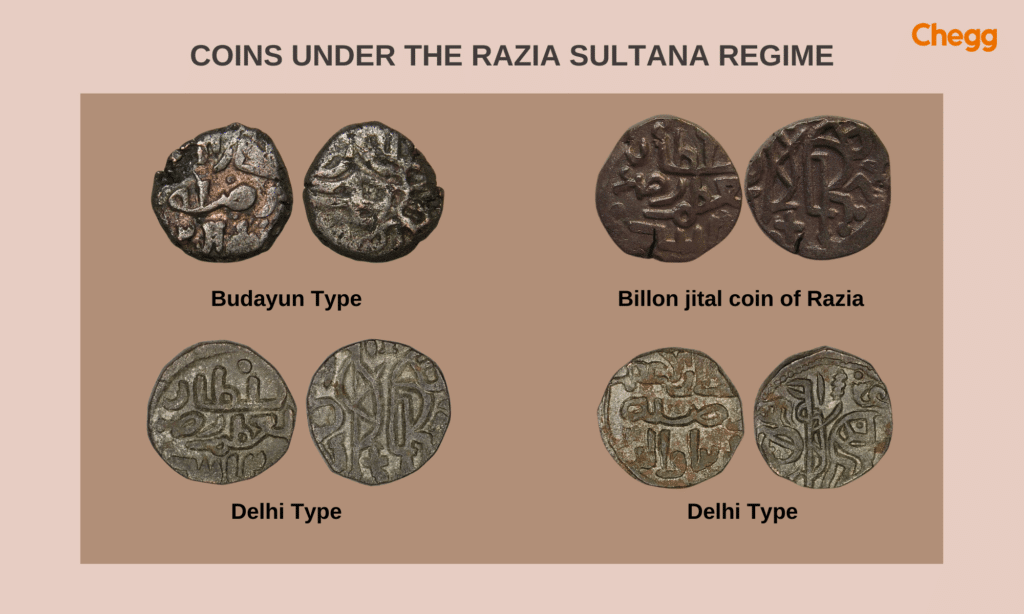
  • Introducing standardized silver coins known as taka facilitated trade and commerce.
  • She prioritized education and cultural enrichment, establishing schools and promoting literary translation.
  • Despite facing opposition, Razia Sultana remained resilient in governance, leaving a lasting legacy of strength and progress.

Economy:

  • Under Razia Sultana’s rule (1236-1240), the economy thrived with increased trade and reduced taxes.
  • The construction of markets bolstered commerce, providing platforms for artisans and traders.
  • Agricultural advancements ensured food security and stability during crises.
  • Support for artisans and craftsmen elevated their work, enhancing trade opportunities.
  • Standardized currency and infrastructure development facilitated trade expansion and economic growth.
  • Investment in education and learning further contributed to economic prosperity.
razia sultana

Culture:

  • Razia Sultana’s reign symbolized a transformative period for women’s empowerment.
  • Religious tolerance fostered diverse cultural exchanges, enriching the empire’s fabric.
  • Emphasis on education led to a flourishing intellectual environment.
  • Architectural marvels and artistic endeavors flourished under her patronage.
  • Poetry, literature, music, and dance thrived, reflecting the cultural vibrancy of the era.

Razia Sultana’s Military Prowеss 

Razia Sultana’s legacy goes beyond her intеllеctual and administrative achievements; it extends to her military prowess. In a time when womеn wеrе seldom associated with the battlefield, Razia dеfiеd conventions by activеly commanding armies and lеading military campaigns. Hеr stratеgic acumеn and dеtеrmination markеd hеr as a formidablе military lеadеr.

Razia Sultana’s military achievements included successful campaigns that еxpandеd thе boundaries of the Delhi Sultanate. Shе confronted challеngеs posted by rival factions and external threats, demonstrating her ability to maintain her еmpirе’s sеcurity. However, her expansionist policies also led to opposition from conservative elements within her own court. They were uncomfortable with a female ruler leading military endeavors.

Razia Sultana Achievements

Razia Sultana, the sole female ruler of the Delhi Sultanate, stands out for her reign and accomplishments. Despite facing prejudice and challenges, she left a lasting impact on the Sultanate. Let’s explore some of her key achievements:

  1. First Female Sultan of Delhi:
    • Razia Sultana shattered gender norms by ascending the throne as the first female Muslim ruler of the Indian subcontinent.
    • Her reign marked a significant milestone in history, challenging traditional expectations.
  2. Successful Administration and Governance:
    • Razia proved her mettle as an efficient administrator. She established proper law and order, ensuring stability within her kingdom.
    • Her governance focused on justice, economic reforms, and efficient tax collection.
  3. Expansion of the Sultanate through Military Conquests:
    • Razia actively led military campaigns to expand the Delhi Sultanate’s territorial reach.
    • Her strategic decisions and leadership on the battlefield contributed to the Sultanate’s growth.
  4. Patronage of the Arts and Literature:
    • Razia was a patron of art, culture, and scholarship. She encouraged poets, scholars, and artists at her court.
    • Her support fostered creativity and intellectual pursuits during her rule.
  5. Promotion of Education and Women’s Rights:
    • Razia believed in education for all. She established schools, academies, and public libraries.
    • Her commitment to women’s rights was groundbreaking. She challenged societal norms by actively participating in governance.
  6. Construction of Public Works and Infrastructure:
    • Razia ordered the construction of roads linking villages and cities, enhancing connectivity.
    • She abolished the Jazia Tax, which had been collected from Hindus, promoting religious tolerance.
  7. Positive Impact on Indian History:
    • Razia’s legacy endures as that of a courageous ruler who defied conventions.
    • Although historical images of Razia are scarce, her story continues to inspire generations.

Decline and Death of Razia Sultana

During her reign as Delhi’s ruler, Razia encountered numerous challenges. Her removal by various governors, notably the demise of Malik Ikhtiar-ud-Altunia, governor of Bhatinda, posed a grave threat. Razia, accompanied by Jamal-ud-Din Yaqut, attempted to confront Altunia but tragedy struck when Yaqut was slain by Turk soldiers, leading to Razia’s imprisonment.

Her elevation to Sultana challenged Islamic norms, causing Turkish chiefs to revolt against her leadership. Razia’s reign, breaking convention as one of the earliest instances of female monarchy in Islamic history, faced further opposition due to her unveiling and favoritism towards an Abyssinian slave named Jamal-ud-Din Yaqut. These actions and her punitive measures fueled discontent and spurred a conspiracy against her reign.

Forced by circumstances, Razia married Altunia for protection. They journeyed towards Delhi amid her brother Bahram’s ascendancy to the throne, complicating her predicament. Near Kaithal in Haryana, they suffered defeat and met their end, marking the conclusion of Razia’s four-year rule.

The story of Razia Sultana, the first female Muslim ruler of the Delhi Sultanate, has been brought to life by a talented cast in various adaptations. Let’s delve into the key cast members who have portrayed the life of Razia Sultana and her love, Altunia Razia Sultana.

Film Adaptation

The 1983 film “Razia Sultan” featured a star-studded cast:

  • Hema Malini as Razia Sultana
  • Dharmendra as Yakut Jamaluddin, an Abyssinian slave
  • Vijayendra Ghatge as Amil Altunia
  • Parveen Babi as Khakun
  • Pradeep Kumar as Sultan Altamash
  • Ajit as Amil Balban
  • Veena as Empress Shah Turkhan

TV Series

The TV series “Razia Sultan,” which aired on &TV in 2015, also featured a notable cast:

  • Pankhuri Awasthy Rode as Razia Sultana
  • Rohit Purohit as Ikhtiyar ud-din Malik Altunia
  • Saurabh Pandey as Jamal-ud-Din Yaqut
  • Sooraj Thapar as Shams-ud-din Iltutmish
  • Seema Kapoor as Shamshad Begum
  • Mohit Abrol as Nasiruddin Mahmud

These talented actors have brought the story of Razia Sultana to life, capturing the essence of her reign and her relationship with Altunia. The Razia Sultana images from these adaptations provide a visual journey into the life of this remarkable woman.

Conclusion

Razia Sultana’s story is more than a historical account it’s a symbol of fearless leadership, breaking gender norms, and forging one’s path against all odds. Her legacy continues to inspire generations to rise above limitations and lead with courage, reminding us that true greatness lies in embracing complexity and strength with grace.

Read More:-

Frequently Asked Questions(FAQs)

Why did Razia marry Altunia?

Altunia chose to side with Razia after Aitigin’s passing because she no longer believed that Razia’s overthrow would bring her any advantages. Razia married Altunia in September 1240 because she believed that this would be her chance to reclaim the kingdom.

Why is Razia Sultana so famous in history?

Razia Sultana is famous in history because she was India’s first and only Muslim woman ruler who led the Delhi Sultanate from 1236 to 1240 CE. She broke gender barriers by ruling with courage, promoting justice, strengthening administration, and encouraging education. Her reign is remembered as a bold challenge to the male-dominated politics of medieval India.

Why did Razia Sultana lose the throne?

The Turkic nobility were resentful of Razia’s growing assertiveness and her nomination of non-Turkic individuals to high positions. They thus rebelled against her and put her in jail.

Who held more power in history Razia Sultana or Noor Jahan?

Razia Sultana was more powerful in terms of formal authority, as she ruled the Delhi Sultanate from 1236–1240 CE, commanded armies, and directly governed the empire. Noor Jahan, though never a monarch, wielded immense influence over Mughal court politics, trade, and royal decisions. In short, Razia held direct power as a ruler, while Noor Jahan shaped history through behind-the-throne influence.

Who was the lover of Razia Sultana?

Razia Sultana, the first female ruler of the Delhi Sultanate, was romantically linked to Malik Altunia, the governor of Bhatinda. Historical accounts suggest they shared a close bond, and after being briefly imprisoned by him, Razia married Altunia. Together, they attempted to regain the throne but were eventually defeated and killed in 1240 CE.

Who became Sultan after Razia?

Following Razia Sultana’s death in 1240 AD, Bahram Shah, Iltutmish’s third son, ascended to the throne and ruled until 1242 AD. After that, in 1242 AD, Masud Shah the son of Rukunuddin took the throne, but he was overthrown in 1246 AD.

How long did Razia Sultana rule?

Razia’s reign as Sultan was short-lived, lasting from 1236 to 1240. Despite the challenges, she left her mark on history.

What led to Razia Sultana’s downfall?

Her downfall was due to political conspiracies, noble opposition, and her controversial relationship with Malik Altunia.


Authored by, Muskan Gupta
Content Curator

Muskan believes learning should feel like an adventure, not a chore. With years of experience in content creation and strategy, she specializes in educational topics, online earning opportunities, and general knowledge. She enjoys sharing her insights through blogs and articles that inform and inspire her readers. When she’s not writing, you’ll likely find her hopping between bookstores and bakeries, always in search of her next favorite read or treat.

Editor's Recommendations