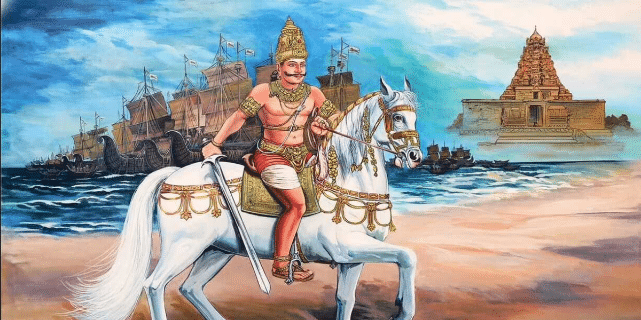
Rajendra Chola I emerged from one of the most royal legacies of South India, the Chola Empire. He acquired the title after his father, Raja Rajendra Chola. He carried his father’s legacy from 1014 to 1044 C.E., expanded the kingdom to the Northern Ganges. The son of the notable king of South India claimed the Andaman and Nicobar Islands, the Maldives, the Lakshadweep, and coastal Burma. He bravely defeated the Srivijaya Kings of Sumatra, Malaya, and Java during his reign. His list of conquests extends to the Pegu Islands and the Pala King, ruling Bengal and Bihar.
Rajendra Chola I expanded maritime trade routes, strengthening India’s sea links with Southeast Asia. His formidable naval power was crucial in defeating the Srivijaya Kingdom and securing Chola dominance across the Indian Ocean. A hallmark of the Chola dynasty under his rule was the promotion of local self-governance, setting a unique example in administrative excellence. Rajendra Chola’s achievements matched and elevated his father’s legacy, Rajaraja Chola. Together, they are remembered as two of the greatest rulers in South Indian history.

Rajendra Chola I, one of the most extraordinary emperors of the Chola dynasty, is a name that resonates with power and grandeur in the annals of South Asian history. This illustrious ruler, however, had a different name at birth, a fact unknown to many. Rajendra Chola’s real name was Madhurantaka Chola.
Born to the legendary Rajaraja Chola I and his queen, Vaanathi or Thiripuvana Madeviyar, Madhurantaka was destined for greatness. His father declared him the crown prince in 1012, though he started assisting him in his conquests in 1002. Upon ascending the throne in 1014, Madhurantaka adopted the regnal name Rajendra Chola I. His reign was marked by numerous military conquests, including the historic expedition to the Ganges, earning him the title ‘Gangaikonda Chola’.
Rajendra, I was born on the auspicious day of the Thiruvathira festival. It is a grandly celebrated festival of South Indians. His parents were Raja Rajendra I and Queen Vaanathi. They had him in the auspicious Tamil month called Margalzhi Thingal. His father pronounced him the Chola prince in 1012. However, the young prince gained combat and expansion experience early in life. In 1002, he joined his father on campaigns against Kalinga, Western Chalukyas, and Vengi. In 1014, Chola I administered the kingdom as the King. He proclaimed his eldest son, Rajadhiraja Chola I, as the co-regent.
His initial accomplishments won him the Rashtrakuta Country and the states of India, specifically Northwestern Karnataka, Pandharpur, and regions from Southern Maharashtra to Kolhapur. Sinhala King Kassapa threatened Ceylon, leading to a war between Rajendra I and the Sinhala King Mahinda’s son. The Cholas triumphed in the war and reigned in Ceylon until Kulothunga Chola III.
Later, he returned victorious against the Vijayaditya forces. He strategically overpowered the Western and Eastern Chalukyas. Thus, the kingdom expanded to the River Ganges and the Pala kingdom in Bengal. Here, he defeated Mahipala and gained treasure, elephants, and women.
The Chola King has accomplished various things along the way. Some of them remain to this day. You may recognize the prevalence of stone shrines and brick temples in the regions he ruled. Besides, he artificially manufactured a 33-mile-wide and 16-mile-long lake in Gangaikonda Cholapuram. It ranks as the largest present-day manmade lake in India.
Rajendra’s victory quickly escalated from expansion ventures to rapid conquests. He first displayed his valor against the Western Chalukyas and the Anuradhapura Rulers. He defeated the rebels in Chera, Sri Lanka, and the Pandiya vassal states.
Afterward, he conquered a significant portion of Sri Lanka. He moved on to acclaim Kalinga and Vengai Kingdoms, then renamed the Maldives as Munnir Palantivu Pannirayiram. These would go on to become his naval bases.

The Chola Dynasty administration followed the traditional local approach to self-government. Thirty wards, or Kudumbus, together formed a village. Each ward elects representatives for the village council.
Rajendra Chola I operated under the pre-established government systems, a hereditary monarchy. A council of ministers served the present king. The Chola Dynasty had three main divisions: Mandalum, Valanadus, and Nadus. An advanced revenue system called Puravuvarithinaikkalam decided the final revenue.
The Chola Kingdom marked its King’s achievements in temples and monuments. One such temple is in Thanjavur, known as the Brihadeeswara Temple. It is devoted to Lord Shiva and was built during his rule. He also expanded the Koneswaram and Pathirakali Amman Temple in Trincomalee.
Rajendra Chola I, the illustrious emperor of the Chola dynasty, is a name that echoes with grandeur in the annals of South Asian history. His reign marked a golden era for the Chola Empire, with significant art, architecture, and administrative advancements. But who succeeded this great ruler? Who is Rajendra Chola’s son?
Rajendra Chola I was succeeded by his eldest son, Rajadhiraja Chola I. Born to Chola King I and his queen, Tribhuvan Mahadevi, Rajadhiraja was destined for greatness from a young age. His father declared him the crown prince in 1018, though he started assisting him in his conquests from an early age.
Rajadhiraja Chola I ascended the throne in 1044 and ruled until 1054. His reign was marked by numerous military conquests and administrative reforms, continuing his father’s legacy. In addition to Rajadhiraja, Rajendra Chola I had two other sons, Rajendra II and Virarajendra. They also went on to rule the Chola Empire, contributing to its glory and expansion.
Rajendra II reigned over the Chola Dynasty from 1052 to 1064 C.E. He claimed the title of king after his brother’s defeat in the battle of Koppam. Under his reign, the empire enjoyed its most significant expansion. He overtook the regions from Bengal to Southeast Asia. The Chola Dynasty prospered in its trade across the Indian Ocean.
Son of Rajendra Chola I and Mukkokilan Adigal, Rajendra II conquered the entire Sri Lanka. He was at his peak in the Battle of Koppam. He goes down in history for maintaining the kingdom well. This implies that no property was lost under his leadership.
Rajendra Chola I and Rajendra Chola II were significant rulers of the Chola Dynasty, but their reigns differed in focus and achievements. Here’s a breakdown for a more precise comparison:
| Ruler | Reign Period | Focus of Reign | Key Achievements | Legacy |
|---|---|---|---|---|
| Rajendra Chola I | 1012-1044 AD | Known as a great conqueror, he expanded the Chola empire significantly through military campaigns in Southeast Asia and Bengal, earning the title “Gangaikonda Chola” (The Conqueror of Ganges). He’s also credited with building the magnificent capital city Gangaikonda Cholapuram. | 1. Military conquests in Southeast Asia (Srivijaya) and Bengal. 2. Construction of Gangaikonda Cholapuram, a UNESCO World Heritage Site. 3. Strengthened Chola naval power. | The empire builder and military conqueror. |
| Rajendra Chola II | 1052-1064 AD | Primarily focused on maintaining the vast empire inherited from his predecessors. He successfully defended Chola territories from rebellions in Sri Lanka and countered challenges from the Western Chalukyas. | 1. Suppressed rebellions in Sri Lanka. 2. Defended against the Western Chalukyas. 3. Maintained a strong and prosperous Chola empire. | The defender and administrator. |
In 1246, Rajendra Chola III succeeded Rajaraja Chola III as king of the Chola Dynasty. He revived the defeated Chola regions, and his epigraphs found on the borders of Cuddappah are evidence of his reign in the north. The Pandya War marked the end of the centuries-long rule of the Cholas. The Pandyan Empire overtook the Chola territories in Tamil Nadu.
The Hoysalas succeeded in dividing the powers in Tamil Nadu. Their strategy targeted the two most prominent kingdoms, the Cholas and Pandyas. They provoked one kingdom against the other, which prevented either kingdom from expanding its domain. Jatvarman Sundara Pandya I vanquished the Chola Dynasty. He expelled the Hoysalas’ interference and annihilated their king.
The Cholas imprisoned and enslaved Pandyans across three centuries. As the Chola Dynasty met its fate, the Pandyans made the remaining Cholas their chieftains. Some of the officials preserved their rule until the British Invasion. A further mention in the 16th century states Pandya’s defeat against the Cholas. Veerasekhara, a Chola Chief, has led the mission.
Rajendra Chola I, also known as Gangaikonda Chola (The Conqueror of Ganges), was pivotal in shaping the Chola Dynasty’s legacy. Here’s a breakdown of his significant contributions:
Rajendra Cholan’s contributions secured the Chola Dynasty’s place as a mighty empire. His military conquests, emphasis on naval power, patronage of the arts, and focus on economic development significantly shaped the Chola legacy.
While Chola King I is often remembered for his vast conquests, Rajendra Chola II, who inherited a sprawling empire, made significant contributions to the Chola Dynasty. Here’s a look at his key achievements:
In essence, Rajendra Chola II’s contributions focused on consolidating and preserving the vast Chola empire he inherited. His successful defense against rebellions and external threats and his focus on administration and naval power ensured the Chola Dynasty remained dominant for another decade.
While large-scale conquests like those of his predecessor didn’t mark his reign, his contributions were crucial in maintaining the empire’s power and ensuring a smooth transition to future rulers.
Rajendra Chola III ruled during a challenging period for the Chola Dynasty. The empire’s grip on power weakened due to internal conflicts and external pressures. However, his contributions deserve recognition:
It’s important to acknowledge that Rajendra Chola III’s reign ultimately coincided with the decline of the Chola Dynasty. However, his efforts to revive Chola’s power, resist the Pandyas, and possibly maintain some administrative structure demonstrate his attempts to preserve the empire’s legacy during a difficult period.
His family wasn’t just a collection of names, but a network of power that shaped the Chola dynasty’s destiny. This visual representation allows for a deeper appreciation of the forces that propelled him towards becoming one of India’s most celebrated emperors.
Rajendra Cholan I, one of the most celebrated rulers of the Chola dynasty, took his empire to unprecedented heights. Known for his strategic brilliance, naval dominance, and administrative reforms, his reign marked the golden era of South Indian history. Rajendra Chola’s achievements, from military conquests to cultural expansion, reflect his vision of a powerful and prosperous empire. Below are some of his most remarkable accomplishments that solidify his legacy as a legendary king.
Rajendra Chola I’s legacy encompasses territorial expansion, military victories, architectural marvels, and cultural contributions. His reign remains a golden era in Chola history!
King Rajendra I’s reign (1014-1044 CE) marked the pinnacle of Chola power and influence:
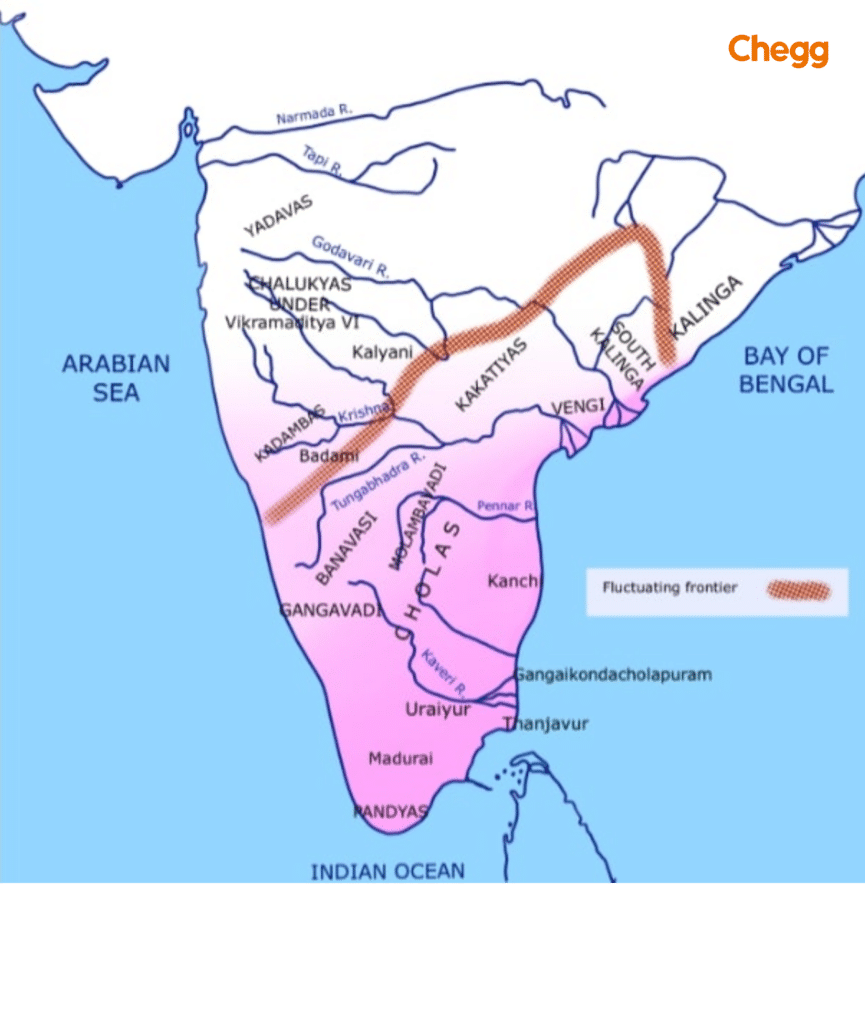
The Chola Empire reached its expansion potential. It covered the northern regions of Sri Lanka right up to the north of the Godavari-Krishna River basin and stretched to the Konkan Coast, Malabar Coast, Lakshadweep, and the Maldives. Rajendra Chola I claimed Odisha, the Srivijaya Kingdom, parts of Sri Lanka, the Ganges-Hooghly-Damodar Basin, the Maldives, and more.
The Cholas defeated the Pallavas in South India, setting in motion the empire’s uphill development in the ninth century. They successfully ruled most of South India and directed expansion strategies towards the Malay Peninsula and Sri Lanka.
Internationally speaking, the Chola Dynasty extended to China, the Maldives, Thailand, Malaysia, and Indonesia in Southeast Asia. They heavily relied on trade and maritime activities. From India, the Cholas engaged in the exchange of spices, illicit substances, jewels, textiles, and much more. They imported Arabian horses to build their army.
In all, the Chola Dynasty focused on the Indian peninsula. They administered it as a single unit over three centuries. The southernmost extent stretched to the Maldives. The Godavari banks were the northernmost point of this powerful dynasty.
Emperor Rajendra Chola I, a mighty ruler of the Chola dynasty, wasn’t just a conqueror. He was also a prolific builder who left behind a lasting legacy in the form of magnificent temples. These architectural marvels stand as testaments to his devotion, power, and the artistic brilliance of the Chola era.
Let’s explore the remarkable Rajendra Chola, a visionary ruler of the Chola dynasty during the 11th century, who built temple endeavors. His architectural legacy continues to captivate historians and visitors alike:
Rajendra Chola I’s temple-building legacy at Gangaikonda Cholapuram is a beacon of artistic achievement and spiritual devotion. The echoes of his reign resonate through the stone carvings and sacred halls of this timeless masterpiece!
Raja Rajendra Chola is considered one of the greatest rulers of Tamil Nadu. His proud parents are Queen Vanavan Mahadevi and King Parantaka II. He ruled from 985 to 1014 C.E. During his reign, he conquered parts of the Pandya Country, Northern Sri Lanka, and the Chera. He also undertook the claims of Lakshadweep, the Maldives, and the Thiladhunmadulu Atoll.
He trained the young to become one of the finest rulers of the Chola Empire. His invasions, expansion strategies, and inexhaustible valor define his mindful composure. In his international expansions, South India developed under his leadership.
He enforced protection around Vengi. One of his first initiatives was to strengthen the army and navy bases. He acquired the current-day Karnataka state. His ambitions expanded to the Chera Country and Sri Lanka. His primary constructions are the Brihadeshwara Temple and Cholapuram Temple.
Kundavai Vanathi’s amiability and wittiness caught the king’s eye. She was an emotionally strong woman and supported her husband relentlessly. Much of her timid thoughtfulness could be seen in her son.
On the other hand, Raja Rajendra Chola’s wife, Kundavai, played a direct role in the Cholas’ success. Even in those times, she was a straightforward feminist. Vanathi outperformed herself in strategies and duties. She single-handedly managed the kingdom while the kings were out on the field. Hers was the brain behind Raja Rajendra Chola’s unique tactics. She contributed to the Chola Dynasty beyond being the wife and mother of two of the greatest Chola Kings.
In the annals of South Asian history, the name Rajendra Chola, also known as Raja Rajendra Chola, resonates with power and grandeur. As the illustrious emperor of the Chola dynasty, King Rajendra Chola’s reign marked a golden era for the empire, with significant advancements in art, architecture, and administration. But every reign has its end, and so did the reign of Rajendra Cholan.
Rajendra Cholan I, the first of his names, was succeeded by his son Rajadhiraja Chola I, who ruled from 1044 to 1054. Rajendra Chola’s reign was largely successful, with numerous military conquests and administrative reforms. However, Rajendra Chola III, the last king of the Chola dynasty, faced defeat.
The Chola dynasty ended in 1279, when King Maravarman Kulasekara Pandyan I defeated the last Chola king, Rajendra Chola III, and established Pandya rule. This marked the end of one of the longest-ruling dynasties in the world.
While Rajendra Chola I had a prosperous reign, Rajendra Chola III faced defeat, marking the end of the Chola dynasty.
Rajendra Chola I, the illustrious son of the legendary Rajaraja Chola I, ascended the throne in 1014 C.E. as the ruler of the mighty Chola Empire. Building on his father’s legacy, he expanded the empire’s dominance beyond southern India, stretching its reach to the banks of the Ganges in the north and establishing a formidable presence overseas.
Rajaraja Chola I was Rajendra Chola I’s father. He was another great Chola emperor who laid the foundation for Rajendra Chola’s future conquests.
Both Rajendra Chola and his father, Rajaraja Chola I, are contenders. Rajendra Chola’s conquests might have been more extensive, especially with his dominant navy.
Rajendra Chola I was not defeated during his reign. However, the Chola dynasty eventually fell under Rajendra Chola III, who was defeated by Maravarman Kulasekara Pandyan I in 1279 CE, marking the end of the dynasty.
Rajadhiraja Chola I, the son of Rajendra Chola I, died on the battlefield while riding an elephant during a war against the Western Chalukyas. He was killed in the Battle of Koppam (1054 CE).
Out of the many temples Rajendra Chola I built, three stand out. The temples of Gangaikonda Cholapuram, Airavatesvara, and Brihadiswara are the most prominent ones.
Rajendra Chola is famous for:
Expanding the Chola Empire to Bengal and Southeast Asia
Defeating the Srivijaya Empire via naval conquests
Building the capital city, Gangaikonda Cholapuram
Promoting local self-governance and temple architecture
Being one of the first Indian rulers to establish international naval dominance