The Powers and Functions of Prime Minister of India make the office the most influential and central institution in the country’s governance. While the President is the constitutional head, the Prime Minister is regarded as the absolute executive authority in India.
As the leader of the Council of Ministers, the Prime Minister plays a crucial role in shaping policies, implementing laws, and ensuring the smooth functioning of the government. This position coordinates the work of various ministries and guides the nation’s domestic and foreign policies.
Being the head of the government, the Prime Minister represents India at national and international levels, acts as a bridge between the President and the Cabinet, and ensures collective responsibility in decision-making. Thus, the Prime Minister’s powers extend across legislative, executive, administrative, and diplomatic spheres, making the office indispensable in India’s parliamentary democracy.
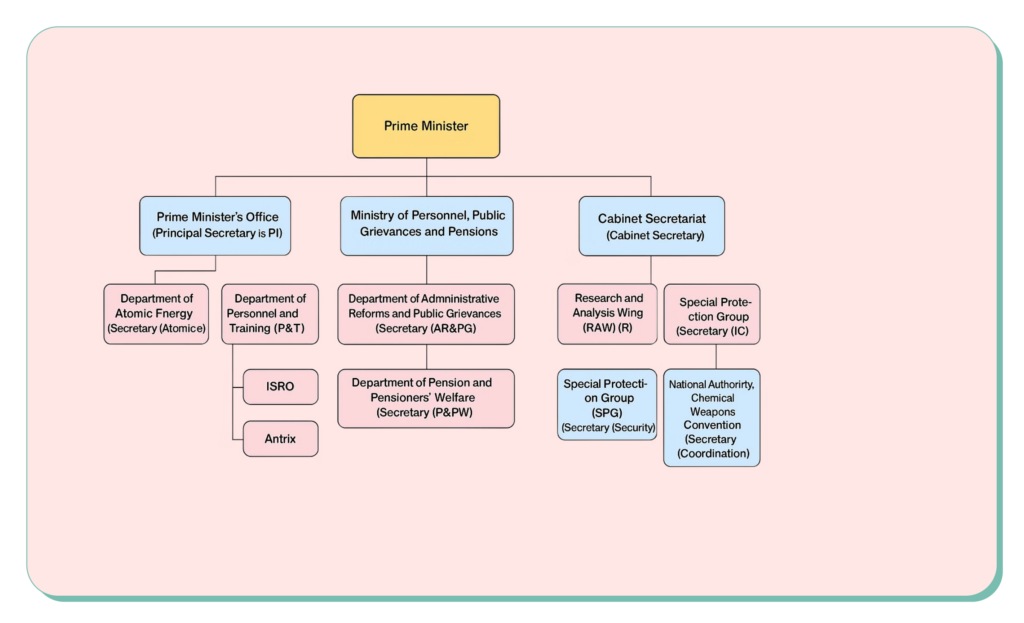
India is a parliamentary democracy, where the President is the constitutional head but the Prime Minister has absolute executive authority. As the leader of the Council of Ministers, the Prime Minister plays a central role in the country’s governance. This office is crucial for policy-making, administration, and coordinating various ministries to ensure the effective functioning of the government.
The Prime Minister guides the formulation and implementation of domestic and foreign policies, represents India at international forums, and acts as a vital link between the President and the Cabinet. In Parliament, the Prime Minister answers questions on government policies, steers debates, and upholds the Cabinet’s collective responsibility.
Beyond administration, the Prime Minister provides leadership during national crises, shapes long-term development strategies, and ensures political stability. The powers and functions associated with this office extend across executive, legislative, and diplomatic spheres, making the Prime Minister indispensable in India’s democratic system.
In essence, the Prime Minister is the chief decision-maker and the symbol of governance, leadership, and accountability to the people.
The Prime Minister of India is the head of the Government of India and plays a pivotal role in the executive’s functioning. The constitutional basis for the Prime Minister’s Office (PMO) is primarily laid down in Articles 74 to 78 of the Indian Constitution, which define the appointment, powers, responsibilities, and workings of the Prime Minister and the Council of Ministers.
The President of India appoints the Prime Minister. While the President has the authority to appoint, the choice is conventionally based on the person’s ability to command a majority in the Lok Sabha. Other ministers are appointed on the recommendation of the Prime Minister. Article 75 also stipulates that the Council of Ministers holds office during the pleasure of the President, effectively ensuring that they remain accountable to the Parliament.
The Prime Minister’s term is not fixed and depends on retaining the confidence of the Lok Sabha. To be eligible, a person must be a citizen of India and a member of either House of Parliament. If not a member at the appointment, the individual must secure membership within six months.
Since India’s independence in 1947, the office of the Prime Minister has evolved significantly. Jawaharlal Nehru, the first Prime Minister, established the precedent for a strong parliamentary leadership. Over the decades, the role has adapted to changing political dynamics, balancing administrative responsibilities, party leadership, and policy formulation.
Understanding these constitutional provisions clarifies the powers and functions of the Prime Minister of India, reflecting both legal authority and political significance in India’s parliamentary system.
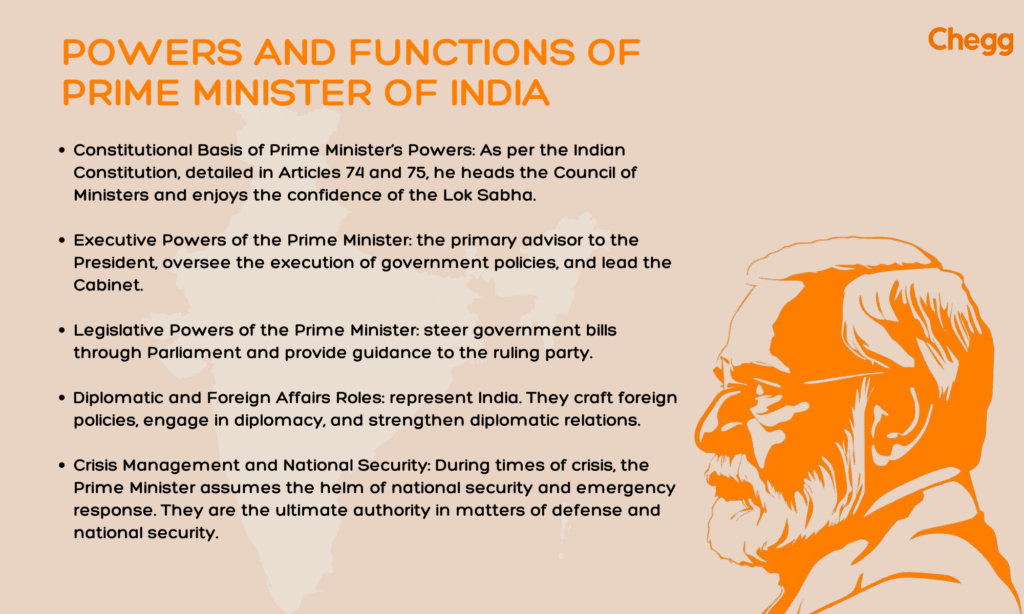
The Prime Minister of India is the central figure in the country’s political system, serving as the leader of the executive, coordinator of government policy, and principal advisor to the President. The PM’s powers are broadly classified into executive, legislative, financial, diplomatic, military, and emergency functions, reflecting constitutional authority and political influence.
The Prime Minister holds significant executive powers as head of the Council of Ministers, allocating portfolios and ensuring efficient administration across ministries. The PM supervises ministries, coordinates inter-ministerial work, and guides policy implementation. They influence key appointments, lead Cabinet meetings, set agendas, and resolve disputes. While the President is the nominal executive, the Prime Minister directs government operations, ensures administrative cohesion, and plays a pivotal role in India’s policymaking, governance, and political leadership.
In the legislative domain, the Prime Minister leads the majority in the Lok Sabha and shapes lawmaking. The PM advises the President on summoning, proroguing, and dissolving Parliament when necessary. They influence the legislative agenda, introduce bills, set priorities, and coordinate policy discussions. As head of the ruling party or coalition, the PM ensures key legislation passes and maintains parliamentary discipline. The Prime Minister communicates government policies through debates, speeches, and statements, strengthening the executive-legislative link in India’s democracy.
The Prime Minister exercises key financial powers, guiding budget preparation and presentation, which shape taxation, expenditure, and fiscal policy. Working with the Finance Minister and ministries, the PM ensures balanced growth and social development. Through institutions like NITI Aayog, they oversee national economic planning in line with government priorities. The PM also directs resource allocation, approves major projects, and steers financial reforms, underscoring their central role in economic governance, fiscal stability, and driving India’s long-term economic progress.
The Prime Minister is India’s chief representative globally in foreign policy and diplomacy. They negotiate treaties, attend summits, and engage with world leaders to safeguard India’s strategic and economic interests. The PM advises the President on international agreements and directs India’s role in the UN, BRICS, and G20. By setting foreign policy priorities, fostering collaborations, and managing diplomatic ties, the Prime Minister ensures India’s voice is heard worldwide while balancing national interests with global responsibilities.
The Prime Minister plays a crucial role in defense and national security. They guide defense policy, oversee armed forces deployment, and coordinate with the Defense Minister and National Security Council. In times of war or crisis, the PM approves military operations, authorizes the use of force, and makes strategic decisions with the Cabinet. They also oversee intelligence, counter-terrorism, and internal security measures. This blend of administrative and strategic authority ensures national sovereignty, reflecting the Prime Minister’s central role in safeguarding India’s security.
The Prime Minister holds significant powers during constitutional emergencies under Articles 352–360. In a National Emergency, they advise the President to suspend fundamental rights, deploy armed forces, and centralize authority to restore order. For instance, during the 1975 Emergency, Indira Gandhi used these powers to manage unrest and enforce strict measures. While essential in crises, such powers highlight the PM’s vast authority, which must be exercised responsibly to safeguard democracy and national stability.
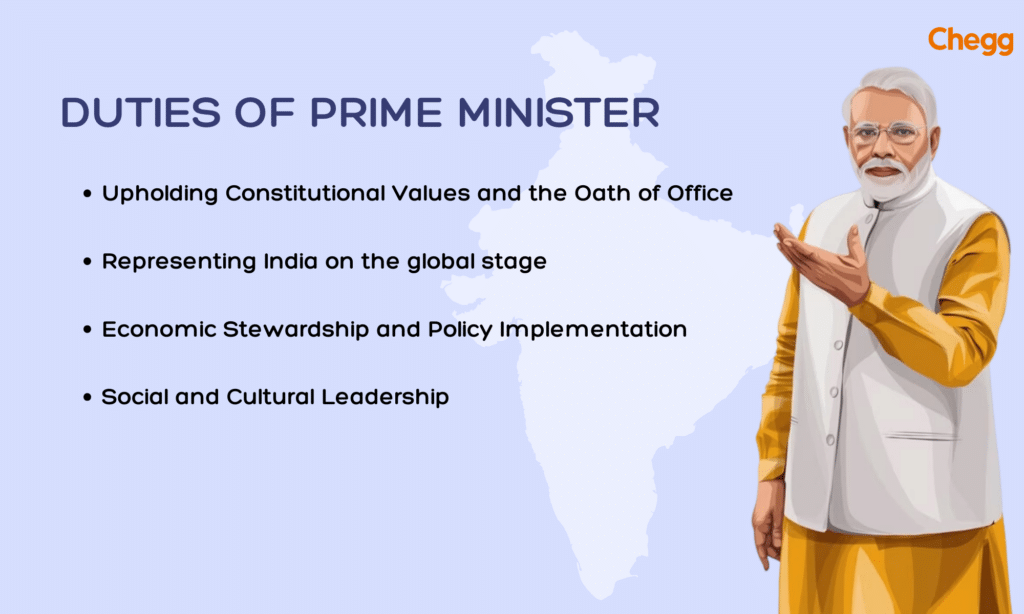
The Prime Minister of India is the head of government, providing leadership, coordinating executive and legislative functions, and symbolizing national unity in India’s democratic system.
The Prime Minister of India provides strong policy leadership, guiding national development, economic reforms, and social programs. By setting legislative priorities and directing the Cabinet, the PM ensures that government policies reflect the ruling party’s vision and the nation’s broader interests. This leadership role helps formulate long-term strategies and implement reforms crucial for India’s progress.
The Prime Minister serves as a vital link between the President and Parliament. While the President is the constitutional head of state, the PM communicates decisions of the Council of Ministers to the President and advises on summoning, proroguing, or dissolving Parliament. This coordination ensures the smooth functioning of the executive and legislative branches and maintains accountability within the democratic framework.
Beyond administrative functions, the Prime Minister acts as a symbol of national unity. The PM embodies government stability and leadership during political, social, or economic challenges. Their role reassures citizens and represents India both domestically and internationally. By balancing political leadership with constitutional responsibilities, the PM reinforces democratic values while fostering national cohesion.
The Prime Minister and the President are two key constitutional authorities in India, but their roles, powers, and responsibilities differ significantly. While the President is the ceremonial head of state, the Prime Minister wields absolute executive authority. The following table highlights the key differences:
| Aspect | Prime Minister | President |
|---|---|---|
| Role | Head of Government, exercises executive powers | Head of State, largely ceremonial |
| Appointment | Appointed by the President, must have majority support in Lok Sabha | Elected by an electoral college (Parliament + State Legislatures) |
| Executive Powers | Controls Council of Ministers, policy decisions, administration | Acts on advice of PM and Cabinet; nominal executive |
| Legislative Role | Leader in Lok Sabha, influences bills and policies | Summons Parliament, gives assent to bills; cannot introduce bills |
| Financial Powers | Guides budget, economic planning, fiscal decisions | Approves budget on advice of Cabinet; cannot independently formulate policies |
| Diplomatic & Defense Powers | Represents India internationally, oversees defense & national security | Ceremonial in diplomacy, Commander-in-Chief in name only |
| Tenure | As long as majority in Lok Sabha is maintained | Fixed 5-year term, independent of parliamentary confidence |
Who is More Powerful?
The Prime Minister is more powerful due to control over government machinery, legislative influence, and policy-making authority. The President’s powers are exercised mainly on the advice of the Prime Minister and Council of Ministers, making the PM the country’s de facto leader.
While the Prime Minister of India holds significant authority, their powers are not absolute and are subject to various constitutional and democratic checks.
The Prime Minister operates within a collective Cabinet system, meaning decisions are taken collectively with the Council of Ministers. Major policies and administrative actions require Cabinet approval, and ministers can question or dissent within the Cabinet. This ensures the PM cannot act unilaterally, promoting consensus and shared responsibility.
The judiciary acts as a crucial check on the Prime Minister’s powers. Any executive action violating the Constitution can be challenged in courts, and the Supreme Court has the authority to strike down unconstitutional decisions. Similarly, Parliamentary oversight through question hours, debates, and motions of no confidence keeps the PM accountable to elected representatives.
A robust opposition in Parliament and a free press also limit the arbitrary use of power. The Prime Minister must maintain public confidence, manage political criticism, and justify policy decisions transparently. Democratic accountability ensures that abuse of executive authority can lead to political consequences, including resignation or electoral defeat.
While the Prime Minister is the chief executive, their authority is balanced by collective decision-making, constitutional safeguards, and democratic accountability, ensuring that power is exercised responsibly within India’s parliamentary system.
The powers of the Prime Minister of India have been demonstrated in various ways by leaders who shaped the nation’s political, economic, and international trajectory.
As India’s first Prime Minister, Jawaharlal Nehru used his executive and diplomatic powers to establish India’s foreign policy framework. He championed the policy of non-alignment, fostering relationships with countries worldwide while maintaining independence from major power blocs during the Cold War. Nehru’s role in shaping international alliances and representing India at global forums highlighted the Prime Minister’s influence in diplomacy.
During the 1975 Emergency, Prime Minister Indira Gandhi exercised extraordinary powers under constitutional provisions. She advised the President to declare a National Emergency, suspending certain fundamental rights and centralizing executive authority. This period exemplified how emergency powers could dramatically expand the PM’s control over governance, legislation, and public administration, highlighting the need for checks and balances.
Prime Minister Manmohan Singh, an economist, utilized his executive powers to guide India’s economic policy. His government implemented key reforms in fiscal policy, banking, and international trade. Singh’s leadership in coordinating with the Finance Ministry and shaping national economic planning demonstrates how the PM influences financial governance and long-term economic strategy.
Under Narendra Modi, the Prime Minister has actively used his powers to drive governance reforms and shape foreign policy. Initiatives like Digital India, Make in India, and international outreach through bilateral summits reflect the PM’s role in policy formulation, administration, and global representation. Modi’s tenure illustrates how contemporary Prime Ministers leverage their authority to influence domestic governance and India’s international standing.
These examples collectively show that the powers and functions of the Prime Minister of India extend across diplomacy, economic management, legislative leadership, and crisis governance, shaping the nation’s course over time.
The Prime Minister of India is the linchpin of the country’s governance, bridging the executive, legislature, and the President. Through the powers and functions of Prime Minister, the office directs policy, shapes national and international priorities, and ensures the smooth functioning of government machinery. From foreign diplomacy to economic planning, defense, and emergency management, the Prime Minister’s role embodies authority and responsibility, making it central to India’s political and administrative framework.
However, India’s democratic framework balances these powers. Cabinet responsibility, parliamentary oversight, judicial review, and political accountability ensure that executive authority is exercised within constitutional limits. This balance prevents the concentration of power and upholds the principles of democracy, the rule of law, and accountability.
The Prime Minister will continue to play a central role in India’s political, economic, and social development, adapting to evolving challenges while maintaining citizens’ trust. The office remains vital for stability, governance, and the projection of India’s vision domestically and globally.
Read More:-
In most political systems, the Prime Minister is the cabinet’s presiding member and chairman. However, in semi-presidential systems, the Prime Minister is primarily appointed to oversee the civil service and implement the head of state’s directives.
The Prime Minister of India serves as the government’s chief executive, holding the authority to assign ministries to other ministers. As the head of the Council of Ministers, the Prime Minister is a vital connection between the President and the Cabinet.
Indira Gandhi was an Indian political figure who held office as the third Prime Minister of India from 1966 to 1977 and resumed her tenure from 1980 until her tragic assassination in 1984.
According to the provisions, the President can remove the Prime Minister, Governors can remove Chief Ministers, and Lieutenant Governors can remove Union Territory Chief Ministers. If no resignation or advice is given within 31 days, the office becomes vacant on the 32nd day.
On 9 June 2024, Shri Narendra Modi took oath as India’s Prime Minister for a historic third term after securing a resounding mandate in the 2024 Parliamentary elections. This reaffirms his leadership and the people’s strong trust in his governance.