
The creamy layer in OBC refers to individuals within the Other Backward Classes who have higher income or social status and are, therefore, not eligible for reservation benefits. The Supreme Court introduced this concept in the landmark Indra Sawhney case of 1992.
In April 1993, the government passed the National Commission for Backward Classes (NCBC) Act. “Section 2 of the NCBC Act defines “backward classes” as any group of people designated by the Central Government in lists, excluding Scheduled Castes and Tribes. Additionally, they divided them into OBC and non-creamy layers. The idea of the Creamy Layer inside the Other Backward Classes (OBCs) lends richness to the discrimination narrative in India’s variegated quilt.
OBC creamy layer means the OBC folks have socioeconomic advantages comparable to those of the general population. The goal is to ensure that economically and socially disadvantaged individuals receive the benefits of reserve laws.
The Government of India uses the term Other Backward Classes (OBC) to classify castes that are educationally or socially backward. OBCs are distinct from the Scheduled Castes (SC) and the Scheduled Tribes (ST). The Mandal Commission report of 1980 found that OBCs comprise 52% of the country’s population. However, the National Sample Survey Organization estimated their representation at 41% in 2006.
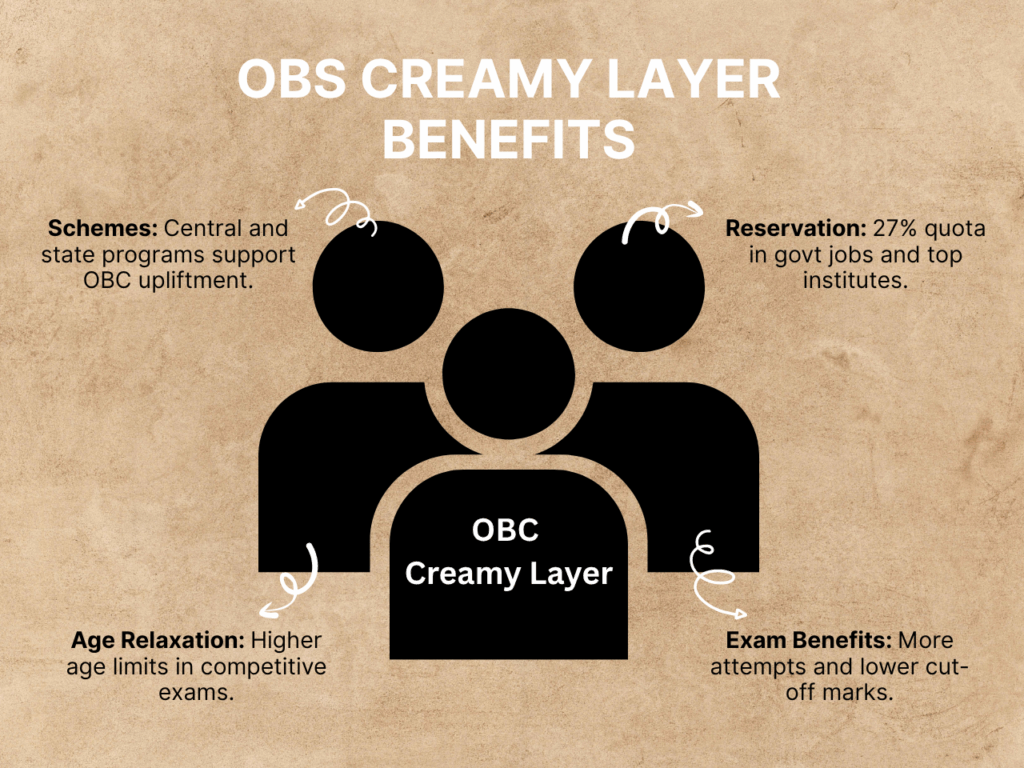
In 1979, the Indian government formed the Mandal Commission, led by B.P. Mandal, to identify socially and educationally backward classes. Its 1980 report introduced the term “Other Backward Classes” (OBCs) and recommended 27% reservations in government jobs and education, raising total reservations for disadvantaged groups to 49%.
In the context of equal opportunity in India, where diversity permeates society, the term “OBC Creamy Layer” holds crucial significance. It frames society in a certain way. Let’s dissect this idea understandably and directly: What is the Other Backward Classes (OBCs) creamy layer?
OBC Creamy Layer refers to the economically and socially advanced members of the Other Backward Classes. Families earning more than ₹8 lakh annually or holding high-level government or professional positions fall under this category. They are ineligible for the reservation benefits meant for OBC non-creamy layer individuals.
The OBC group now includes a category called the “Creamy Layer.” However, don’t be misled by the name; this group within the OBCs is unrelated to dairy! You are considered in the Creamy Layer based on the following criteria:
Income is one of the main factors determining one’s status as a Creamy Layer. People earning more than a certain amount annually are classified in the Creamy Layer. If your parents’ yearly income is more than 8 lakhs in India, you fall under the Creamy Layer. They periodically adjust the income limit level for the OBC creamy layer to reflect economic inflation.
They also consider the qualifying educational background. Individuals in the Other Backward Classes (OBC) category with advanced degrees or professional credentials are sometimes classified as belonging to the Creamy Layer.
A few professions with higher socioeconomic standing may influence the Creamy Layer categorization. People in high-paying occupations like physicians, engineers, and other professionals fit this description.
The OBC Creamy Layer refers to individuals from the Other Backward Classes considered socially and economically advanced. As a result, they are not eligible for reservation benefits in education, government jobs, or other schemes. Instead, they compete under the General Category. This classification ensures that the benefits of affirmative action reach the truly disadvantaged within the OBC community, those in the Non-Creamy Layer.
By excluding the Creamy Layer, the system promotes fairness and prevents more privileged OBC individuals from dominating opportunities meant for the underprivileged. It helps maintain the true spirit of social justice and balanced representation.
Recommended Read: OBC Creamy Layer Rules for Students 2025
Fairness is the rationale for drawing this line. It ensures that the affluent OBC members don’t take advantage of possibilities intended for others struggling on the social and economic fronts. The system attempts to level the playing field and correct past injustices by directing these advantages toward those who need them.
For example, consider two pupils who come from OBC households. One has a household income of over 8 lakhs and belongs to the Creamy Layer, while the other is in the Non-Creamy Layer. The latter can get opportunities for others, requiring them more, by using reservation benefits. Meanwhile, applicants in the general category face equal competition from the former.
The Other Backward Classes (OBC) Creamy Layer and Non-Creamy Layer illustrate India’s varied geography of complex affirmative action policies. There is a massive difference between the perks that these classes get. Let’s understand the non-creamy and creamy layers and their significance in an approachable manner.
OBC Non Creamy Layer means individuals belonging to the Other Backward Classes (OBC) are eligible for reservation benefits because their family income is below the government-defined limit, currently ₹8 lakhs per annum. They do not fall under the “creamy layer,” which includes higher-income or socially advanced OBCs.
India’s reservation system aims to uplift socially and economically disadvantaged groups like OBCs. The OBC category is divided into Creamy and Non-Creamy Layers to ensure fair distribution. Only the Non-Creamy Layer, representing the less privileged, is eligible for reservation benefits in education and jobs, promoting equal opportunities.
To maintain fairness in India’s reservation system, the OBC category is divided into Creamy and Non-Creamy Layers. This ensures that economically privileged individuals don’t receive the same benefits as those in need. By excluding the Creamy Layer, affirmative action remains focused on uplifting the genuinely disadvantaged, preserving balance, and promoting social justice through targeted support and opportunity.
Read More:
| Category | Creamy Layer | Non-Creamy Layer |
| Reservation Benefits | The Creamy Layer has to apply for jobs similar to the general population. | The creamy layer means that members of the Other Backward Classes are not eligible for the reservation benefit. |
| Acronym | OBC-CL | OBC-NCL |
| Income Limit | The OBC creamy layer income limit is 8 lakhs and more | Below 8 lakhs |
| Family Income Threshold | The Creamy Layer has to apply for jobs similar to the general population. | In the event of competitive exams, they are classified as a General category and are not eligible for any exemption offered to OBCs. |
| Treatment In Competitive Exams | There is no facility on the government housing schemes for OBC-CL | They use every perk, including age, and attempt relaxation during competitive examinations. |
| Reservation Certificate Requirement | If the individual is not asserting any reservation, then no such certificate has to be provided. | Each individual requesting a reservation as an OBC must present a certificate from an authority specified in the DOPT Office Memorandum attesting to their “OBC status and non-creamy layer status.” |
| Educational Loans | Individuals from OBC backgrounds can pursue education more easily as CL and NCL are eligible for educational loan relaxations. | Individuals from OBC backgrounds can pursue education more easily as CL and NCL are eligible for educational loan relaxations. |
| Government Job Applications | Non-Creamy Layer people may be able to reduce or avoid paying professional certification costs, which will help them advance their careers and improve their skill sets. | As a result of affirmative action rules, people in the Non-Creamy Layer get age and attempt relaxation, reserved positions, and other benefits when applying for government jobs. |
| Professional Certification Fees | There is no relaxation on the fee spectrum for this class. | This class is qualified for financial assistance programs and scholarships offered by OBC, which provide extra funding for education. |
| Scholarships | They are usually disqualified from some financial help and scholarships targeted towards OBCs. | May be able to access programs, such as training and financial aid, that encourage OBC businesses. |
| Government Housing Schemes | Those whose family’s annual income exceeds 8 lakhs fall under this category. However, this creamy layer income limit should not include salaries or revenue from agricultural land. | This class may be entitled to priority placement or reserved housing in government housing programs. |
| Healthcare Benefit | No healthcare advantages are offered to CL | NCL may be eligible for specific healthcare benefits and medical schemes catering to OBC communities. |
| Entrepreneurship Support | This class has to initiate a business just like the general populace. | Those whose annual income of the family exceeds 8 lakhs fall under this category. However, this creamy layer income limit should not include salaries or revenue from agricultural land. |
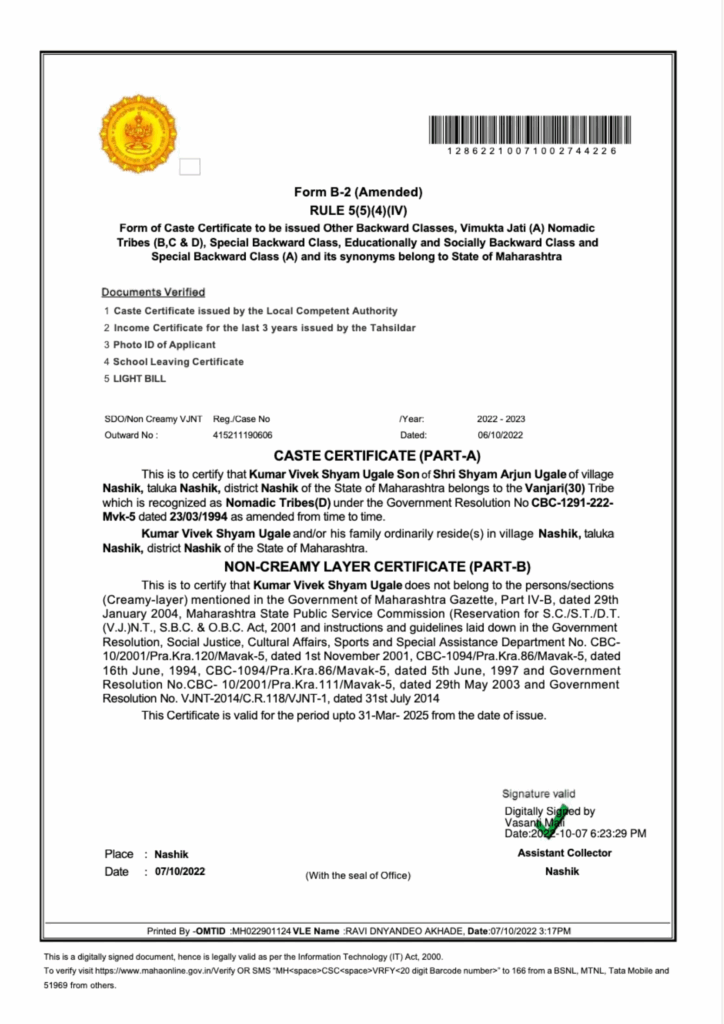
A non-creamy layer (NCL) certificate is issued to individuals belonging to Other Backward Classes (OBC) in India but with a family income below a specific limit (typically below Rs. 8 lakh annually). This OBC NCL certificate helps them avail reservation benefits in government jobs, educational institutions, and specific scholarship programs to uplift socially and educationally disadvantaged communities.
Only individuals from the non-creamy layer can apply for this certificate.
The applicant has to buy Rs. 20 stamp paper, an affidavit from the notary public advocate, and the required documents should be attached. The applicant’s parent or guardian should sign all these documents and submit them to the VAO. The VAO, RI, and the Tahsildar must sign all these documents.
The following documents, along with the application form, are required:
The authority issuing the OBC Non-Creamy Layer Certificate varies depending on your location in India. In most cases, it’s the Tahsildar of the relevant state government. However, the issuing authority can differ by state, so checking with your local government for the specific process is advisable.
The current ₹8 lakh annual income limit for determining the OBC Creamy Layer has remained unchanged since 2017. In 2025, a Parliamentary Committee recommended revising this outdated threshold and excluding salaries from Public Sector Undertakings (PSUs) while calculating income. This aims to prevent unfair exclusion of deserving OBC applicants due to technical salary structures.
In a landmark judgment in August 2024, the Supreme Court ruled that the Creamy Layer concept should also apply to SC/ST communities. This means economically and socially advanced members of SC/ST groups should not get reservations. The judgment has sparked national discussions and policy planning for clear exclusion guidelines.
The AICC (Congress) is organizing a national-level OBC convention on July 25, 2025, pushing for a nationwide caste-based census. This data is expected to strengthen demands for expanding reservations beyond the 50% cap and refining OBC classifications based on updated socio-economic realities.
In July 2025, the state reformed its medical admission rules to simplify the process for OBC candidates. The new system allows online verification of income certificates and prioritizes local candidates—making access to education more transparent and efficient.
Concerns about the lack of transparency in the “triple test” used to determine OBC reservation eligibility in urban bodies have been raised. The state government’s reduction of OBC reservations from 27% to 14% has sparked political protests.
Understanding the OBC Creamy Layer classification is crucial for ensuring that reservations and benefits reach the truly deserving sections of society. The distinction between the OBC Creamy Layer and Non-Creamy Layer helps maintain social equity while addressing economic disparities within the OBC category.
Knowing the eligibility criteria, application process, and required documents for an OBC Non-Creamy Layer certificate ensures individuals can claim their rightful benefits. As government policies evolve, staying informed about these classifications is essential for those seeking educational, employment, and social welfare advantages.
Based on parental income, individuals are categorized into OBC Creamy Layer and Non-Creamy Layers. Those with incomes above 8 lakhs fall under the Creamy Layer, while those below 8 lakhs are classified as Non-Creamy Layer.
You are considered OBC non creamy if your family’s annual income is below ₹8 lakh (excluding salary and agricultural income) and you do not hold high-ranking government or professional positions. If your income or status exceeds these criteria, you fall under the OBC creamy layer and are not eligible for reservation benefits.
Introduced in 1993 by former Prime Minister V.P. Singh, the Non-Creamy Layer Certificate, also known as the Other Backward Class Certificate, provides certificate holders with job opportunities in the Central Government and Public Sectors.
Individuals from the Other Backward Classes (OBC) fall under the non-creamy layer if their family’s annual income is below ₹8 lakh, excluding income from salary and agriculture. They must also not hold high-ranking government or public sector positions to remain eligible for reservation benefits.
The full form of OBC is Other Backward Classes. This term refers to the category of people in India who are socially and educationally disadvantaged. OBCs are eligible for certain reservations and benefits to aid their development, which can help improve their status and promote their welfare.
The creamy layer in OBC refers to the relatively wealthier and more socially advanced members of the other backward classes. Individuals with an annual family income above ₹8 lakh or holding high-ranking positions are classified under the creamy layer and are not eligible for OBC reservation benefits.
The OBC non-creamy layer income limit is ₹8 lakh per annum. This excludes income from salary and agriculture. Families earning below this limit qualify for reservation benefits under the non-creamy layer category. The limit is subject to change based on government updates.
The OBC creamy layer criteria determine which individuals from the Other Backward Classes (OBC) are excluded from reservation benefits. As of 2024-25, families with a gross annual income above ₹8 lakh are considered part of the creamy layer. Additionally, individuals holding high government posts or certain professional ranks are excluded, regardless of income. The criteria are based on parents’ status, not the individual’s income.