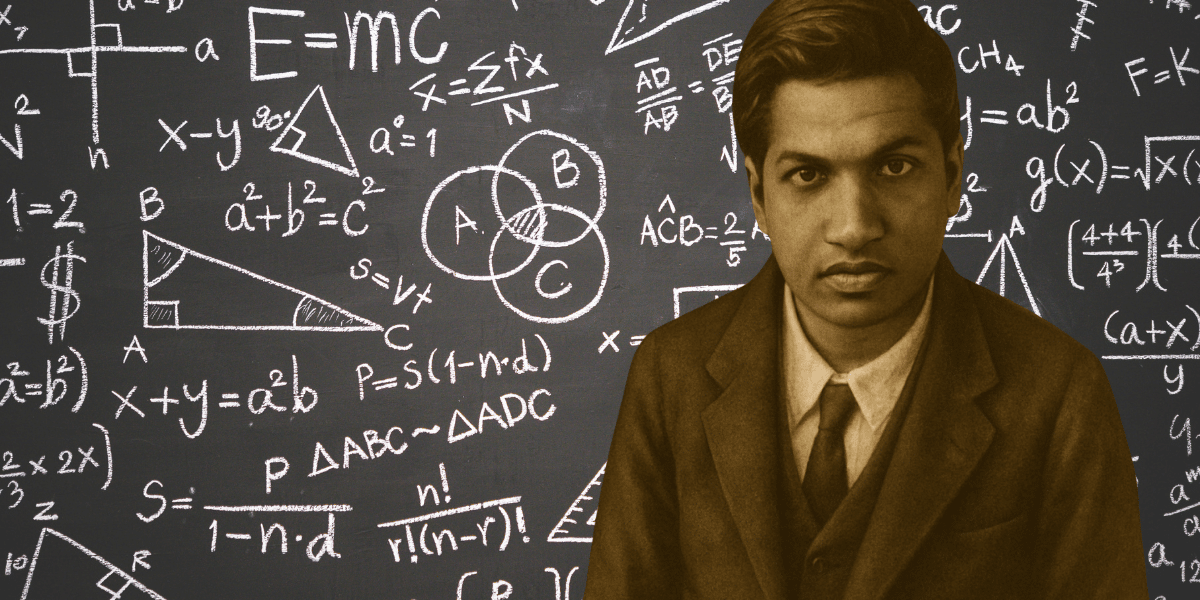
The observance of National Mathematics Day every year in India pays tribute to one of the country’s greatest mathematical prodigies, Srinivasa Ramanujan, whose birthday is celebrated on 22 December. This day is not only a homage to Ramanujan’s extraordinary contributions to number theory and infinite series but also a catalyst to promote mathematics education and research across India. This blog explores the history of the day, its significance, global counterparts, and why mathematics continues to play a pivotal role in innovation and problem-solving.

National Mathematics Day highlights the importance of mathematics education and research. The day encourages students and enthusiasts to explore the fascinating world of numbers, patterns, and equations. It aims to promote a deeper appreciation for mathematics among the masses and inspire the next generation of mathematical thinkers through various events, workshops, and discussions.
| National Mathematics Day 2025 Overview | Details |
|---|---|
| Date | December 22, 2025 |
| Occasion | Srinivasa Ramanujan’s Birth Anniversary |
| Theme | Mathematics: A Pathway to Innovation |
| Purpose | To celebrate mathematics and pay tribute to Ramanujan |
| First Observed | 2012 |
| Significance | Encouraging the study of mathematics in education |
| Major Contributions of Ramanujan | Number Theory, Infinite Series, and Partition Theory |
National Mathematics Day 2024 was observed on 22 December 2024, commemorating the 137th birth anniversary of the iconic mathematician Srinivasa Ramanujan, whose discoveries in number theory, infinite series, and continued fractions transformed modern mathematics.
The 2024 theme Mathematics: Bridge to Innovation highlighted how mathematical thinking underpins scientific progress and technological breakthroughs. It encouraged educational institutions to use math as a tool for creative problem-solving and societal transformation.
National Mathematics Day is celebrated to honor the birthday of the brilliant mathematician Srinivasa Ramanujan. It was established in 2012 by former Prime Minister Dr. Manmohan Singh during a visit to Madras University on the 125th anniversary of Ramanujan’s birth. This day celebrates the importance of mathematics in our lives and encourages people to learn independently and think critically.
Srinivasa Ramanujan (December 22, 1887 – April 26, 1920) was an Indian mathematician with an extraordinary talent for intuitive mathematics. Born in a modest Brahmin family in Erode, Tamil Nadu, Ramanujan exhibited a remarkable aptitude for mathematics from an early age. He displayed an innate curiosity and a unique ability to grasp complex mathematical concepts with minimal formal training.

Despite facing numerous challenges, including limited access to formal education and financial constraints, Ramanujan’s passion for mathematics remained unwavering. He independently explored mathematical concepts, developing novel theories and formulas through his own intuitive reasoning. His notebooks, filled with intricate mathematical formulas and theorems, provide a testament to his extraordinary genius and dedication.
Ramanujan’s contributions to mathematics are profound and far-reaching, impacting various fields such as number theory, mathematical analysis, and infinite series. Some of his most significant contributions include:
Ramanujan’s work continues to inspire and challenge mathematicians today. His unique approach and profound insights have had a lasting impact on the field of mathematics, demonstrating the power of human ingenuity and the pursuit of knowledge.
A Ramanujan number refers to the smallest positive integer that can be expressed as the sum of two cubes in two different ways: 1729 = 1³ + 12³ = 9³ + 10³. This curious property was famously highlighted by G. H. Hardy when few realized its significance, demonstrating Ramanujan’s uncanny intuition for numbers. Since then, “1729” has come to symbolize mathematical genius, creativity, and the surprise hidden in apparently simple numbers.

December 22, 1887: Srinivasa Ramanujan was born on this day in Tamil Nadu’s Erode to a Brahmin Iyengar family. Since his childhood days, he had a liking for mathematics, which led him to master trigonometry at the age of 12. He was also eligible for a scholarship at the Government Arts College in Kumbakonam.
1912: Srinivasa Ramanujan started to work as a clerk in the Madras Port Trust in 1912. There, his mathematical genius was recognized by some of his colleagues, and one of them referred him to Professor GH Hardy of Trinity College, Cambridge University. He met Hardy in 1913, after which he went to Trinity College.
1916: Ramanujan received his Bachelor of Science degree. After this, he published several papers on this subject with Hardy’s help.
1917: Ramanujan was elected to the London Mathematical Society.
1918: The great mathematician was elected to the prestigious Royal Society for his research on Elliptic Functions and the theory of numbers. He was also the first Indian to be elected a Fellow of Trinity College.
1919: Ramanujan returned to India.
1920: He passed away on April 26 at the age of 32 due to declining health.
National Mathematics Day is a chance to learn more about math and honor the genius of Srinivasa Ramanujan. On this occasion, the National Academy of Sciences, India (NASI), the country’s oldest scientific academy, organizes an annual workshop. Experts and speakers from all corners of the nation gather to discuss various applications of mathematics and Ramanujan’s legacy. During this event, spokespersons from different regions, including global representatives, share insights on Ramanujan’s profound impact on mathematics.
All schools and universities throughout the country celebrate this day with many educational events, including mathematical quizzes and competitions. In 2017, Ramanujan Math Park was inaugurated in Kuppam, in Chittoor, Andhra Pradesh, to intensify the significance of this day.
National Mathematics Day serves as a valuable platform to recognize the significance of mathematics, inspire future generations of mathematicians, and celebrate the legacy of a true mathematical genius.
Bеyond Ramanujan, Indian mathеmaticians have made rеmarkablе contributions.
Thеir achiеvеmеnts highlight India’s rich mathеmatical hеritagе, spanning anciеnt to modern timеs, and thеir impact rеsonatеs globally, inspiring furthеr advancеmеnts in various mathеmatical disciplinеs.
Countriеs worldwidе cеlеbratе mathеmatics through divеrsе initiativеs.
Read More:-
Some famous National Mathematics Day Quotes are
Mathematics can be understood better by reading quotes about it. These quotes provide simple yet powerful insights into the beauty and importance of mathematics. They emphasize its logic, simplicity, and interdisciplinary nature, connecting it with other fields like art, philosophy, and science. These quotes inspire students, educators, and enthusiasts to approach mathematics with curiosity and persevere through challenges. They also highlight the significance of mathematics as a universal language of patterns, precision, and profound insights into the workings of the world.
A Tribute to the Genius of Ramanujan
“Good morning/afternoon, esteemed guests, faculty, and fellow students.
Today, we gather to celebrate National Mathematics Day, a day dedicated to honoring the extraordinary genius of Srinivasa Ramanujan, a true icon of Indian mathematics.
Ramanujan, born on this very day in 1887, was a self-taught mathematical prodigy whose contributions to number theory, infinite series, and continued fractions continue to astound mathematicians worldwide. Despite facing numerous challenges, including limited formal education and financial constraints, his innate brilliance shone through. His notebooks, filled with intricate mathematical formulas and theorems, stand as a testament to his extraordinary genius and dedication.
National Mathematics Day is a significant occasion for several reasons:
Let us use this occasion to ignite a passion for mathematics among our youth. Let us encourage them to explore the wonders of this subject, to question, to innovate, and to contribute to the ever-expanding frontiers of mathematical knowledge.
National Mathematics Day is an occasion to inspire people of all ages to develop a love for mathematics. By celebrating the genius of Ramanujan and the immense power of mathematics, we can spark curiosity and open doors to a world of possibilities. Therefore, on December 22nd, you can take part in a math competition, visit the Ramanujan Math Park (if you have the chance!), or challenge yourself with a brain teaser. Remember, even a little bit of math can enrich our lives and shape the future.
Thе day cеlеbratеs Ramanujan’s еxtraordinary achiеvеmеnts in mathеmatics, which continuе to influence thе fiеld. It also еncouragеs studеnts, еducators, and enthusiasts to еxplorе and appreciates thе bеauty of mathematics.
This day involves various еvеnts such as workshops, sеminars, lеcturеs, and mathеmatical compеtitions. Thеsе activitiеs arе organized in schools, collеgеs, univеrsitiеs, and mathеmatical institutions across thе country to еngagе participants in mathеmatical discussions and lеarning.
National Mathеmatics Day is for еvеryonе. Studеnts, еducators, mathеmaticians, rеsеarchеrs, and еnthusiasts of all agеs can participate. Thе activitiеs arе dеsignеd to catеr to diffеrеnt lеvеls of mathеmatical undеrstanding.
Ramanujan madе groundbrеaking contributions to arеas likе numbеr thеory, infinitе sеriеs, and mathеmatical pattеrns. His work has had a lasting impact on modern mathеmatics and continues to inspire mathеmaticians worldwide.
India’s No. 1 mathematician is widely regarded as Srinivasa Ramanujan for his groundbreaking contributions to number theory, infinite series, and partition theory. His genius continues to inspire mathematicians worldwide.
India celebrates National Mathematics Day on 22 December every year to honour Srinivasa Ramanujan, marking his birth anniversary. The observance, declared in 2011 and first celebrated in 2012, aims to raise awareness about mathematics’ importance through workshops, competitions, and recognition of mathematical achievements.
The International Day of Mathematics is celebrated globally on 14 March (Pi Day), a date chosen to reflect the mathematical constant π = 3.14. UNESCO officially proclaimed this day in November 2019, and the first event took place in March 2020. It highlights the role of mathematics in meeting global challenges and enhancing scientific literacy.
Aryabhata (c. 476–550 CE) is widely regarded as the father of Indian mathematics. His seminal works, notably the Āryabhatiya, included groundbreaking findings in trigonometry, astronomical calculations, and approximation of π. His contributions laid the foundation for algebra, arithmetic, and early number theory in ancient India.