
national emblem of india

National Emblem of India: Meaning, History, and Symbolism

Published on October 3, 2025
|
9 Min read time

Quick Summary

  • Adopted on January 26, 1950, the National Emblem is adapted from the Lion Capital of Ashoka at Sarnath.
  • Depicts four Asiatic lions standing back-to-back, symbolizing power, courage, and confidence.
  • Features the Ashoka Chakra at the centre, flanked by a bull and a galloping horse, with the motto “Satyameva Jayate” inscribed below.
  • Usage is protected under the State Emblem of India (Prohibition of Improper Use) Act, 2005, appearing on official documents, currency, and government buildings.

Table of Contents

National Symbols of India are the visual representation of the nation’s identity, culture, and values. These symbols, such as the national flag, emblem, or anthem, capture centuries of history, collective struggles, and shared aspirations in easily recognizable forms. For example, the tricolor flag with the Ashoka Chakra reflects India’s unity, justice, and progress, while inspiring pride among citizens across diverse backgrounds. The National Emblem of India, adapted from the Lion Capital of Ashoka at Sarnath and adopted on January 26, 1950, is one of the most significant symbols.

It features four lions standing back-to-back on a circular abacus, with carvings of an elephant, a galloping horse, a bull, and a lion, along with the Dharma Chakra (Wheel of Law) at the center. Below the abacus, the national motto “Satyameva Jayate” (Truth Alone Triumphs) is inscribed in Devanagari script, reminding citizens of India’s timeless values of truth, unity, and righteousness.

What is the National Emblem of India?

The original national emblem of India in English is an adaptation of the Lion Capital of Ashoka, a sculpture erected initially at Sarnath. In this place, Gautama Buddha first taught the Dharma. The statue is a three-dimensional emblem showing four lions. It became the emblem of the Dominion of India in December 1947 and later the symbol of the Republic of India. The State Emblem of India is an official seal of the Government of India. The national emblem of India is used on official documents, currency, and passports. The Union government, many state governments, and other government agencies utilize it.

National Emblem Of India: Historical Background

  • The origins of the National Symbol date back to the third century when the Mauryas ruled India. 
  • To spread Buddhist teachings, Emperor Ashoka produced various sculptures and stone carvings, the most notable of which is the Ashoka Lion Capital at Sarnath.
  • In 1905, Friedrich Oscar Oertel discovered the pillar. When excavating, he found three remnants of the Ashoka Pillar of Sarnath.
  • The Sarnath Museum currently houses the entire upper half of the found Lion Capital.

Symbolism and Elements Within the Emblem

The State Emblem of India is an adaptation of the Lion Capital of Asoka at Sarnath. In the original emblem, four lions stand back to back on a circular abacus resting on a bell-shaped lotus. The frieze of the abacus has sculptures in high relief of an elephant, a galloping horse, a bull, and a lion, separated by intervening Dharma Chakras.

The current State Emblem of India was adopted on January 26, 1950. It depicts four Asiatic lions standing back to back on the abacus. The lions are mounted on a circular abacus with the Dharma Chakra in the center, a bull on the right, and a galloping horse on the left. Outlines of Dharma Chakras are also visible on the extreme right and left. The final design omitted the bell-shaped lotus. The motto Satyameva Jayate, which means ‘Truth Alone Triumphs,’ is written in Devanagari script below the profile of the Lion Capital and constitutes an integral part of the State Emblem of India.

Symbolism of the spokes in the Ashok Chakra

Role in Government and Official Use

The emblem of India, which shows the Ashoka Chakra, is vital to government work and official papers. It can be seen in government buildings and currency notes, often on official documents. However, the emblem’s use is regulated and restricted under the State Emblem of India (Prohibition of Improper Use) Act, 2005, under which no individual or private organization can use it for official correspondence. This is because it’s a prominent symbol of India’s power and control.

It also reminds everyone that India follows rules and democracy. It’s a way to say this is important and real on official papers. The national emblem is like a flag for the Indian government. It shows that they are in charge, follow specific values, and are here to make things fair and united.

National emblem of India in the new Parliament building

Buildings that Feature the National Emblem of India

  • Parliament House
  • State Legislature
  • Rashtrapati Bhawan
  • Raj Bhawan or Raj Niwas
  • Supreme Court
  • High Courts
  • Central Secretariat Buildings
  • Secretariat Buildings of the State Governments or UT Governments.
  • House of the Indian Diplomatic Missions Abroad
  • The Indian Consulates in Foreign Countries authorize entrance gates to the buildings.
  • Premises of the Heads of Missions representing India in other countries.

Adoption of the National Emblem of India

The Indian national emblem, featuring the Ashoka Chakra, was incorporated into official use on January 26, 1950, coinciding with the noteworthy enactment of the Indian Constitution. This pivotal decision marked India’s transition to a republic, which meant a transition towards sovereignty and democracy.

Cultural Significance of the National Symbol of India

The emblem is a unifying force, bringing together India’s diverse regions and cultures. It transcends linguistic and geographical boundaries, functioning as a cohesive symbol that binds the nation. Its design, notably the Ashoka Chakra with 24 spokes, symbolizes democratic principles like justice, truth, and equality, reflecting a pivotal moment in India’s political evolution.

Evolution and Changes in Originla National Emblem of India

While based on a historical sculpture, India’s national emblem has a relatively short evolutionary path.

  • Origin: The emblem’s source is the Lion Capital of Ashoka, a 3rd-century BC sculpture from Sarnath. It depicts four lions standing back to back, symbolizing power and righteousness.
  • Adaptation: In 1950, when India became a republic, the Lion Capital was adopted as the national emblem. However, for a more practical representation, some elements were modified:
    • The original sculpture featured a bell-shaped lotus below the lions, which was omitted in the emblem.
    • The emblem has only three lions visible, while the fourth remains unseen, signifying unity despite hidden aspects.
  • Essentially Unchanged: Since its adoption in 1950, India’s national emblem has remained unchanged. Its core elements the lions, Dharmachakra (wheel of law), and the motto “Satyameva Jayate” (Truth Alone Triumphs) continue to represent the nation’s strength, moral values, and commitment to truth.

National Emblem of India and Indian Currency

The original national emblem of India, which prominently displays the Ashoka Chakra, is featured on Indian currency notes and coins. Its appearance on these financial instruments goes beyond aesthetics, carrying significant symbolic weight. The emblem’s inclusion on currency notes and coins is a tangible representation of India’s economic stability and strength. This interconnected relationship between currency and the national emblem underscores the dynamic connection between economic prosperity and national pride. It serves as a continuous reminder to citizens that their financial well-being is closely tied to the broader ideals and principles embodied in the emblem.
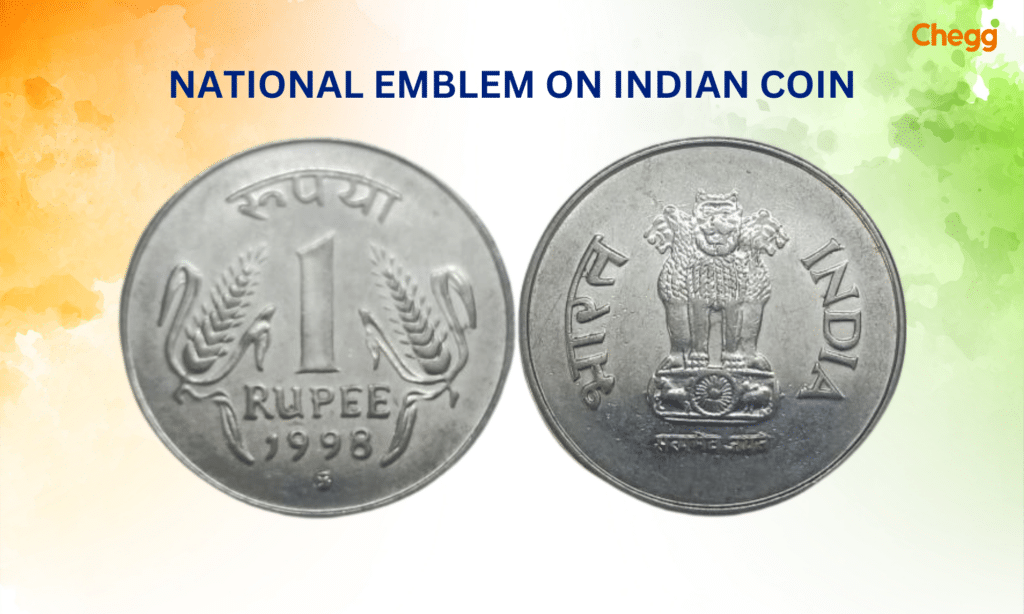
National emblem on Indian coin

Applications of the National Emblem of India

The National Emblem of India has significant symbolic and official purposes. It serves as:

  • The central and state governments use the official seal of the President of India.
  • A feature on Indian passports and other official international documents.

It is displayed in prominent public locations such as:

  • Rashtrapati Bhawan
  • Parliament House
  • Supreme Court
  • Central Secretariat

Additionally, the emblem can be placed:

  • At the entry doors of buildings housing India’s Consulates abroad.
  • On the premises of India’s Diplomatic Missions worldwide, including the residences of Heads of Missions.
  • In locations like Raj Bhawan, Raj Niwas, State Legislature, High Courts, and Secretariat buildings of the states and Union Territories.

Rules and Regulations on the applications of the National Emblem of India.

Specific laws and regulations govern the use of the National Emblem of India:

  1. State Emblem of India (Prohibition of Improper Use) Act, 2005, and State Emblem of India (Regulation of Use) Rules, 2007, regulate the proper use of the emblem.
  2. Rule 10 of the State Emblem of India (Regulation of Use) Rules, 2007, prohibits individuals and organizations from using the national emblem or flag without authorization.
  3. The Emblems and Names (Prevention of Improper Use) Act, 1950, and its associated Rules, 1982, also restrict the use of national symbols of India, such as the emblem and national flags, on official government documents.
  4. According to the Emblems and Names (Prevention of Improper Use) Act of 1950, the use of the national flag, the official seal of the President or Governor, and the Ashoka Chakra, among others, is prohibited for unauthorized purposes.
  5. Section 4 of the State Emblem of India (Prohibition of Improper Use) Act, 2005, prohibits individuals or organizations from using the national emblem for purposes like company registration, patent registration, or any other unauthorized use unless granted permission by the Central Government.
  6. Section 5 of the Act further restricts registration authorities from registering any business, trade, or patent incorporating the national emblem.

Comparisons of the National Emblem of India with Other National Emblems

The United States and India

  • Similarities
    • Use of Circular Elements: Both emblems incorporate circular elements. In the case of the United States, it’s the 50 stars arranged in a circle on the flag, and for India, it’s the Ashoka Chakra, a circular wheel.
    • Symbolic Colors: Both emblems employ specific colors with deep symbolism. In the U.S. flag, red symbolizes valor and bravery, white represents purity and innocence, and blue signifies vigilance, perseverance, and justice. In the emblem of India, the blue Ashoka Chakra represents truth and virtue.
  • Differences
    • Design Elements: The U.S. flag consists of stars and stripes, representing the 50 states and their union, while India’s emblem includes a lion capital and the Ashoka Chakra, symbolizing its ancient heritage and principles.Number of Elements: The U.S. flag has 50 stars and 13 stripes, whereas India’s emblem has a single Ashoka Chakra with 24 spokes.
    • Historical and Cultural Context: The U.S. flag draws from its revolutionary and colonial history, while India’s emblem reflects its ancient civilization and the principles of Emperor Ashoka.

Key Facts About the National Emblem of India for UPSC Preparation

FactDetail
What is the name of the Indian National Emblem?The official name is the National Emblem of India, also called the State Emblem.
Where was the National Emblem of India adapted from?The emblem is adapted from the Lion Capital of Ashoka at Sarnath and was adopted on 26th January 1950, the day the Constitution came into effect.
How many animals are depicted in the National Emblem?There are four animals:
– Four Asiatic Lions
– One Elephant
– One Bull
– One Horse
How many National Emblems does India have?India has only one National Emblem.
Who designed the National Emblem of India?Dinanath Bhargava sketched and illuminated the National Emblem of India.
How many lions are depicted on the Ashoka Pillar?The Ashoka Pillar features four Asiatic Lions, also represented in the National Emblem.
What does the Ashoka Chakra signify?The Ashoka Chakra is a symbol of the Buddhist Dharmachakra, represented by 24 spokes, symbolizing Buddhist teachings.

Origin & Symbolism of the National Emblem of India

The National Emblem of India, adapted from the Ashoka Pillar of Sarnath, features four Asiatic lions standing back-to-back, symbolizing power, courage, confidence, and pride. Along with the lions, the emblem also features a horse, bull, elephant, and lion, each associated with Buddhist symbolism and the life of the Buddha.

  • The elephant signifies Buddha’s conception.
  • The bull represents Taurus, his zodiac sign.
  • The horse symbolizes Kanthaka, the horse he rode while leaving his palace.
  • The lion represents enlightenment and the “Lion’s Roar” of Buddhist teachings.

This emblem reflects India’s rich heritage, Buddhist influence, and values of strength and dignity.

Craftsmanship and Construction of the National Emblem

  • Material & Origin: Crafted from fine sandstone sourced mainly from Chunar and Mathura quarries.
  • Artisan Skill: Expertly carved by skilled artisans with high precision and intricate detailing.
  • Dimensions & Weight: Each pillar stood 40–50 feet tall, weighed about 50 tons, and was transported to its final location for erection.
  • Animal Capitals: Featured elaborately sculpted animal capitals, with only six animal-capped pillars surviving today.
  • Inscriptions: Engravings contained Buddhist moral teachings and royal decrees issued by Emperor Ashoka.

National Emblem of India and the Ashoka Pillar: An Overview for UPSC Preparation

The National Emblem of India is a stylized adaptation of the Lion Capital of Ashoka, located at Sarnath and preserved in the Sarnath Museum. The Ashoka Pillars are a series of stone columns erected across North India by Emperor Ashoka during the 3rd century BC, representing a significant part of Mauryan architecture.

Design and Features of the Original Ashoka Pillar:

  • The Lion Capital features four lions standing back-to-back, symbolizing power, courage, confidence, and pride.
  • The lions rest on an abacus adorned with high-relief carvings of an elephant, a galloping horse, a bull, and another lion, separated by intricately carved Dharma wheels.
  • The entire structure stands atop a bell-shaped lotus, representing purity.

Modifications in the National Emblem:

  • The version adopted by the Government of India depicts only three lions, with the fourth lion obscured as it faces the rear.
  • The wheel (Dharma Chakra) is prominently displayed at the center of the abacus, flanked by the horse on the left and the bull on the right. Outlines of wheels appear on the far right and left.
  • The bell-shaped lotus base seen in the original Ashoka pillar is not included in the National Emblem.

Relevance for UPSC Aspirants:

The National Emblem and other national symbols of India, like the National Anthem and Official Language, are critical topics for UPSC exams and are often featured in the India Yearbook. Understanding the origins and meanings of these symbols is essential for comprehensive preparation.

For further information on state and union territory symbols, refer to the dedicated Government National Emblem of India. These facts encapsulate the significance, history, and legal aspects of the Indian National Emblem, which are vital for any UPSC aspirant’s knowledge.

Conclusion

The national emblem of India, featuring the Ashoka Chakra, symbolizes unity and reflects India’s commitment to justice, truth, and democracy. While the U.S. emblem represents its recent history and democratic values, India’s emblem echoes its ancient roots and cultural heritage. Both emblems embody their nations’ core values and cultural uniqueness. India’s emblem inspires national pride and unity, guiding the country towards a brighter, more united future.

Read More:-

Get Paid to Help Students Across the World - Earn With Chegg

Frequently Asked Questions (FAQ’s)

What is our national emblem of India?

The National Emblem of India, adopted on January 26, 1950, is adapted from the Lion Capital of Ashoka at Sarnath. It features four lions symbolizing strength and courage, a circular abacus with animal figures and Dharma Chakras, and the motto “Satyameva Jayate” (Truth Alone Triumphs).

What is our national emblem name?

The name of our national emblem is Dharma Chakra, or the Wheel of Law.

Does the national emblem of India have 3 or 4 lions, and what is 4 Lion Emblem?

The Indian national emblem has 4 lions. The four lions stand on a cylindrical base adorned with four Ashoka Chakras and reliefs of a lion, bull, elephant, and galloping horse. The National Emblem represents India’s sovereignty.

Where is the elephant on the national emblem of India?

The elephant is located on the abacus of the national emblem.

What is India’s original national emblem?

The original National Emblem of India is the Lion Capital of Ashoka.

Who designed the national emblem of India?

Dinanath Bhargava is said to have drawn inspiration from a visit to the Alipore Zoo in Kolkata, where he observed lions before creating the design.

Who wrote the National Emblem of India?

The National Emblem of India was not “written” by anyone but is an adaptation of the Lion Capital of Ashoka at Sarnath, built by Emperor Ashoka in the 3rd century BCE. It was officially adopted as the national emblem on January 26, 1950. The motto “Satyameva Jayate” (Truth Alone Triumphs) inscribed below the emblem is taken from the Mundaka Upanishad, an ancient Vedic text.


Authored by, Muskan Gupta
Content Curator

Muskan believes learning should feel like an adventure, not a chore. With years of experience in content creation and strategy, she specializes in educational topics, online earning opportunities, and general knowledge. She enjoys sharing her insights through blogs and articles that inform and inspire her readers. When she’s not writing, you’ll likely find her hopping between bookstores and bakeries, always in search of her next favorite read or treat.

Editor's Recommendations