
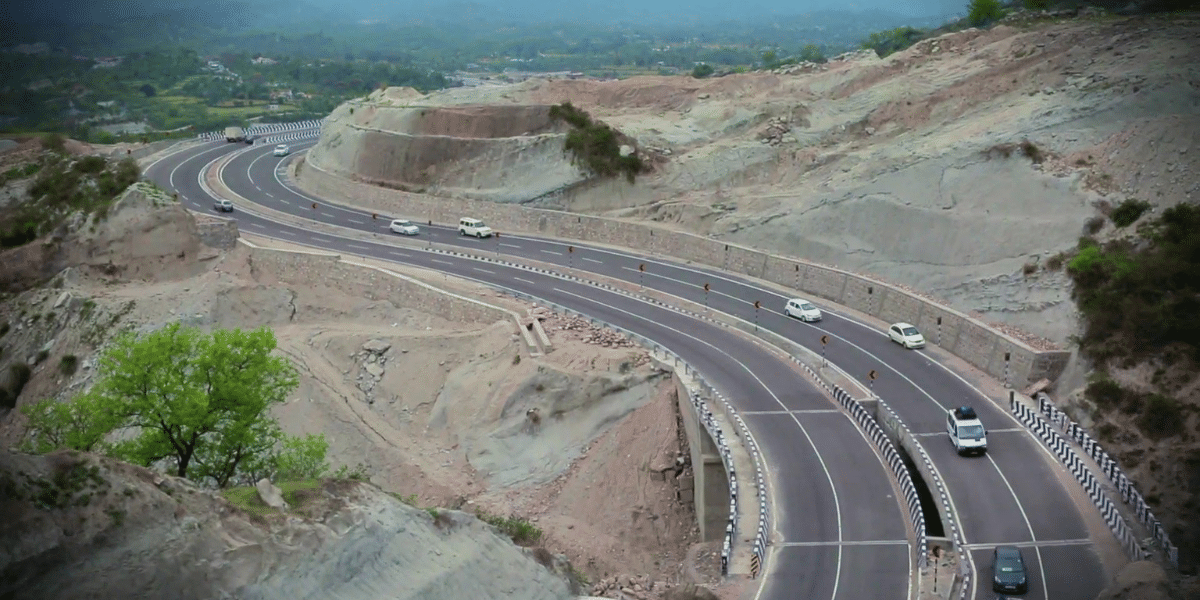
India’s national highway system is a vast network of roads connecting cities and villages across the country. It covers more than 16,000 kilometers, making it the world’s fourth-largest highway system. The Old NH 7, or NH 44, is the longest national highway in India. These roads play a crucial role in India’s transportation network, facilitating the movement of people and goods. In 1956, they established the initial national highway, NH1, connecting New Delhi and Lahore, Pakistan.

The longest national highway in India is National Highway 44 (NH-44), which spans a vast distance as it combines seven major national highways. It spans approximately 4,112 kilometers, connecting Srinagar in Jammu and Kashmir to Kanyakumari in Tamil Nadu through multiple states, including Haryana, Punjab, Delhi, Uttar Pradesh, and Tamil Nadu, making it the longest national highway in India.
As the main artery of the North-South Corridor of the National Highways Development Project (NHDP), NH 44 highway is more than just the longest road in India; it is a vital lifeline for trade, transport, and tourism.
While NH 44 is the single longest highway, a different exam-friendly question often appears: Which state has the largest aggregate length of national highways within its boundaries? Maharashtra consistently ranks at or near the top for total NH kilometers owing to its extensive network that links western ports, industrial cities, and hinterland districts. Given frequent additions and reclassifications, always verify the latest year’s figures for absolute totals, but Maharashtra remains the safest factual pick for the “longest NH network by state” framing.
NH 44 was created by merging seven older national highways, creating a single, continuous route that streamlines transportation across the subcontinent. It integrated parts of the former NH 1A, NH 1, NH 2, NH 3, NH 7, NH 75, and NH 26.
This super-highway traverses 11 states, connecting a diverse array of cities and landscapes. The route passes through:
Key cities along its path include Srinagar, Delhi, Agra, Gwalior, Nagpur, Hyderabad, and Bangalore, making it a critical corridor for millions of people.
To ensure safety across its extensive length, specific speed limits are enforced:
While NH 44 is the longest, it is part of a larger network of extensive highways. Here are the top ten longest national highways that form the backbone of India’s connectivity.
| National Highway | Route | Distance (in km) |
|---|---|---|
| NH 44 | Srinagar to Kanyakumari | 3,745 |
| NH 27 | Porbandar (Gujarat) to Silchar (Assam) | 3,507 |
| NH 48 | Delhi to Chennai | 2,807 |
| NH 52 | Sangrur (Punjab) to Ankola (Karnataka) | 2,317 |
| NH 30 | Sitarganj (Uttarakhand) to Ibrahimpatnam (Andhra Pradesh) | 2,040 |
| NH 6 | Jorabat (Meghalaya) to Selling (Mizoram) | 1,873 |
| NH 53 | Hajira (Gujarat) to Pradip Port (Odisha) | 1,781 |
| NH 16 | East coast of West Bengal to Chennai | 1,711 |
| NH 66 | Panvel (Maharashtra) to Kanyakumari | 1,622 |
| NH 19 | Delhi to Kolkata | 1,435 |
India has several major highways connecting different parts of the country. Here are some of the most important ones explained in simple words:
At the opposite end, NH 118 and NH 548 are among the shortest national highways in India, each roughly 5km long. They function as strategic connectors within larger urban–industrial clusters rather than as interregional trunks.
Beyond the lengths and routes, several key facts define the national highway system.
The National Highway Authority of India (NHAI) is the autonomous agency responsible for the development, maintenance, and management of India’s national highways. Established by an act of Parliament in 1988, the NHAI oversees a network of over 50,000 km, ensuring quality standards and implementing projects like the NHDP.
Several categories split the number of national roads in India and the different types of goods they carry. Here are several examples:
India’s longest expressway is a significant achievement in transportation, and it is known for its extensive reach and efficiency. Built for fast travel, this expressway has many lanes to keep traffic moving smoothly and reduce travel time. Stretching across a considerable distance and maintaining its lanes well, the expressway connects important cities and states, playing a crucial role in India’s transportation system. Additionally, it complements the longest national highway in India, NH 44, enhancing connectivity and facilitating economic growth across the country.
The impact of this expressway on travel and commerce is noteworthy. It substantially cuts down travel time between connected regions, making journeys more efficient. Additionally, it plays a crucial role in promoting commerce by facilitating the swift movement of goods and people. As the longest national highway in India, this expressway stands as a symbol of India’s commitment to modern and efficient infrastructure, this expressway stands as a sign of progress, influencing both travel convenience and economic development.
The longest national highway in India network is the backbone of India’s logistics and supply chain systems. Here is how it has impacted our economy:
In India, there’s a large network of national roads that cover hundreds of kilometers. To enhance connectivity, India has been consistently expanding the length of its national roads. Among these, the longest national highway in India, NH 44, stands out for its extensive reach and significance. Here are some key features of the longest national highway in India:
System of Highway Numbers: In India, national roads are assigned numbers using a special procedure. Highways with odd numbers normally go north to south, whereas those with even numbers typically travel east to west.
Compared to state or district roads, national highways are often constructed to higher quality standards. They are well-maintained by the NHAI and built to endure considerable traffic.
Many national roads in India are now being converted to access-controlled motorways. Due to their restricted entry points and separate lanes for each direction of traffic, motorways improve efficiency and safety.
Many national highways pass near UNESCO World Heritage Sites, forts, temples, mosques, churches, palaces, and archaeological zones. NH 44 links travelers to heritage cities of the north, the Mughal trail in the heartland, Deccan forts, and South Indian temple towns. These alignments enable road-trippers, pilgrims, and students to experience the fabric of India’s cultural diversity. Over time, some NH alignments have overlain or paralleled historical trade routes, reaffirming their long-standing role in moving goods, ideas, and people.
The broader system frames NH 44 within a national grid:
Over the past decades, upgrades have focused on widening to four, six, or eight lanes where justified, building interchanges instead of roundabouts at major junctions, and adding service roads for local traffic. As volumes grow, more segments are being converted to access-controlled formats to balance high-speed intercity traffic with local safety.
The Golden Quadrilateral connects Delhi, Mumbai, Chennai, and Kolkata in a diamond-shaped loop. Portions of NH 44 intersect the GQ near Bengaluru and in the Delhi–Agra region via connected corridors. This interlock is essential: the GQ carries intense east–west and north–south flows across the four metros, while NH 44 ensures that traffic running the full length of the country can merge or diverge toward the metros with minimal friction.
NH 44 interacts with major industrial corridors and inland logistics hubs. It acts as a feeder to:
Long-distance highways concentrate risk because of speed differentials and fatigue. Modern safety practices emphasize:
NH 44 is more than a statistic in a GK list, it is the practical north–south spine of Indian road transport. Its formation from seven older highways transformed patchwork drives into a genuinely continuous corridor. Its intersections with east–west trunks and high-capacity bypasses allow freight to move faster and more predictably across India’s varied terrain. For students and aspirants, three takeaways will rarely fail you: NH 44 is the longest national highway in India; NH 27 is the second-longest; Maharashtra leads in total NH kilometers among states. For travelers and businesses, the same facts translate into something tangible: shorter trips, wider market access, and a more connected India.
Read More:–
As of now, there are 599 national highways in India, according to the Ministry of Roads, Transport, and Highways.
The longest national highway in India is NH 44. Stretching about 3,745 kilometers, it runs from Kanyakumari in Tamil Nadu to Srinagar in Jammu and Kashmir. Passing through diverse landscapes and major cities, NH 44 plays a vital role in connecting economic hubs, promoting trade, and supporting tourism across the country.
The smallest national highway in India is National Highway 548, or simply NH 548.
The Grand Trunk Road is one of India’s oldest roads and serves as a major national highway. With a history dating back to ancient times, it has connected regions from Bangladesh to Pakistan, playing a crucial role in trade and travel for centuries.
The Delhi-Mumbai Expressway is the longest expressway in India in 2024. Stretching across five states Delhi, Haryana, Rajasthan, Gujarat, and Maharashtra it is designed to improve connectivity and reduce travel time between the two major cities.
National Highway 44 (NH 44) is longer. The old NH 7 was previously India’s longest highway, but it has since been integrated into the newly created NH 44. This new route combines seven older highways to form a single, continuous road from Srinagar to Kanyakumari, making it the current longest national highway in India.
No, NH 27 is not the longest highway in India. It is the second-longest, running approximately 3,507 kilometers from east to west between Porbandar, Gujarat, and Silchar, Assam. The distinction of the longest highway belongs to NH 44, which serves as the primary North-South Corridor and is significantly longer.
The old National Highway 7 (NH 7) no longer exists as a single entity. Its route has been largely subsumed into the new National Highway 44 (NH 44). As part of a nationwide renumbering of highways, the former NH 7 was merged with several other highways to create the new, longer NH 44.