Literacy is more than just the ability to read and write. It is essential for human development and societal progress. In a diverse and populous country like India, literacy is key in empowering people, increasing job opportunities, and supporting inclusive growth. It directly affects public health, civic participation, and gender equality, making it essential for national development.
According to the National Statistical Office (NSO) 2017–18 survey, the literacy rate in India is 77.7%. This shows significant progress since independence. However, the country still faces serious issues like regional imbalances, gender disparities, and limited access to quality education in rural and marginalized communities.
This article gives an overview of India’s literacy situation. It looks at how literacy has progressed since 1947, examines literacy rates in different states, and identifies which state is the most educated. It also discusses ongoing issues with illiteracy in India and shows how Kerala’s high literacy rate can be a model for the rest of the country. Understanding these factors is vital for achieving universal literacy and fair access to education.

The literacy journey in India shows the country’s larger social and economic changes since independence. Starting from a low point in 1947, the literacy rate in India has steadily improved due to policy reforms and national education efforts.
At the time of India’s independence in 1947, the literacy rate in India was 18.3%. Education was primarily out of reach for women, marginalized communities, and rural populations. The colonial education system favored the elite, offering few institutions and little infrastructure for mass education. The challenge for independent India was to develop a system that could deliver education to the grassroots level and address social and regional gaps.
The post-independence period witnessed a gradual yet consistent rise in the literacy rate in India through successive census years.
These milestones show that, although progress was slow at first, increased efforts in the late 20th and early 21st centuries greatly improved literacy levels.
Several landmark policies and missions played a crucial role in this upward trend:
These initiatives have helped bridge educational gaps and empowered millions, particularly in rural and underserved regions.
Also Read: National Education Day
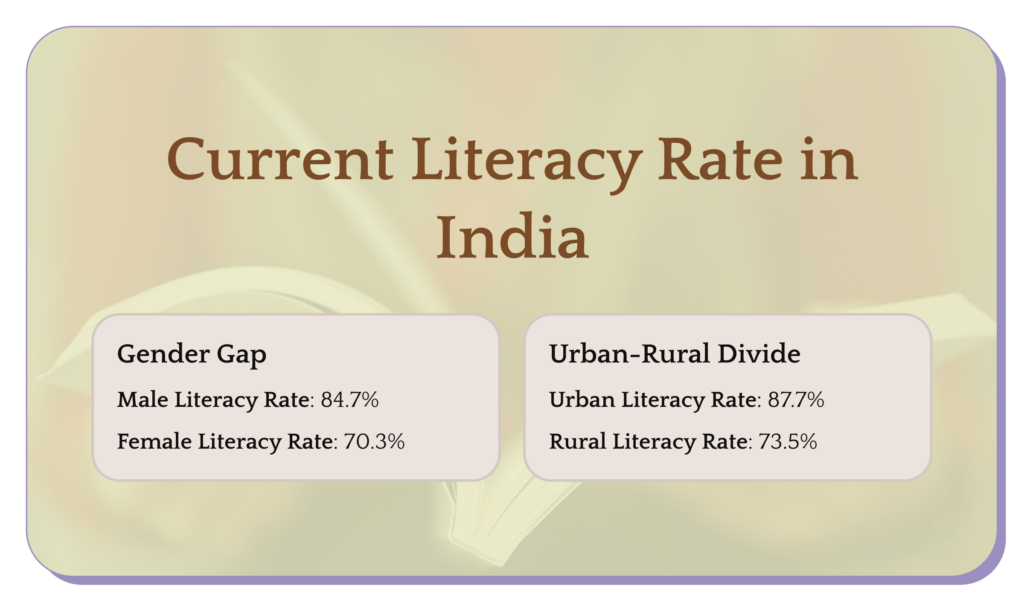
India has made significant progress in raising literacy levels, but the road to universal literacy is still long. According to the latest data from the National Statistical Office (NSO) 2017-18 survey, the literacy rate in India is 77.7%. This number shows the successes and the ongoing challenges in the country’s education system.
One of the most persistent issues is the gender disparity in literacy. The data shows that:
While the gap has narrowed in recent years because of specific policies and awareness campaigns, it still poses a serious hurdle to achieving fair education.
The contrast between urban and rural literacy levels is also stark:
This difference is due to improved access to schools, infrastructure, and educational resources in urban areas compared to rural and remote regions.
A positive sign is the high youth literacy rate for ages 15 to 24, which exceeds 90%. This indicates that recent education efforts benefit younger generations, particularly those aimed at primary and secondary education.
Even with these improvements, significant gaps still exist between states, income groups, and social categories. Closing these gaps requires strategies tailored to each region that emphasize inclusivity, affordability, and quality education. Ongoing monitoring and flexible policies are crucial to maintaining progress and effectively tackling ongoing challenges.
India’s literacy landscape differs greatly across its states and union territories, showing significant regional and socio-economic differences. The literacy rate in each state helps to point out areas of progress and regions that need urgent educational support.
Latest state-wise literacy data based on the Census 2011, the most complete nationwide literacy dataset available, shows the varied literacy levels across India in the following states and union territories:
| State/UT | Literacy Rate (%) |
|---|---|
| Kerala | 94.0 |
| Delhi | 86.2 |
| Uttarakhand | 78.8 |
| Tamil Nadu | 80.1 |
| Maharashtra | 82.3 |
| Bihar | 61.8 |
| Rajasthan | 66.1 |
| Andhra Pradesh | 67.0 |
These figures highlight significant gaps between the most and least literate regions. For instance, Kerala, with a literacy rate of 94%, is far ahead of Bihar, which stands at only 61.8%.
Regional trends show that southern states like Kerala, Tamil Nadu, and Karnataka usually have higher literacy rates. This success comes from early and ongoing investments in education, improved governance, and higher female literacy rates. In contrast, northern and eastern states, such as Bihar, Uttar Pradesh, and Jharkhand, still struggle mostly because of structural and social barriers.
Several interlinked factors contribute to these regional disparities:
Addressing these factors requires a strategy focusing on inclusive growth, targeted funding, community engagement, and better governance. A national approach will not be enough; localized solutions are needed to close India’s literacy gap effectively.
Kerala has a striking literacy rate of 94%, making it the most educated state in India. This southern state has consistently led the country in literacy and education, serving as a strong example for others.
Several interwoven factors have contributed to Kerala’s literacy success:
Kerala’s story shows that strong political commitment, inclusive policy-making, and active community engagement can significantly improve education. Other Indian states can learn from Kerala’s model by using similar strategies that fit their social and cultural situations. By adopting this comprehensive approach, India can make real progress toward achieving universal literacy.
Kerala continues to lead in education in India with a high literacy rate of 94%. This achievement comes from its ongoing and inclusive efforts. A closer look at the data shows Kerala’s strengths across different demographic and geographic areas.
Kerala has a balanced literacy rate. Male literacy is about 96%, and female literacy exceeds 92%. This shows the state’s strong focus on educating women. The urban literacy rate is around 95.1%, while the rural rate is nearly 92.9%. This gap is much smaller than the national average. This balance highlights Kerala’s achievement in offering educational access, even in remote and less developed areas.
The state has also invested a lot in adult literacy programs. Initiatives like the Kerala State Literacy Mission have focused on older, non-literate adults. They use night schools and community learning centers to provide lifelong learning opportunities.
Kerala has made digital literacy a key part of its education reforms. Campaigns like Akshaya have helped citizens gain basic digital skills and close the information gap. Schools now have smart classrooms, and students are introduced to ICT tools early in their education.
Kerala’s model reflects a comprehensive and future-ready approach to literacy that combines traditional education with modern innovations.
Despite decades of progress in improving access to education, illiteracy in India remains a serious issue, especially in economically and socially disadvantaged areas. Several states still show alarmingly low literacy rates, highlighting significant structural challenges.
According to the 2011 Census, states such as Bihar (61.8%), Rajasthan (66.1%), Jharkhand (66.4%), and Uttar Pradesh (67.7%) have some of the lowest literacy rates in India. These areas face poverty, poor infrastructure, and social barriers that block educational progress.
Illiteracy has significant social and economic effects. It limits access to jobs, decreases health awareness, and makes it harder for people to engage in civic activities. Illiteracy also maintains caste and gender inequalities, keeping marginalized groups stuck in cycles of poverty and discrimination. At a national level, widespread illiteracy slows economic growth, lowers productivity, and stifles innovation.
Tackling illiteracy in India requires targeted, region-specific strategies that address systemic and cultural barriers and focus on inclusivity and equity.
The Indian government has rolled out several initiatives to combat illiteracy and improve access to quality education. These programs target various parts of the education system, from the foundational literacy rate in India to nutrition and vocational skills.
While these initiatives have raised enrollment rates and awareness, real challenges persist. Many students still drop out before finishing secondary education. Learning outcomes, particularly in reading and math, fall short of expectations. Furthermore, gaps in implementation, inconsistent teacher training, and poor monitoring at the state and district levels limit the effectiveness of these programs.
To achieve universal literacy, there is a pressing need for data-driven monitoring, localized solutions, and collaborative efforts involving government, civil society, and the private sector.
Achieving universal literacy in India requires a comprehensive approach that includes technology, collaboration, and inclusivity. One of the most promising developments is the integration of EdTech platforms like DIKSHA, BYJU’S, and Khan Academy. These tools make learning accessible, interactive, and personalized, especially for students in remote and underserved areas. Additionally, many public schools now use digital classrooms and smartboards, improving teaching effectiveness.
Public-private partnerships (PPPs) are vital in bridging the resource gap. Corporations and NGOs can contribute by funding school infrastructure, training teachers, and providing digital learning aids. These partnerships help scale proven education models to underserved regions.
Focusing on marginalized communities is important. Customized curricula that honor tribal languages and cultures and support for educating girls and improving adult female literacy can tackle long-standing inequalities. Helping communities through local programs leads to lasting change.
India’s push toward literacy aligns with Sustainable Development Goal (SDG) 4, which emphasizes inclusive, equitable, and quality education for all. Moving forward, India must continue innovating, investing, and collaborating across sectors to ensure that every citizen, regardless of gender, caste, or geography, has access to lifelong learning opportunities.
India’s literacy journey shows decades of hard work, policy changes, and local efforts. The progress, from an 18.3% literacy rate in 1951 to 77.7% today, is impressive. However, illiteracy, gender inequality, and regional differences prevent inclusive growth.
The example of Kerala, the most educated state in India, shows what can happen with ongoing investment in education, gender equality, and community involvement. Its success can serve as a model for other states that want to improve literacy rates.
Digital inclusion, innovative learning models, and strong public-private partnerships will be crucial for reaching the last mile. In line with global goals like SDG 4, India must work towards a fair, inclusive education system and ready for the future. We should commit to building a literate nation because education is not just a right; it is the foundation for a stronger, empowered India.
Kerala is the No. 1 state in India in terms of literacy rate, with a remarkable 94% literacy rate as of Census 2011. Its success is attributed to strong public education and reforms.
India’s female literacy rate in 2025 (for ages 7 and above) is approximately 74.6%, as per the Periodic Labour Force Survey 2023–24. This reflects a gender gap of about 12.6 percentage points compared to male literacy (87.2%).
Bihar often ranks lowest in literacy rate in India, with a rate below 65%, highlighting the need for improved educational infrastructure.
Kerala’s literacy rate in 2025 is approximately 96.2%, positioning it among India’s most literate states. This high rate reflects decades of prioritizing education, especially women’s education, and sustained efforts through government initiatives and social mobilization.