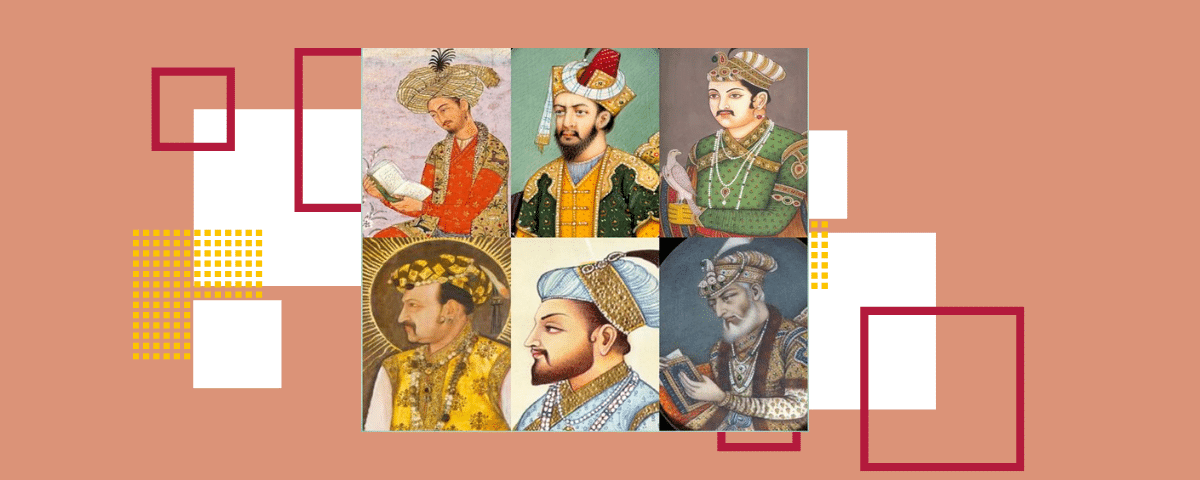
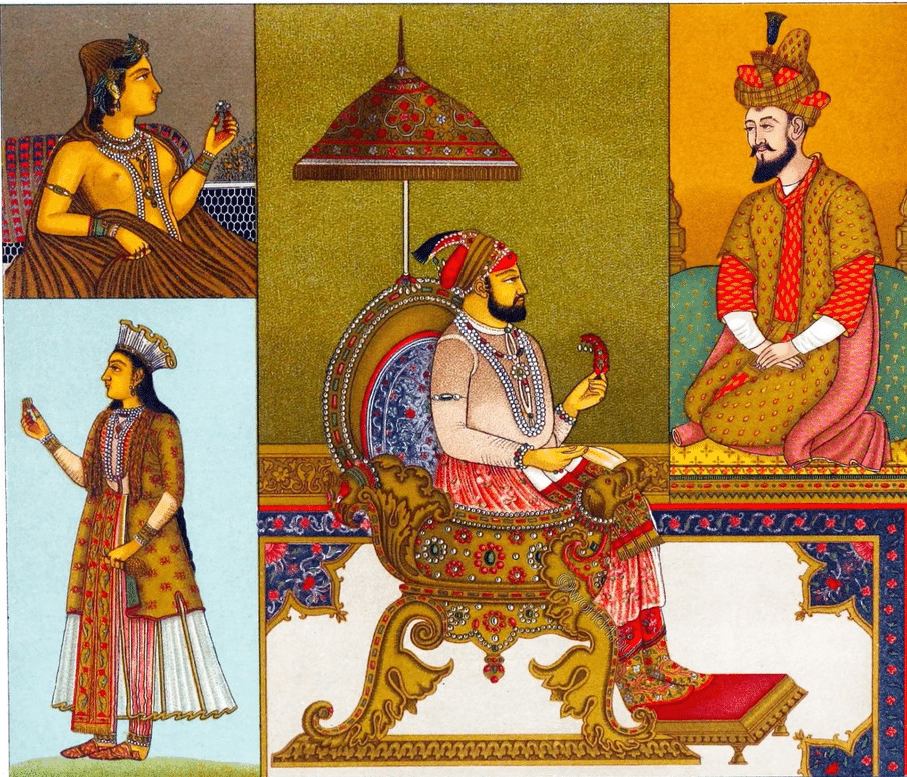
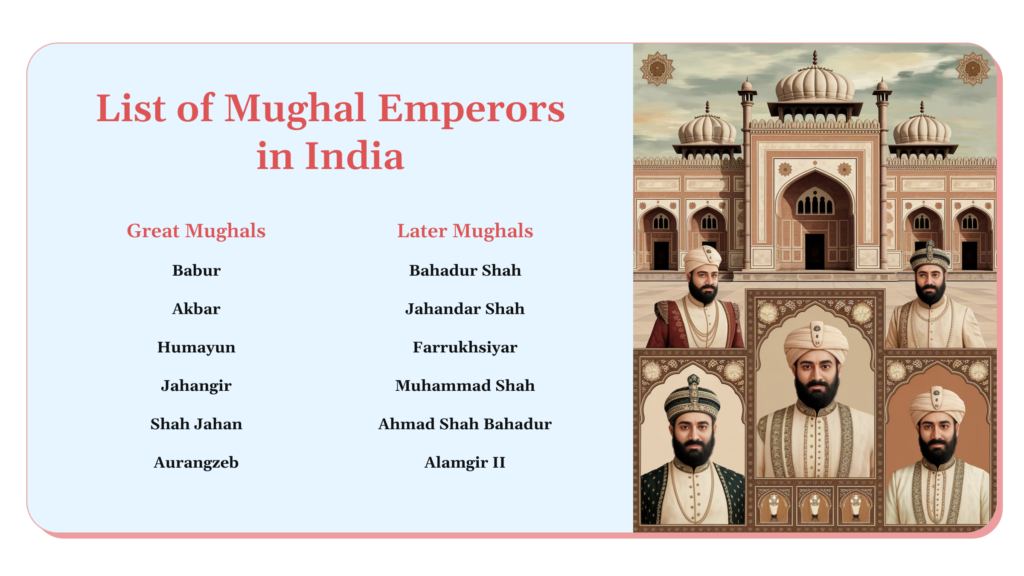
The list of Mughal emperors in India begins with Babur, the first Mughal emperor, and ends with Bahadur Shah II, marking over 300 years of rule.
Famous Mughal emperors like Akbar, Shah Jahan, and Aurangzeb contributed to India’s governance, culture, and iconic architecture like the Taj Mahal.
The Mughal Empire’s decline was due to weak rulers, rebellions, and British colonisation, but its legacy lives on in India’s art, administration, and historical monuments.
Table of Contents
The list of Mughal emperors in India includes some of the most powerful rulers in Indian history, such as Babur, Akbar, Jahangir, Shah Jahan, and Aurangzeb. These emperors ruled from 1526 to 1857, contributing to India’s architecture, art, governance, and culture. This blog presents a timeline of all Mughal rulers, their achievements, and their lasting legacy in shaping modern India.
From Babur’s victories to Aurangzeb’s growth, each emperor showed how they helped the empire with different changes, ideas from books, and the blending of Persian and Indian cultures. Even though some people did not support their rule, their legacies were strong. Let’s learn about Mughal dynasty emperors, their rise, their reigns, and the impressions they left on the subcontinent.
List of Mughal Emperors in India with years
The Mughal Empire was one of the greatest dynasties in Indian history. Their rulers have left a lasting impact on the country. The following table provides a summary of the list of Mughal emperors in India, when they ruled, their main achievements, and significant contributions:
Emperor
Timeline
Major Achievements
Contributions
Babur
1526-1530
Defeated Ibrahim Lodi and won the First Battle of Panipat, and introduced Persian culture
Established Mughal rule in India; defeated Ibrahim Lodi to lay the foundation.
Humayun
1530-1540, 1555-1556
Defeated Ibrahim Lodi and won the First Battle of Panipat, introduced Persian culture
Laid the groundwork for the future stability of the Mughal Empire.
Akbar
1556-1605
Din-i-Ilahi, Nine Jewels (Navratnas), Married Rajput princess
Established a centralized government; promoted arts and architecture (e.g., Fatehpur Sikri).
Jahangir
1605-1627
Nur Jahan’s influence, Trade relations with England
Promoted Mughal painting; facilitated trade with European merchants.
Shah Jahan
1628-1658
Taj Mahal, Red Fort, Peacock Throne
Introduced Persian art styles, built Din-Panah
Aurangzeb
Built iconic structures like the Red Fort and the Jama Masjid.
Most extensive territory, Strict Islamic law
Imposed strict policies; faced rebellions that marked the empire’s decline.
Bahadur Shah I to II
1707-1857
Promoted Mughal painting and facilitated trade with European merchants.
Bahadur Shah II’s reign ended Mughal rule after the revolt of 1857.
List of Mughal Emperors in India
List of Mughal Emperors in order
The Great Mughals:
Babur (1526–1530), Founder of the Empire: A descendant of Timur and Genghis Khan, Babur defeated Ibrahim Lodi at the First Battle of Panipat and introduced gunpowder warfare to India. He established the Mughal dynasty and brought with him Central Asian military strategies and cultural traditions. His memoir, Baburnama, is one of the earliest examples of detailed autobiographical writing in Islamic literature. His short reign laid the groundwork for a dynasty that would dominate the Indian subcontinent for over three centuries.
Humayun (1530-1540; 1555-1556), Transitional Figure: Babur’s son Humayun inherited a fragile empire and struggled against Afghan ruler Sher Shah Suri, losing control temporarily. During his exile in Persia, he absorbed Persian artistic and cultural influences, which he brought back after regaining the throne. His reign was brief and turbulent, but his return helped ensure a smoother succession for his son Akbar and the cultural fusion that would define the Mughal court.
Akbar (1556-1605), Architect of Mughal Glory: Ascending the throne at just 13, Akbar led the Mughal Empire to its political and cultural zenith. He conquered much of North and Central India and integrated diverse communities into his administration. Akbar’s policies of religious tolerance, such as the abolition of jizya and introduction of Sulh-i-kul, fostered harmony. He reorganized land revenue, restructured the mansabdari system, and turned his court into a cultural hub, attracting poets, artists, scientists, and philosophers. Fatehpur Sikri, his capital city, remains a masterpiece of Mughal architecture.
Jahangir (1605-1627), Patron of Arts: Jahangir, Akbar’s son, inherited a stable empire and maintained its prosperity. He was deeply interested in justice, nature, and the arts. His reign saw a golden age of Mughal miniature paintings and artistic innovation. Jahangir’s marriage to Nur Jahan significantly influenced court politics, as she became one of the most powerful women in Mughal history. He encouraged diplomatic ties, including allowing English merchants to establish trade links that laid the foundation for later colonial involvement.
Shah Jahan (1628-1658), Master Builder: Known as the “Architect King,” Shah Jahan presided over the Mughal Empire’s golden age of architecture. His reign is marked by immense wealth, cultural refinement, and monumental construction projects. The Taj Mahal, built in memory of his wife Mumtaz Mahal, symbolizes Mughal architectural excellence. He also commissioned the Red Fort and the Jama Masjid in Delhi. Under Shah Jahan, the empire experienced economic prosperity, but his rule ended in conflict as his son Aurangzeb seized power.
Aurangzeb (1658-1707), Expansion & Orthodoxy: Aurangzeb extended the empire to its greatest territorial limits, stretching from Kashmir in the north to Tamil Nadu in the south. However, his reign also marked the beginning of decline due to his orthodox Islamic policies and military overreach. He reimposed the jizya, restricted religious freedom, and waged long, costly wars in the Deccan. Though a disciplined administrator, his policies alienated many non-Muslim subjects and overstrained the empire’s resources, leading to rebellions and instability.
The Later Mughals:
Bahadur Shah I (1707-1712): Bahadur Shah I, also known as Shah Alam I, inherited a vast but fragile empire after Aurangzeb’s death. His reign was marked by rising regional powers such as the Marathas, Sikhs, and Rajputs asserting autonomy. Though he attempted to reconcile with some factions and secure loyalty from powerful nobles, internal conflicts and his inability to firmly assert authority over the provinces weakened central control. He was the last emperor to hold real influence over the entire empire, albeit tenuously.
Jahandar Shah (1712-1713): Jahandar Shah’s brief reign was characterized by moral decay and administrative breakdown. He came to power after a brutal succession conflict and was heavily influenced by his courtier and consort Lal Kunwar. His policies favored court luxuries over governance. The empire’s image suffered, and his lack of military prowess made him vulnerable. He was deposed and executed by his nephew Farrukhsiyar with the help of the Sayyid brothers.
Farrukhsiyar (1713-1719): Farrukhsiyar ascended the throne with assistance from the Sayyid brothers, who became the de facto rulers of the empire. His reign saw increased decentralization, with nobles gaining disproportionate power. While he issued the famous Farman allowing the British East India Company to trade freely in Bengal, his inability to assert independent control led to his downfall. He was eventually blinded and executed on the orders of the Sayyid brothers.
Muhammad Shah (1719-1748): Muhammad Shah is remembered more for cultural patronage and extravagance than effective governance. During his rule, the empire lost key territories like Gujarat and Malwa to the Marathas. His reign saw the invasion of Delhi by Persian ruler Nadir Shah in 1739, resulting in the sacking of the city and the looting of the Peacock Throne. Despite setbacks, his court remained a center for art, poetry, and music.
Ahmad Shah Bahadur (1748-1754): The son of Muhammad Shah, Ahmad Shah Bahadur was an inept and inexperienced ruler. His reign was marked by increasing corruption, factional rivalry, and loss of central control. The Marathas continued their territorial gains, and the Afghan invader Ahmad Shah Abdali repeatedly attacked northern India. Ultimately, Ahmad Shah Bahadur was deposed by his wazir, Imad-ul-Mulk.
Alamgir II (1754-1759): Alamgir II ruled in name only, with real power in the hands of his wazir, Imad-ul-Mulk. His reign witnessed continued infighting among nobles and foreign incursions. He lacked both authority and vision. In 1759, he was assassinated under suspicious circumstances, likely orchestrated by court factions.
Shah Jahan III (1759): A puppet emperor, Shah Jahan III wielded little real power, with control residing with the nobles.
Shah Alam II (1759-1806): Facing constant invasions and power struggles, Shah Alam II’s reign was marked by significant territorial losses. The Treaty of Allahabad, signed after the Battle of Buxar in 1764, further diminished Mughal authority.
Akbar II (1806-1837): Ruling during a period of British dominance, Akbar II played a minor role in the Indian Rebellion of 1857.
Bahadur Shah II (1837-1857): The last Mughal emperor, Bahadur Shah II, held nominal power under British rule. His involvement in the Indian Rebellion of 1857 led to his exile, effectively marking the end of the Mughal Empire.
Contributions of the Mughal Emperors
The Mughal dynasty emperors made a long-lasting impression on India through their building, art, government, and religious work. The first Mughal emperor, Babur, started this legacy, but every ruler added his skills to it, changing the culture and politics of India. Let’s take a closer look at what they contributed:
Architecture
The grand Mughal emperors are remembered mainly for their architectural excellence. Beyond the famous Taj Mahal, they built entire cities like Fatehpur Sikri, which combined Persian and Indian styles. Their architectural innovations included:
Bulbous domes and tall minarets,
Pietra dura (intricate stone inlay work),
Char Bagh gardens (four-part paradise gardens),
Innovative cooling systems in palaces,
Acoustic engineering in mosques.
Art and Culture
Under the Mughal rulers list, art and culture flourished. Jahangir loved the fine arts. Literature did not lag either, and Persian became the language in court and influenced modern Urdu. Cultural stories were enriched by the poet Amir Khusrau and historians like Abul Fazl.
Created a unique Mughal miniature painting style combining Persian and Indian techniques.
Music flourished greatly, too, since Akbar supported the classical style
of dhrupad. Hence, they also promoted the development of new musical instruments and ragas.
Introduced new clothing styles like the Achkan and Sherwani.
Promoted Urdu language development.
Started detailed chronicle-writing tradition (Akbarnama, Tuzk-e-Jahangiri).
Administration
The timeline of Mughal emperors reveals their sophisticated methods of managing the government. Akbar established a robust central government and distributed the empire into provinces led by the most trusted leaders. He collaborated with Raja Todar Mal to design a fair and effective tax system. Some other key insights on the Mughal administration are:
Mansabdari system (military and civil administration),
Standardised currency and weights,
Land revenue system (Todar Mal’s reforms),
Postal system (Dak Chowki),
Professional bureaucracy.
Religious Policy
The Mughal dynasty had emperors who had different religious rules. Akbar is known to be tolerant and founded the Din-i-Ilahi, which blended all religions. In contrast, Aurangzeb’s strict laws resulted in problems since he reinstated the jizya and curbed cultural freedom. The notable developments in religious policy during the Mughal era were:
Translation of Hindu texts into Persian.
Creation of Sulh-i-kul (universal peace) policy.
Building of composite architectural styles.
Establishment of marriage alliances with Rajput kingdoms.
Development of syncretic traditions.
Legacy of the Mughal Empire
The list of Mughal emperors in India shows a family that greatly influenced India’s history. Their impacts go beyond the time they ruled, starting with the first Mughal emperor, Babur, and ending with Bahadur Shah II. Their cultural legacy is easy to see in India’s lively traditions. Mughal art and literature mixed Persian, Indian, and Central Asian styles that still affect today’s designs. Politically, their centralized administration introduced structured governance. The land revenue system served as a model for subsequent rulers. Even the judicial reforms laid the groundwork for India’s current legal system.
Modern Indian culture, including language and food, is influenced by the Mughals. The popularity of Urdu, Mughlai food, and Basant festivals shows that Mughal traditions have become a part of people’s lives. The emperors of the Mughals connected the past to the present, leaving behind a rich legacy of beauty, variety, and complexity.
Reasons Behind the Decline of Mughal Empire
Weak Successors: After Aurangzeb, the Mughal throne was occupied by a series of incompetent or short-reigning emperors who lacked the charisma, authority, and administrative skill to govern effectively.
Economic Drain: Continuous military campaigns, particularly in the Deccan under Aurangzeb, severely strained imperial finances. Extravagant court spending further depleted the treasury.
Religious Intolerance: Aurangzeb’s strict policies reversed Akbar’s inclusive approach. The reimposition of jizya and the destruction of temples led to widespread discontent among Hindus and Sikhs.
Provincial Revolts: Regional powers like the Marathas, Sikhs, and Rajputs began asserting autonomy. The empire’s inability to suppress these revolts fragmented central authority.
Rise of European Powers: The British East India Company and other colonial powers steadily gained influence through trade, diplomacy, and military strength, eventually overshadowing the weakened Mughal state.
Administrative Decay: Corruption, inefficiency, and decentralization plagued the Mughal administration, leading to a loss of control in distant provinces.
Loss of Military Superiority: The Mughal military, once technologically advanced, failed to modernize while European armies adopted superior firearms and battlefield tactics.
How the Mughals Shaped Modern India!
A list of Mughal emperors in India illustrates how they transformed the nation. From Babur’s wins to Akbar’s astute changes and Shah Jahan’s magnificent structures, each emperor made a distinct impact.
Their influence goes far beyond the buildings and legislation. They helped form India’s identity by combining various cultures and traditions. The Mughals taught the world about governance, art creation, and strength. We not only remember them as leaders but also as builders of India’s spirit. The history of Mughal emperors shows us a dynasty that valued creativity, strength, and diversity, qualities that still represent India today!
Frequently Asked Questions (FAQs)
Who was the first Mughal emperor in India?
The first Mughal emperor was Babur. This emperor founded the Mughal Empire and established himself in India by defeating Ibrahim Lodi in the First Battle of Panipat in 1526. He was a master military tactician and introduced gunpowder into Indian warfare, thus starting the rule of the Mughal Empire in India.
Which Mughal emperor built the Taj Mahal?
Shah Jahan built the Taj Mahal, one of the world’s most iconic monuments. He commissioned it in memory of his beloved wife, Mumtaz Mahal, in 1632. The Taj Mahal is a masterpiece of Mughal architecture, blending Persian, Islamic, and Indian styles. It stands as a symbol of eternal love.
Who was the last Mughal emperor?
Bahadur Shah II, commonly known as Bahadur Shah Zafar, was the last Mughal emperor. He ruled during the 1857 revolt, which ended the Mughal dynasty. After the British suppressed the uprising, Bahadur Shah Zafar was exiled to Rangoon, where he lived the rest of his life in captivity.
What were the major contributions of Akbar?
Akbar was an established visionary leader who also encouraged religious tolerance through means like Sulh-e-Kul (universal peace). He reformulated administration through a centralized government and an efficient tax policy. He also patronized art, literature, and architecture, leaving behind monuments like Fatehpur Sikri and the Akbarnama.
Why did the Mughal Empire decline?
There were many reasons behind the decline of the Mughal Empire. The successors of Aurangzeb, after the great emperor, turned out to be weak. The rebellions by provincial powers and the unprecedented surge of British power further weakened their rule, culminating in their final downfall in 1857.
How many Mughal emperors are there in India?
The Mughal Empire was governed by a total of 16 emperors between the years 1526 and 1857.
Who were the top 5 Mughals?
The top 5 Mughal emperors, based on power, legacy, and cultural influence, are: Babur – Founder of the Mughal Empire (1526) Akbar – Known for expansion, tolerance, and reforms Jahangir – Patron of the arts and stable governance Shah Jahan – Builder of the Taj Mahal Aurangzeb – Longest-reigning emperor with vast territorial control
Who is the No. 1 Mughal Emperor in India?
Emperor Akbar is widely regarded as the No. 1 Mughal Emperor in India due to his military conquests, administrative reforms, religious tolerance, and unifying rule. His reign (1556–1605) marked the golden age of the Mughal Empire and laid the foundation for a centralized, culturally rich Indian state.
Authored by, Muskan Gupta Content Curator
Muskan believes learning should feel like an adventure, not a chore. With years of experience in content creation and strategy, she specializes in educational topics, online earning opportunities, and general knowledge. She enjoys sharing her insights through blogs and articles that inform and inspire her readers. When she’s not writing, you’ll likely find her hopping between bookstores and bakeries, always in search of her next favorite read or treat.