

The laws of reflection form a fundamental principle in physics, explaining how light behaves when it encounters reflective surfaces. Reflection occurs when light rays strike a surface and bounce back, following specific, predictable patterns. These laws are crucial in understanding how mirrors, lenses, and optical instruments function, influencing everything from periscopes and telescopes to vehicle headlights and interior lighting.
Beyond scientific applications, the concept of reflection impacts our daily lives, such as improving visibility, designing safe roads, and creating efficient lighting systems. Mastering the laws of reflection is particularly important for students, as it forms a core topic in physics curricula and competitive exams like UPSC, SSC, and other science-based assessments. A clear understanding of these principles helps solve numerical problems and strengthens conceptual knowledge, making it easier to grasp more advanced optics and modern physics topics.
The law of reflection is a fundamental principle in physics that explains how light behaves when it strikes a reflective surface. In simple terms, it states that the light ray hitting a surface (incident ray) bounces back (reflected ray) in a predictable manner.
The law has two main key points:
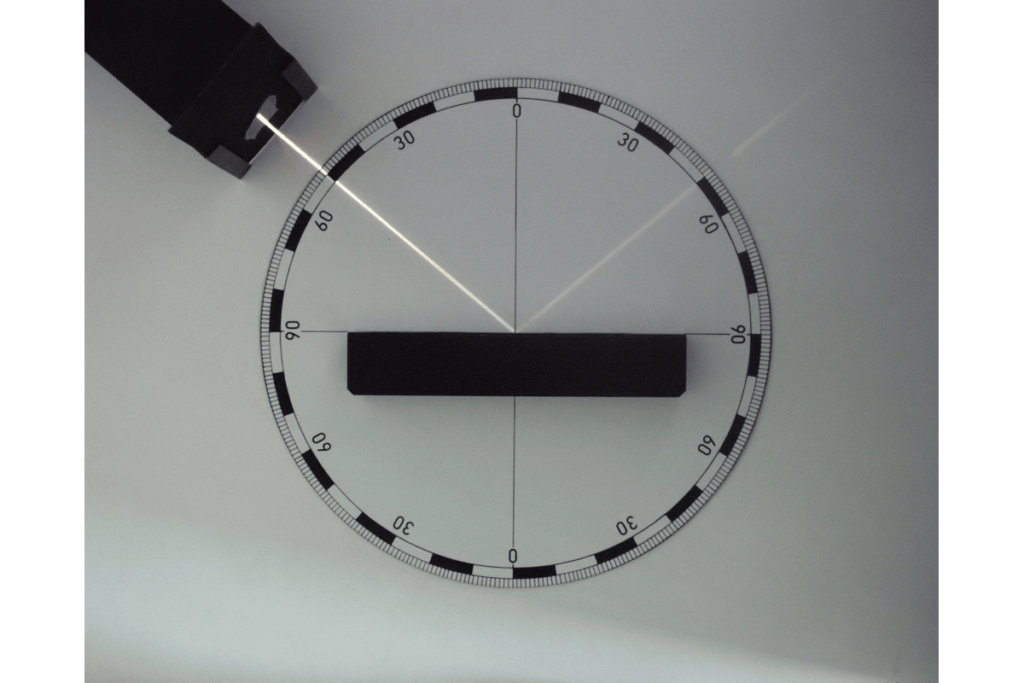
A plane mirror diagram is an ideal way to visualize this. It shows the incident ray striking the mirror, the normal at the point of incidence, and the reflected ray bouncing off at an equal angle. This diagram helps students understand the predictable nature of light reflection.

Hero of Alexandria first explored the law of reflection in the 1st century AD. Later, Ibn al-Haytham (Alhazen), the renowned Arab scientist of the 10th–11th centuries, conducted detailed studies on light and mirrors, laying the foundation for modern optics.
Understanding this law is essential for students preparing for UPSC, SSC, or physics exams, as it forms the basis for solving numerical problems and grasping advanced concepts in optics and daily applications like mirrors, periscopes, and optical devices.
The reflection of light can occur in different ways depending on the nature of the surface on which it strikes. Broadly, reflection is classified into specular and diffuse reflection, each with distinct characteristics and real-life examples. Understanding these types is essential for students preparing for UPSC, SSC, or physics exams, as they form the basis of many optics problems.

Specular reflection occurs when light reflects off a smooth and polished surface. In this type, the reflected rays remain parallel, producing a clear and sharp image. The angle of incidence still equals the angle of reflection, following the law of reflection.
A classic example of specular reflection is the reflection of objects in a calm lake or a plane mirror. When light rays hit the smooth water surface, they reflect uniformly, allowing the observer to see a clear image of the surrounding trees or sky.
Specular reflection is crucial in everyday life and technology, including mirrors, optical instruments, periscopes, and cameras, where precise image formation is required.
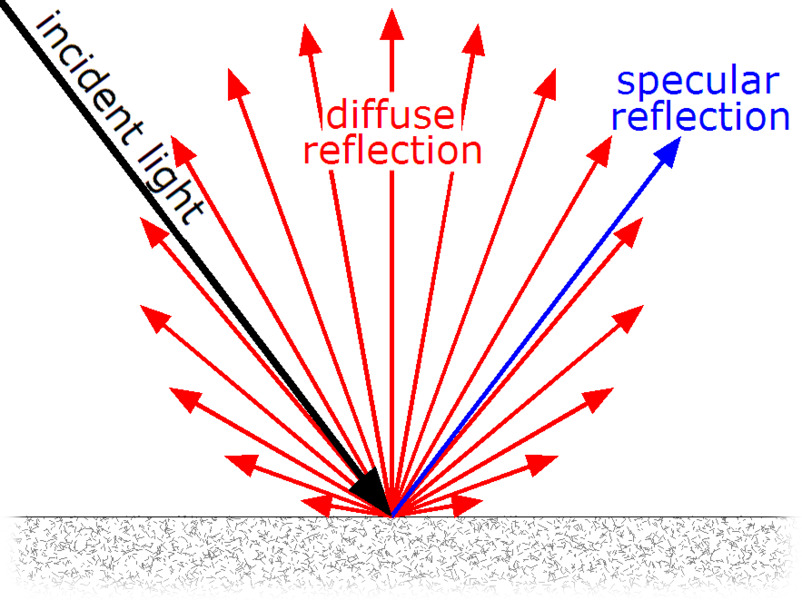
Diffuse reflection occurs when light strikes a rough or irregular surface. Unlike specular reflection, the reflected rays scatter in multiple directions, making it impossible to form a sharp image. Despite this scattering, the law of reflection still applies at each microscopic point on the surface.
An everyday example is sunlight falling on a rough wall or white paper. The light rays bounce in various directions, allowing the surface to appear bright from all angles. Diffuse reflection is essential for illumination, ensuring light spreads evenly in rooms, streets, and open areas.
Understanding the difference between specular and diffuse reflection can help students analyze real-life optical phenomena and solve numerical problems more effectively. These concepts are also applied in designing lighting systems, screens, and photography setups, demonstrating the practical significance of reflection in daily life.
The reflection of light can be precisely described using a simple mathematical formula based on the law of reflection: θi=θr\theta_i = \theta_rθi=θr
Here, θi represents the angle of incidence, the angle between the incident ray and the normal (an imaginary line perpendicular to the surface at the point of contact). θr represents the angle of reflection between the reflected ray and the normal. Both angles are measured in degrees from the normal, not the surface.
This mathematical representation allows students to calculate reflection angles for various scenarios, particularly useful in physics exams and practical applications like optics.
Plane mirrors are flat, polished surfaces that reflect light according to the laws of reflection. When light rays strike a plane mirror, they bounce off at equal angles, making reflection predictable. This principle allows plane mirrors to form virtual images, which appear behind the mirror, and explains laterality or left-right reversal. Understanding reflection in plane mirrors is essential for exam preparation (UPSC, SSC, Physics) and practical applications, from daily use in bathrooms and dressing rooms to scientific devices like periscopes and optical instruments.

When light strikes a plane mirror, it follows the laws of reflection: the angle of incidence equals the angle of reflection, and the incident ray, reflected ray, and normal lie in the same plane. The reflected rays remain orderly, forming transparent and predictable images. This principle ensures that mirrors provide accurate representations of objects, which is vital for both practical uses and solving optics problems in exams.
Plane mirrors produce virtual images, meaning the image appears behind the mirror and cannot be projected onto a screen. The reflected rays only appear to diverge from a point behind the mirror. The virtual image is upright, the same size as the object, and laterally inverted, helping us understand how mirrors function in daily life and optical instruments.
A unique feature of plane mirrors is laterality, or left-right reversal. For example, when you raise your right hand, your mirror image appears to raise its left hand. This reversal occurs because the mirror flips the object along the axis perpendicular to its surface, while top-bottom orientation remains unchanged.
Plane mirrors are used in bathrooms, dressing rooms, and vehicles for personal grooming and safety. They are essential in periscopes, telescopes, and microscopes, where precise reflection is required. Mirrors also enhance room brightness and create the illusion of larger spaces, demonstrating their practical significance in daily life.
A simple ray diagram can illustrate plane mirror reflection: draw an object before the mirror, the incident ray striking the mirror, the reflected ray, and the virtual image behind the mirror. Label the angles of incidence and reflection to show the law of reflection in action.
Curved mirrors have surfaces that are either concave (curved inward) or convex (curved outward), causing light rays to converge or diverge. Understanding their reflection behavior is essential for exam preparation and practical applications in daily life.
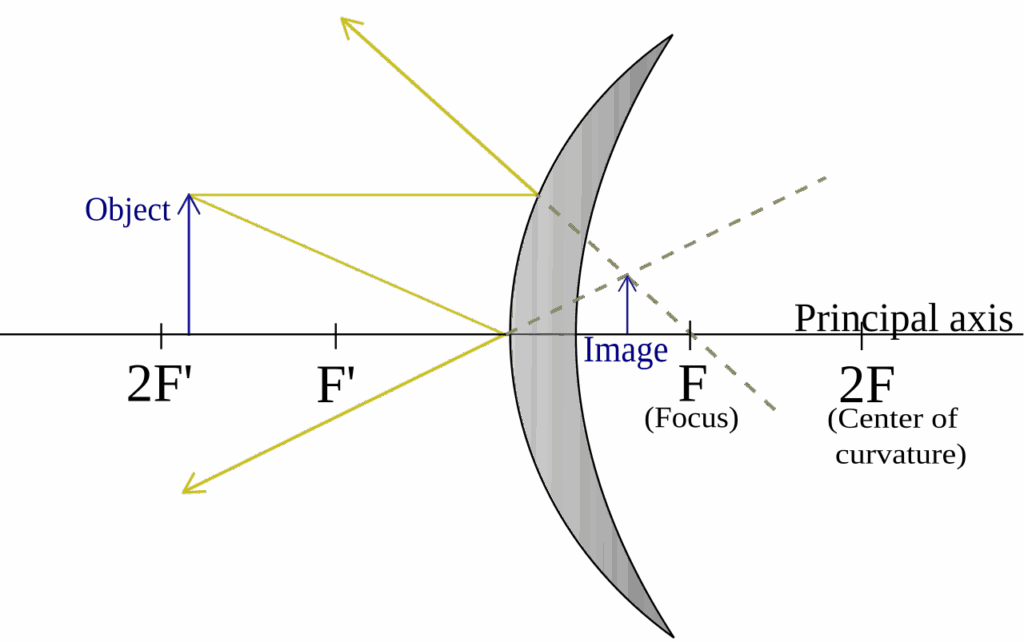
Concave mirrors focus incoming parallel rays toward a focal point, allowing the formation of real or virtual images depending on the object’s position. A real image forms when the object is beyond the focal point and can be projected on a screen, while a virtual image appears behind the mirror and cannot be projected. These mirrors are commonly used in makeup mirrors, shaving mirrors, and vehicle headlights, where focusing light efficiently is essential.
Convex mirrors diverge light rays, producing virtual, upright, and diminished images. Although the images are smaller, they provide a wider field of view, making convex mirrors ideal for vehicle rearview mirrors, security mirrors, and road safety mirrors. They help drivers and security personnel monitor large areas safely.
The mirror formula (1/f=1/v+1/u)(1/f = 1/v + 1/u)(1/f=1/v+1/u) and curvature formula (R=2f)(R = 2f)(R=2f) are used to calculate focal length, object distance, and image distance. Diagrams of concave and convex mirrors showing incident rays, reflected rays, focal points, and virtual or real images help visualize how light behaves on curved surfaces.
Concave mirrors are found in torchlights, telescopes, and solar concentrators, while convex mirrors appear in vehicles, ATMs, and security systems. These practical examples highlight how curved mirrors enhance visibility, safety, and focused illumination in daily life.
The laws of reflection are not just theoretical concepts; they have numerous practical applications in daily life and scientific instruments. Understanding how light reflects enables the design of devices that improve visibility, safety, and imaging.
By applying the laws of reflection, these devices improve daily life, scientific research, and technology, highlighting the practical significance of light reflection.
Demonstrating the laws of reflection through simple experiments helps students practically understand the principles of light behavior. A typical classroom experiment uses a plane mirror and a ray box.
This hands-on approach reinforces theoretical knowledge and helps exam-focused students understand the practical applications of reflection, improving comprehension for UPSC, SSC, and physics exams.
Understanding the laws of reflection is crucial for students, professionals, and anyone interested in practical applications of light.
Reflection is a core concept in optics for students preparing for UPSC, SSC, or physics exams. It helps solve numerical problems, understand ray diagrams, and perform practical experiments in physics labs. Mastery of this topic builds a strong foundation for more advanced optics and modern physics concepts.
Reflection principles are widely applied in optics, astronomy, and laser technology. Telescopes use concave mirrors to focus light from distant stars. Lasers and optical instruments rely on precise reflection for accurate measurements and imaging. Projectors, cameras, and scientific equipment depend on controlled reflection for functionality.
Reflection plays a significant role in daily life. Household, vehicle rearview, and dressing mirrors rely on these laws. Convex mirrors enhance road safety by providing a wider field of view, while cameras and photography equipment utilize reflection to capture images accurately.
By understanding these laws, students can connect theoretical knowledge with real-world applications, making it easier to solve problems, design optical devices, and appreciate the role of light in daily life and technology.
Reflection of light is often misunderstood, leading to several common misconceptions among students.
This is false. Reflection occurs on any smooth surface, not just mirrors. Calm water, polished metal, or glass surfaces can also reflect light, producing clear or faint images depending on surface smoothness. For example, trees reflected in a calm lake illustrate natural reflection.
Many students incorrectly believe the incident ray always strikes at 90°. In reality, the angle of incidence can vary, and it is measured from the normal, not the surface. Only when the ray is perpendicular to the surface is the angle 0°, producing no noticeable deviation.
Students often mix up real and virtual images. A real image forms where reflected rays converge and can be projected on a screen, while a virtual image appears behind a mirror and cannot be projected. For example, images in a plane mirror are virtual, whereas pictures on a screen from a concave mirror are authentic.
Clarifying these misconceptions helps students accurately apply the laws of reflection, improving conceptual understanding and performance in physics exams.
The laws of reflection are fundamental principles in physics, explaining how light behaves when it strikes different surfaces. From plane mirrors to curved mirrors, understanding reflection involves knowing the types of reflection (specular and diffuse), the mathematical formula θi=θrθ_i = θ_rθi=θr, and the behavior of concave and convex mirrors. These principles are essential not only for academic success in exams like UPSC, SSC, and physics competitions but also for practical applications in daily life and technology, including mirrors, cameras, telescopes, periscopes, and vehicle safety.
Students can deepen their understanding by exploring related topics such as refraction, lenses, and mirror optics, which build on the foundational concepts of reflection. Mastery of these concepts bridges the gap between theory and real-world applications, fostering both academic and practical knowledge in the study of light.
Read more:
The third law of reflection states that the incident ray, reflected ray, and the normal at the point of incidence all lie in the same plane, ensuring predictable light behavior.
The two laws of reflection are: (1) the angle of incidence equals the angle of reflection, and (2) the incident ray, reflected ray, and normal all lie in the same plane.
The first law of reflection states that the angle of incidence equals the angle of reflection. The second law states that the incident ray, reflected ray, and standard lie in the same plane.
Newton’s laws are: (1) First Law – an object remains at rest or in motion unless acted on by force. (2) Second Law – F = ma. (3) Third Law – action equals reaction.
The 3 R’s of reflection are Recall, Recognition, and Relate. These help students review, understand, and connect learned concepts effectively.