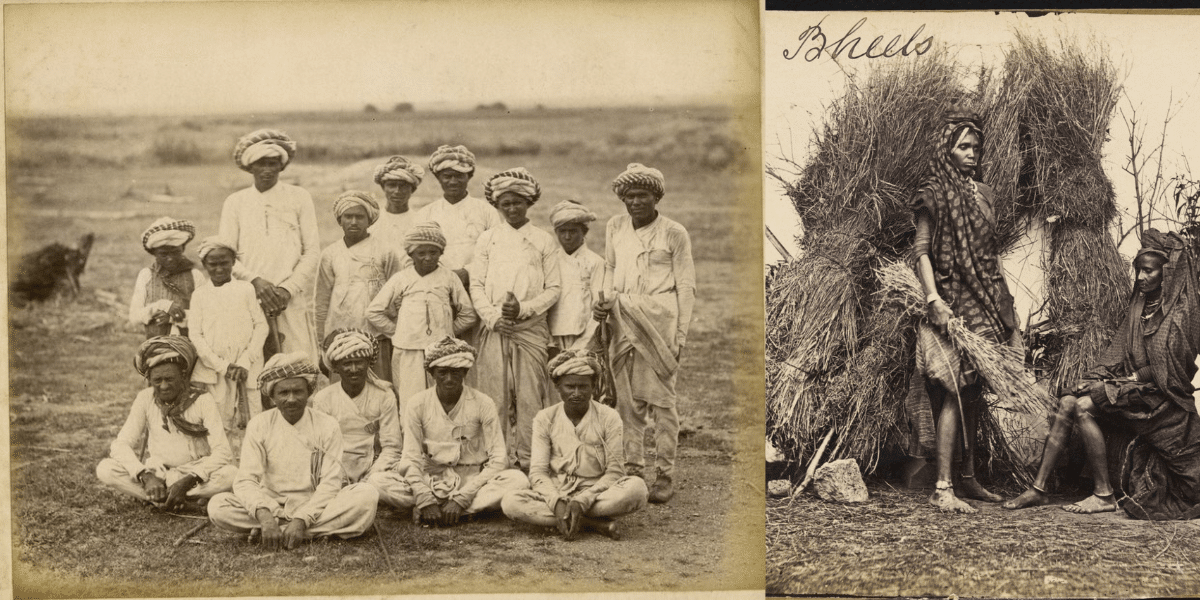
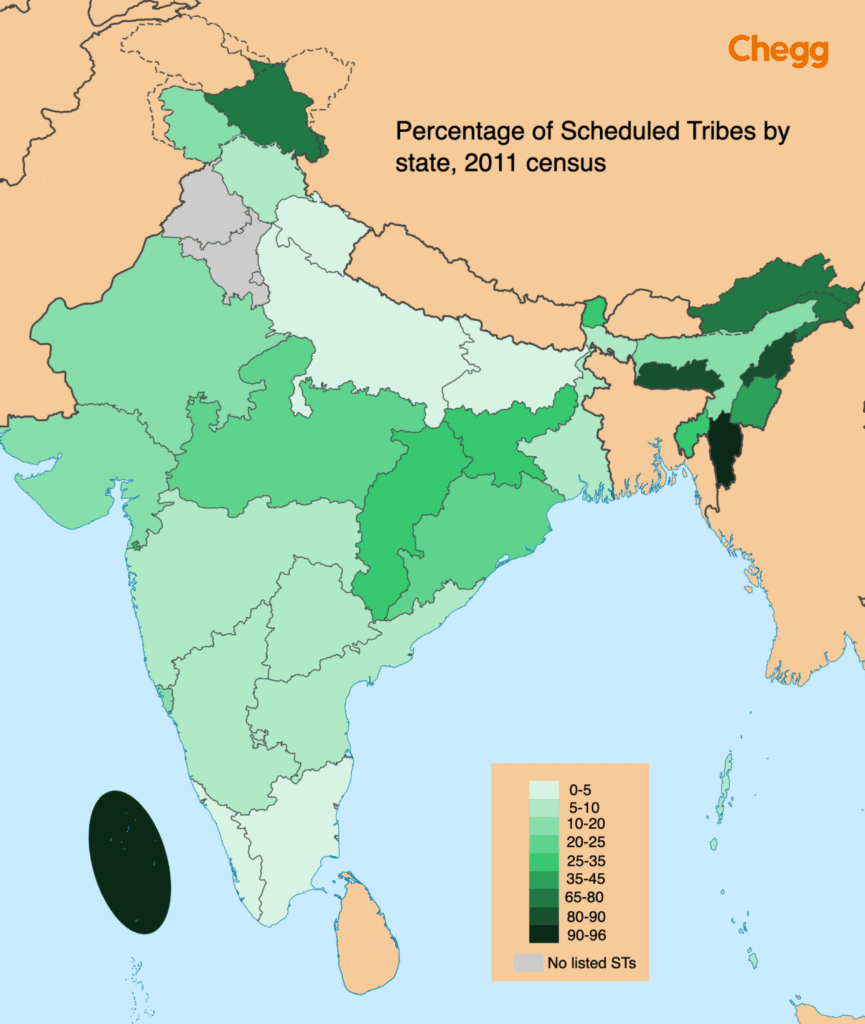
India is home to over 700 officially recognized Scheduled Tribes, representing around 8.6% of the country’s population making it the second-largest tribal population globally after Africa. Among these, the Bhil tribe stands out as the most numerous, constituting about 16.4% of all Scheduled Tribe members. Following close behind, the Gond tribe accounts for roughly 12.7% of the tribal populace, with over 13 million people identifying as Gond, according to Census 2011 data.
A tribe refers to individuals who live and work together in a particular shared geographical area. The tribe often has a common culture, dialect, and religion. They live in a tribal area where the tribe is usually headed by a leader called the chief. They are a part of the larger tribal society, a group of tribes organized around kinship. India has the world’s second-largest tribal population. These tribal people make up around 8.9% of the population, as mentioned in the Census 2011.
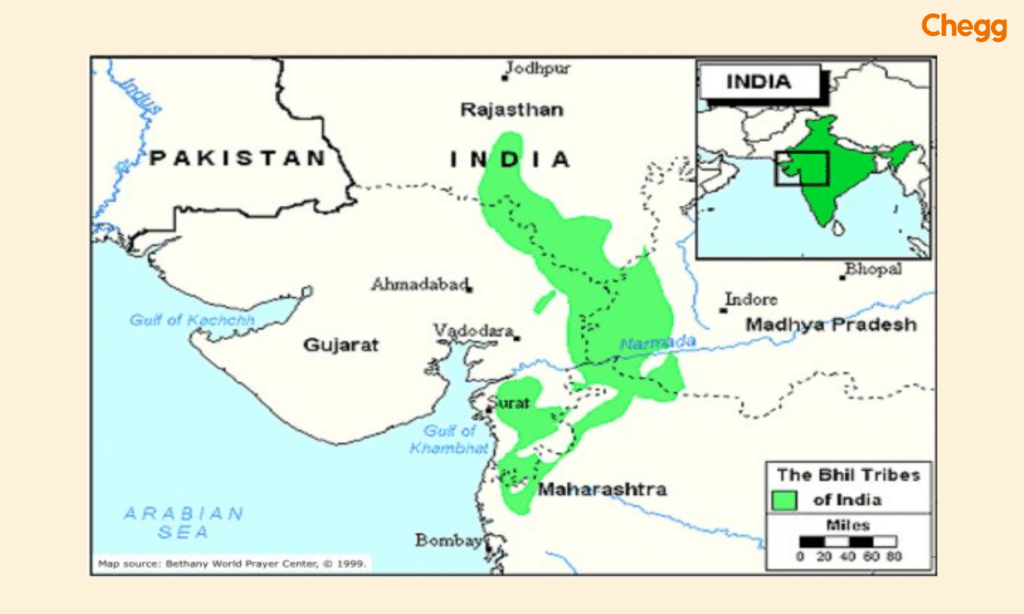
The Bhil tribe, the largest tribal community in India, makes up nearly 38% of the Scheduled Tribe population according to the 2011 Census. Spread across states like Madhya Pradesh, Rajasthan, Gujarat, Maharashtra, and Chhattisgarh, the Bhils speak their own language along with Marathi, Gujarati, and other regional tongues. Known for their traditional hunting skills and vibrant folk culture, they are also celebrated for Bhil Art a unique dot-style painting that depicts daily life, deities, and ancestral stories using natural colors and brushes made from neem twigs.
Moreover, their language is of Dravidian origin. The people from the Bhil tribe are Hindus by religion. They appease evil spirits and deities of the forest. A few others offer pujas to Lord Shiva and Goddess Durga. A small percentage of people, among them, also follow Christianity.
Bhil Art refers to the traditional art form of the Bhil tribe, one of the largest indigenous communities in India. This art is primarily practiced by the Bhils, who are spread across several states, including Madhya Pradesh, Gujarat, Rajasthan, Maharashtra, and Odisha. Bhil art is deeply connected to the community’s cultural expressions, rituals, and daily life, reflecting their natural surroundings, spiritual beliefs, and history.
You can easily divide the different dialects prevalent in India into five major language families. These tribal community languages start from the first civilizations of Indo-Aryan, Andamanese, Dravidian, Tibeto-Burman, and Austro-Asiatic. However, it is best to look at the regions where the tribal population inhabits for a better understanding of the tribal region segregation. Therefore, a glance at the Indian map will divide the country into five major belts, as mentioned below.
This particular region consists of states nicknamed the seven sisters, along with Uttar Pradesh and Himachal Pradesh. The seven North Eastern States that include Indian tribes are as follows:
The Tibeto-Burman speakers are mostly confined along the Himalayan belt in India. These types of tribes are contiguous with the international boundaries. The tribal groups speaking the Tibeto-Burman languages come from the Mongoloid stock who inhabit the North East region of India.
This belt is home to almost half of India’s population. Bihar, Odisha, West Bengal, and Madhya Pradesh are the states that fall under this belt category. Some important Dravidian languages in Central India are Kurukh, spoken by the Oraon; Kui, spoken by the Kondh of Orissa; and Malto, spoken by tribes of the Rajmahal hills.
The western Indian belt includes the following states:
Santhali, Dravidian, Austro-Asiatic, Indo-European, and Sora are some of the languages spoken in this region. This Indian belt also includes the Gonds, the largest tribe in India.
The Dravidian belt is mostly the South Indian region, which includes
The main languages are Kannada, Malayalam, Tamil, and Telugu spoken in this belt. Out of them, Tamil is the oldest and the first Dravidian language. For the unversed, the Dravidian language category is the second-largest language family in the country, with around 277 million speakers.
It includes India’s Andaman and Nicobar Islands and Lakshadweep Islands. The native Andamanese people, who are tribals, speak languages like Tamil, Malayalam, Hindi, English, and Bengali. These are different from the Nicobari languages, like the Shompen and Moh-Khmer languages. Very few of them speak the Jero language. It is one of the last remaining indigenous languages in the islands. There are different types of tribes residing in Lakshadweep who speak Malayalam and the Mahi (old Sinhalese) language.
Article 342 of the Indian Constitution lists the tribal communities in India based on the states and union territories. According to Article 342, these Scheduled Tribes are the tribal communities declared as such by the President through any public notification. The following table represents the tribal communities in India by state.
| Tribal Languages in India | Tribal Communities | State Name |
| Baigani | Indo-Aryan Family | Chattisgarh |
| Bhili | Gujarat, Rajasthan | |
| Chakma | West Bengal, Assam | |
| Dhanki | Gujarat, Rajasthan, Maharashtra | |
| Dhundhari | Rajasthan | |
| Garasia | Gujarat, Rajasthan | |
| Gujjari | Haryana, Uttar Pradesh, Madhya Pradesh, Rajasthan, Gujarat, Punjab, Delhi | |
| Hajong | Meghalaya, Assam, Arunachal Pradesh | |
| Harauti | Rajasthan, Madhya Pradesh | |
| Halbi | Rajasthan, Gujarat, and Andhra Pradesh | |
| Jaunsari | Uttarakhand, Uttar Pradesh, Himachal Pradesh | |
| Khotta | West Bengal | |
| Kokni | Gujarat, Rajasthan | |
| Kotwalia | Madhya Pradesh, Rajasthan, Gujarat | |
| Thar | Rajasthan | |
| Lamani | Madhya Pradesh, Himachal Pradesh, Gujarat, Tamil Nadu, Odisha, West Bengal | |
| Magahi | Bihar, Jharkhand, West Bengal | |
| Mavchi | Gujarat, Maharashtra | |
| Nimari | Madhya Pradesh, Uttar Pradesh, Maharashtra | |
| Rathi | Madhya Pradesh, Maharashtra | |
| Tharu | Uttar Pradesh, Jharkhand, Assam, Madhya Pradesh, West Bengal | |
| Wagri | Rajasthan, Gujarat, Andhra Pradesh | |
| Warli | Maharashtra, Gujarat, Dadra & Nagar Haveli | |
| AdiAshing | Tibeto-Burman Family | Arunachal Pradesh |
| Apatani | Arunachal Pradesh | |
| Ao | Nagaland | |
| Balti | Kashmir | |
| Dafla | Arunachal Pradesh | |
| Bodo | Assam | |
| Bhotia | Uttarakhand | |
| Chiru | Manipur, Nagaland | |
| Deori | Assam, Arunachal Pradesh | |
| Duhlian-Tawng | Mizoram | |
| Gangte | Manipur, Meghalaya, Assam | |
| Hmar | Mizoram, Manipur, Assam | |
| Hualngo | Mizoram | |
| Koireng | Manipur | |
| Konyak | Arunachal Pradesh, Nagaland | |
| Lahauli | Himachal Pradesh | |
| Mara | Mizoram | |
| Lushai | Mizoram, Tripura, Assam, Manipur, Meghalaya, Nagaland | |
| Mishing | Assam | |
| Monpa | Arunachal Pradesh | |
| Naga | Nagaland | |
| Sherdukpen | Assam, Arunachal Pradesh | |
| Paite | Manipur | |
| Rengma | Nagaland | |
| Sajalong | Arunachal Pradesh | |
| Singpho | Arunachal Pradesh, Assam | |
| Tagin | Assam | |
| Vaiphei | Manipur, Assam, Meghalaya, Tripura | |
| Wancho | Nagaland | |
| Zakhring | Arunachal Pradesh | |
| Zou | Manipur | |
| Dhurwa | Dravidian Family | Chattisgarh |
| Gondi | Madhya Pradesh, Gujarat, Andhra Pradesh, Maharashtra, Chhattisgarh | |
| Koraga | Karnataka, Kerala | |
| Kodagu | Karnataka | |
| Kolami | Andhra Pradesh, Maharashtra | |
| Koya | Andhra Pradesh, Odisha | |
| Kui | Odisha | |
| Kuvi | Odisha | |
| Kurukh | Bihar, Jharkhand, Odisha, Chhattisgarh | |
| Maria | Madhya Pradesh, Maharashtra, Chhattisgarh | |
| Naiki | Andhra Pradesh, Maharashtra | |
| Parji | Madhya Pradesh | |
| Pengo | Odisha | |
| Tulu | Karnataka, Kerala | |
| Yerukula | Andhra Pradesh | |
| Asuri | Austro-Asiatic Family | Jharkhand |
| Bondo | Odisha | |
| Juang | Odisha | |
| Ho | Jharkhand, Odisha | |
| Kharia | Chhattisgarh, Jharkhand, West Bengal, Odisha, Andaman & Nicobar Islands, Assam, Tripura | |
| Korku | Madhya Pradesh, Maharashtra | |
| Kurmi | Maharashtra | |
| Korwa | Chhattisgarh | |
| Lodha | West Bengal, Odisha | |
| Mundari | Jharkhand | |
| Nicobarese | Nicobar Islands | |
| Savara | Andhra Pradesh | |
| Santali | Jharkhand, Assam, Odisha, Tripura, West Bengal, Assam | |
| Shompen | Andaman & Nicobar Islands | |
| Jarawa | Andamanese Family | Andaman & Nicobar Islands |
| Santinelese | Sentinel Islands – Andaman | |
| Onge | Andaman Islands |
The Constitution of India has recognized tribal communities under ‘Schedule 5’ of the Indian Constitution. That’s why the Constitution recognizes the tribal people as ‘Scheduled Tribes’. So, if you ask how many tribes there are in India, the country has around 645 groups. Here’s a state-wise arrangement of the major tribes of India for better understanding:
The Bhils which is the largest tribe in India and are famously known as the bowmen of Rajasthan. They are spread across various parts of the country, especially in Madhya Pradesh, Gujarat, Maharashtra, Rajasthan, and even parts of Tripura. Bhils are grouped into two main types: the eastern (Rajput) Bhils and the central (pure) Bhils. Their traditional language is called Bhili, and their population is around 4.6 million.
In villages, Bhils live in small clusters called Falia, usually led by elders and planned based on resources like water, firewood, farmland, and grazing areas. They also have different clans like Ahir, Bhore, Bhavare, and Pawar.
Bhils celebrate their main festival called the Baneshwar Fair, held during Shivratri on the banks of the Som and Mahi rivers. The event includes traditional dances, songs, animal acts, and magic shows. Other major festivals they enjoy include Holi and Dussehra.
The Bhil tribe boasts a rich and ancient history. Their name itself, believed to be derived from the Dravidian word “billu,” meaning “bow and arrow,” reflects their close association with archery. References to Bhils appear in the epics of Ramayana (associated with Shabri) and Mahabharata (Eklavya). Sanskrit literature also mentions them, with the Katha-Sarit-Sagar (600 AD) describing a Bhil chief mounted on an elephant, fiercely defending his territory in the Vindhya Mountains.
While some accounts suggest that the Bhils once wielded political power, they are believed to have retreated to the jungles and hills after facing defeat. Rajputs, Muslims, and Marathas gradually encroached upon their lands. Despite these challenges, the Bhils’ physical prowess made them valuable allies. Rajput kings, recognizing their strength, even incorporated Bhil symbols into their emblems and invited Bhil chiefs to participate in coronation ceremonies. This highlights a period of co-existence and even inter-community relationships between Bhils and Rajputs.
The Bhils’ story is one of resilience and adaptation. From their ancient roots to their encounters with various kingdoms, they have carved a unique space in history, leaving behind a legacy of courage and cultural richness.
The Gond tribe, the second largest tribe in India, is a cornerstone of the country’s cultural richness. Central India forms their heartland, with Gond communities flourishing in Madhya Pradesh, Chhattisgarh, Maharashtra, and pockets of Odisha and Andhra Pradesh. This diverse geographical spread, encompassing forests, hills, and plains, has left its mark on the Gond way of life.
The Gonds are more than just geographically dispersed. Renowned for their exquisite art forms, the Gonds express themselves through vibrant paintings and intricate metalwork. They weave their deep-rooted spiritual beliefs into their daily lives and artistic expressions. Furthermore, the Gonds demonstrate their deep connection to the land through sustainable agricultural practices.
In essence, the Gonds are not merely a tribe; they are a vibrant cultural force that has significantly shaped the identity of Central India.
Understanding the Tribals in India involves exploring the rich cultural, social, and historical diversity of indigenous communities that have inhabited the Indian subcontinent for thousands of years. India is home to one of the largest and most diverse tribal populations in the world, with over 700 recognized tribes, each with its unique traditions, languages, customs, and ways of life.
While there are several government initiatives aimed at improving the conditions of tribals, challenges like cultural erosion, social integration, economic disparity, and lack of basic infrastructure continue to persist.
Understanding the Tribals in India means acknowledging the deep cultural, social, and historical roots of these communities, as well as addressing the modern challenges they face. Tribal societies have rich traditions, languages, and customs that contribute significantly to India’s cultural diversity. However, they continue to battle social and economic inequalities, requiring both legal protections and sustainable development practices to ensure their empowerment and well-being in the modern world.
Read More:-
The term ‘scheduled tribe’ refers to the tribal community categories in India that are a part of Article 342 of the Indian Constitution.
Article 366 (25) of the Indian Constitution prescribes that the scheduled tribes are the categories deemed under Article 342 in the country.
The Bhils, Gonds, Santhals, Khasis, Angamis, Garos, Bhutias, and Kodabas are among the major tribes in India.
The tribal people are also called the ‘Adivasis’ in the country.
Mizoram, a state, and Lakshadweep, a Union Territory, stand out with 94.4% and 94.8% of their respective populations being tribal. Across India, the tribal population constitutes 8.6% of the total populace.
Based on population data from Census 2011, the six largest tribes are:
Bhil (~17 million, 16.4%)
Gond (~13.25 million, 12.7%)
Santhal (~6.57 million)
Mina (~4.35 million)
Naikda (~3.79 million)
Oraon (~3.68 million)