The largest lake in India is Vembanad Lake, located in Kerala, covering an area of about 2,033 sq km. It is not only the biggest freshwater lake but also the longest, stretching across multiple districts, including Alappuzha, Kottayam, and Ernakulam. Vembanad plays a vital role in Kerala’s ecosystem, backwater tourism, and fishing economy.
Following it, the largest brackish water lake in India is Chilika Lake in Odisha, spanning around 1,100–1,165 sq km. It is famous as a UNESCO-recognized wetland and a biodiversity hotspot that hosts migratory birds from across the globe. Other notable large lakes include Loktak Lake in Manipur, known for its floating phumdis, and Pulicat Lake in Andhra Pradesh and Tamil Nadu, the second-largest brackish water lagoon in the country.
Thus, while Vembanad is the largest overall, Chilika and others hold ecological, cultural, and geographical significance.
Lakes hold immense significance in India’s geography, culture, and ecosystem. They serve as crucial reservoirs of freshwater. Lake waters assist in supporting irrigation, drinking water, and industrial needs. They contribute largely to India’s rich ecological diversity. They provide a home to various plant and animal species, some unique to specific lakes. and also influence climate moderation, carbon storage, and flood control during monsoons. At the same time, they act as natural purifiers, enhancing water quality through processes like sedimentation and nutrient removal. Indian lakes are not merely geographic features; they symbolize culture, vital ecosystems, and economic assets, serving multifaceted roles in the nation’s prosperity and well-being.
These lakes play a vital role in water supply, biodiversity, tourism, and hydroelectric power.
| Rank | Lake Name | Type | Location | Key Feature |
|---|---|---|---|---|
| 1 | Vembanad Lake | Brackish / Lagoon | Kerala | The longest lake in India, famous backwaters, and houseboats |
| 2 | Chilika Lake | Brackish / Lagoon | Odisha | The largest coastal lagoon in India, a bird sanctuary |
| 3 | Shivaji Sagar | Reservoir | Maharashtra | Largest coastal lagoon in India, a bird sanctuary |
| 4 | Indira Sagar | Reservoir | Madhya Pradesh | Formed by the Koyna Dam, important for power generation |
| 5 | Pangong Lake | Endorheic (Saltwater) | Ladakh | India’s largest reservoir, a major hydropower project |
| 6 | Pulicat Lake | Brackish Lagoon | Andhra Pradesh & Tamil Nadu | Created by the Sardar Sarovar Dam, supplies water & electricity |
| 7 | Sardar Sarovar Lake | Reservoir | Gujarat | The largest freshwater lake in India, unique floating gardens |
| 8 | Loktak Lake | Freshwater | Manipur | Famous for floating phumdis and Keibul Lamjao National Park |
| 9 | Wular Lake | Freshwater | Jammu & Kashmir | High-altitude lake stretches into China |
| 10 | Kolleru Lake | Freshwater | Andhra Pradesh | Second second-largest lagoon in India |
The largest lake in India are natural wonders and crucial resources for the nation. India’s lakes are a testament to its geographical diversity and cultural richness. They not only provide captivating landscapes but also provide valuable resources. They also engage in supporting ecosystems and enhancing the lives of millions across the nation.
Let’s explore the diverse types of lakes found across the country:
Glacial Lakes: A glacial lake is created when a glacier melts and fills the depression it fills the water. Glacial lakes can affect the local ecosystem and water availability downstream, so tracking changes in the number of glacial lakes is important.
Tectonic Lakes: Tectonic lakes are formed as a result of movements in the Earth’s crust, which create depressions or hollows in the Earth’s surface. These are then filled up with water to form large and deep lakes. These are formed due to natural geological forces.
Volcanic Lakes: Volcanic lakes are usually created following an eruption. The melted rock flows out of the crater, and the water running off the surrounding land collects in the crater to form a lake. If the lake sits above the ruptured volcano, it can also be molten. Some volcanic lakes, such as Pozzo del Merro, Rome; Lake Te Anau, Southland, New Zealand; and Lake Viedma, Argentina, are filled with pure fresh water. Other lakes contain sulphuric minerals, making the lake toxic and acidic.
Oxbow Lakes: Oxbow lakes are created when a river’s wide meander is severed and the river finds a new, shorter course. One example of an Oxbow lake is Chandubi in Assam.
Saltwater Lagoons: Salt concentrations are high in saltwater lakes. A saltwater lake is the Sambhar Lake in Rajasthan.
Crater Lakes: When there is a collapse or violent volcanic eruption, crater lakes are created. Lonar Lake in Maharashtra is an illustration of a crater lake.
Artificial Lakes: These man-made lakes are intended to hold water for public use. One artificial lake is Chembarambakkam in Tamil Nadu.
The various criteria for measuring the size of different types of lakes in India are:
| Lake Name | Location |
| Pulicat Lake | Tamil Nadu, Andhra Pradesh |
| Kolleru Lake | Andhra Pradesh |
| Haflong Lake | Assam |
| Deepor Beel | Assam |
| Chandubi Lake | Assam |
| Kanwar Lake | Bihar |
| Hamirsar Lake | Gujarat |
| Kankaria Lake | Gujarat (Ahmedabad) |
| Badkhal Lake | Haryana (Faridabad) |
| Brahma Sarovar | Haryana (Kurukshetra) |
| Chandra Taal | Himachal Pradesh |
| Maharana Pratap Sagar | Rajasthan (Kota) |
| Dal Lake | Jammu & Kashmir (Srinagar) |
| Wular Lake | Jammu & Kashmir |
| Agara Lake | Karnataka (Bangalore) |
| Ulsoor Lake | Karnataka (Bangalore) |
| Kuttanad Lake | Kerala (Alappuzha) |
| Sasthamkotta Lake | Kerala (Kollam) |
| Bhojtal | Madhya Pradesh (Bhopal) |
| Shivsagar | Assam |
| Loktak Lake | Manipur |
| Umiam Lake | Meghalaya (Shillong) |
| Tam Dil | Mizoram |
| Chilika Lake | Odisha |
| Harike Lake | Punjab |
| Kanjli Lake | Punjab |
| Sambhar Lake | Rajasthan |
| Tsomgo Lake | Sikkim |
| Chembarambakkam Lake | Tamil Nadu (Chennai) |
| Hussain Sagar | Telangana (Hyderabad) |
| Govind Ballabh Pant Sagar | Uttarakhand (Nainital) |
| Belasagar | Uttar Pradesh (Agra) |
| Bhimtal | Uttarakhand (Nainital) |
| Kaliveli Lake | Tamil Nadu (Viluppuram) |
Wular Lake (Jammu & Kashmir) is India’s largest freshwater lake. Fed primarily by the Jhelum River, Wular’s surface area fluctuates seasonally due to inflows and sediment, but it remains the country’s biggest inland freshwater body.
Location & Hydrology
Views from Watlab and around Bandipora; birdwatching, photography, and lake drives are popular.
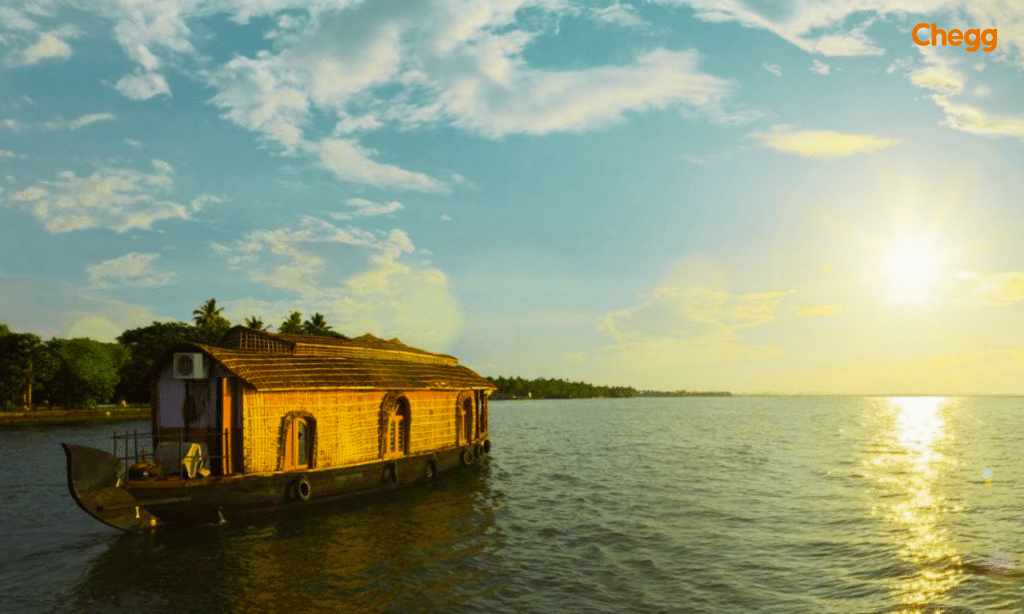
Besides Vembanad Lake, the largest lake in India, many other lakes are special for their unique features and cultural significance. Here are some noteworthy lakes in India celebrated for their size, depth, or cultural importance:
Let’s uncover details about the largest lake in India, including its name, location, and unique characteristics. In the table provided below, you’ll find the profile of the remarkable Indian lakes:
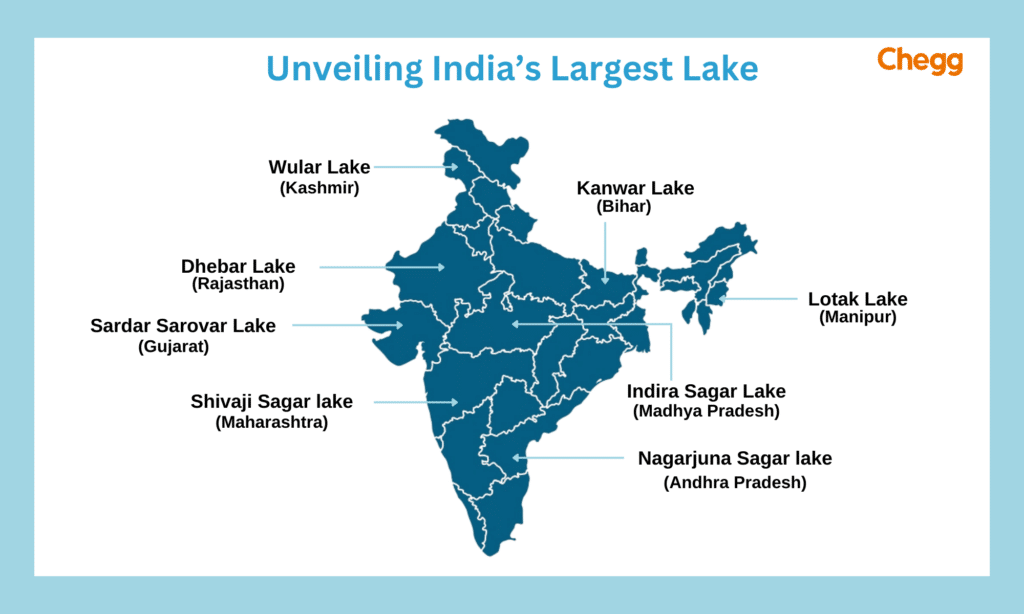
| Lake Name | Geographical Location | Distinctive Features |
| Wular Lake | Jammu and Kashmir | One of Asia’s largest freshwater lakes. Situated at 1,580 meters above sea level in the Himalayan region. Functions as a natural flood reservoir. Surrounded by snow-capped mountains and lush greenery. Unique “Raad” floating gardens for vegetable cultivation. |
| Shivaji Sagar Lake | Maharashtra | It serves as a reservoir, providing water for irrigation and drinking purposes. The lake is man-made. One of India’s largest reservoirs is on the Narmada River. Used for irrigation and hydroelectric power generation. Provides water for agriculture in Madhya Pradesh. Generates electricity for the region. A popular tourist destination for boating and recreation. |
| Indira Sagar Lake | Madhya Pradesh | Sardar Sarovar Lake is a reservoir made by the Sardar Sarovar Dam on the river Narmada. The reservoir serves as a source of water for various needs like irrigation, drinking water, and industrial consumption. The lake supplies water for agriculture and for domestic and other uses. It also provides water for industry in the local area and for the generation of electricity by hydropower. Further, it helps in checking floods in the deltaic region. The project thus as a whole affords ample facilities for developing the economy of the region by augmenting the water resources. |
| Sardar Sarovar Lake | Gujarat | A man-made lake in the 14th century by Maharana Dhebar of Mewar.One of Udaipur’s largest and most picturesque lakes. Home to islands with historic structures like the Lake Palace and Jag Mandir. Offers boat rides for tourists to explore its beauty.Integral to the history and culture of Udaipur and the Mewar region. A popular and iconic tourist destination known as the “Venice of the East.” |
| Loktak Lake | Manipur | Loktak Lake is renowned for its floating phumdis, unique, naturally formed floating islands. It hosts the Keibul Lamjao National Park, recognized as the world’s sole floating national park, devoted to safeguarding the endangered Sangai deer. Loktak Lake is home to diverse bird and fish species, contributing to its ecological significance. The lake holds cultural importance among Manipuri communities, reflecting their traditions and lifestyles. It functions as a reservoir for hydropower generation, fulfilling the region’s energy needs. |
| Nagarjuna Sagar lake | Telangana | It serves as a reservoir, providing water for irrigation and drinking purposes. The lake is man-made. |
| Dhebar Lake | Rajasthan | In the Himalayas, a lake called Pangong is situated at a higher altitude in Ladakh. The location is famous for its crystal clear water and its surroundings, which make this a must-visit place for tourists. This lake is spread over 627 sq km. |
| Kanwar Lake | Bihar | Asia’s largest oxbow lake. Home to diverse bird species.Supports livelihoods through fishing, boating, and tourism. Helps mitigate downstream flood risk by absorbing excess water. |
| Pangong Lake | Ladakh | The second-largest brackish water lake in India, Pulicat Lake is famous for its rich ecosystem and beautiful surroundings. It is situated in the states of Andhra Pradesh and Tamil Nadu. This lake is spread over 450 sq km. |
| Pulicat Lake | Andhra Pradesh | The second-largest brackish water lake in India, Pulicat Lake, is famous for its rich ecosystem and beautiful surroundings. It is situated in the states of Andhra Pradesh and Tamil Nadu. This lake is spread over 450 sq km. |
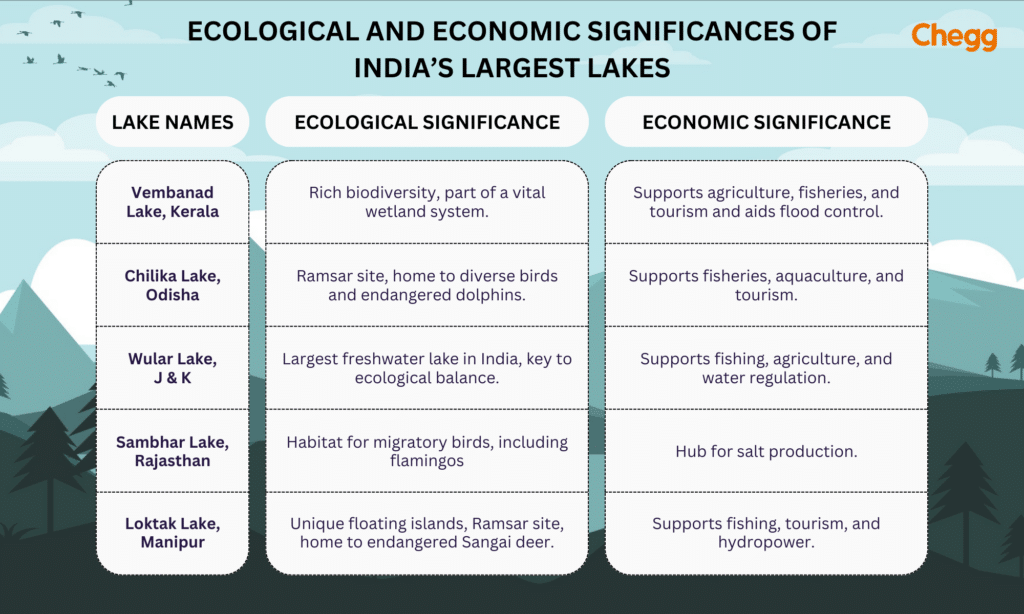
Below are the concise ecological and economic significances of some of the Largest lake in India:
The largest lake in India(man-made) is Govind Ballabh Pant Sagar Lake, also known as Rihand Dam, located in the Sonbhadra district of Uttar Pradesh. It covers an area of 480 square kilometers and has a storage capacity of 10.6 billion cubic meters of water. The lake was created by the construction of the Rihand Dam in 1962.
Gobind Ballabh Pant Sagar Lake is a vital source of water for irrigation, hydropower generation, and drinking water supply. It also supports a thriving fishing industry and is a popular tourist destination.
Read More:-
The Chilika Lake, located in Odisha, holds the title of the second largest lake in India and is also the largest coastal lagoon in the country. Spanning over 1,100 square kilometers, Chilika is famous for its rich biodiversity, supporting more than 160 species of birds, both resident and migratory. It is a vital habitat for the endangered Irrawaddy dolphins and countless fish species, making it an ecological treasure.
Besides its environmental significance, Chilika is a major attraction for tourists due to its scenic beauty, birdwatching opportunities, and vibrant fishing communities. Every year, the lake hosts thousands of migratory birds from Siberia, Iran, and Central Asia during the winter, turning it into a birdwatcher’s paradise.
This iconic lake is not only important for biodiversity but also supports the livelihood of thousands of local fishermen and communities, making it a key part of Odisha’s culture and economy.
The largest lake in India is Vembanad Lake, located in the state of Kerala. It is a significant part of the Kerala backwaters and is known for its stunning beauty, rich biodiversity, and cultural significance. Here are some key points about Vembanad Lake:
India has a diverse landscape; its lakes are no exception. While some are shallow and serene, others plunge into impressive depths, harboring unique characteristics that make them geological wonders.
These deep lakes are primarily formed through various geological processes, including tectonic activity, volcanic eruptions, and glacial action. In India’s geography, they hold great significance:
The Largest Lake in India holds a profound place in the nation’s cultural landscape, serving as more than just a body of water. They are repositories of tradition, spirituality, and a source of livelihood for millions. India’s lakes are often steeped in spirituality.
From the sacred Pushkar Lake in Rajasthan to the serene Dal Lake in Jammu and Kashmir, these water bodies are believed to be holy, and their waters possess purifying qualities. Pilgrims flock to their shores to perform rituals and take ritual baths, seeking spiritual cleansing. They also play a vital role in supporting livelihoods. The serene beauty of lakes has long inspired Indian art, music, and literature. The largest lake in India are more than geographic features; they are repositories of cultural heritage and embody spirituality, art, community, and livelihood.
Chilika Lake in Odisha is the second-largest lake, covering an area of approximately 1,165 square kilometers. It is the largest brackish water lagoon in India and supports a rich ecosystem.
The Caspian Sea holds the title of the largest lake in the world by surface area, covering approximately 371,000 square kilometers.
Sursagar Lake, located in Gujarat, is the smallest lake in India, with a surface area of approximately 0.02 square kilometers.
The largest salt lake in India is Sambhar Lake, located in Rajasthan. It covers an area of around 230 sq. km and is known for its salt production and rich biodiversity, attracting migratory birds like flamingos.
Several rivers flow into Vembanad Lake, including the Pamba, Meenachil, Manimala, and Achankovil rivers.
Vembanad Lake in Kerala is the largest lake in India, covering approximately 2,033 sq km and stretching up to 96.5 km in length.
No, Dal Lake—while famous and scenic—spans only about 18 km², making it far smaller than several others, including Vembanad and Wular.
Not overall, but yes for freshwater lakes. Wular Lake in Jammu and Kashmir is the largest natural freshwater lake in India, stretching up to 259 km² during peak seasons.
Wular Lake, located in the Bandipora district of Jammu and Kashmir. Its area can vary seasonally but is generally between 30 and 260 square kilometers.