Imagine a massive flower weighing up to 11 kilograms and over a meter in diameter! The Rafflesia arnoldii, famously known as the “corpse flower” due to its strong odor, is the largest single flower in the world. Native to the rainforests of Southeast Asia, this rare and parasitic plant fascinates botanists and nature enthusiasts alike.
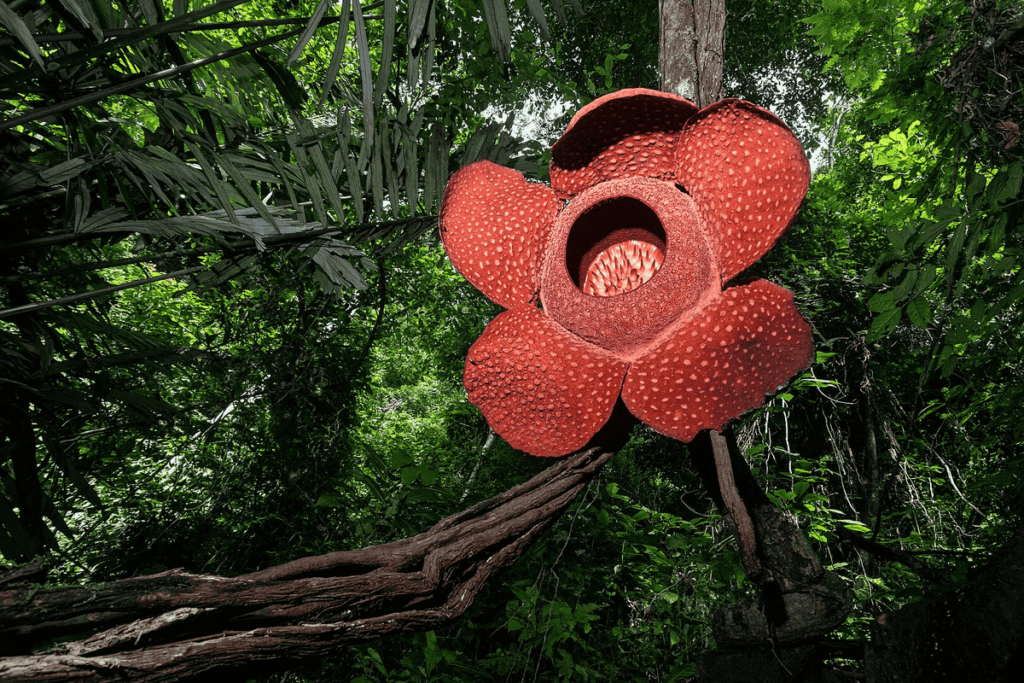
While Rafflesia reigns supreme in size, other remarkable giants, like Amorphophallus titanum, another awe-inspiring bloomer, compete for attention with their towering presence and unusual features. This guide dives into the world of these botanical giants, exploring their size, rarity, and the secrets behind their extraordinary growth.
The term “largest flower in the world” can be defined in several ways: by diameter, weight, or the overall structure of the bloom. When considering these factors, the Rafflesia arnoldii emerges as the undisputed champion. Native to the dense rainforests of Sumatra and Borneo, Rafflesia can grow up to over 1 meter (3.3 feet) in diameter and weigh as much as 11 kilograms (24 pounds). Its massive, fleshy petals and a unique parasitic lifestyle growing on host vines rather than roots make it structurally distinct from other flowering plants.
Rafflesia’s sheer size, rarity, and unusual biology make it the world’s largest single flower. While it holds this record, other giant blooms like Amorphophallus titanum (the titan arum) and Puya raimondii amaze botanists with impressive dimensions. Titan arum may not outweigh Rafflesia, but it boasts the tallest inflorescence, reaching over 3 meters (10 feet). These botanical giants remind us of nature’s incredible diversity and the astonishing scale some flowers can achieve.
The Rafflesia arnoldii is one of nature’s marvels, holding the record as the largest single flower in the world. Its astonishing size, bizarre lifecycle, and rare occurrence make it a subject of fascination for botanists, nature enthusiasts, and travelers alike. Let’s explore this botanical giant in detail.
This parasitic flowering plant is a member of the Rafflesiaceae family, which consists entirely of parasitic species. Unlike typical plants, Rafflesia lacks conventional roots, stems, or leaves.
Rafflesia arnoldii is instantly recognizable for its massive bloom, which can reach a diameter of over 1 meter (3.3 feet) and weigh as much as 11 kilograms (24 pounds). Its thick, fleshy petals are typically reddish-orange with white spots, giving it a striking appearance. The flower emits a strong odor resembling rotting flesh, earning it the nickname “corpse flower”.
Unlike most plants, Rafflesia is parasitic, relying entirely on a host vine from the Tetrastigma genus for water and nutrients. It produces no leaves, stems, or roots, which is highly unusual in the plant kingdom. Its unique reproductive strategy, massive size, and foul smell contribute to its notoriety and ecological importance.
Rafflesia arnoldii is native to the tropical rainforests of Southeast Asia, specifically Sumatra and Borneo in Indonesia and parts of Malaysia. It thrives in dense, humid, shaded forest areas with abundant host vines. The flower plays a unique role in its ecosystem by attracting carrion-feeding insects like flies and beetles, which help pollinate despite the flower’s unusual odor.
Due to its rarity and slow growth, Rafflesia arnoldii is considered a vulnerable species, and conservation efforts in its natural habitat are crucial for its survival. Its extraordinary size and unusual biology make it a symbol of the remarkable diversity found in tropical rainforests.

The Rafflesia arnoldii has a fascinating yet challenging life cycle. Unlike typical flowers, it relies heavily on flies and carrion-feeding insects for pollination. The flower’s strong odor of decaying flesh attracts these insects, inadvertently transferring pollen from one bloom to another, ensuring reproduction in its dense rainforest habitat.
Rafflesia’s life cycle begins as a tiny bud, emerging from the host vine of the Tetrastigma genus. This bud develops slowly over 9 to 12 months, swelling until it reaches its full size of over 1 meter in diameter. The bloom lasts only 5 to 7 days, after which it begins to decay. Because it spends most of its life as an inconspicuous bud inside the host vine, its fleeting bloom and reliance on specific pollinators make successful reproduction rare.
Reproduction is further challenged by its parasitic nature, dependence on a single host species, and the difficulty of locating another Rafflesia nearby for pollination. Consequently, the survival rate of new plants is low, and the species remains vulnerable. Despite these obstacles, Rafflesia continues to thrive in select pockets of Southeast Asian rainforests, a testament to its extraordinary adaptation and ecological niche.
While Rafflesia arnoldii is the largest single flower in the world by diameter and weight, other botanical giants like Amorphophallus titanum, commonly called the titan arum or corpse flower, are equally fascinating. Native to the rainforests of Sumatra, the titan arum boasts the tallest unbranched inflorescence in the plant kingdom, reaching over 3 meters (10 feet) in height. Its towering presence makes it a spectacular sight, though it cannot match Rafflesia’s impressive width and mass.

When comparing the two giants, Rafflesia blooms up to 1 meter across and weighs as much as 11 kilograms, while Titan Arum produces a vertical bloom that can last 24–48 hours, in contrast to Rafflesia’s 5–7 days. Both emit a foul odor resembling rotting flesh, attracting flies and beetles for pollination. Enthusiasts often note that titan arum’s smell is even more pungent, filling entire greenhouse spaces during rare displays.

Here’s a detailed look at the top 10 biggest flowers in the world, each celebrated for its unique size, features, and ecological significance:
| Rank | Scientific Name | Common Name | Size | Region | Feature |
|---|---|---|---|---|---|
| 1 | Rafflesia arnoldii | Corpse Flower | 3-3 ft diameter | Indonesia, Malaysia | Largest single flower in the world |
| 2 | Amorphophallus titanum | Titan Arum | Up to 10 ft tall | Sumatra, Indonesia | Largest unbranched inflorescence |
| 3 | Helianthus annuus | Sunflower | Up to 12 ft tall | Worldwide cultivation | Largest flowering head |
| 4 | Puya raimondii | Queen of the Andes | 30 ft tall spike | Andes, Peru & Bolivia | Largest bromeliad |
| 5 | Magnolia grandiflora | Southern Magnolia | 12-inch flowers | Southeastern USA | Fragrant, waxy flowers |
| 6 | Nelumbo nucifera | Indian Lotus | Up to 1 ft diameter | Asia, Australia | Sacred flower in many cultures |
| 7 | Victoria amazonica | Amazon Water Lily | 10 ft leaves, 16-inch flowers | Amazon Basin | Giant floating flowers |
| 8 | Espeletia schultzii | Frailejón | Flowers 6–8 inches | Venezuela, Colombia | High-altitude bloomer |
| 9 | Corypha umbraculifera | Talipot Palm | Flower clusters up to 26 ft wide | India, Sri Lanka | Rare flowering palm |
| 10 | Strongylodon macrobotrys | Jade Vine | Clusters 3 ft long | Philippines | Iridescent turquoise flowers |
Despite its fame as the world’s largest flower, Rafflesia arnoldii faces serious threats that put its survival at risk. Its rarity and unique biology make it highly sensitive to environmental changes, and human activity has intensified the challenges it faces. Understanding these threats and ongoing conservation efforts is essential to ensuring this botanical wonder continues to thrive in its natural habitat.
Rafflesia’s parasitic lifestyle, relying entirely on Tetrastigma host vines, makes it highly vulnerable. Any disruption in the rainforest ecosystem, such as the loss of host plants, can prevent the flower from blooming. Its slow growth and short flowering period also reduce its chances of successful reproduction.
The main human-induced threats include deforestation, agricultural expansion, and urban development, which destroy or fragment its natural habitat in Sumatra and Borneo. Illegal collection by enthusiasts and researchers, and climate change affecting rainfall and humidity, further endangers this rare species.
Several botanical gardens and research centers cultivate the plant under controlled conditions to protect Rafflesia, studying its growth and reproductive patterns. Protected areas and national parks in Indonesia and Malaysia offer safe habitats, where human access is regulated. Local communities are increasingly involved in conservation programs, combining ecological awareness with sustainable livelihoods.
Responsible observation is crucial for ecotourists and nature lovers. Visitors are encouraged to stay on marked trails, avoid touching or damaging the flowers, and follow local regulations. Guided tours led by trained naturalists help minimize human impact while raising awareness about Rafflesia and the broader rainforest ecosystem.
Preserving Rafflesia arnoldii is about more than protecting a single giant flower it is about maintaining the delicate balance of the rainforest that sustains countless species. With careful conservation efforts and mindful ecotourism, future generations can continue to witness the awe-inspiring beauty of this rare floral giant.
The largest flower in the world, Rafflesia arnoldii, is full of surprises that make it one of nature’s most extraordinary creations. Here are some fun and quirky facts to spark your curiosity:
These fascinating traits make the largest flower in the world not only a record holder but also a symbol of nature’s incredible diversity and ingenuity.
Certain flowers have captured human fascination throughout history due to their extraordinary size and rarity. The Rafflesia arnoldii is the largest single flower, with documented blooms reaching over 1 meter (3.3 feet) in diameter and weighing up to 11 kilograms (24 pounds). These monumental flowers were first described in the 19th century by botanists in the rainforests of Sumatra, immediately earning a place in botanical records and Guinness World Records.
The Amorphophallus titanum, or titan arum, holds its own records, producing the tallest unbranched inflorescence ever recorded at over 3.1 meters (10.2 feet). While its blooms are shorter-lived and narrower than Rafflesia, titan arum’s towering height and dramatic appearance have made it a global sensation, attracting attention from scientists and flower enthusiasts alike.
These historical records not only highlight the sheer scale of these floral giants but also underscore their rarity and ecological uniqueness. Documented blooms of Rafflesia and titan arum remain milestones in botanical exploration, celebrating nature’s ability to push the limits of size and survival in the plant kingdom.
If you want to witness the Rafflesia arnoldii in full bloom, your best destinations are the rainforests of Sumatra and Borneo, spanning Indonesia and Malaysia. National parks such as Gunung Leuser National Park in Sumatra and Kinabalu Park in Sabah, Malaysia, are among the most reliable spots to spot this rare giant flower.
Timing is crucial—Rafflesia blooms are unpredictable and short-lived, lasting only 5–7 days. Hiring a local guide increases your chances of finding the flower and ensures minimal disturbance to its fragile habitat.
Photographers should be prepared for low-light rainforest conditions and plan for a wide-angle lens to capture the flower’s massive size. Avoid stepping on surrounding vegetation and maintain a safe distance, respecting the plant and its ecosystem.
The Rafflesia arnoldii, the world’s largest single flower, is famous for its impressive size and unique biology, ecological role, and cultural significance. This extraordinary bloom continues to captivate scientists, travelers, and nature enthusiasts alike.
Rafflesia plays a vital role in rainforest ecosystems. It emits a strong odor resembling rotting flesh, which attracts flies and beetles that help pollinate, supporting its habitat’s delicate balance. Its presence contributes to the overall biodiversity and ecological interactions of Southeast Asian rainforests.
The flower’s parasitic nature, lack of stems, leaves, or roots, and enormous size make it a fascinating subject for botanists and researchers. Studying Rafflesia helps scientists understand unusual plant adaptations, parasitism, and reproductive strategies in tropical environments.
Rafflesia is also a major tourist attraction in Sumatra and Borneo, attracting visitors to witness its rare bloom. Beyond tourism, it holds cultural value, appearing in local folklore, stories, and festivals, symbolizing the region’s rich natural heritage.
The world’s largest flower, Rafflesia arnoldii, stands out for its immense size, unusual parasitic lifestyle, and rare bloom, making it a true marvel of nature. Its fleeting yet spectacular presence in the Sumatra and Borneo rainforests highlights the beauty and fragility of tropical ecosystems. While other giant flowers like Amorphophallus titanum and Puya raimondii impress with height and structure, Rafflesia remains unrivaled in width and mass, capturing global fascination.
Conservation is crucial to ensure this extraordinary flower thrives amidst threats like deforestation, habitat loss, and climate change. By supporting protected areas, responsible ecotourism, and awareness initiatives, we can help preserve not just Rafflesia but the entire rainforest ecosystem it depends on.
Learn more about the world’s wonders and protect nature! Witnessing the largest flower in its natural habitat is a rare and inspiring experience, reminding us of the incredible diversity and ingenuity found in the plant kingdom.
Read More:
Rafflesia arnoldii is the largest individual flower in the world.
In the tropical rainforests of Indonesia, Malaysia, Thailand, the Philippines, and other South Asian nations, most of its concentration is found in the Sumatra and Borneo forests.
To attract pollinating insects like carrion flies.
Each flower lasts 5–7 days before wilting.
Rafflesia is a single flower, while Titan Arum is a flower cluster (inflorescence)
In India, Sapria himalayana, which is closely related to Rafflesia, is found in the Arunachal Pradesh region, specifically within the Namdapha National Park.