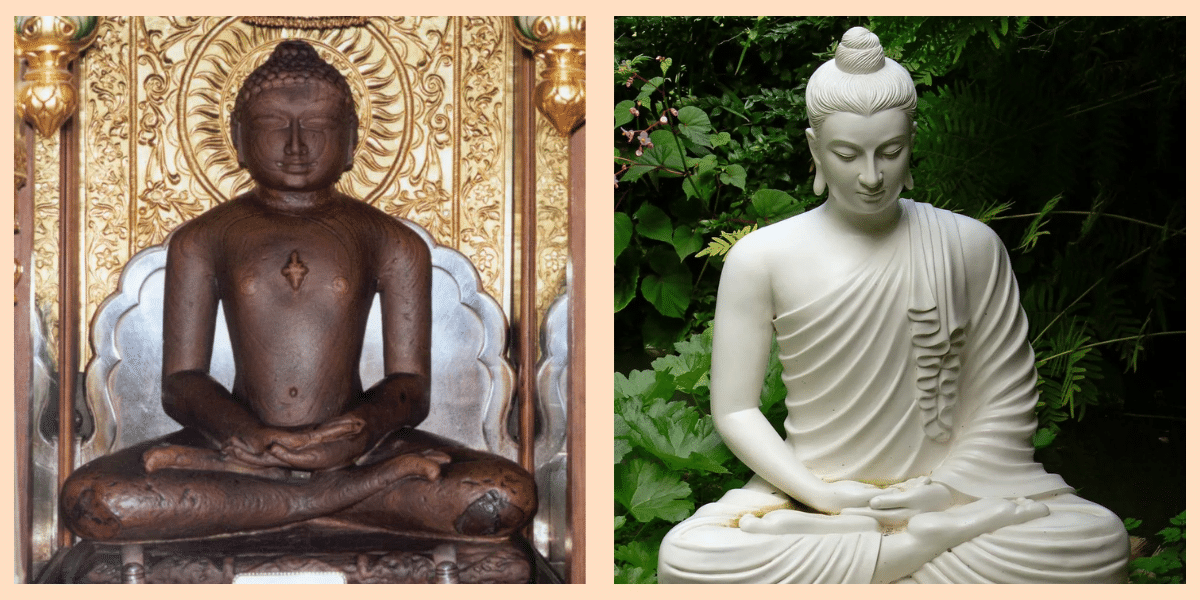
Jainism and Buddhism emerged around the same time in India, during the 6th century BCE, as reformist movements challenging the dominance of Vedic rituals and priestly hierarchy. Both religions promote non-violence (Ahimsa), detachment, self-discipline, and the quest for liberation (moksha), but they differ significantly in their approach to the soul, rituals, and theology. Jainism emphasizes strict asceticism and the permanence of the soul, while Buddhism centers on the Middle Path, impermanence, and the concept of Anatta (no self). Understanding their philosophical and historical connections helps explore the roots of Indian spirituality and ethical living.

Lord Mahavira founded Jainism, which is based on principles of rigorous self-discipline and compassion for all living beings. Siddhartha Gautama founded Buddhism, which preached a balanced path to conquer suffering. Although both have fundamental beliefs, the two philosophies differ in many ways and provide varied views on life, the soul, and liberation.
Jainism and Buddhism originated in India around the 6th century BCE during social and religious reform. Both emerged as alternatives to Vedic traditions, opposing Brahminical authority and the caste system.
Jainism, founded by Mahavira, emphasizes strict asceticism, belief in a permanent soul (jiva), and practices such as the Five Great Vows and idol worship.
Buddhism, founded by Gautama Buddha, teaches the Four Noble Truths and the Eightfold Path and denies the existence of a permanent soul. Jainism is primarily practiced in India, while Buddhism has spread globally.
This article compares Jainism and Buddhism regarding history, beliefs, and practices to highlight their distinct spiritual paths.
The roots of Jainism and Buddhism lie in ancient India when spiritual exploration flourished, and new philosophies emerged to challenge Vedic orthodoxy. Here’s how the two religions came into being:

Jainism traces its beginnings to the 6th century BCE with Lord Mahavira. He was the 24th Tirthankara, whose lineage dates back to centuries of enlightened teachers guiding humankind toward liberation. Nonetheless, his teachings systematized Jainism as we know it today.
Lord Mahavira preached asceticism, shunning possessions and worldly pleasures. He believed in Ahimsa, or nonviolence, not only towards human beings but also towards all living entities, however small. This accounts for vegetarianism among Jains and their utmost care to avoid harming even insects.
The emphasis on self-discipline and ethical purity aimed to help individuals break free from karmic cycles and achieve Moksha or liberation. These principles have remained the cornerstones of Jain philosophy, influencing millions of followers to lead lives of simplicity and compassion.

Buddhism, founded in the 5th–4th century BCE by Siddhartha Gautama, began as a personal quest to understand the nature of suffering. Born a prince, Siddhartha abandoned his life of luxury to seek deeper meaning through meditation and self-reflection.
After years of ascetic practices, he realized that extreme deprivation was as unfulfilling as indulgence. This realization led to the Middle Way, a path balanced between the two extremes. His enlightenment under the Bodhi Tree marked the starting point of Buddhism. The Buddha provided practical steps for overcoming suffering, attracting followers from all walks of life.
Both Jainism and Buddhism, originating in ancient India, share several fundamental principles:
While sharing these core principles, Jainism and Buddhism also have distinct philosophical and doctrinal differences.
Jainism and Buddhism both preach right living and spiritual liberation. Though they share similar principles, their methods reveal some interesting differences. The following are the key teachings of each:
The central teaching of Jainism is non-violence or Ahimsa. This does not only refer to physical violence but also extends to thoughts and speech. Even unintentional harm caused to the most diminutive creature holds karmic significance for Jains. Hence, Jain monks and devout followers are incredibly cautious in their daily activities; some even sweep the ground as they walk to avoid stepping on insects.
The founder of Jainism, Lord Mahavira, advocated self-discipline as the path to liberation. The concept of karma is central to this philosophy. However, unlike other religions, Jainism views karma as a physical substance that attaches itself to the soul due to one’s actions. Each decision made adds to or subtracts from this karmic burden.
According to Jainism, the ultimate goal of life is Moksha (liberation). Jains pursue rigorous asceticism, fasting, renunciation, and self-control to achieve this.
The teachings of Buddha revolve around understanding and overcoming suffering. Buddhism preaches the Four Noble Truths, which explain that suffering is a part of life, but there is a way to end it. The Eightfold Path provides a practical guide to achieving this, with steps like right mindfulness, action, and effort.
Mindfulness is central to Buddhism. It involves being fully present in the moment, whether meditating, working, or even eating. Buddhists cultivate inner peace and wisdom through mindfulness and meditation, leading to enlightenment.
Compassion is another pillar of Buddhism. The Buddha believed that by letting go of desires and attachments, we can free ourselves from suffering and help others do the same.
| Aspect | Jainism | Buddhism |
| Founder | Mahavira (24th Tirthankara) | Gautama Buddha |
| View on Soul | Believes in an eternal, individual soul (Atman) bound by karma | Denies the existence of a permanent soul (Anatta or non-self) |
| Path to Liberation | Strict asceticism to purify the soul and attain Moksha | Follows the Middle Way through the Four Noble Truths and Eightfold Path |
| Spiritual Practice | Emphasis on fasting, self-denial, and renunciation | Emphasis on mindfulness, balance, and meditation |
| Non-violence (Ahimsa) | Central and absolute principle—guides all actions | Emphasizes Metta (loving-kindness) and compassion to reduce suffering |
| Detachment | Achieved through extreme asceticism and rejection of all material comfort | Encouraged through mindfulness and letting go of attachments |
| Approach to Suffering | Eliminate karma through personal discipline | Understand and end suffering through insight and balanced living |
| Spread | Primarily practiced in India | Spread across Asia and the world |
1. Non-Violence (Ahimsa):
2. Karma:
3. Meditation:
4. Rejection of Vedas and Caste System:
5. Renunciation and Detachment:
Both Jainism and Buddhism have rich literary traditions that preserve their teachings, ethical codes, and spiritual philosophies. These sacred texts document the life and teachings of their founders and serve as guides for followers across generations.
The primary scriptures of Jainism are known as the Agamas, which are believed to be the direct teachings of Lord Mahavira, the 24th Tirthankara. These texts were originally passed down orally and were later written down by Jain monks. The Agamas are divided into several sections, including the Angas (limbs) and Upangas (sub-limbs). They cover Jain cosmology, ethics, conduct for monks and laypeople, and philosophical discussions. Over time, due to sectarian differences, the Digambara and Svetambara sects developed different scriptural canons.
The most important texts in Buddhism are compiled in the Tripitaka or “Three Baskets.” These include the Vinaya Pitaka (monastic rules), Sutta Pitaka (teachings of the Buddha), and Abhidhamma Pitaka (philosophical analysis). Another well-known Buddhist scripture is the Dhammapada, a collection of the Buddha’s sayings on ethics and spiritual wisdom. These texts were originally written in Pali and Sanskrit and were preserved and transmitted by Buddhist councils and monastic communities.
Jain texts were primarily written in Prakrit, while Buddhist texts were composed in Pali and later translated into Sanskrit, Tibetan, and Chinese, facilitating Buddhism’s global spread. Both traditions initially relied on oral transmission before their teachings were recorded in written form, preserving their spiritual heritage over millennia.

Both Jainism and Buddhism use distinct symbols and spiritual practices to represent and reinforce their core philosophies. These visual elements and rituals are vital in daily devotion, spiritual growth, and cultural identity.
In Jainism, symbols are deeply tied to its values and cosmology. One of the most recognized symbols is the hand with a wheel (Ahimsa symbol). The raised hand signifies non-violence, and the wheel (Dharmachakra) represents the cycle of birth and rebirth and the resolve to halt it through right conduct. Another prominent symbol is the swastika, which stands for the four types of existence: heavenly, human, animal, and hellish beings. Jain temples, often intricately carved from marble, are sacred spaces where devotees engage in rituals, prayers, and offerings.
Jains also follow strict practices like fasting, especially during festivals such as Paryushan, and lead ascetic lifestyles, particularly for monks and nuns who renounce all worldly possessions.
In Buddhism, symbols convey teachings and inspire contemplation. The Dharma Wheel (Dharmachakra) symbolizes the Buddha’s teachings and the path to enlightenment. The lotus flower represents purity, spiritual awakening, and the potential to rise above suffering. Stupas, dome-shaped structures, house relics and symbolize the enlightened mind.
Buddhists emphasize meditation, mindfulness, and ethical living. Monastic life is central to spiritual practice, with monks and nuns following a disciplined routine of study, reflection, and teaching. Fasting and chanting are also standard practices, especially during significant religious observances.
Together, these symbols and practices serve as tools for inner transformation and expressions of deep-rooted spiritual devotion.
Jainism and Buddhism: Important Topics for UPSC Exam
Buddhism is an essential topic in the UPSC syllabus, particularly in the Ancient Indian History section of Prelims and Mains (GS Paper I). It is often asked due to its historical, philosophical, and cultural importance.
Jainism is another core subject in Ancient Indian History and is frequently tested in UPSC exams. Its emphasis on non-violence and its unique philosophical tenets are especially relevant for Prelims and Mains.
Jainism and Buddhism originated in the 6th century BCE in India as reformist movements opposing Vedic authority and the caste system. While they share core beliefs like non-violence (Ahimsa), karma, rebirth, and the goal of liberation, they differ in philosophy and practice. Jainism believes in a permanent soul (jiva) and emphasizes strict asceticism, whereas Buddhism teaches Anatta (no-self) and follows the Middle Path. Despite these differences, both stress ethical living, mindfulness, and spiritual self-effort. Understanding the difference between Jainism and Buddhism enhances our grasp of Indian philosophy and its lasting influence on global spiritual thought.
Read More-
The main difference is that Jainism believes in a permanent soul (jiva) and strict asceticism, while Buddhism denies a permanent self (Anatta) and follows the Middle Path.
Non-violence (Ahimsa) is central to both traditions. Jainism extends it to all living beings, while Buddhism emphasises compassion and loving-kindness towards others. In Jainism, ahimsa is the most important teaching and the basis of Jain ethics. All living beings are believed to possess souls; harming them leads to bad karma.
The Buddhist canon, or collection of teachings, is divided into three sections: Sutta Pitaka, Vinaya Pitaka, and Abhidhamma Pitaka. All these canons are in the Pali language. Jain literature falls into two main classes: Digambara literature and Svetambara literature.
The Buddha rejected Jainism for its extreme asceticism, promoting the “Middle Way” of moderation and mindfulness instead, as he believed extreme practices did not lead to true enlightenment.
Jainism and Buddhism are ancient Indian religions that arose in the 6th century BCE as parallel reform movements against Vedic orthodoxy. Both focus on renunciation, non-violence, meditation, and liberation from the cycle of rebirth. While they share ethical values, they differ in concepts like the soul. Jainism believes in an eternal soul; Buddhism denies a permanent self.
Jainism is believed by followers to be much older, with roots traced back to previous Tirthankaras before Mahavira (599–527 BCE), the 24th Tirthankara. Buddhism was founded by Gautama Buddha, born around 563 BCE. Historically, both religions evolved around the same time, but Jainism may have slightly older philosophical origins.
Buddhism is considered closest to Jainism in terms of principles like non-violence, karma, and the pursuit of liberation. However, Jainism aligns more with a rigorous ascetic lifestyle, whereas Buddhism promotes the Middle Path. Both diverge significantly from theistic religions like Hinduism and Islam.
Jainism is a distinct religion, neither Hindu nor Buddhist. While it originated in the same cultural context as Hinduism and shares some philosophical terms, Jainism rejects the authority of the Vedas and the concept of a creator god, distinguishing it as an independent spiritual path.