India’s fight for independence was marked by peaceful resistance and fiery revolutionary movements determined to dismantle British rule through direct action. Among the most iconic of these was the Hindustan Socialist Republican Association (HSRA), a revolutionary organization that embodied the fierce determination of young patriots who believed in action over appeasement.
While the Indian National Congress and other moderate groups focused on petitions and constitutional reforms, the Hindustan Socialist Republican Association represented a radical departure. It championed the cause of armed revolution and envisioned a future grounded in socialist principles, free from exploitation and foreign domination. HSRA’s emergence was a bold counterpoint to Gandhian non-violence, signaling the multifaceted nature of India’s freedom struggle.
When was HSRA formed?
The Hindustan Socialist Republican Association (HSRA) was formed in 1928 by revolutionaries like Bhagat Singh, Chandrashekhar Azad, and others to fight British colonial rule through armed resistance.
HSRA full form is Hindustan Socialist Republican Association. It was a revolutionary organization in colonial India that aimed to overthrow British rule through armed struggle and establish a socialist republic based on equality and justice.
The primary objective was to shift from individual heroic acts to organized revolutionary action with a clear ideological foundation. The British government’s increasing oppression, especially after events like the Simon Commission protests and Lala Lajpat Rai’s death, triggered the need for a more structured and radical response.
Before HSRA, the Hindustan Republican Association (HRA) existed, which was formed in 1924 by revolutionaries including Ram Prasad Bismil and Ashfaqulla Khan. HRA focused on armed resistance and mobilizing funds through revolutionary means. However, after the Kakori Conspiracy Case, where several key leaders were executed or imprisoned, younger revolutionaries restructured the organization with a new vision.
In 1928, the group was renamed Hindustan Socialist Republican Association (HSRA) to reflect its commitment to socialism, not just independence. This marked a strategic shift toward creating a classless and exploitation-free India, influenced by global socialist movements.
At the core of this revolutionary movement was Ram Prasad Bismil, the HSRA founder, a fervent nationalist, poet, and visionary leader. Believing that armed struggle was the only way to achieve true independence, Bismil was deeply inspired by global revolutionary movements and India’s patriotic spirit. He aimed to awaken and mobilize the youth against British rule.
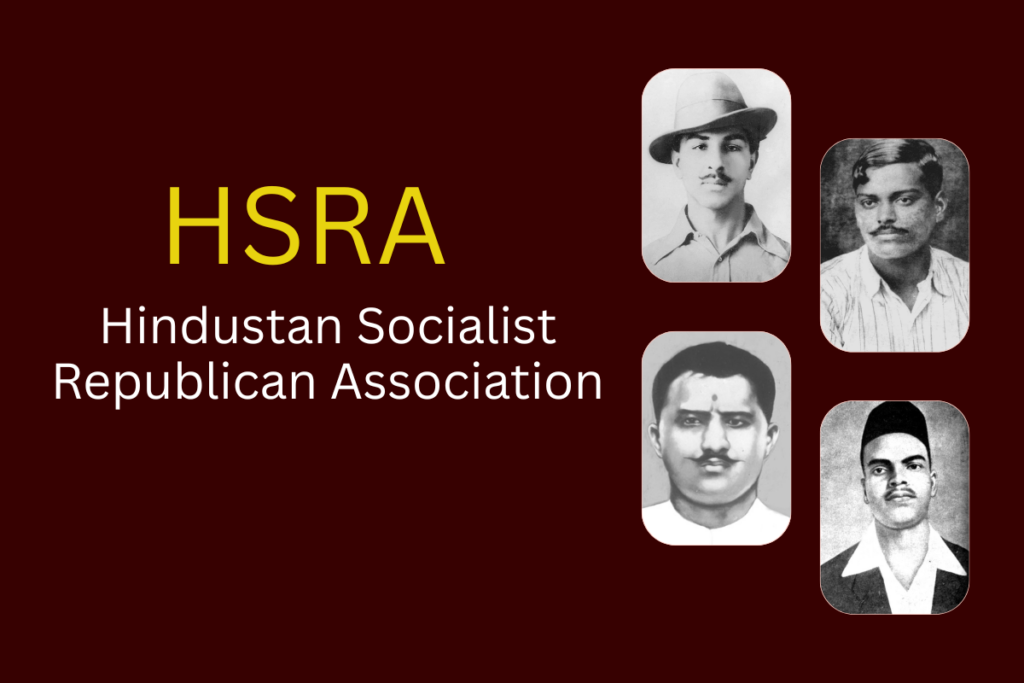
Several committed revolutionaries joined Bismil:
The 1920s were a turning point in the Indian freedom struggle. The British Raj was tightening its grip on India, using repressive laws and violent crackdowns to suppress dissent. While mass movements like the Non-Cooperation Movement (1920–22) stirred national consciousness, many young Indians began to feel that non-violent methods alone were not enough to achieve true independence.
The decade was marked by widespread political unrest, economic hardship, and rising discontent against British rule. Events like the Jallianwala Bagh Massacre (1919) had already shaken public faith in the British. The Simon Commission was sent to India in 1928 without a single Indian member, further fueling nationalist anger.
In this volatile atmosphere, moderate political approaches were seen as increasingly ineffective, especially after the abrupt suspension of the Non-Cooperation Movement due to the Chauri Chaura incident. Many youth grew disillusioned with the Indian National Congress’s passive methods.
Launched by Mahatma Gandhi, the Non-Cooperation Movement was a mass civil disobedience campaign encouraging Indians to boycott British institutions. Though it united people across regions and classes, its sudden withdrawal left many feeling directionless. This vacuum inspired a new wave of revolutionary movements in India focused on direct action.
The failure of peaceful protests to bring about real change led to the belief that armed resistance was necessary to overthrow the British Empire. Revolutionary groups like the Hindustan Republican Association (HRA) and later the Hindustan Socialist Republican Association (HSRA) emerged, advocating for violent struggle to achieve independence and establish a just, socialist society.
| Name | Role in HSRA/HRA | Known For | Key Contributions | Legacy/Impact |
|---|---|---|---|---|
| Chandrashekhar Azad | Led HSRA operations, mentored Bhagat Singh, and planned strategic missions | Refused to be captured; died by suicide in Alfred Park | Executioner in the Saunders assassination | Symbol of unyielding courage; inspired generations with his motto: “Dushman ki goliyon ka…” |
| Bhagat Singh | Ideologue, public face of HSRA | Intellectual brilliance, revolutionary writings, fearless activism | Known for calm leadership, a martyr who inspired youth-led activism | Wrote “Why I am an Atheist”, led the Saunders assassination, and the Assembly bombing |
| Rajguru | Participated in the killing of J.P. Saunders | Loyalty to Bhagat Singh, immense personal bravery | Remembered for valor and commitment, martyred at age 22 | Known for calm leadership, martyr who inspired youth-led activism |
| Sukhdev | Organizer, ideological planner | Known for calm leadership, a martyr who inspired youth-led activism | Built support among students, planned HSRA operations | Mobilizing Lahore’s youth, with a firm ideological grounding |
| Ram Prasad Bismil | Founder of HRA | Co-leader in the Kakori plot | Poet, strategist, executed in the Kakori Conspiracy | Mobilizing Lahore’s youth, with a firm ideological grounding |
| Ashfaqulla Khan | Hindu-Muslim unity, courage, and deep friendship with Bismil | Involved in planning and executing the Kakori train robbery | Honored as HRA’s founder, symbol of patriotic poetry and sacrifice | National icon; face of revolutionary patriotism, central figure in youth and student activism |
The HSRA formation in 1928 marked a defining moment in India’s revolutionary movement. It emerged as a restructured and ideologically stronger version of the Hindustan Republican Association (HRA), driven by the need for organized, socialist-led armed resistance against the British Raj.
The Hindustan Republican Association (HRA), established in 1924 by revolutionaries like Ram Prasad Bismil and Ashfaqulla Khan, initially focused on armed struggle and fundraising through revolutionary means, like the Kakori Train Robbery. However, after the execution and imprisonment of its top leaders following the Kakori case, the organization began to fade.
In 1928, young revolutionaries, including Bhagat Singh, Chandrashekhar Azad, Sukhdev, Bhagwati Charan Vohra, and others, revived and restructured HRA, merging it with socialist ideals to form the Hindustan Socialist Republican Association (HSRA). The change also shifted from just political freedom to social and economic justice.
Several developments contributed to the reformation of HRA into HSRA:
The Simon Commission protest in 1928 became the immediate trigger for HSRA’s resurgence. During a peaceful demonstration against the all-British commission in Lahore, veteran leader Lala Lajpat Rai was brutally beaten by police and later died from his injuries. This incident deeply angered the revolutionaries, especially Bhagat Singh, who vowed to avenge Rai’s death.
This led to the assassination of British police officer J.P. Saunders, mistakenly identified as the officer responsible. The action was carried out by Bhagat Singh, Rajguru, and Chandrashekhar Azad and marked HSRA’s first significant act, symbolizing the beginning of a more aggressive revolutionary phase.
The Hindustan Socialist Republican Association (HSRA) was more than just an armed revolutionary group; it was a political collective guided by socialist principles and a transformative vision for India. Inspired by the Russian Revolution of 1917 and the writings of Karl Marx, Friedrich Engels, and Lenin, HSRA sought political independence and a complete overhaul of India’s socio-economic structure.
The Hindustan Socialist Republican Association (HSRA) carried out a series of high-impact revolutionary actions to challenge British imperialism and awaken the Indian masses.
One of the most significant actions by HSRA was the assassination of British police officer J.P. Saunders on 17 December 1928 in Lahore. The attack was in retaliation for the death of Lala Lajpat Rai, who succumbed to injuries after being lathi-charged during a protest against the Simon Commission.
Bhagat Singh, Rajguru, and Chandrashekhar Azad executed the plan. Though their intended target was police superintendent James Scott, they mistakenly killed Saunders. This incident became a significant turning point in the Lahore Conspiracy Case and catapulted Bhagat Singh to national prominence.
On 8 April 1929, Bhagat Singh and Batukeshwar Dutt threw bombs inside the Central Legislative Assembly in Delhi to protest against repressive British laws, particularly the Public Safety Bill and Trade Disputes Act. The bombing was deliberately non-lethal, aimed at creating noise, not casualties.
After throwing the bombs, they shouted slogans like “Inquilab Zindabad” and “Down with British Imperialism”, and courteously surrendered, using their trial as a platform to spread HSRA ideology. This event generated massive public interest and helped spread revolutionary ideas nationwide.
HSRA also made several attempts to eliminate British officials involved in repression and surveillance. These included:
Apart from armed actions, HSRA was also deeply involved in ideological propaganda. The group published and circulated pamphlets, manifestos, and handwritten leaflets to educate the masses about:
Bhagat Singh’s articles and jail writings, such as “Why I Am an Atheist” and the HSRA Manifesto, circulated widely and influenced generations of young Indians.
The decline of the HSRA began soon after its major revolutionary actions gained nationwide attention. While the organization had ignited a strong wave of nationalism and youth activism, intense British surveillance, multiple arrests, and the loss of its top leaders eventually led to its collapse by the mid-1930s.
Following the Central Assembly Bombing (1929) and the Saunders killing, the British government launched a massive crackdown on HSRA members. Dozens of revolutionaries were arrested and tried under the Lahore Conspiracy Case. The courtroom became a battleground for ideas, where Bhagat Singh and others used their trials to defend their revolutionary ideals publicly.
Despite massive public support, the British were determined to make an example out of them. Long prison sentences, torture, and death sentences severely weakened the group’s leadership and operational capacity.
The execution of Bhagat Singh, Shivaram Rajguru, and Sukhdev Thapar on 23 March 1931 dealt a devastating blow to the HSRA. Despite nationwide protests, petitions, and appeals for clemency, the British colonial government went ahead with the hangings.
Another major setback was the death of Chandrashekhar Azad on 27 February 1931 in Alfred Park, Allahabad. Surrounded by British police and refusing to be captured alive, Azad fought bravely and ultimately took his own life with the last bullet. His death marked the collapse of HSRA’s armed wing, as he was one of the previous active commanders.
After losing its core leadership, the HSRA gradually disintegrated by 1935. Surviving members either went underground, joined other political groups, or shifted their focus to ideological work and social reform.
Although short-lived, HSRA left a lasting legacy in India’s freedom movement. It proved that armed revolution and socialist thought could coexist, and that young Indians were willing to sacrifice their lives for the dream of a free and just nation.

Ram Prasad Bismil and revolutionaries like Sachindra Nath Bakshi and Jogesh Chandra Chatterjee founded the Hindustan Republic Association in Kanpur. The group sought to end British rule through armed revolution, rejecting the moderate, constitutional approach of earlier nationalists.
On August 9, 1925, members of the Hindustan Republican Association looted a British train carrying the government treasury near Kakori, Uttar Pradesh. Though bold, the Kakori Conspiracy led to the arrest and execution of key revolutionaries like Ram Prasad Bismil and Ashfaqulla Khan.
After the Kakori incident, surviving revolutionaries reorganized and embraced socialist ideals. Under the leadership of Bhagat Singh and Chandrashekhar Azad, the Hindustan Republican Association was renamed the Hindustan Socialist Republican Association (HSRA).
To avenge the death of Lala Lajpat Rai, who was fatally injured during a police lathi-charge, Bhagat Singh and Rajguru assassinated British officer J.P. Saunders in Lahore. This bold act was carried out under the banner of the Hindustan Socialist Republican Association (HSRA).
Bhagat Singh and Batukeshwar Dutt hurled non-lethal bombs in the Central Legislative Assembly in Delhi to protest against repressive British laws. Intending to make noise, not cause harm, they were arrested on the spot.
On March 23, 1931, Bhagat Singh, Rajguru, and Sukhdev were hanged in Lahore Jail, despite widespread appeals for clemency. Their execution ignited nationwide protests and immense public outrage. The trio’s sacrifice inspired millions, turning them into enduring symbols of courage and resistance.
From the formation of the Hindustan Republican Association (HRA) in 1924 to its transformation into the Hindustan Socialist Republican Association (HSRA) in 1928, a bold new chapter of India’s freedom struggle began. Unlike the Indian National Congress, HSRA embraced armed resistance and socialist ideals to challenge British rule. Visionaries like Bhagat Singh, Chandrashekhar Azad, and Sukhdev became symbols of fearless defiance, inspiring generations through their sacrifices.
Today, their legacy lives on in India’s pursuit of justice, equality, and secularism. HSRA’s dream wasn’t just about ending colonialism but building a fair, dignified, and united nation. Their revolutionary spirit continues to echo in modern movements for truth, rights, and social change across democratic India.
The Hindustan Socialist Republican Association (HSRA), originally known as the Hindustan Republican Association (HRA) or Hindustan Republican Army, was a radical left-wing revolutionary group in India founded by Sachindranath Sanyal.
Bhagat Singh was a key figure in the Hindustan Republican Association (HRA) and played a significant role in its renaming to the Hindustan Socialist Republican Association (HSRA) in 1928.
Founded in 1928 by revolutionaries like Bhagat Singh, Chandrashekhar Azad, and Sukhdev, the Hindustan Socialist Republican Association (HSRA) aimed to establish a socialist and republican state in India.
Bhagat Singh and his revolutionary associates established the Hindustan Socialist Republican Association (HSRA) in Feroz Shah Kotla, Delhi, in 1928, transforming the earlier Hindustan Republican Association into a socialist group.
HSRA stands for Hindustan Socialist Republican Association, a revolutionary organization aiming to establish a socialist and independent Indian republic.