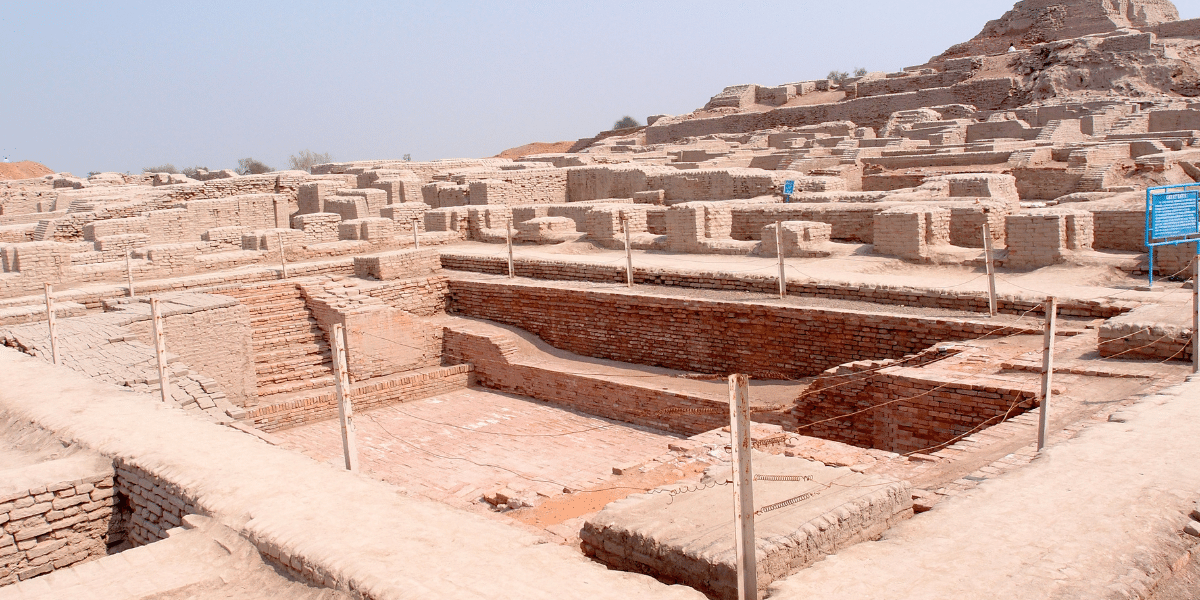
The Harappan Civilization, also known as the Indus Valley Civilization, flourished around 2500 BCE in present-day Pakistan and northwest India.
Renowned for its advanced urban planning, the civilization featured well-laid streets, sophisticated drainage systems, and impressive brick buildings.
Major cities like Harappa and Mohenjo-Daro showcased remarkable architecture and a high level of craftsmanship in pottery and jewelry.
Table of Contents
The Harappan Civilization, also known as the Indus Valley Civilization, was a Bronze Age society and one of the world’s three earliest civilizations, alongside Mesopotamia and Ancient Egypt. Flourishing between 3300 BCE and 1300 BCE in northwestern South Asia, it is renowned for its advanced urban planning, sophisticated drainage systems, and undeciphered script. This article provides a comprehensive introduction to the Harappan Civilization, exploring its history, major cities like Harappa and Mohenjo-daro, cultural achievements, and the mysteries surrounding its decline. It is an essential resource for students, UPSC/SSC aspirants, and history enthusiasts.
We will journey through the meticulously laid streets of its cities, decipher the secrets held by its seals, unravel the mysteries of its citadel of Harappan civilization, and contemplate the various theories surrounding the decline of Harappan civilization. By exploring its art, technology, and trade networks, we aim to construct a vivid picture of a civilization that was, in many ways, millennia ahead of its time.
What is the Harappan Civilization?
Before we delve into the details, it is crucial to answer a fundamental question: what is Harappan civilization? Also known as the Indus Valley Civilization, it was one of the world’s three earliest urban cultures, alongside ancient Egypt and Mesopotamia. Thriving during the Harappan civilization time period of approximately 2600 BCE to 1900 BCE, it represented the mature, urban phase of a longer cultural tradition in the Indus River basin.
Its name is derived from Harappa, the first site excavated in the early 20th century. This civilization was distinguished by its remarkable uniformity and standardization across a vast geographical expanse. From the type of bricks used in construction to the systems of weights and measures, a surprising degree of homogeneity is evident across all major sites, suggesting strong central administration or a shared cultural ethos. It was a society that mastered urban living, with unparalleled expertise in town planning of the Harappan civilization, drainage systems, and water management, creating a template for urban efficiency that would not be seen again for centuries.
Discovery and Initial Excavations
The story of the Harappan Civilization’s discovery is a tale of archaeological curiosity and persistence. For centuries, the ruins lay buried under the silt of the Indus plains, their significance unknown. The first clues emerged in the mid-19th century when British engineers building the railway line in Punjab used bricks from a massive mound near the village of Harappa as ballast. Unknowingly, they were plundering the ancient city itself.
It wasn’t until 1921, under the directorship of Daya Ram Sahni, that systematic excavations began at Harappa. The following year, R.D. Banerjee began digging at another mound, Mohenjo-daro (meaning ‘Mound of the Dead’), further south. What they unearthed sent shockwaves through the historical community. They had not discovered just isolated towns but the remains of a vast, forgotten civilization that once rivaled its contemporaries in Egypt and Sumer. John Marshall, the then Director-General of the Archaeological Survey of India (ASI), was instrumental in recognizing the significance of these finds and first used the term ‘Indus Valley Civilization’.
Subsequent excavations by luminaries like Mortimer Wheeler, George Dales, and numerous Indian archaeologists have continued to expand our understanding, revealing hundreds of sites and painting a richer picture of this ancient culture.
Chronology and Time Period
Understanding the Harappan civilization time period is key to contextualizing its achievements. Scholars typically divide its evolution into three main phases:
Early Harappan Phase (c. 3300 – 2600 BCE): This was a formative period marked by the development of farming communities, early pottery styles, and the beginning of trade networks. Settlements were small and not yet fully urban.
Mature Harappan Phase (c. 2600 – 1900 BCE): This was the golden age, the zenith of the civilization. The rise of large, planned urban centers like Harappa, Mohenjo-daro, Dholavira, and Rakhigarhi characterizes it. This period saw the standardization of bricks, the widespread use of the Indus script, and a flourishing of art, culture, and long-distance trade. This is the phase most commonly referred to when discussing the Harappan Civilization history.
Late Harappan Phase (c. 1900 – 1300 BCE): This period witnessed the gradual decline of Harappan civilization. Urban features like planned streets and drainage systems disappeared, the use of seals and script declined, and there was a movement of populations towards the east and south. This was not a sudden collapse but a slow process of de-urbanization and cultural transformation.
Timeline of the Harappan Civilization
Period
Approximate Time Frame
Key Characteristics
Pre-Harappan
7000 – 3300 BCE
Early Neolithic villages; beginnings of agriculture and pottery.
Early Harappan
3300 – 2600 BCE
Development of trade networks; emergence of small towns.
Decline of urbanism; abandonment of cities; migration eastward.
Post-Harappan
1300 BCE onwards
Rise of regional cultures like the Painted Grey Ware culture.
Geographical Extent and Major Sites
The sheer size of the Harappan Civilization is staggering. At its peak, it encompassed over a million square kilometers, far exceeding the geographical spread of contemporary ancient Egypt and Mesopotamia combined. To visualize this vastness, a Harappan civilization map would show its core centered along the Indus River in modern-day Pakistan, but its influence stretched far beyond.
North: Reached to Manda in Jammu and Kashmir, India.
South: Extended to Daimabad in Maharashtra, India.
East: Spread as far as Alamgirpur in Uttar Pradesh, India.
West: Included Sutkagen Dor on the Makran coast near the Iran-Pakistan border, a likely trading outpost.
This expansive territory was dotted with over 1,000 sites, including five major urban centers.
Harappa (Pakistan): The type-site, located in Punjab province. It was a major urban center with massive walls and gateways, and evidence of extensive bead manufacturing.
Mohenjo-daro (Pakistan): Located in Sindh province, it is the most extensively excavated site and often considered the civilization’s capital. It showcases the pinnacle of town planning of the Harappan civilization, featuring the iconic Great Bath and a large granary.
Dholavira (India): Located on Khadir Bet island in the Rann of Kutch, Gujarat, it is notable for its unique water conservation system, large reservoirs, and a signboard featuring the Indus script.
Rakhigarhi (India): Located in Haryana, it is the largest Harappan site, even larger than Mohenjo-daro. Recent excavations here are providing groundbreaking insights.
Lothal (India): Located in Gujarat, it was a vital port and center for bead-making and metallurgy. Its most famous feature is a rectangular dockyard, suggesting sophisticated maritime trade.
A Harappan civilization map illustrates a network of cities, towns, and villages connected by trade routes, both overland and riverine, forming a cohesive economic and cultural zone.
Town Planning: The Hallmark of Harappan Genius
The most striking feature of the Mature Harappan phase is its extraordinary town planning of Harappan civilization. This urban brilliance sets it apart from all other contemporary cultures and speaks volumes about its advanced administrative and engineering capabilities.
The Citadel and the Lower Town
Almost all major urban centers were divided into two distinct parts: the Citadel of Harappan civilization and the Lower Town.
The Citadel: This was a raised, massive mud-brick platform located to the west of the city. It was fortified with thick walls and was presumably the administrative and religious heart of the city. Important structures like the Great Bath of Mohenjo-daro and large granaries were located here, suggesting it was occupied by the ruling elite or priests. The consistent presence of a raised citadel across multiple sites points to a unified vision of urban power structures.
The Lower Town: This was the residential area where the common people lived. It was spread out to the east of the citadel and was also walled. The layout was just as meticulously planned as the citadel.
Grid Pattern and Streets
The cities were built on a strict grid pattern oriented along the cardinal directions (north-south, east-west). The streets were wide, straight, and intersected at right angles, dividing the city into large rectangular blocks. This design facilitated not only organization but also airflow and movement.
The Great Bath
The Great Bath at Mohenjo-daro is one of the most celebrated structures of the ancient world. Located within the citadel, it is a large, waterproofed pool made of finely baked bricks and gypsum mortar. It was surrounded by corridors and rooms and likely served a ritual, religious purpose, indicating the importance of purification ceremonies.
Advanced Drainage System
Perhaps the most impressive feat of town planning of Harappan civilization was its sophisticated, city-wide drainage system. It was far more advanced than any found in contemporary Middle Eastern sites.
Every house had a bathroom and a latrine connected to a central drain.
Drains from houses emptied into larger, covered sewer drains that ran along the main streets.
These drains were equipped with manholes for inspection and cleaning.
This emphasis on sanitation and water management highlights a remarkable concern for public health and civic order.
Architecture and Building Materials
Houses, ranging from single-room tenements to large mansions with dozens of rooms, were built around courtyards. They were made of standardized, kiln-baked bricks of a uniform ratio (4:2:1). This standardization across a vast region is a unique feature, pointing to a centralized authority or a deeply ingrained cultural standard. Most houses had wells, providing direct access to clean water.
Society and Social Structure of Harappan Civilization Time Period
Deciphering the social structure of the Harappans is challenging due to the lack of deciphered written records. However, material evidence provides crucial clues.
An Egalitarian Society? The absence of monumental palaces, temples, or grandiose royal tombs, common in Egypt and Mesopotamia, suggests a society that an all-powerful monarch or a theocratic elite may not have ruled. The impressive uniformity in town planning and artifacts might indicate a strong, organized civic authority rather than a despotic ruler.
Evidence of Social Stratification: Despite the lack of palaces, there was likely some social hierarchy. The presence of larger, well-built houses with private wells and bathrooms in certain areas, contrasted with smaller, simpler dwellings in others, indicates differences in wealth and social status. The very existence of a fortified citadel separate from the lower town also implies a ruling class with the authority to command labor and resources.
Craftspeople and Merchants: The society supported a vast class of skilled artisans, potters, weavers, masons, bead-makers, metalworkers, and seal-carvers. The scale of trade also suggests a powerful merchant class.
Position of Women: Numerous terracotta figurines of women, often interpreted as mother goddesses, suggest that women held a place of reverence. The prevalence of these figurines might indicate the worship of a female principle, but their exact role in daily social life is unclear.
Economy: Agriculture, Trade, and Crafts
The Harappan economy was a complex and thriving system based on a surplus of agricultural production, which supported urbanization and fueled extensive trade networks.
Agriculture
The fertile plains of the Indus and its tributaries provided the ideal conditions for agriculture. They grew a variety of crops:
Staples: Wheat and barley were the primary staples.
Others: They also cultivated rice (found at sites in Gujarat), peas, lentils, chickpeas, mustard, sesame, and dates.
Cotton: They were among the first people in the world to produce cotton, which they called “sindon” (related to Sindh, the region of Indus).
They used wooden ploughs and stone sickle blades for cultivation. Canals were dug for irrigation, and sophisticated water storage systems, as seen in Dholavira, were constructed to manage water resources.
Animal Domestication and Pastoralism
They domesticated a range of animals, including cattle, buffalo, sheep, goats, pigs, and cats. The humped zebu bull was particularly common and is frequently depicted on the seals of Harappan civilization. They also used elephants and camels, and evidence suggests they may have domesticated fowl.
Trade and Commerce
The Harappans were master traders, maintaining extensive networks.
Internal Trade: There was a vibrant exchange of goods between cities and regions within the civilization. Materials like copper (from Rajasthan), timber (from the Himalayas), and semi-precious stones were transported via carts and riverboats.
External Trade: They had well-established maritime and overland trade links with Mesopotamia (modern Iraq and Iran), the Persian Gulf, Central Asia, and even parts of Afghanistan.
Exports: Cotton textiles, pottery, beads, ivory products, and wooden goods.
Imports: Gold (from Karnataka and Afghanistan), copper, tin, lapis lazuli (from Afghanistan), turquoise (from Iran), and jade (from Central Asia).
Seals as Trade Tools: The famous seals of Harappan civilization, found in abundance, were likely used to mark ownership of goods for trade. Impressions of these seals have been found on clay tags attached to bundles of merchandise.
Crafts and Industries
Harappan cities were hubs of industrial activity.
Metallurgy: They were skilled coppersmiths, creating tools, weapons, and vessels. They also knew how to mix copper with tin to make bronze.
Bead Making: They manufactured exquisite beads from carnelian, steatite, quartz, and gold, using sophisticated drilling techniques.
Pottery: They produced wheel-made pottery, often painted with geometric designs and patterns of plants and animals.
Weights and Measures: A highly standardized system of weights, made of chert, has been found across all sites. This standardization was crucial for smooth trade and commerce.
Religion and Belief Systems of Harappan Civilization History
Understanding Harappan religion is speculative, as no temples or definitive religious texts have been found. Interpretations are based on seals, figurines, and structural remains.
Mother Goddess: The numerous terracotta figurines of women, often with elaborate headdresses and ornaments, are widely believed to represent a mother goddess, a symbol of fertility and creation.
Proto-Shiva: A famous seal from Mohenjo-daro depicts a horned figure seated in a yogic posture, surrounded by animals. Sir John Marshall identified it as an early form of the Hindu god Shiva (Pashupati, the lord of animals). While this interpretation is debated, the figure is undoubtedly of religious significance.
Nature and Animal Worship: The reverence for certain animals, particularly the bull, is evident from their prominence on seals. The unicorn (a mythical one-horned creature) is the most common motif. Trees (like the pipal) and water were also likely objects of veneration, as suggested by seals.
The Great Bath and Ritual Purification: The presence of the Great Bath strongly points to the practice of ritual bathing, which remains an integral part of Indian religions to this day.
Burial Practices: Cemeteries have been found at sites like Harappa and Lothal. The dead were usually buried in pits, often with pottery and personal ornaments, suggesting a belief in an afterlife.
Seals, Script, and Language
One of the greatest enigmas of the Harappan Civilization is its writing system. The seals of Harappan civilization are its most famous artifacts, but their message remains locked away.
The Seals
Typically made of steatite (a soft stone that was baked to harden), these small, square seals are beautifully carved. They feature a line of script at the top and a central depiction of an animal, the unicorn being the most common, but also bulls, elephants, rhinoceroses, and tigers. The back has a perforated knob for suspension. As mentioned, their primary use was probably in trade for stamping goods. The artistic quality of these seals of Harappan civilization remains unmatched in the ancient world for their miniature detail.
The Script
The Harappan script remains undeciphered, posing a massive challenge to understanding this culture more deeply.
Characteristics: It is logo-syllabic, meaning it uses signs to represent words and syllables. There are about 400-600 distinct signs, too many for a purely alphabetic system and too few for a logo-syllabic one like Chinese.
Direction of Writing: The script is usually written from right to left.
Challenges in Decipherment: The main obstacles are the shortness of the inscriptions (the longest has only 26 signs) and the absence of a bilingual text (like the Rosetta Stone for Egyptian hieroglyphs). Without a known language to compare it to, decipherment is extremely difficult.
The Language
The language(s) spoken by the Harappans is a subject of intense debate. Various hypotheses suggest it could be a precursor to:
A Dravidian language family (now spoken mainly in South India).
A Munda language family (tribal languages of Central and Eastern India).
A language that has no living descendants (a “language isolate”).
Until the script is deciphered, the language and much of the civilization’s intellectual life will remain a mystery.
Art and Culture During Harappan Civilization Time Period
Despite the focus on utilitarian objects, the Harappans produced a rich variety of art, displaying skill, observation, and a sense of aesthetics.
Sculpture: Very few stone sculptures have been found. The most famous is the bearded “Priest-King” from Mohenjo-daro, depicting a dignified figure with half-closed eyes and an ornate cloak. Several exquisite bronze figurines have also been found, the best-known being the “Dancing Girl” from Mohenjo-daro, a confident-looking young woman captured in a dynamic pose.
Terracotta Figurines: These were more common and included human figures (especially the mother goddess), toy carts, animals, and birds.
Pottery: Harappan pottery was typically red and was often painted with black designs. Common motifs included geometric patterns, leaves, peacocks, and fish.
Beads and Ornaments: They were experts in crafting jewelry from gold, silver, copper, semi-precious stones, and shell. Both men and women wore necklaces, bracelets, armlets, and earrings.
The Decline of Harappan Civilization
The decline of Harappan civilization around 1900 BCE was not a sudden, catastrophic event but a gradual process of de-urbanization that unfolded over centuries. No single cause can explain it; rather, it was likely a combination of several factors.
Climate Change and Drought: Geological evidence suggests that the Indus region became significantly drier during the late 3rd millennium BCE. The monsoons may have weakened or shifted, leading to prolonged droughts. This would have devastated the agricultural base that supported the urban centers.
Drying of the Ghaggar-Hakra River: Many major Harappan sites are located along the banks of the now-seasonal Ghaggar-Hakra river, which many scholars identify with the mythical Saraswati. It is hypothesized that this mighty river dried up due to tectonic shifts or the capture of its tributaries by other river systems, forcing populations to migrate.
Floods: Ironically, while some areas suffered drought, others, like Mohenjo-daro, show evidence of catastrophic flooding. The Indus River is known for its unpredictable and violent floods, which may have repeatedly damaged cities and farmland.
Deforestation and Environmental Degradation: The large-scale consumption of firewood for baking billions of bricks and for smelting copper ores may have led to widespread deforestation. This could have caused soil erosion and a loss of natural resources.
The Aryan Invasion/Migration Theory: This was a popular theory proposed by Mortimer Wheeler, who suggested that the arrival of nomadic Indo-Aryan tribes from Central Asia led to the violent destruction of the cities. However, this theory has largely been discredited due to a lack of strong archaeological evidence for widespread warfare and destruction. The interaction between the declining Harappans and incoming migrant groups was likely more complex, involving a slow process of cultural assimilation and change.
Breakdown of Trade Networks: The collapse of trade with Mesopotamia, which was also undergoing a period of decline around the same time, would have severely impacted the urban economy, which relied heavily on commerce.
In essence, a combination of ecological stress and economic breakdown likely led to the abandonment of the great cities. The population did not vanish; they dispersed into smaller, rural villages in the east and south, gradually merging with other cultures and giving rise to the subsequent cultural phases of the Indian subcontinent. The story of the decline of Harappan civilization is a complex narrative of environmental and social transformation.
Legacy and Significance
The Harappan Civilization left an indelible mark on the cultural fabric of the Indian subcontinent. While its script was forgotten and its cities buried, its legacy lived on in subtle ways.
Elements of Harappan art, such as the swastika and pipal leaf motifs, appear in later Indian art.
The emphasis on ritual bathing and water purity, as seen in the Great Bath, may have influenced later Hindu traditions.
The worship of certain animals and possibly a proto-form of Shiva suggest a cultural continuity.
Its most enduring legacy is its demonstration of sophisticated urban planning and engineering, a testament to the ingenuity of one of humanity’s first experiments with city life. A true Harappan civilization introduction reveals a foundational chapter in South Asian history.
Conclusion
The Harappan Civilization stands as a monument to human innovation and organization. For seven centuries, it built and sustained a vast, peaceful, and highly sophisticated urban world. Its achievements in town planning, sanitation, and trade are a source of wonder. Yet, it remains an enigma, its voice silent behind the veil of an undeciphered script. The mystery of its uniform culture and its gradual decline continues to fuel research and debate. As excavations and scientific analyses continue, particularly at sites like Rakhigarhi, we inch closer to understanding the full story of this remarkable chapter in human history, a story that fundamentally shaped the destiny of the Indian subcontinent.
The Harappan Civilization, also known as the Indus Valley Civilization (3300–1300 BCE), was one of the world’s earliest urban cultures. Centered in present-day India and Pakistan, it was renowned for its advanced city planning, well-structured drainage systems, flourishing trade, agriculture, and distinctive art and crafts. Major sites like Harappa and Mohenjo-Daro showcase its cultural brilliance, making it a foundation of ancient Indian history.
What was the Harappan civilization most famous for?
The Harappan culture created the earliest precise system of regulated weights and measures, sometimes called the Indus River Valley culture; some of its measurements were as precise as 1.6 mm. Terracotta, metal, and stone were among the materials used by the Harappans to produce jewelry, sculptures, and seals.
Who discovered the Harappa civilization?
The Harappa Civilization was discovered in 1921 by Daya Ram Sahni, an Indian archaeologist, during excavations at Harappa in present-day Punjab, Pakistan. This discovery, followed by R.D. Banerjee’s excavation at Mohenjo-daro in 1922, revealed the existence of the Indus Valley Civilization one of the world’s earliest urban cultures known for advanced city planning, trade, and art.
Which was the first city of Harappan civilization?
First discovered in 1921 in the Punjab region at Harappa, the civilization was later found in 1922 in the Sindh (Sind) region at Mohenjo-daro (Mohenjodaro), close to the Indus River.
What is the period of the Harappan Civilization?
The Harappan Civilization, or Indus Valley Civilization, is divided into three phases: the Early Harappan Phase (3300–2600 BCE), the Mature Harappan Phase (2600–1900 BCE), and the Late Harappan Phase (1900–1300 BCE).
What contributed to the Harappan Civilization decline?
The decline of the Harappan Civilization is attributed to climate change, shifting river patterns, declining trade, overexploitation of resources, and possibly invasions, which led to urban collapse and population dispersal.
Authored by, Muskan Gupta Content Curator
Muskan believes learning should feel like an adventure, not a chore. With years of experience in content creation and strategy, she specializes in educational topics, online earning opportunities, and general knowledge. She enjoys sharing her insights through blogs and articles that inform and inspire her readers. When she’s not writing, you’ll likely find her hopping between bookstores and bakeries, always in search of her next favorite read or treat.