

The leadership of numerous distinguished Presidents has shaped India, each contributing uniquely to the nation’s growth and identity. From Dr. Rajendra Prasad, the first President of independent India, who laid the constitutional foundation of the republic, to Dr. A.P.J. Abdul Kalam, revered as the ‘People’s President’ for his visionary thinking and connection with the youth, these leaders have left lasting legacies.
The role of S. Radhakrishnan, an academic and philosopher, further emphasized India’s intellectual and cultural heritage. To further answer the question, “Who was the first female president of India?” Pratibha Patil joined this esteemed lineage as the first woman President of India, adding a new dimension to the presidency by bringing in representation, inclusivity, and a focus on education, diplomacy, and women’s empowerment.
India, a land known for its democratic values and cultural diversity, achieved a historic milestone in 2007 with the election of its first woman President, Pratibha Devisingh Patil. This remarkable achievement reflected a political victory and a societal shift towards gender equality and inclusion. Her journey from a modest beginning in Maharashtra to occupying the highest constitutional position in India is a testament to perseverance, dedication, and leadership. This blog explores the life and legacy of Pratibha Patil in detail, providing valuable insights into her political career, presidency, and the broader impact of her role.
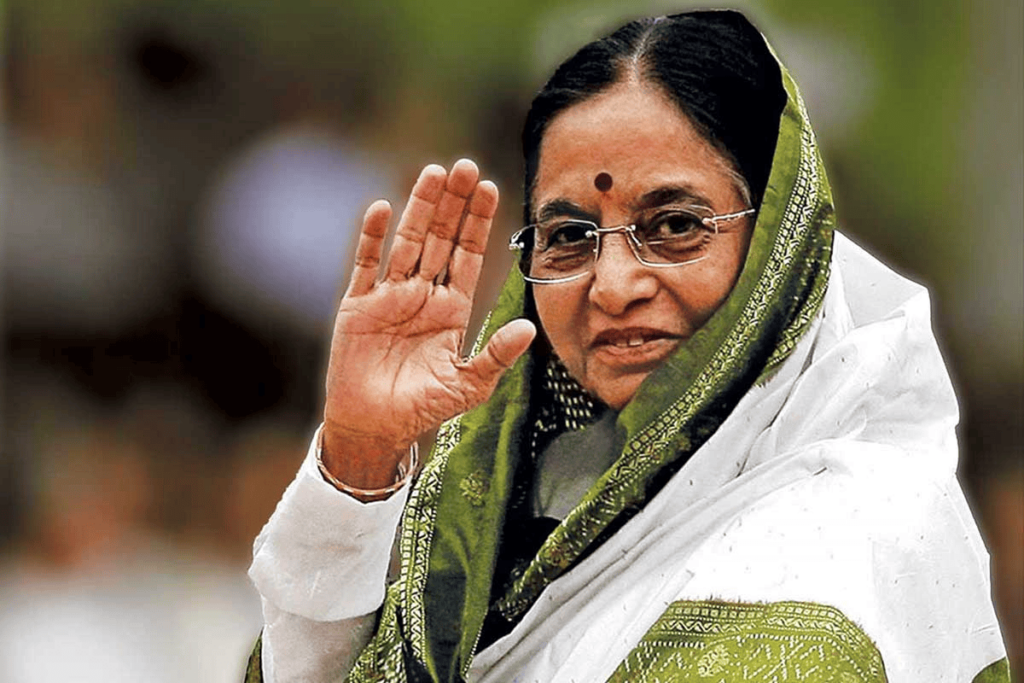
Pratibha Patil is an Indian politician and lawyer who served as the 12th President of India from 25 July 2007 to 25 July 2012. She was born on 19 December 1934 and she made history as the first woman to hold the office of President, breaking a longstanding gender barrier in Indian politics. Before her presidency, she had a distinguished political career spanning over five decades, serving as a member of both the Maharashtra Legislative Assembly and the Indian Parliament. She held significant positions such as the Governor of Rajasthan and worked extensively on issues related to women’s empowerment, education, and social welfare.
As President, Pratibha Patil acted as the ceremonial head of state and the Commander-in-Chief of the Indian Armed Forces, representing India on domestic and international platforms and upholding constitutional values. Her election marked a significant step toward gender equality in Indian leadership, symbolizing progress and inclusivity. Beyond politics, she has been recognized for her dedication to public service, promotion of education, and advocacy for social justice, leaving a lasting legacy in India’s political history.
Pratibha Patil was born on December 19, 1934, in Nadgaon, a small village in the Jalgaon district of Maharashtra. She hailed from a politically conscious family, with her father, Narayan Rao Patil, an influential local figure. Her early upbringing emphasized discipline, education, and service to society.
She pursued her early education at RR Vidyalaya in Jalgaon. She later attended Mooljee Jetha College under North Maharashtra University, where she earned a Master’s degree in Political Science and Economics. Her academic interests laid the foundation for her involvement in governance and public policy. Subsequently, she obtained a Law degree from the Government Law College in Mumbai. Her legal education, combined with her social awareness, played a critical role in shaping her career.
Apart from academics, Patil was active in sports, especially table tennis, where she won several inter-collegiate championships. Her multifaceted personality helped her build a strong public persona and prepared her for the challenges of political life.
Pratibha Patil’s political career began in 1962 when she was elected as a Member of the Maharashtra Legislative Assembly (MLA) from Edlabad (now Muktainagar) at just 27 years of age. This victory began her long and dedicated service in Indian politics.
While in the state legislature, she held several important portfolios in the Maharashtra government, including Social Welfare, Public Health, Prohibition, Rehabilitation, and Urban Development. She was known for her strong commitment to social causes, especially those concerning women, education, and healthcare.
One of her most notable achievements in her early political career was advocating for prohibition and promoting public health awareness. Her work in these areas won her respect across party lines and established her reputation as a sincere and hardworking leader. She also founded several educational institutions and cooperatives in Maharashtra to improve access to education and economic opportunities in rural areas.
In 1985, Patil transitioned to national politics, becoming a Rajya Sabha member. Her leadership qualities shone through during her tenure as Deputy Chairperson of the Rajya Sabha from 1986 to 1988. In 1991, she was elected to the Lok Sabha from Amravati, further solidifying her influence in Indian politics.
Throughout her career, Patil remained focused on promoting education, women’s empowerment, and rural development. Her involvement in multiple parliamentary committees broadened her legislative expertise and prepared her for higher constitutional responsibilities. This rich political background culminated in her selection as India’s first female president, a role she would undertake with poise and commitment.
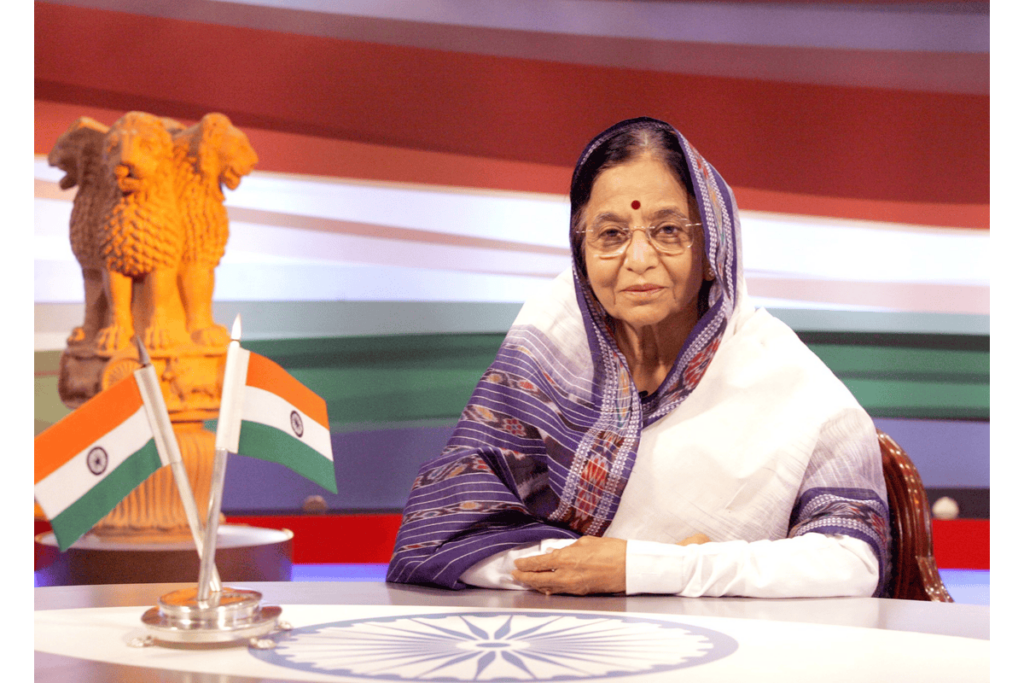
As a parliamentarian, Patil focused on issues such as health, education, rural development, and gender equality.
In 2004, Pratibha Patil achieved another first by becoming the Governor of Rajasthan, the state’s first female to do so. Her tenure as governor was marked by efforts to reform education, support tribal communities, and enhance social justice. She emphasized women’s rights and ethical governance, reinforcing her position as a transformative leader.
As Chancellor of state universities, she promoted academic excellence and institutional transparency. Her performance as governor demonstrated administrative capability and moral clarity, making her a strong presidential candidate. This role became the final stepping stone in her rise to become the first woman President of India.
In 2007, after much deliberation, the United Progressive Alliance (UPA) named Pratibha Patil its presidential candidate. Her nomination initially surprised many, but her extensive experience and clean image quickly rallied support from across the political spectrum.
Patil defeated Bhairon Singh Shekhawat with over 65% of the electoral vote. On July 25, 2007, she took the oath of office and formally became the first woman President of India. Her election was a personal success and a victory for Indian democracy. “Who is the first female president of India?” was firmly answered, with Pratibha Patil’s name etched in history.
As Pratibha Patil, the President of India, she diligently and diplomatically carried out her constitutional duties. Although the role of the Indian President is mainly ceremonial, Patil took an active interest in global outreach and domestic advocacy.
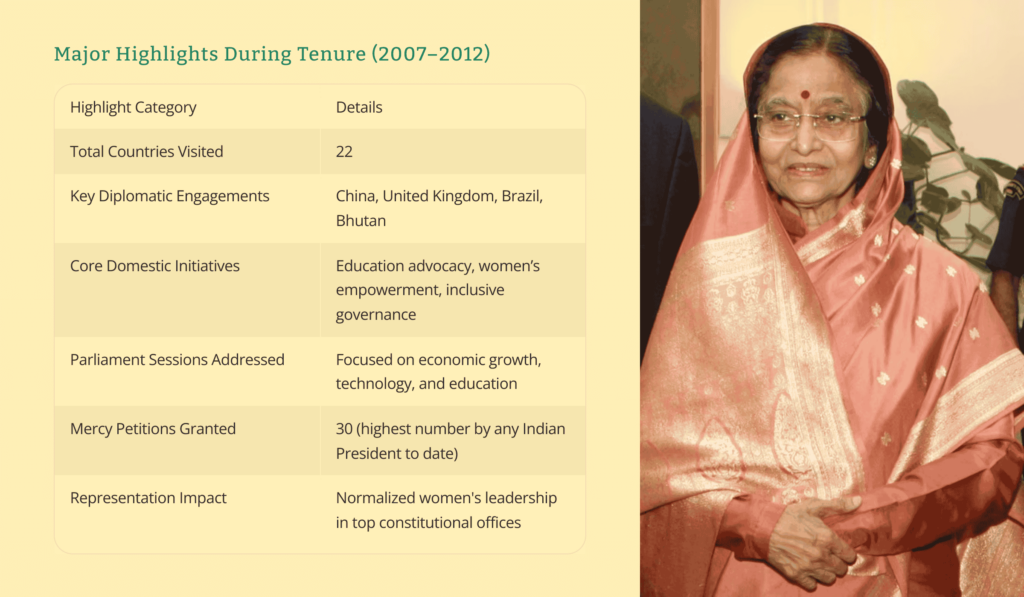
She conducted over 20 international visits to foster diplomatic ties, enhance trade relations, and represent India globally. Her travels included engagements in China, the UK, Brazil, and Bhutan. In speeches and initiatives, she promoted education, women’s empowerment, and inclusive development at home.
One controversial yet defining aspect of her presidency was granting clemency in numerous death penalty cases. While opinions were divided, her actions stemmed from deep humanitarian values. These defining moments further solidified her place as India’s first woman president and a global ambassador of peace and progress.
Though her term was essentially dignified, Patil did face some controversies. Criticism arose regarding land allocated for her retirement home in Pune, which was initially reserved for military personnel. Amid public scrutiny, she chose to relinquish the land voluntarily.
Additionally, the media scrutinized the expenses associated with her foreign travels. However, the government clarified that the visits were state-sponsored and aimed at strengthening diplomatic ties. Despite such challenges, Pratibha Patil, President of India, remained within the bounds of constitutional conduct.
Her resilience in navigating public criticism and maintaining the integrity of the office further underscored her pioneering role as the first woman President of India.
Despite the controversies, none involved corruption or major breaches of constitutional conduct.
Pratibha Patil’s legacy is rooted in her unwavering commitment to public service, education, and women’s empowerment. As India’s first female president, she set a precedent for gender equality in top-tier political roles. Her initiatives to improve rural education, health care, and cooperative development continue to influence national policies.
She founded institutions such as Vidya Bharati Shikshan Prasarak Mandal and supported vocational education for women. Through these efforts, Pratibha Patil, the first woman President of India, emphasized the importance of inclusive growth and long-term development.
Her time in Rashtrapati Bhavan was marked by humility, grace, and a nurturing approach to leadership. Her legacy inspires countless women aspiring to break barriers and contribute meaningfully to the nation.
The impact of India’s first female president extends far beyond her five-year term. Her election to the highest constitutional office in the country demonstrated the growing acceptance of women in leadership roles. In a nation often challenged by gender disparity, her rise to the presidency was a beacon of hope.
Young women across India saw her journey as evidence that determination and dedication could defy social norms. Political parties, too, began to field more female candidates and promote women within their ranks. Patil’s presidency brought the conversation of gender equity to the forefront of national discourse.
“Who is the first female president of India?” is now a reference point in Indian history classes and leadership seminars. Pratibha Patil, the first woman president of India, has stood tall as a role model for generations.
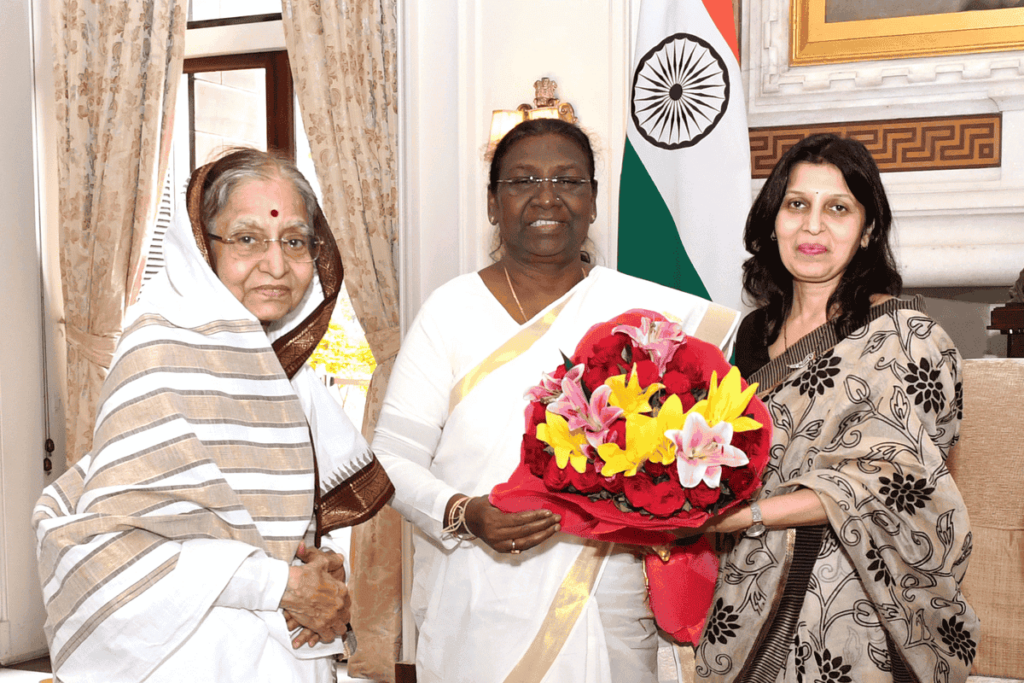
The journey of Pratibha Patil, the first woman President of India, from a humble village to the highest office in the nation is a remarkable narrative of grit, grace, and service. As the first woman President of India, she changed the perception of leadership and redefined what women can achieve in public life.
Her presidency was a political milestone and a societal statement that India, with its rich democratic framework, can embrace inclusive progress. Today, her legacy as India’s first woman president, and indeed as the 1st female president of India, continues to motivate and guide the future of Indian governance.
Read more:
Pratibha Patil was the first woman President of India, elected in 2007.
She was the first woman president of India from July 25, 2007, to July 25, 2012.
She promoted women’s rights, supported education, visited 22 countries for diplomacy, and broke gender barriers in Indian politics. Promoting women’s rights, strengthening diplomatic relations, and supporting education and rural development were hallmarks of her tenure as Pratibha Patil, President of India.
She resides in Pune and occasionally participates in post-retirement social and educational initiatives.
As the 1st female president of India, she broke gender barriers and paved the way for greater female representation in Indian politics.
She was a lawyer and politician with extensive experience in Maharashtra state politics and the Indian Parliament. She also served as the Governor of Rajasthan before becoming India’s first female president.
The first male President of India was Dr. Rajendra Prasad, who served from 1950 to 1962 and was the only President to serve two full terms. The first female President of India was Pratibha Patil, who held office from 2007 to 2012, making history as the first woman to occupy the country’s highest constitutional position.
The first woman Prime Minister of India was Indira Gandhi, who first took office on 24 January 1966. She served as Prime Minister in two terms, from 1966 to 1977 and from 1980 until her assassination in 1984, becoming one of the most influential leaders in India’s history.