Physics is often called the mother of all sciences because it forms the foundation for understanding how the universe works, from the motion of planets to the behavior of atoms. Yet, one intriguing question continues to spark curiosity among students, scholars, and history enthusiasts: Who is the Father of Physics?
The answer is not simple because physics has evolved across centuries through the genius of many minds. Some argue that Galileo Galilei deserves the title of the father of modern physics for pioneering the experimental method. Others highlight Sir Isaac Newton, whose laws of motion and gravitation built the framework of classical physics. Still others point to Albert Einstein, whose revolutionary theories of relativity reshaped modern science and earned him recognition as the father of contemporary theoretical physics.
Interestingly, even in India, debates around the “Father of Physics in India” bring figures like C.V. Raman into focus, especially after his Nobel-winning discovery of the Raman Effect. This layered history shows why the title is not fixed but shared, reflecting how physics as a discipline grew from ancient philosophy into a precise science that drives today’s technological world.
In this article, we will explore the contributions of these great scientists, examine the different branches of classical and modern physics, and uncover why the legacy of the “Father of Physics” continues to inspire generations.
The title “Father of Physics” cannot be easily assigned to a single individual. As we know it today, physics results from continuous evolution from ancient philosophical ideas to modern scientific breakthroughs. The question “Who invented physics?” does not have a singular answer because the discipline developed gradually through the efforts of many thinkers across different periods.
The earliest contributions to physics came not from scientists in the modern sense, but from philosophers. Ancient Greek thinkers like Aristotle and Archimedes laid down the initial groundwork. Despite lacking empirical evidence, Aristotle’s natural philosophy was one of the first systematic attempts to explain the physical world. Archimedes, however, introduced mathematical rigor by applying geometry to physical problems such as buoyancy and levers. These ideas were fundamental but lacked experimental validation, a core principle of modern physics.
As the centuries progressed, physics branched into distinct eras, each marked by transformational figures:
Given these shifts, it’s clear that physics has no single inventor or father. Instead, it has evolved through collective brilliance across generations, each phase producing its leading figure.
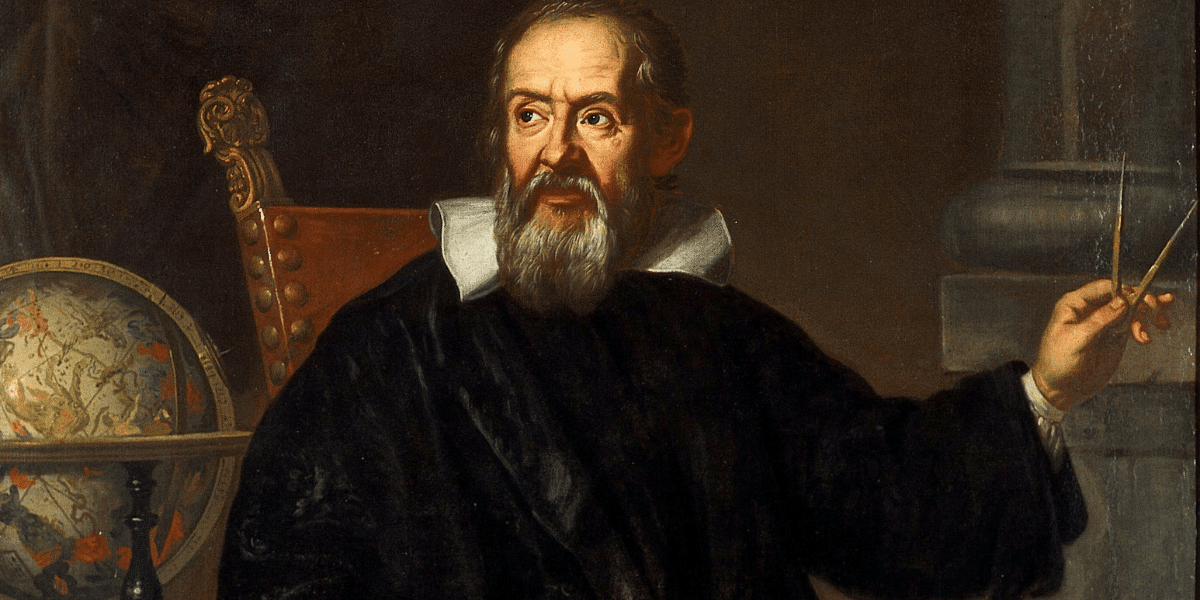
Galileo Galilei (1564–1642), born in Pisa, Italy, was one of history’s greatest scientific minds. A physicist, astronomer, mathematician, and philosopher, he played a central role in the Scientific Revolution, forever changing the way humans studied nature. He is often called the Father of Modern Physics for his groundbreaking work on motion and mechanics and the Father of Modern Science for introducing systematic experimentation and mathematics into the study of natural laws.
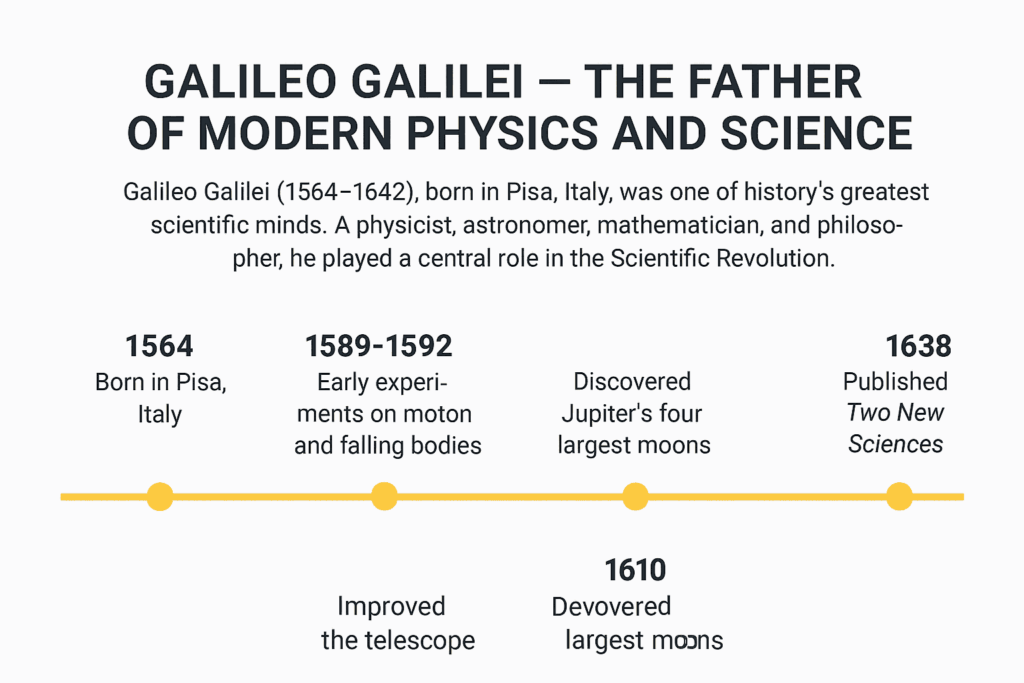
Historians honor Galileo with this title because he:
Galileo’s legacy lies not only in his discoveries but in how he redefined the scientific method, placing observation, measurement, and repeatability at the heart of science. His name continues to echo as the beginning of modern scientific inquiry.
Read More: Who Discovered Telescope

Isaac Newton (1643–1727), born in Woolsthorpe, England, stands among the greatest figures in the history of science. A mathematician, physicist, and astronomer, Newton transformed the way humanity understood motion, gravity, and light. He is widely honored as the Father of Classical Physics because his theories laid the groundwork for mechanics, optics, and celestial science.
Newton’s three laws of motion forever redefined mechanics:
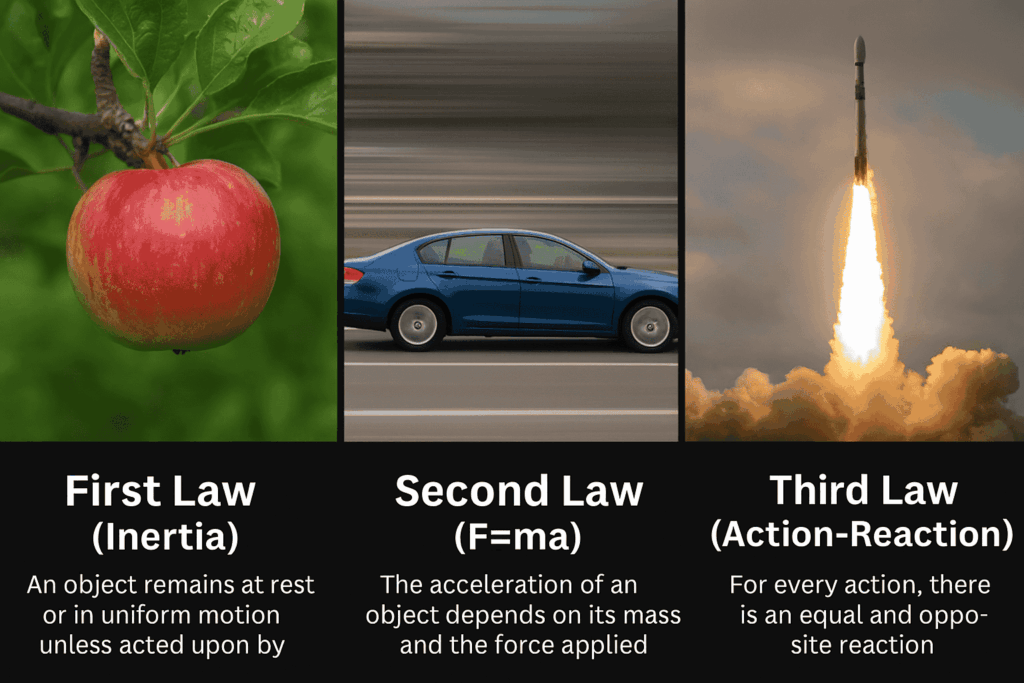
Together, these laws explained everything from falling apples to planetary orbits. Adding to this, his Law of Universal Gravitation proposed that every mass attracts every other mass with a force proportional to their product and inversely proportional to the square of their distance. This unified Earthly physics with celestial mechanics for the first time.
1687 Newton published Philosophiæ Naturalis Principia Mathematica, often shortened to Principia. This monumental work mathematically proved the laws of motion and gravity, explaining tides, eclipses, and planet movements with unprecedented precision. Historians often call Principia the most influential scientific book ever written, as it established the framework of classical mechanics that guided science for over two centuries.
Newton’s genius extended well beyond mechanics:
While Galileo Galilei is credited with pioneering the experimental method and discovering laws of motion, Newton took those foundations and created a complete mathematical framework. Galileo showed that falling objects accelerate uniformly; Newton explained that this is because of universal gravitation and motion laws. Galileo relied on experiments, while Newton combined theory, experiment, and mathematics to build a comprehensive worldview.
This synthesis is why Newton is celebrated as a great scientist and as the architect of classical physics, a system that remained unchallenged until Einstein’s relativity reshaped physics centuries later.

Albert Einstein (1879–1955) was a German-born theoretical physicist whose name has become synonymous with brilliance and scientific revolution. Einstein showed early signs of deep curiosity and mathematical talent in a secular Jewish family. After completing his studies at the Swiss Federal Polytechnic in Zurich, he worked at the Swiss Patent Office, where he spent time reflecting on fundamental physics problems. His groundbreaking ideas, developed independently, soon shook the foundations of classical physics.
Einstein’s most famous contribution is the theory of relativity, divided into two key parts:
In 1905, Einstein also published a paper explaining the photoelectric effect, where light shining on certain materials releases electrons. This work demonstrated that light can behave as discrete packets of energy (quanta) rather than just waves, earning him the Nobel Prize in Physics in 1921.
While Einstein famously resisted aspects of quantum mechanics, his early contributions helped establish its foundation. His theoretical work paved the way for technologies like lasers, semiconductors, and even GPS, which relies on relativistic corrections to function accurately.
Albert Einstein’s insights reshaped our understanding of the universe. For his monumental contributions to relativity and quantum physics, he is rightly considered the father of modern theoretical physics.
Read More: Nobel Prize Winners In India
While Galileo, Newton, and Einstein dominate the conversation around the “Father of Physics,” several other brilliant scientists have profoundly shaped the field, making a strong case for a more collective legacy.
A self-taught English scientist, Faraday revolutionized our understanding of electricity and magnetism.
Maxwell transformed Faraday’s observations into a unified theoretical framework.
Planck is widely recognized as the founder of quantum theory.
Each of these scientists advanced physics by building upon the work of their predecessors. Their combined efforts demonstrate that physics is not the creation of one mind but the result of a collaborative evolution of ideas, making it difficult and perhaps unnecessary to crown a single “father.”
Regarding the Father of Physics in India, two legendary scientists stand out: Acharya Jagadish Chandra Bose and Sir Chandrasekhara Venkata Raman (C.V. Raman). Their pioneering research laid the foundation of India’s modern physics and gained global recognition.
Jagadish Chandra Bose is often regarded as the Father of Modern Physics in India. He was a physicist, biologist, botanist, and inventor whose contributions were far ahead of his time.
While Bose laid the foundation, C.V. Raman is most widely celebrated as the Father of Physics in India, particularly for discovering the Raman Effect.
Bose and Raman embody India’s rich legacy in physics, inspiring generations of scientists.
The question “Who invented physics?” has no answer, as physics is a cumulative science shaped by centuries of inquiry. Its foundations were laid by ancient and classical thinkers long before modern pioneers like Galileo and Newton.
Aristotle (384–322 BCE), often regarded as the first physicist, explored motion, change, cause, and effect in his treatise Physics. Though many of his ideas were later challenged, his logical approach to natural phenomena influenced science for centuries.
Archimedes (287–212 BCE) contributed to mechanics and fluid dynamics, discovering the principle of buoyancy and advancing the mathematics of levers, pulleys, and geometry. His work established key principles of force and motion.
Johannes Kepler (1571–1630) revolutionized astronomy with his three laws of planetary motion, providing critical support for Newton’s theory of gravitation.
André-Marie Ampère (1775–1836) laid the foundation of electrodynamics through Ampère’s Law, linking electricity and magnetism.
Rather than being invented by one person, physics evolved through the combined efforts of such thinkers. Their insights created the intellectual bedrock for modern physics.
The journey of physics is not the legacy of a single individual but a collective triumph of human curiosity and intellect. From Galileo Galilei, who revolutionized scientific observation, to Isaac Newton, whose mathematical laws governed the universe, and Albert Einstein, who reshaped our understanding of time, space, and energy, each contributed uniquely to the fabric of physics.
Labeling just one person as the father of physics oversimplifies a complex, evolving discipline. Instead, it’s more accurate to recognize these figures as pillars in a discovery continuum. Their ideas didn’t replace each other; they built upon one another, deepening our understanding of the universe with each breakthrough.
In the end, asking “Who is the father of physics?” is less about naming one man and more about celebrating the enduring legacy of minds that dared to ask bold questions and transformed the world with their answers.
C. V. Raman is considered the Indian father of physics. He was awarded the Nobel Prize in Physics in 1930 for discovering the Raman Effect, which revealed how light scatters when passing through a transparent material. His work laid the foundation for modern optics and spectroscopy in India.
There is no official “world No. 1 physicist” as rankings don’t exist for scientists like in sports. However, Albert Einstein is widely regarded as one of the greatest physicists in history for his theories of relativity and contributions to quantum physics, which revolutionized our understanding of space, time, and energy.
Albert Einstein, often hailed as the father of modern physics, revolutionized science with his theory of relativity and major contributions to quantum theory. His explanation of the photoelectric effect earned him the 1921 Nobel Prize in Physics, cementing his legacy.
Physics doesn’t have a “real name” beyond the term itself, which comes from the Greek word physikē, meaning “knowledge of nature.” It originally referred to natural philosophy, the study of the physical world. Over time, it evolved into the modern science we now call physics, focused on matter and energy.
There is no single father of physics. Galileo Galilei pioneered experimental science, Isaac Newton established classical mechanics with his laws of motion and gravitation, and Albert Einstein revolutionized modern physics through relativity, shaping our understanding of space, time, and the universe.