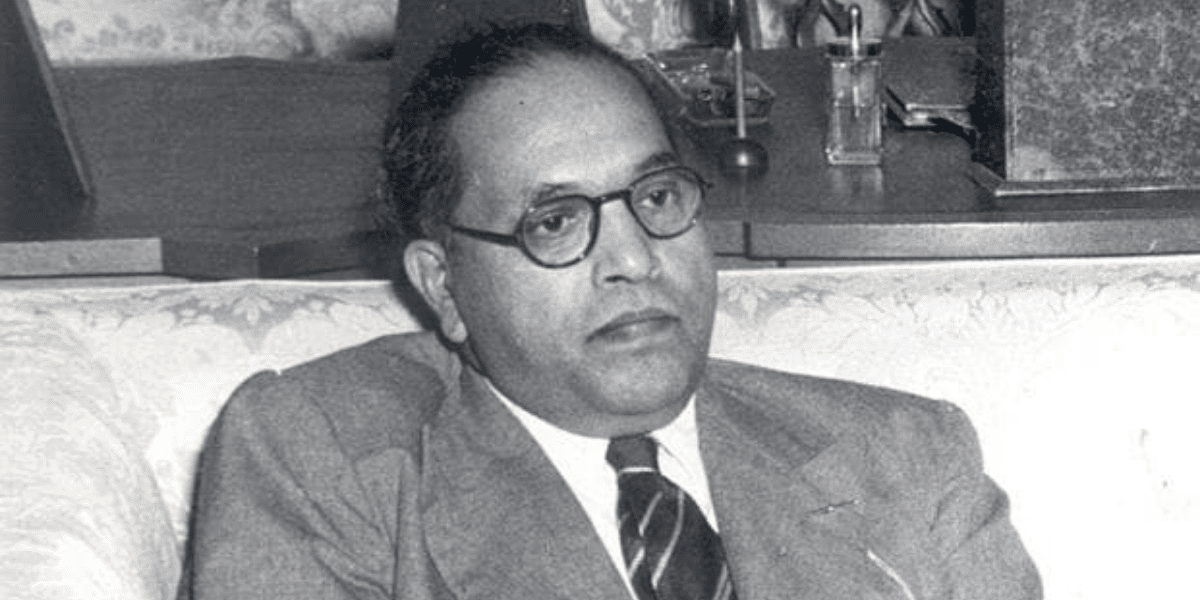
Dr Bhimrao Ramji Ambedkar is universally recognized as the Father of Indian Constitution. As the Chairman of the Drafting Committee, his visionary leadership and profound scholarship were instrumental in crafting the world’s longest written constitution. This article explores his life, his monumental contributions to the constitution, and his enduring legacy as a social reformer.
Born into a society marked by deep social inequalities, Ambedkar rose to become the chief architect of the nation’s supreme law, ensuring that the Constitution would become a powerful tool for social transformation. This article explores his remarkable journey, his monumental contributions to the Constitution, and his enduring legacy as a social reformer.
I measure the progress of a community by the degree of progress which women have achieved.
– Dr Bhim Rao Ambedkar
The Indian Constitution is the foundation upon which the nation is built. It’s the supreme law of the land, outlining the core principles of governance.
What it Does:
A Historic Milestone:
Adopted in 1949 and coming into effect in 1950, the Indian Constitution marked the birth of the Republic of India. It’s one of the longest-written constitutions globally, with 470 articles categorized across 25 parts. These parts delve into various aspects of governing, from fundamental rights to the distribution of power between the central and state governments.
Dr Bhim Rao Ambedkar was the chief architect and referred to as the “Father of Indian Constitution.” Being an ambitious leader and social reformer, he dedicated his life’s work to fighting discrimination against Dalits. On August 29, 1947, he was appointed Chairman of the Drafting Committee tasked with framing India’s Constitution. To prepare, Ambedkar thoroughly studied the constitutions of 60 other nations.
After independence, the government recognized Ambedkar’s instrumental role by naming him India’s first Union Law Minister. He also laid important policy groundwork across roles – from establishing guidelines that shaped the Reserve Bank of India to championing labor reforms for the vulnerable as a member of the Viceroy’s Council. Ambedkar is rightly remembered as a transformative national leader due to his foundational impact spanning social justice, governance, and economics.
Bhimrao Ambedkar is known as the Father of Indian Constitution due to his instrumental role in its drafting and framing. Here’s a breakdown of his key contributions:
These significant contributions solidified his position as the architect of the Indian Constitution, earning him the title “Father of Indian Constitution.”
Ambedkar’s vision for an equitable and just India is embedded in the very fabric of the Constitution. His most significant contributions include:
Ambedkar is considered the prime architect of Part III of the Constitution (Articles 12-35), which enshrines the Fundamental Rights. These rights guarantee individual freedoms and protect citizens from state arbitrariness. He ensured these rights were justiciable, meaning they could be enforced in a court of law.
Ambedkar famously declared Article 32 as the “heart and soul of the Constitution.” This article gives citizens the right to move the Supreme Court directly for the enforcement of their Fundamental Rights. It is the cornerstone that makes all other fundamental rights meaningful.
A direct result of his lifelong battle against social hierarchy, Article 17 abolishes “untouchability” in any form and makes its practice a punishable offence. This was a revolutionary step towards establishing social democracy.
While acknowledging they were not legally enforceable, Ambedkar supported the Directive Principles of State Policy (Part IV). He saw them as crucial guidelines for the government to work towards establishing social and economic democracy.
Fearing centrifugal forces in a vast and diverse country, Ambedkar advocated for a strong central government. He helped design a federal structure with a clear bias towards the Centre to maintain the unity and integrity of the nation.
He firmly believed in a parliamentary system with a removable executive, as opposed to a presidential system. He argued that this model ensured greater accountability of the government to the people.
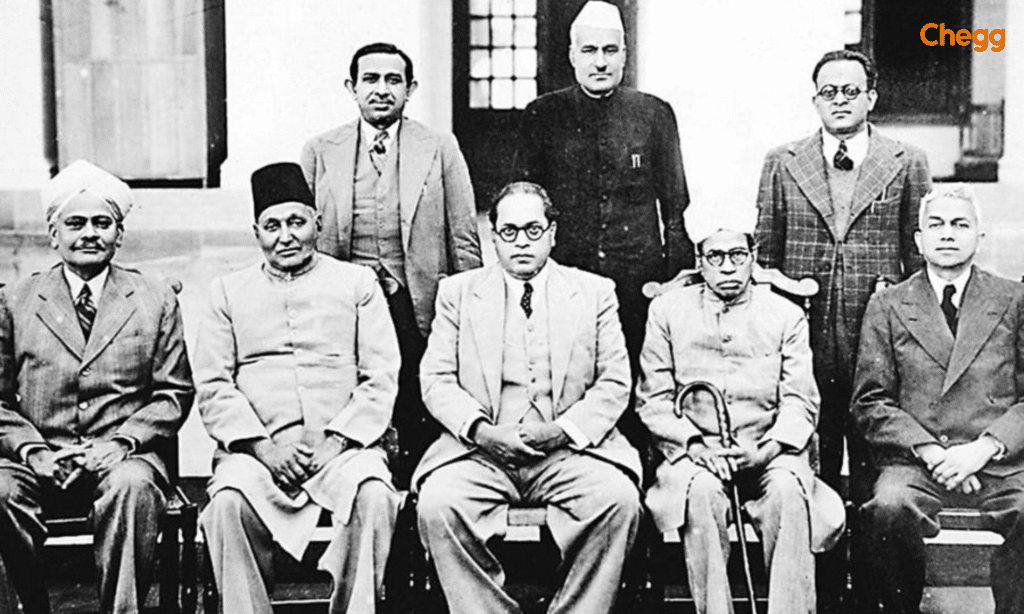
After India gained independence, the Constituent Assembly became the sovereign body tasked with framing the new constitution. The Drafting Committee, formed under Ambedkar’s chairmanship, was the most crucial committee.
Ambedkar’s approach was both pragmatic and idealistic. He skillfully navigated the debates between various ideological camps within the Assembly, balancing the idealist visions of leaders like Nehru with the realist perspectives of Patel. He played a key role in resolving critical debates on issues like minority rights, the language problem, and the nature of federalism.
The process was arduous. The Drafting Committee met for 114 days, and Ambedkar worked tirelessly for 2 years, 11 months, and 18 days to prepare the draft. He continued this work even through periods of ill health, demonstrating an unwavering commitment to the task. The final document, adopted on November 26, 1949, and enacted on January 26, 1950, stands as a testament to his monumental effort.
Bhimrao Ambedkar was born on April 14, 1891, in Mhow, Madhya Pradesh, into a Dalit Mahar family. From his earliest days, he faced the brutal reality of caste-based untouchability. He and his community were subjected to social ostracism, denied access to public spaces, and treated as inferior.
Despite immense hurdles, Ambedkar’s academic brilliance shone through. His journey was marked by several milestones:
Upon returning to India, his qualifications did not shield him from prejudice. His experience as a military secretary in Baroda ended abruptly when he was forced to leave due to discrimination, even in his place of residence. This reinforced his resolve to fight the caste system not just for himself, but for millions.
Being born into a Dalit family, Ambedkar faced discrimination from his peers and society throughout his life. However, he took the leadership to reform the condition of Dalits in the country. He pushed for legislative reforms, recognition in educational institutions, etc. During his fight against the deeply rooted caste system in the country, he had to face the bias of the British and Indians. He considered untouchability a political issue and sought to dismiss it with political reforms. However, in this ideology, he was opposed by M. K. Gandhi. Gandhi thought that untouchability was more of a social issue.
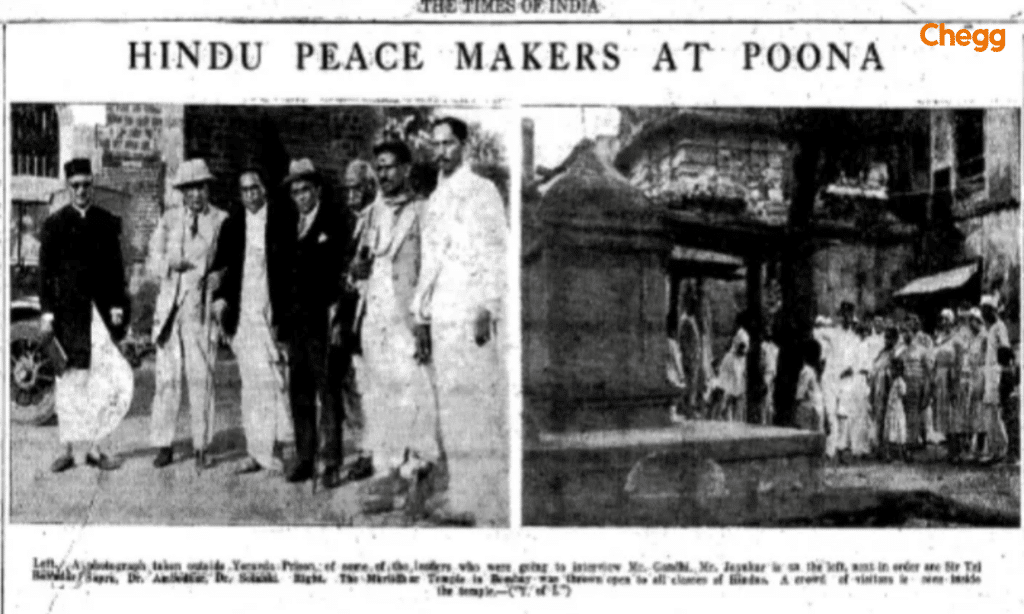
Ambedkar led the movement against untouchability in 1927. He and his followers marched to demand the right to draw water from public wells and other water resources. Ambedkar also organized the march to allow Dalits entry to the temples. He negotiated the untouchables’ political and educational status with M. K. Gandhi in the Poona Pact of 1932. Under this, he facilitated reservation seats for Dalits in political positions and educational institutions.
Indian society still follows the social reforms carried out by the Father of Indian Constitution, the maker of the Constitution of India. He was a staunch supporter of equality, along with a thought-provoking writer. His works, from Annihilation of Caste to Thoughts on Pakistan, are still important in political literature. Various commemorations have honored him for his efforts in enhancing the country’s social structure and economic stability. Many institutions across the country bear his name. They renamed his birthplace, Mhow, to Dr. Ambedkar Nagar. His birthday, April 14, is observed as a holiday as well.
Dr Ambedkar’s quotes include, “I measure the progress of a community by the degree of progress which women have achieved.” Ambedkar worked for the lower castes of society to bring them self-esteem and better living conditions. He targeted his movements to secure equal rights for the untouchables, including access to safe drinking water, places of worship, etc.
He also considered education the most essential social tool for uplifting society. Ambedkar asked for separate electors for Dalits in the first Round Table Conference held in London in 1930. He worked towards the economic progress of the country by promoting industrialization. Dr Ambedkar proposed solutions for rural nationalism and collective farming.
| Full Name | Bhimrao Ramji Ambedkar |
| Nickname | Babasaheb Ambedkar |
| Birthdate | April 14, 1891 |
| Birthplace | Mhow, Madhya Pradesh, India |
| Father’s Name | Ramji Maloji Sakpal |
| Mother’s Name | Bhimabai Sakpal |
| Education | 1. Elphinstone College, University of Mumbai 2. Columbia University, USA 3. London School of Economics, UK |
| Occupation | Social reformer, jurist, economist, politician |
| Religion | Buddhism |
| Family | Spouse: Ramabai Ambedkar Children: Yashwant, Gangadhar, Ramesh, Indu, Rajratna |
Dr. Ambedkar, who drafted the Indian Constitution, always took active steps towards uplifting the country’s marginalized communities. This included leading movements that brought equal status to the people belonging to the Scheduled Castes. He also proposed a separate Dalit electorate, which M.K. Gandhi opposed. As a negotiation, the Poona Pact marked the first step towards the political upliftment of the “depressed castes,” with its signing. He also included Articles 17 and 46 in the Constitution. Article 17 illegalises untouchability of any form in the country. He recognized that this does not give any active rights to the people. However, it was still a step towards bringing the condition of the marginalized community to equality.
Article 46 emphasizes the educational and economic upliftment of the Dalits and other marginalized sections. It provides reservations in educational institutions, employment places, etc., to reduce social and economic inequalities. He was also an advocate of entrepreneurship and industrialization for the economic upliftment of society. He wanted land reforms to distribute land among the landless and backward castes of the community. His land reforms, economic guidelines, and establishment of the Tenancy Act are some of his outstanding achievements.
| Title | Year | Summary | Focus Area |
|---|---|---|---|
| Annihilation of Caste | 1936 | A powerful critique of the caste system advocating for its complete eradication, foundational for movements promoting social equality in India. | Social Justice & Equality |
| Castes in India: Their Mechanism, Genesis, and Development | 1916 | Explores the life and teachings of Gautama Buddha, highlighting principles of non-violence and social equality, aligning with Ambedkar’s vision for inclusivity. | Historical Analysis of Caste |
| The Problem of the Rupee: Its Origin and Its Solution | 1940 | Ambedkar’s analysis of the challenges faced by the Indian rupee proposes solutions for a more stable currency. | Economic Policy |
| States and Minorities | 1945 | A discussion on the concerns of minority groups in India, proposing frameworks for their protection and equal participation in society. | Minority Rights |
| Buddha and His Dhamma | 1957 | The Untouchables: Who Were They and Why Did They Became Untouchables? | Philosophy & Social Equality |
| The Untouchables: Who Were They and Why Did They Become Untouchables? | 1959 | An exploration of the historical roots and social conditions leading to the marginalization of the Dalit community. | History of Untouchability |
Ambedkar, who is the father of the constitution, faced various struggles during the drafting of the document. The first challenge was that he had to create an amalgam of the idealist and realist ideas of Nehru and Patel, respectively. Dr Ambedkar also had to draw clear solutions for the debates on minority rights, federalism, etc.
Dr also faced challenges while trying to change the rigid social order in Indian society. He wanted to promote social justice and equality, for which different leaders had different ideas and viewpoints. He wanted to build a secular India that treats all its citizens as equals, which is a humongous task for a country as varied as India.
Ambedkar wrote the Indian Constitution based on his Buddhist principles. He thus introduced the values of equality, liberty, justice, and fraternity in the Constitution. Ambedkar worked on the Constitution for 2 years, 11 months, and 18 days after the 114 days of meetings held by the Drafting Committee. He kept at work even through his deteriorating health.
| Founding Fathers of the Indian Constitution | Contributions |
|---|---|
| Dr. B.R. Ambedkar | Chairman of the Drafting Committee; Principal Architect of the Constitution. |
| Pandit Jawaharlal Nehru | The first Prime Minister made significant contributions to constitutional debates. |
| Sardar Vallabhbhai Patel | Integrated princely states are invaluable in constitutional discussions. |
| K.M. Munshi | Lawyer, writer, politician, active in drafting the Constitution. |
| Alladi Krishnaswamy Iyer | Prominent jurist; significant legal contributions in the Constituent Assembly. |
| N. Gopalaswami Ayyangar | Drafted provisions for Jammu and Kashmir’s special status. |
| Maulana Abul Kalam Azad | The First Minister of Education contributed to education and cultural reforms. |
| D.P. Khaitan | Legal scholar, enriched constitutional discussions with his expertise. |
After the promulgation of the Constitution on January 26, 1950, Ambedkar, also known as the Father of the Indian Constitution, returned to Bombay to recover his health. He acknowledged that the Constitution still had its limits. However, various essential parts of the documents, such as federalism, liberal democracy, and reforms for minorities, showcase the impact of the father of the Indian Constitution. A year later, in 1951, he resigned from the post of Law Minister because of differences in views between the government and his. Even after his death, his social reforms reflected the people of the Scheduled Castes and other minority communities.
Read More:-
For his contribution as the Chairman of the Drafting Committee, Dr B.R. Ambedkar is known as the father of Indian Constitution.
Some prominent works of Bhim Rao Ambedkar include Annihilation of Caste, Waiting for Visa, The Problem of the Rupee: Its Origin and Its Solution, etc.
Dr Ambedkar set up various institutions for the upliftment and representation of minorities in Indian society. These include the All India Scheduled Castes Federation, People’s Education Society, and Bahishkrit Hitakarini Sabha.
Babasaheb includes fundamental rights such as equality, freedom of speech, protection against discrimination and untouchability, etc.
Ambedkar, also known as the father of Indian constitution, belonged to the Dalit community, formerly known as the Scheduled Castes or untouchables.
Dr. B.R. Ambedkar is considered the principal architect of the Indian Constitution.
While there is no official title for the “Mother of the Indian Constitution,” this honorific is often attributed to Mrs. Madam Bhikaji Cama. She was a prominent freedom fighter who designed one of India’s first tricolor flags in 1907. However, it’s more accurate to say that the contribution of many women in the freedom struggle and the Constituent Assembly collectively mother the ideals of the nation. There is no officially designated “Mother of the Indian Constitution” like Ambedkar is the Father.