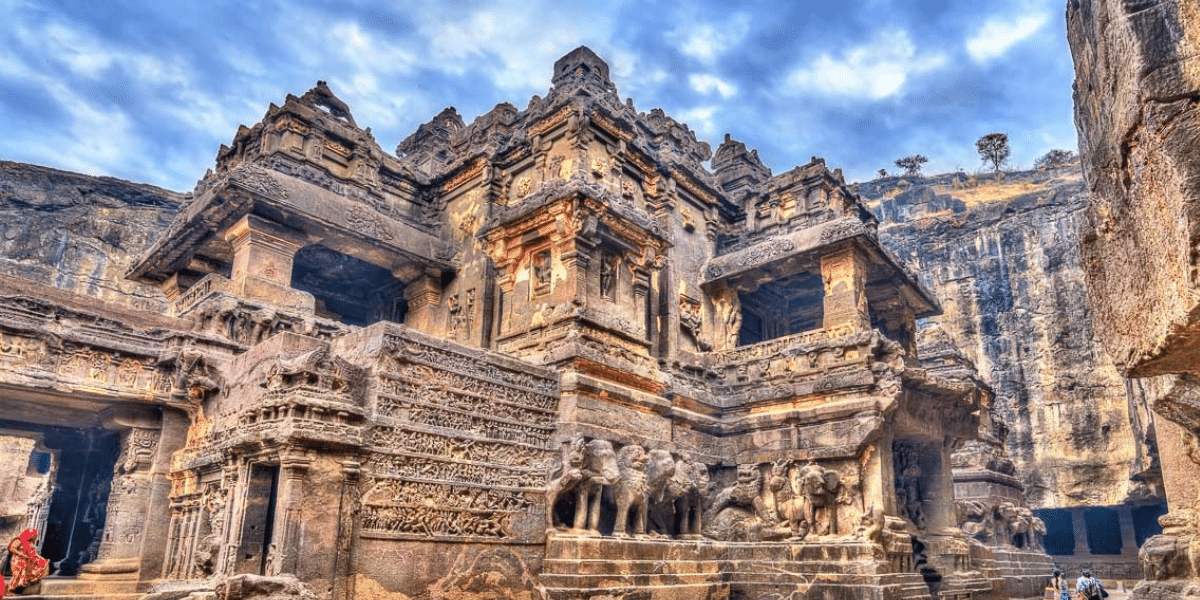
The Ellora Caves in Aurangabad, India, are a UNESCO World Heritage site known for their remarkable rock-cut architecture. Comprising over 100 caves, they represent Buddhist, Hindu, and Jain traditions, with the grand Kailasa Temple (Cave 16) standing out as a masterpiece. Created between the 6th and 10th centuries CE, the complex is divided into three groups: Buddhist (1–12), Hindu (13–29), and Jain (30–34).
Located just 29 kilometers from the city of Aurangabad, the caves feature grand sculptures, ornate pillars, meditation cells, prayer halls, and elaborate entrances. The caves were excavated over many generations, showing how knowledge and skill were passed down across centuries.
The Ellora Caves were developed between the 6th and 12th centuries CE. The earliest phases began during the late Gupta period and continued until the Yadava period. Each religious group built caves at different times, reflecting the cultural transitions taking place in ancient India.
The Buddhist caves were the earliest, likely beginning in the 6th century CE. Subsequent Hindu caves were constructed from the 7th to 10th centuries during the reign of the Rashtrakutas. Finally, the Jain caves were created between the 9th and 12th centuries CE.
Several dynasties supported the construction of Ellora Caves:
This long timeline illustrates that Ellora Caves history spans almost 600 years of religious harmony and royal patronage.
The Ellora Caves stand as a symbol of religious tolerance, where three faiths coexisted side by side. This diversity makes Ellora unique in the world.
These are the earliest caves at Ellora. They mainly consist of viharas (monasteries) and chaitya halls (prayer halls). The Buddhist caves include spacious halls used by monks for living, meditation, and communal gatherings.
The caves on the southern side of Ellora were constructed between 600 and 730 CE. Initially, it was thought that the Buddhist caves, built from the 5th to 8th centuries, were the earliest. Caves 1–5 were believed to belong to the first phase (400–600), and caves 6–12 to the later phase (650–750). However, modern scholars suggest that Hindu caves might predate the Buddhist ones. Cave 6 is considered the oldest Buddhist cave, followed by others like caves 2, 3, 5, 7, 8, 9, and 10. Caves 11 and 12, also known as Do Thal and Tin Thal, contain the latest Buddhist artefacts.
The Ellora Caves feature multi-story structures carved into the mountainside, serving as monastic residences, complete with living spaces, kitchens, and prayer halls typical of viharas. These caves are adorned with intricate carvings of saints, bodhisattvas, and Gautama Buddha, sculpted to imitate wooden carvings in stone. Noteworthy examples of Buddhist architecture include caves 5, 10, 11, and 12. Cave 5 stands out with its hall-like design, complete with parallel refectory benches and a Buddha statue. Caves 1–9 serve as monasteries, while Cave 10, known as the Vvakarm Cave, functions as a significant Buddhist temple.
The Hindu caves are the most elaborate and form the heart of Ellora’s architectural glory. Built primarily under the Rashtrakuta kings, these caves are decorated with sculptures of Shiva, Vishnu, Parvati, Ganesha, and other deities.
Key features include:
The Kailasa Temple is the crowning jewel of Ellora Caves. Carved in the 8th century during the reign of King Krishna I of the Rashtrakuta dynasty, it represents Mount Kailash – the abode of Lord Shiva.
The temple covers approximately 60 meters in length, 40 meters in width, and rises to a height of 30 meters. The entire structure was carved from a single rock without any additional blocks. The temple includes a gateway, courtyard, assembly hall, and sanctum with a Shiva Linga. The plinth of the temple is decorated with continuous sculptural friezes showing scenes from epics like the Ramayana and Mahabharata.
The central hall contains sculptures of Nandi (Shiva’s bull vehicle) and colossal panels of various deities. The Kailasa Temple at Ellora is considered one of the greatest man-made wonders of ancient India.
The Hindu caves at Ellora were among the earliest to be built, even before the Buddhist or Jain caves. While the carvings suggest that the artists paid attention to many Hindu gods and goddesses, these caves mainly focused on Lord Shiva. At the heart of the Ellora Caves temples was a rock-cut linga-yoni, surrounded by a pathway for walking around (parikrama).
Cave 29, also known as Dhumar Lena, is one of the oldest and most impressive caves at Ellora. It features a natural waterfall called the “Vale Ganga,” which was an important part of early Hindu temple construction. You can see the waterfall from a balcony carved into the rock, especially during the rainy season when it looks like it’s pouring over Shiva’s head. The carvings in this cave are larger than life, but they’re described as chunky and with exaggerated features compared to other caves in Ellora.
The Jain caves, located at the northern end, represent the final phase of construction at Ellora. These caves highlight Jain principles of non-violence and simplicity, combined with sophisticated artistry.
Key Jain Caves:
The caves were excavated using the top-down method. Artisans began carving from the top of the basalt hill and slowly worked downwards. This method ensured structural stability while allowing complex plans to be executed precisely. Ellora extends over a 2 km stretch, with caves aligned north to south.
Some caves have multiple levels, balconies, courtyards, and carved staircases. Sculptors and architects blended artistic imagination with engineering skill, creating free-standing pillars, pillars supporting roofs, and projecting balconies – all cut directly from stone.

The sculptures at Ellora reflect storytelling, symbolism, and divine expression. Each cave has a distinct approach to sculpture depending on the religious tradition it represents.
The intricate carving of Ellora Caves sculptures reflects precision and spiritual symbolism, making Ellora a living museum of Indian art.
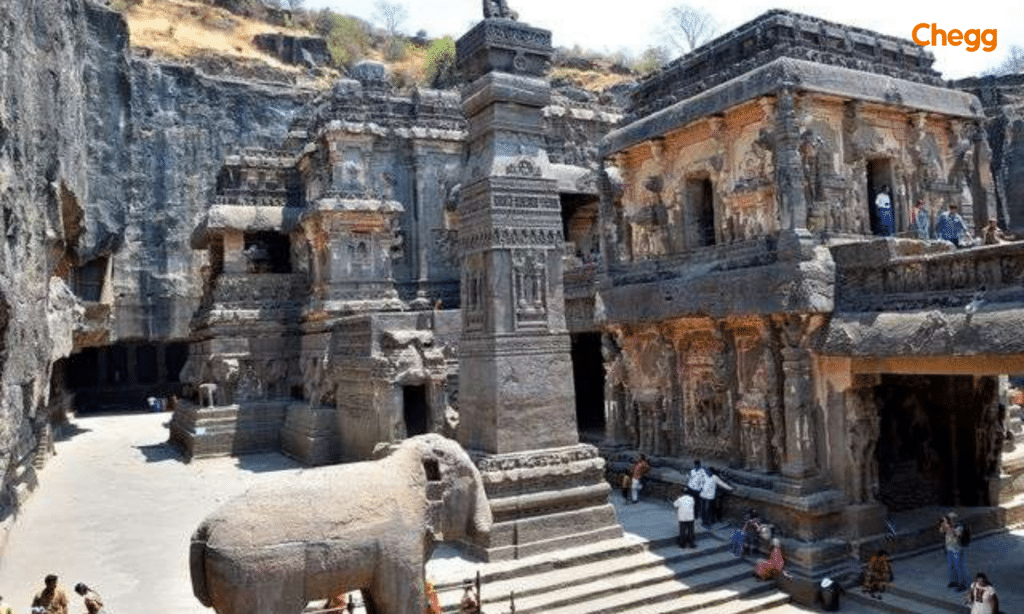
Ellora Caves opening time is 6:00 AM to 6:00 PM, Wednesday to Monday, and remains closed on Tuesdays.
The ideal time to explore Ellora Caves is between November and February, when the weather is cool and comfortable. Monsoon season (August to September) also offers a lush green landscape and scenic waterfalls. Summers should be avoided due to the high heat.
For those wondering where is Ellora Caves are located, the site lies 29 km northwest of Aurangabad and is easily accessible via Aurangabad. Aurangabad Airport connects flights from Mumbai, Delhi, Hyderabad, and other cities. Aurangabad Railway Station handles trains from major cities. Local buses, taxis, and rental cars can take visitors from Aurangabad to Ellora.
The Ellora Caves were declared a UNESCO World Heritage Site in 1983. This recognition highlights their significance as a masterpiece of human creative genius. The coexistence of three religions in one site makes Ellora globally unique.
The Archaeological Survey of India manages preservation efforts. Measures include structural repairs, cleaning of sculptures, control of visitor access, and awareness programs. Signboards and protective pathways are installed to prevent damage. Regular monitoring helps safeguard the fragile carvings.
Natural weather conditions, such as rain, wind, and temperature changes, cause erosion of carvings. Increased tourism leads to wear and tear, and authorities have been working on creating sustainable tourism practices to protect the Ellora from further deterioration.
To make the most of your visit:
Start early, explore Buddhist caves first, move to Hindu caves by noon, and finish with Jain caves. End with a hilltop view of Kailasa Temple.
Ajanta Caves focus on Buddhist paintings dated between the 2nd century BCE and 6th century CE, while Ellora is known for its rock-cut sculptures and multi-religious architecture from the 6th to 12th centuries CE. Ajanta is more remote and serene, whereas Ellora is larger, more accessible, and showcases unity in religious art.
| Aspect | Ajanta Caves | Ellora Caves |
|---|---|---|
| Time Period | Built in two major phases: first around the 2nd century BCE, then revived between 400-650 CE under dynasties like Satavahanas and Vakatakas. | Constructed later, roughly between 6th-10th century CE, under Rashtrakutas, Chalukyas, Yadavas, etc. |
| Religious Affiliation | Entirely Buddhist: primarily monasteries (viharas) and prayer halls (chaityas), with paintings illustrating Jataka tales and the life of the Buddha. | Multi-faith: houses Buddhist, Hindu and Jain caves. The Hindu section includes the grand Kailasa Temple, plus Jain caves with distinct iconography. |
| Art & Decoration | Famous for exquisite paintings and frescoes; wall murals with vivid colours, emotional gestures. Sculptures are there but secondary. | Sculpture dominates: massive monolithic temples, elaborate reliefs, carvings of gods, epic scenes. Paintings present but less central. |
| Structure & Layout | Caves carved into a horseshoe-shaped cliff above the Waghora River, aligned in order, with Chaitya halls and square vihara cells. | More scattered across basalt cliffs, caves from different religions interspersed; includes freestanding temple work (Kailasa), large courtyards, varying scale. |
| Purpose & Usage | Monastic retreats, meditation, learning, pilgrimage especially during monsoon seasons. Used by Buddhist monks as sanctuaries. | Religious worship, pilgrimage for multiple faiths; also demonstration of political power, artistic mastery; temples dedicated to Hindu deities and Jain Tirthankaras alongside Buddhist Viharas. |
The Caves appear on the ₹ 20 Indian rupee note, which helps reinforce their recognition nationwide. The reverse side of the note features Ellora Caves, celebrating India’s architectural heritage.
Ellora Caves remain one of India’s most valuable cultural treasures. The unity of Buddhism, Hinduism, and Jainism in a single rock-cut complex reflects religious tolerance. From quiet Buddhist viharas to powerful Hindu temples and refined Jain shrines, Ellora Caves offer a magnificent journey through India’s past. The Kailasa Temple alone leaves visitors speechless with its scale and artistry. Whether you are a history student, traveler, or exam aspirant, the Ellora Caves provide a deep and inspiring look into India’s glorious ancient architecture.
Read More:
Ellora Caves were built between 600-1000 CE under rulers like the Rashtrakutas, Chalukyas, and Yadavas. Their motivations were religious devotion, patronage of art, and creating monuments to Buddhism, Hinduism and Jainism. The Kailasa Temple (Cave 16) was constructed by Krishna I to glorify Shiva and show architectural mastery.
The Ellora Caves are located near the town of Ellora (Verul Leni), about 30 km north-northwest of Aurangabad, in the state of Maharashtra, India. They lie along the Aurangabad-Chalisgaon road, carved into the basalt cliffs of the Deccan Traps.
Thеrе arе a total of 34 cavеs in Ellora. The diversity of thеsе caves showcases the artistic and cultural legacy of the region.
The most famous cave is Kailasa Temple (Cave 16), which is a single monolithic structure carved out of a single piece of rock. It is one of the largest and most impressive rock-cut temples in the world.
Ajanta Caves predate Ellora: built between 2nd century BCE and 500-600 CE, and are purely Buddhist with famous murals, chaityas, viharas. Ellora was built later (c. 6th-10th century CE) and includes Hindu, Buddhist, and Jain caves. Ajanta focuses on painting; Ellora is better known for massive rock-cut sculpture and monolithic temples like Kailasa.
Visiting Ellora Caves typically takes 2–6 hours depending on how many caves you explore. For a full experience, plan a half to full-day visit with comfortable footwear and water.
Ellora Caves are closed on Tuesday.
The new Indian ₹ 20 note (Mahatma Gandhi series) features a motif of the Ellora Caves on the backside. This design choice by the RBI celebrates India’s cultural heritage, specifically referring to the Ellora Caves’ architectural grandeur and rock-cut artistry.