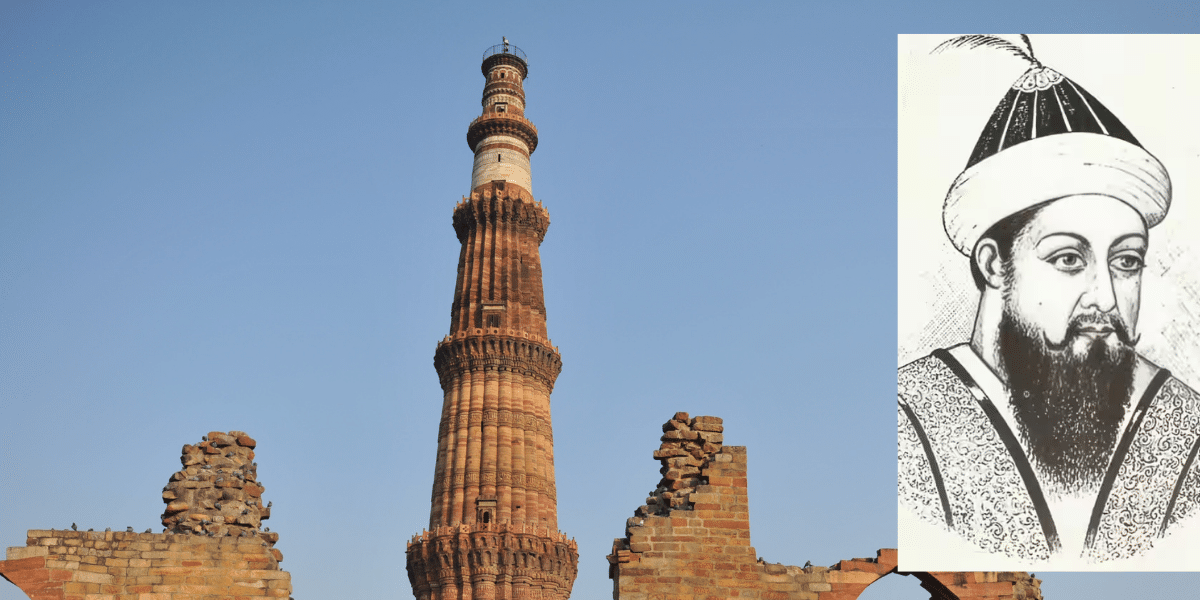
This ancient Muslim kingdom, which flourished from the 13th to the 16th century, played a key role in forming the socio-political landscape of the Indian subcontinent. With its beginnings in battles and cultural exchanges, the Delhi Sultanate left an indelible impression on the location’s records. This article dives into the multiple components of the Delhi Sultanate, consisting of its history, management, and government, touching lightly on the details that marked this fascinating era.
Between 1206 and 1526, the Delhi Sultanate, an Islamic Empire, governed South Asia, primarily the Indian subcontinent, with its epicentre in Delhi, an ancient city in Northern India. Historians divide the Delhi Sultanate’s reign into five distinct dynastic periods.
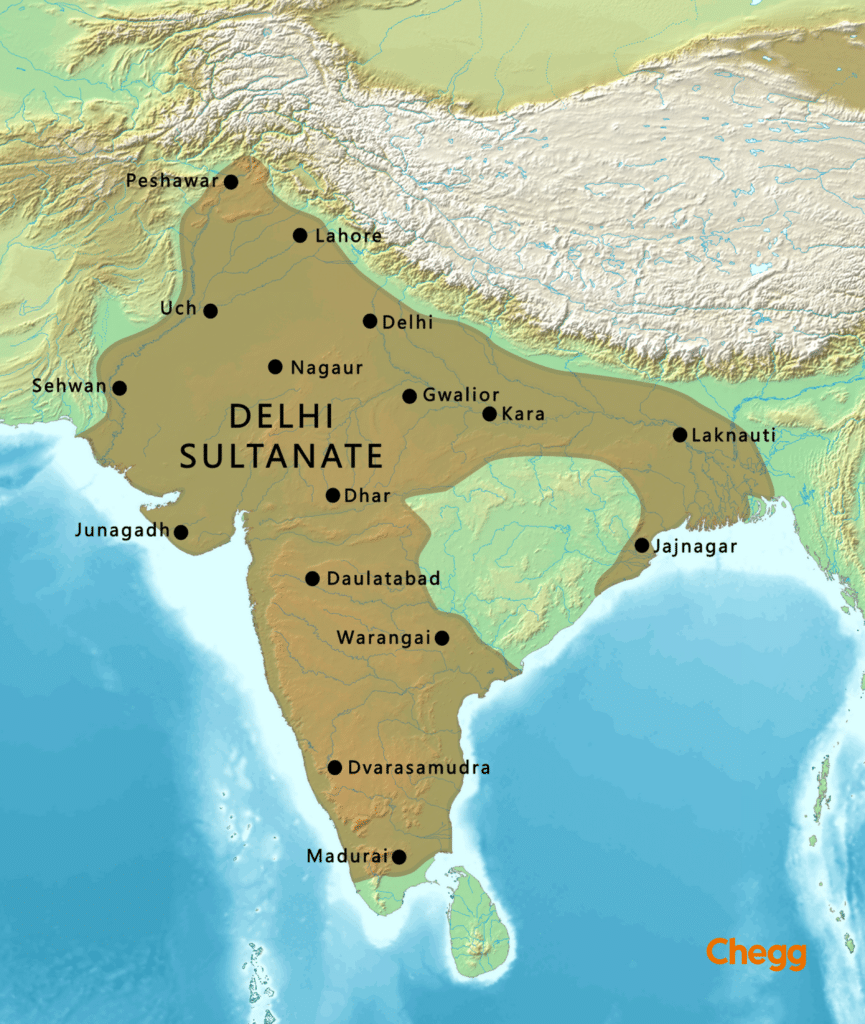
The empire’s inception is rooted in Turkic migration, a widespread phenomenon during the Middle Ages, where Central-Asian ethnic Turks spread across Eurasia, integrating into the cultures and political systems of dominant nations. Often, Turkic migrations were not voluntary; some Turks were compelled to leave their homelands.
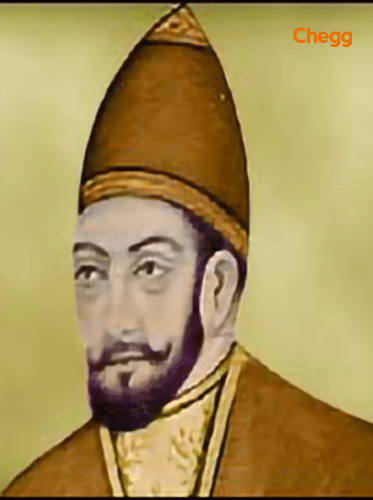
Qutb-ud-din Aibak, a well-known naval commander who served under Muhammad Ghori, founded the Delhi Sultanate. Following Ghori’s death, Aibak hooked up the Slave Dynasty and rose to strength because of the first Sultan of Delhi. Aibak’s rule marked the beginning of the Sultanate’s rule, starting up a Delhi sultanate period of great political and cultural ameliorations.

The established order of the Delhi Sultanate may be credited to the turbulent political scene of the Indian subcontinent in the twelfth century. The attacks by Turkish and Central Asian masters, mainly Muhammad Ghori’s operations, weakened current local forces. The Battle of Tarain in 1192 marked a crucial moment in which Ghori’s win over King Prithviraj Chauhan made way for the established order of the Sultanate.
The Delhi Sultanate is a significant record in Indian history, defined by its active masters, cultural fusion, and lasting effect. For many centuries, the Delhi Sultanate period followed several families’ rise and decline, leaving a permanent impact on the Indian region.
The Delhi sultanate period lasted roughly three centuries, from the thirteenth to the sixteenth century. It marked a changing time in Indian records; at some point, numerous kingdoms established their rule over the location.
The Sultanate’s established order was based on the aftermath of wars by Turkish and Central Asian masters, leading to the established order of a series of effective Islamic powers.

Enslavement of individuals from non-Muslim regions became prevalent in Middle Eastern Islamic societies during the Middle Ages, as enslaving Muslims was prohibited. Many Turks were subsequently transformed into Mamluks, or “slave warriors,” serving the Middle Eastern caliphates. Notably, the Delhi Sultanate’s first ruler emerged from this Mamluk background, showcasing the diverse origins and influences shaping the empire
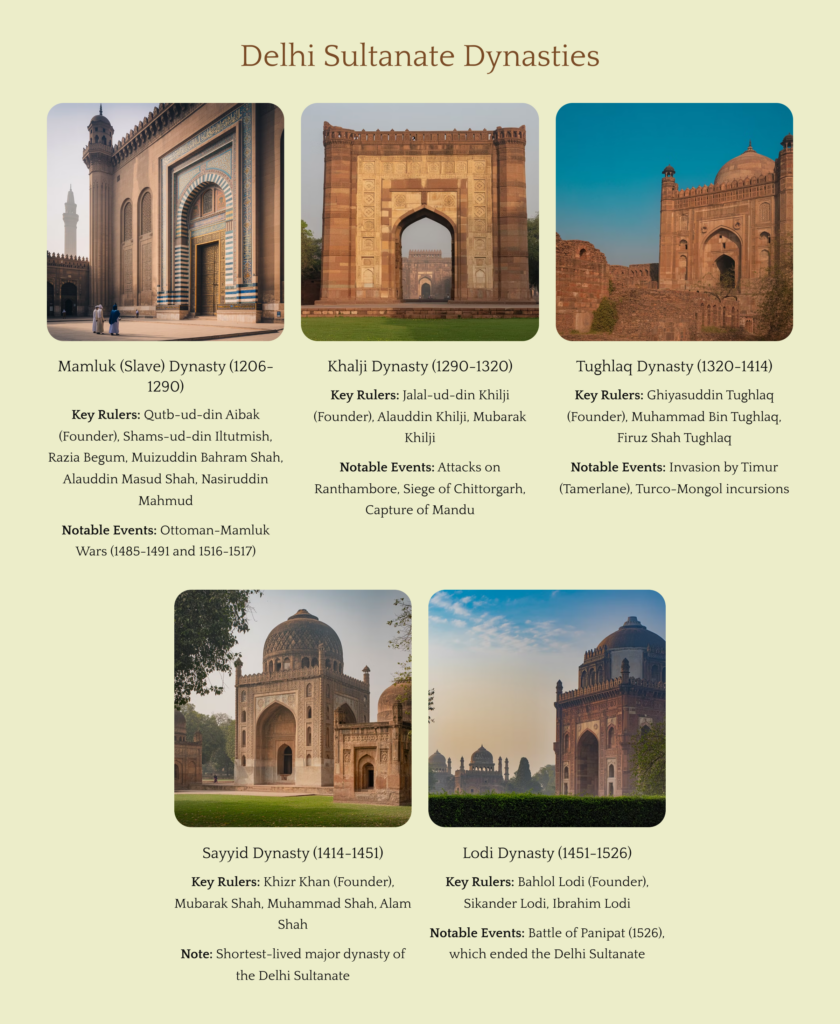
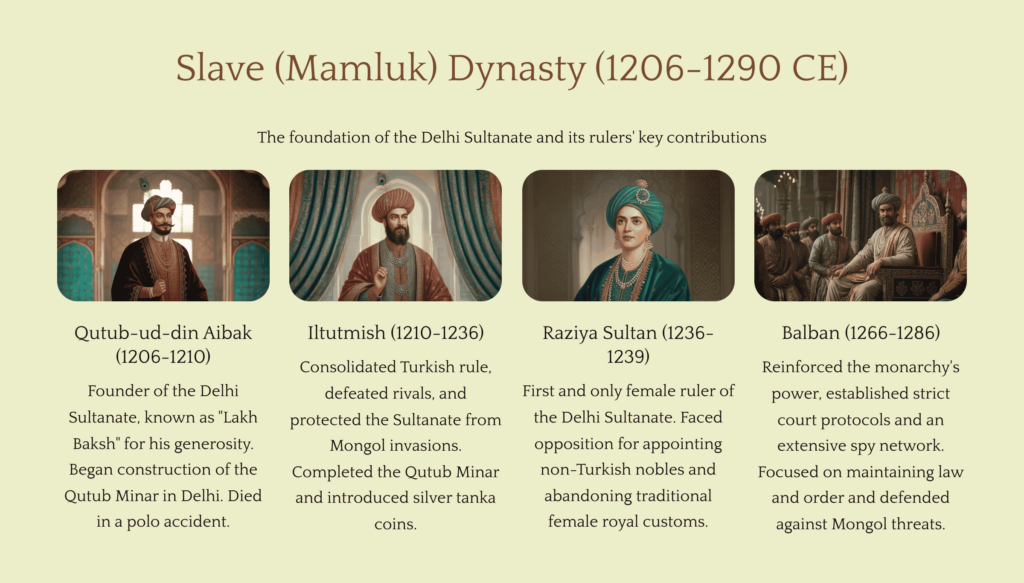
Mamluk Dynasty was founded by Qutb-ud-din Aibak, followed by rulers like Iltutmish and Balban. Known for consolidating power and building Qutub Minar.
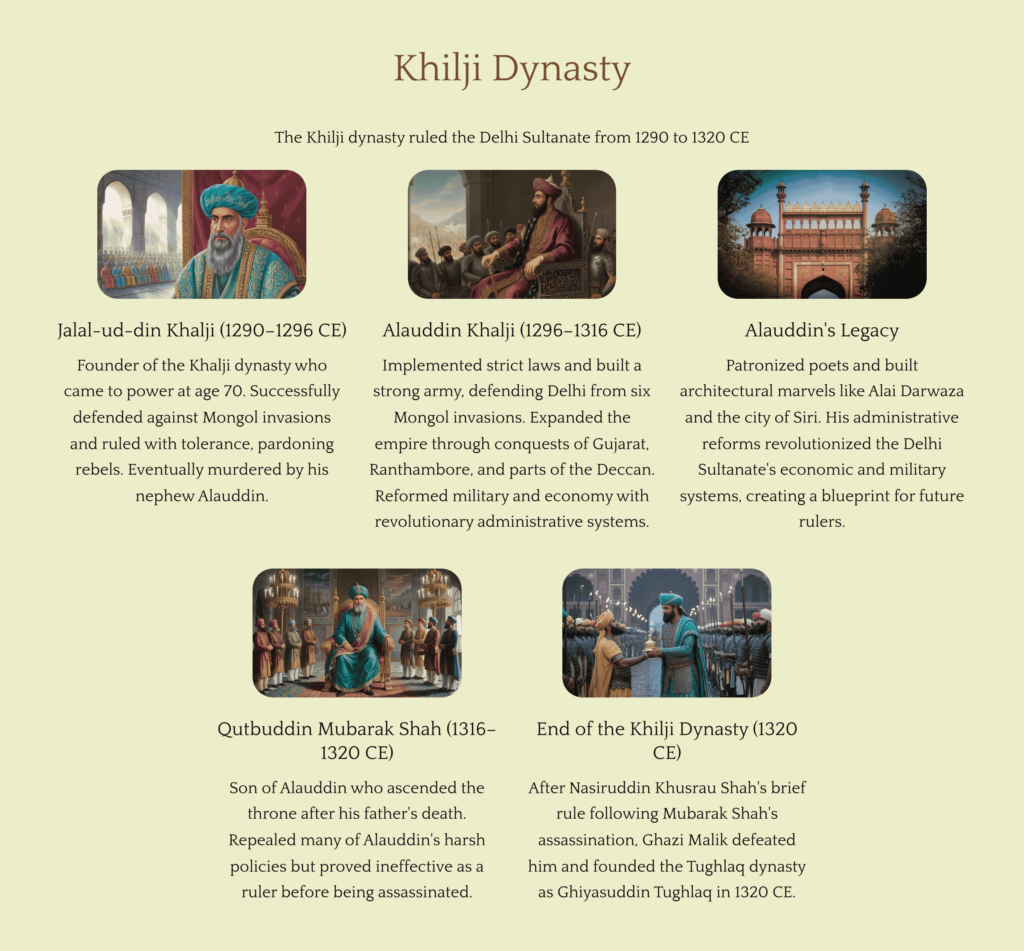
Started by Jalal-ud-din Khilji, most famous ruler was Alauddin Khilji, known for military conquests and market reforms in Khilji Dynasty.
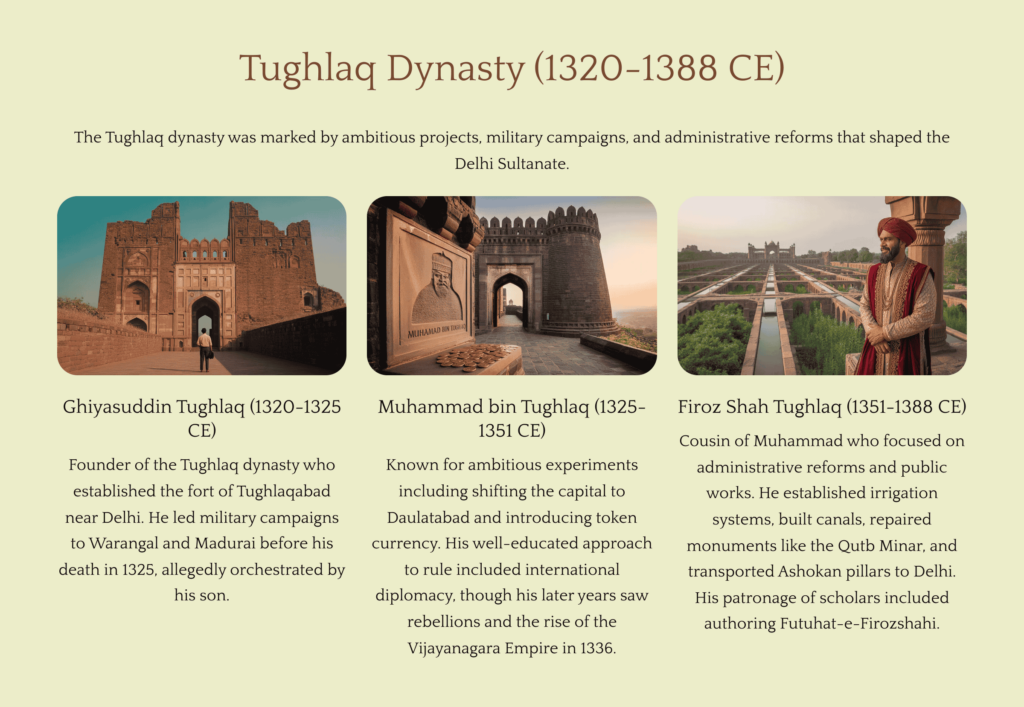
Tughlaq Dynasty was founded by Ghiyas-ud-din Tughlaq. Muhammad bin Tughlaq and Firoz Shah Tughlaq ruled later. Known for ambitious projects and administrative experiments.
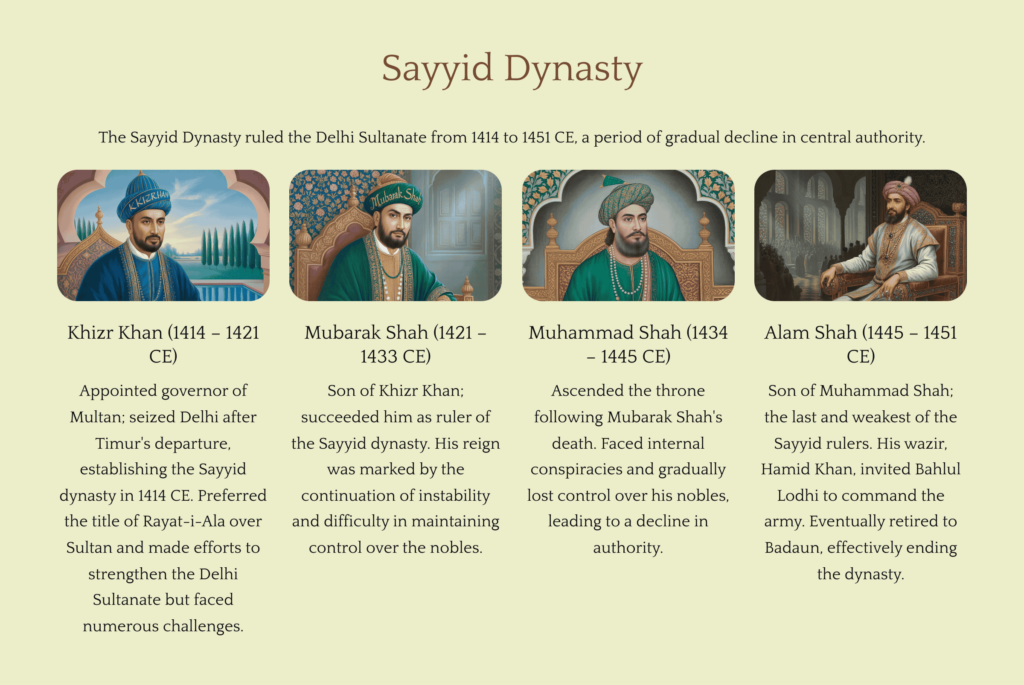
Weak successors of Timur’s invasion. Founded by Khizr Khan, but largely insignificant in expansion or administration.
The Lodhi dynasty was the last to rule during the Sultanate period and the first Afghan-led dynasty. They initially governed Sirhind while the Sayyids ruled in Delhi.
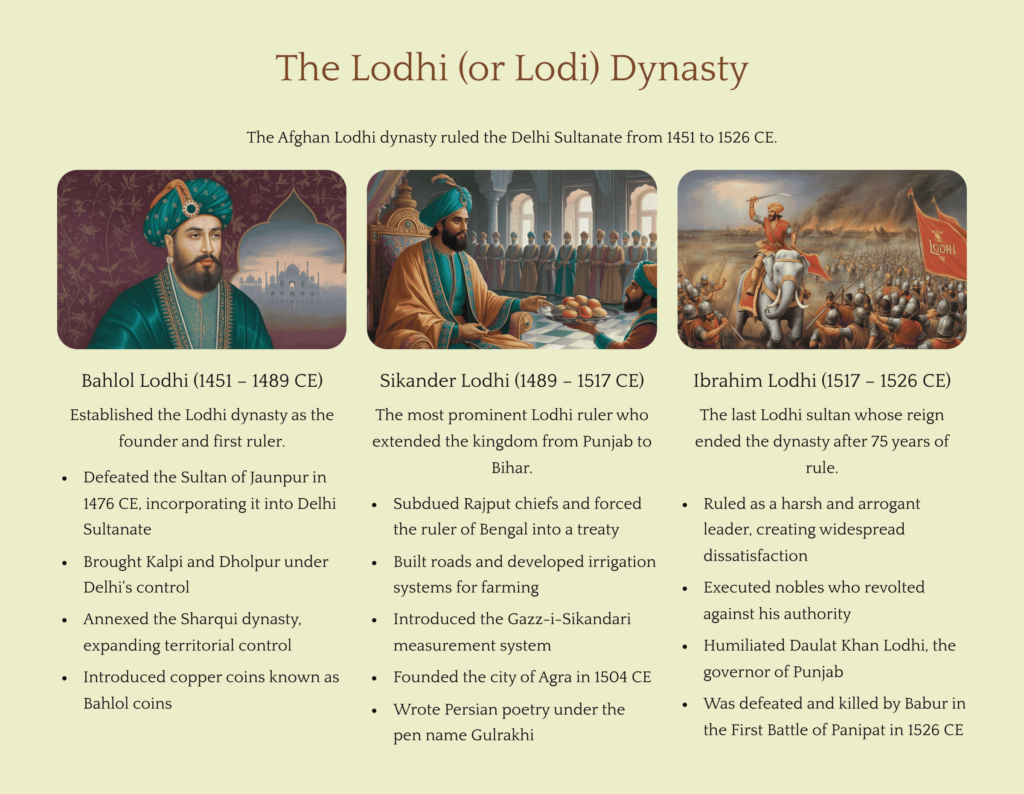
The Iranian Pashtuns of the Lodi Tribe ruled the Lodi Dynasty. The Delhi Sultanate was already in decline by the time the Lodhi took over. Sultan Sikandar Lodi relocated the Delhi Sultanate’s capital to Agra, which would go on to develop and flourish when the Delhi Sultanate ended. The last legitimate ruler of the Delhi Sultanate would be Ibrahim Lodi, the son of Sikandar. The height of political unrest under Ibrahim Lodi’s reign was the First Battle of Panipat in 1526, which saw the future Mughal Emperor Babur defeat Ibrahim Lodi and establish his dynasty in India.
The Delhi Sultanate, which spanned numerous centuries, became defined not only by its wealthy culture but also by its problematic administration and governance systems. As kingdoms grew and fell, the administrative shape formed, having a long-lasting effect on the Indian subcontinent.
The Delhi Sultanate followed a controlled governmental system that placed significant power in the hands of the Sultan. At the top of this shape turned into the Sultan, who held each governmental and religious power. The Sultan’s choices were bound, and different governmental officials performed his will.
At the arterial heart of the executive form became the Sultan, who held the best authority in political and non-secular topics. The Sultan considered his orders as law, and he made final choices. This centralization of power allowed for quick choice-making and fast implementation of policies, allowing the Sultanate to respond to challenges and opportunities with speed.
The empire split into regions called “iqtas,” managed by a ruler chosen by the Sultan. These rulers, or amir-i-shikar, were responsible for keeping law and order, collecting taxes, and ensuring efficient working in their various areas. This decentralized method enabled powerful government and income collection throughout different regions.
The empire was divided into provinces referred to as “iqtas.” These provinces were further divided into districts, each headed with the aid of a governor known as an amir-i-shikar. This decentralized structure allowed for green governance and the collection of revenue.
The administrative structure protected numerous officers responsible for unique parts of government. The Diwan controlled sales and spending, ensuring economic security. Ariz-i-Mumalik became responsible for navy affairs, while Sadur handled spiritual topics.
The Sultanate’s monetary safety rested on the green income series. Land income, known as Kharaj fashioned a broad part of profits. The size of land, measurement of taxes, and tracking of sales series have been carefully done.
The Sultanate’s crime system became mainly based on Islamic principles, with Qazis (judges) allotting justice. Sharia courts’ status ensured Islamic law’s software in civil and crook topics, offering a feeling of justice and order.
The Delhi Sultanate left a profound impact on the governance and political landscape of India, influencing subsequent empires and shaping the region’s administrative practices. Here are some key aspects of its legacy:
The Delhi Sultanate established a model of centralized governance that emphasized the authority of the ruler. This system laid the groundwork for future empires, including the Mughal Empire, which adopted similar administrative structures.
The Sultanate’s military organization was highly structured, with a focus on maintaining a strong standing army. This emphasis on military power influenced later rulers in their approach to governance and territorial expansion.
The Delhi Sultanate implemented efficient revenue collection systems, including land revenue assessments. These practices were refined by later rulers and became integral to the economic administration of subsequent empires.
The incorporation of Shariat (Islamic law) into the legal system established a precedent for the integration of religious principles into governance. This influence persisted in various forms in later Islamic states in India.
The Sultanate fostered a unique blend of Persian, Indian, and Islamic cultures, which influenced administrative practices, art, and architecture. This cultural synthesis became a hallmark of governance in the region.
While the Sultanate was often characterized by nepotism, some rulers promoted merit-based appointments in administration and military, setting a precedent for future governance models.
The political structures and practices established during the Sultanate influenced regional powers and local governance, leading to a complex political landscape that persisted long after its decline.
The importance of the Delhi Sultanate cannot be overstated. It served as a bridge linking the East and the West, enabling alternate trade and the change of thoughts among one-of-a-kind sector components. The Sultanate’s effect on Indian society became deep because it provided new governmental structures, building marvels, and cultural changes that left a lasting imprint on the subcontinent’s past. The status of notable city centres such as Delhi, Agra, and Lahore added to the boom of a numerous and lively city lifestyle.
The Delhi Sultanate era witnessed a dynamic economic landscape. Here’s a closer look at the key aspects:
The Delhi Sultanate era introduced a blend of Indian and Islamic influences that significantly shaped architecture and culture. This period saw the emergence of domes and arches inspired by Indo-Islamic aesthetics. Additionally, advancements in technology contributed to textile innovations with the development of ginning (seed extraction), carding (fibre loosening), and spinning (yarn production), fostering growth in the textile industry.
These iconic structures reflect the fusion of artistic and cultural elements that defined the Delhi Sultanate era.
The Delhi Sultanate, a dominant force in Indian history, eventually went into decline, paving the way for a new empire. While its reign ended, its impact on the subcontinent was undeniable. Let’s explore the factors that led to the Sultanate’s fall and the enduring legacy it left behind.
The decline of the Delhi Sultanate wasn’t an abrupt end, but rather a gradual weakening that created an opportunity for a new dynasty to rise. In 1526, Babur established the Mughal Empire, marking a significant shift in the power structure of India.
Despite its decline, the Delhi Sultanate left an indelible mark on Indian culture. It introduced Islamic customs, traditions, and architectural styles. This rich blend with existing Indian elements gave birth to a unique “Indo-Islamic” culture that continues to shape the subcontinent’s identity today.
The Delhi Sultanate era also witnessed the flourishing of Sufism, a mystical branch of Islam. Sufi saints played a pivotal role in spreading Islam across India, not through force, but through their messages of love, tolerance, and spiritual enlightenment. Their influence transcended religious boundaries, attracting followers from diverse backgrounds and enriching the tapestry of Indian culture.
The Delhi Sultanate’s story may have ended, but its legacy continues to resonate in the cultural fabric of India. It’s a reminder that empires may rise and fall, but the impact they leave on society can be long-lasting.
The Delhi Sultanate (1206–1526) played a crucial role in shaping Indian history, particularly in governance and administration. Centered in Delhi, its rule extended across South Asia, leaving a lasting impact on politics, culture, and architecture.
The Sultanate underwent five dynastic phases, each contributing uniquely to its legacy. Its foundation was influenced by Turkic migrations from Central Asia during the Middle Ages, which integrated various ethnic groups into its administration. The first ruler, belonging to the Mamluk Dynasty, reflected this diverse and dynamic origin of the Sultanate.
Throughout its reign, the Delhi Sultanate played a crucial role in shaping the socio-political landscape of South Asia. Its governance, marked by administrative reforms, cultural exchanges, and architectural marvels, left a lasting impact on the region. Despite its eventual decline in 1526, the Delhi Sultanate’s legacy endures, serving as a pivotal period in India’s history and a subject of study for aspirants preparing for the UPSC examination.
The administrative and governance framework of the Delhi Sultanate was remarkably sophisticated and adaptable, designed to manage a vast and culturally diverse empire over several centuries. This enduring system was built upon a centralized core administration, which was effectively extended through well-defined provincial and local divisions, all managed by a hierarchy of key officials dedicated to efficient governance. Ultimately, it was the seamless integration of a robust revenue collection mechanism, a structured legal framework, a powerful military organization, and significant cultural patronage that collectively forged the Sultanate’s powerful and enduring historical legacy.
Read More:-

In 1206, Qutub ud-din Aibak was the first monarch and founder of the Delhi Sultanate.
Ibrahim Lodhi was the final monarch of the Delhi Sultanate. In 1526, he was defeated by Babur at the Battle of Panipat.
The administration was founded on Shariat or Islamic regulations during the Delhi Sultanate.
Under the Delhi Sultans, Persian was the language of government.
There was a total of five dynasties that reigned in the Delhi Sultanate.
The founder of the Delhi Sultanate was Qutb-ud-din Aibak, who established the Mamluk (Slave) Dynasty in 1206 CE after the death of Muhammad Ghori. As the first Sultan of Delhi, he laid the foundation of Muslim rule in India and started building iconic monuments like the Qutub Minar, marking the beginning of the Delhi Sultanate’s rule.
The Delhi Sultanate (1206–1526) was ruled by five major dynasties that shaped medieval Indian history. These were the Mamluk (Slave) Dynasty (1206–1290), the Khilji Dynasty (1290–1320), the Tughluq Dynasty (1320–1414), the Sayyid Dynasty (1414–1451), and the Lodi Dynasty (1451–1526). Together, they expanded Islamic rule across North India, introduced new administrative systems, and influenced art, architecture, and culture, laying the foundation for the Mughal Empire.