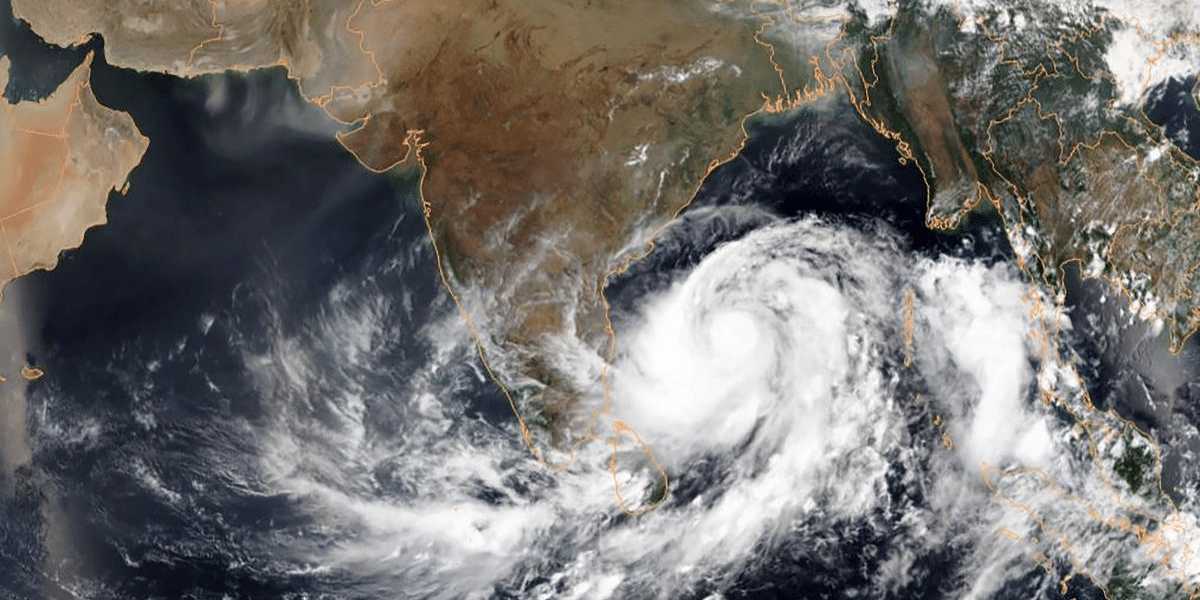
Cyclones in India are intense storm systems that typically form over the Bay of Bengal and Arabian Sea, striking coastal states like Odisha, Andhra Pradesh, West Bengal, and Gujarat. India experiences multiple cyclones annually, with some causing severe flooding, displacement, and economic damage. The Indian Meteorological Department (IMD) tracks these events and issues early warnings to minimize the impact.
Before we learn about cyclones in India, let’s look at what cyclones are. Cyclones are intense natural storms. Cyclone in India. They begin when warm, moist air rises above warm ocean waters. This rising air creates an area with lower air pressure, like a vacuum. Cyclone in India: which sets the stage for a cyclone to form. Imagine Cyclone Shahen as a massive, fast-spinning wind machine. Cyclone Dana recently impacted eastern India, particularly Odisha, causing heavy rains and strong winds. Authorities evacuated nearly 1.5 million people in anticipation of the storm, which made landfall with wind speeds reaching up to 110 km/h.
As it spins, it collects moisture from the ocean, leading to heavy rain, strong winds, and flooding. Cyclone in India. These storms are often found in places like India and nearby countries. Because cyclones can be dangerous, experts closely monitor the weather to predict when and where they might occur. The cyclone has led to significant disruptions, including uprooting trees and power lines and flooding in coastal areas. Cyclone in India. They also help communities prepare for cyclones by creating safe shelters, teaching safety measures, and providing early warnings. So, even though cyclones are powerful, we have ways to keep people safe and minimize their impact.
Cyclone in India, The Indian subcontinent frequently experiences tropical cyclones, particularly in the Bay of Bengal and the Arabian Sea. These storms typically form between April and December, with peak activity from May to November. The eastern coast is particularly vulnerable, especially in states like Odisha and West Bengal. Historical cyclones have caused significant loss of life and property, with events like the 1999 Odisha cyclone particularly devastating.
Coastal areas in India frequently experience harmful storms called cyclones. Cyclones in India typically occur during the rainy season. When these cyclones originate in the Bay of Bengal, they can cause significant damage to regions like India, Bangladesh, and Myanmar. Cyclone in India, To keep people living by the coast safe, there’s a group called the Indian Meteorological Department (IMD) that carefully watches these storms. They give early warnings and predict where the storm might go, helping everyone get ready and stay safe.
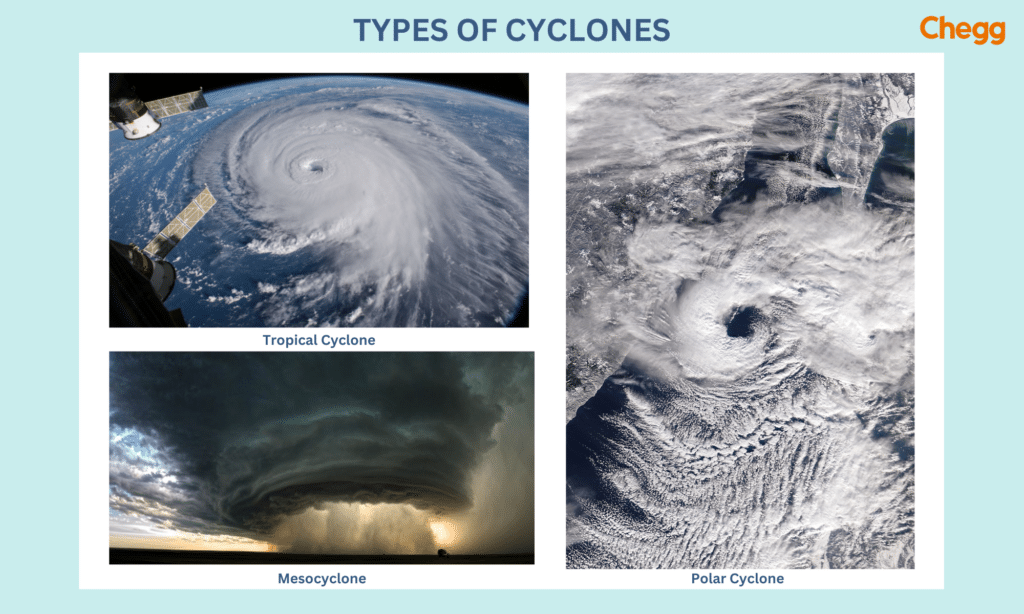
A tropical cyclone is a strong storm that forms over warm ocean waters in tropical and subtropical regions. Tropical cyclones are a significant weather phenomenon in India, particularly affecting the eastern coast and the Bay of Bengal. On average, India experiences 2-3 tropical cyclones annually, with one or two classified as severe.
Polar cyclones, often called polar lows, are smaller-scale cyclonic systems in polar regions, particularly during winter. A polar cyclone, also known as an Arctic cyclone or polar vortex, is a large area of low pressure that forms in Earth’s polar regions. These cyclones are characterized by cold air and can persist year-round, influencing weather patterns in the surrounding areas. Unlike polar lows, which are minor and transient, polar cyclones are larger and more stable systems.
A mesocyclone is a cyclonic system in severe thunderstorms, mainly in supercell thunderstorms. They are associated with rotating updrafts within thunderstorms and are vital to developing tornadoes. Mesocyclones have a high potential for producing severe weather, including large hail and violent winds.
Meteorologists must understand these types to make accurate weather forecasts and help communities prepare for possible weather problems.
The biggest cyclone on record would arguably be Typhoon Tip in the Pacific in 1979. Not an Indian or Atlantic cyclone, it was undoubtedly the most significant tropical cyclone on record. While Typhoon Tip holds the record for size, the biggest cyclone by impact in terms of death toll and damage could differ depending on the region and historical context. For instance, the 1970 Bhola Cyclone, which hit Bangladesh and parts of India, remains the deadliest tropical cyclone, with an estimated 300,000-500,000 deaths.
A recent cyclone in India, Cyclone Biparjoy, struck the Arabian Sea region, affecting Western India from June 6 to June 15, 2023, with some striking characteristics and notable impacts. Cyclone Biparjoy landed in India on June 15, 2023, impacting the western state of Gujarat and parts of southern Pakistan. It brought heavy rainfall and strong winds, leading to significant evacuations, with over 170,000 people moved to safety. The cyclone caused widespread destruction, affecting thousands of villages and resulting in fatalities and injuries.
Cyclone Biparjoy serves as a stark reminder of the significant weather-related challenges faced by coastal regions in India. Cyclone in India, Timely and accurate forecasting and preparedness measures are crucial in minimizing the impact of such cyclonic events and safeguarding the lives and property of affected communities.
Cyclones in India and across the globe are formed due to several key factors. Here are six major causes:
Cyclones in India often hit coastal regions, particularly those along the Bay of Bengal and the Arabian Sea, which are highly vulnerable to these natural disasters. Cyclones can have a profound and far-reaching impact on India’s national economy.
In May 2020, a supercyclone named Amana hit, impacting the Indian states of West Bengal and Odisha. Powerful winds and heavy rainfall caused widespread damage to infrastructure, agriculture, and people’s livelihoods.
Bhola Cyclone in 1970 remains one of the deadliest tropical cyclones ever recorded. The Bhola Cyclone, also known as the Great Bhola Cyclone, was a devastating tropical cyclone that struck Bangladesh (then East Pakistan) on November 12, 1970. It is considered the deadliest tropical cyclone on record, with estimated fatalities ranging from 300,000 to 500,000 people.
Cyclone Tauktae landed on India’s west coast in May 2021, impacting states like Gujarat, Maharashtra, and Kerala. Cyclone Taketa is a tropical cyclone formed in the western Pacific Ocean, impacting regions such as Japan. While specific details about Cyclone Taketa are not widely available in the search results, tropical cyclones in this area can bring heavy rainfall, strong winds, and potential flooding.
The 1999 Odisha Cyclone is infamous for its devastating impact on Odisha. It brought about extensive destruction and led to a significant loss of lives. It was one of the most devastating tropical cyclones to hit India, particularly affecting the state of Odisha (formerly Orissa) in October 1999. It is remembered for its extreme intensity, widespread destruction, and significant loss of life.
Cyclone Phalen, in 2013, affected Odisha and Andhra Pradesh, resulting in one of India’s largest evacuations. Cyclone Phailin serves as a reminder of the destructive power of tropical cyclones and the importance of preparedness and response strategies. For cyclones in India, the relatively low casualty figures compared to previous cyclones highlight the effectiveness of early warning systems and evacuation plans implemented in Odisha.
Hud Hud hit the coast of Andhra Pradesh in 2014, causing extensive damage to infrastructure and agriculture. The affected regions witnessed massive relief and recovery efforts. The extensive damage and loss of life highlight the need for continued improvements in disaster preparedness and response strategies to mitigate the effects of such natural disasters in the future.
In May 2021, Cyclone Yaas struck the eastern coast of India, impacting West Bengal and Odisha. Cyclone Yaas was a powerful tropical cyclone that made landfall on May 26, 2021, affecting the east coast of India, particularly Odisha and West Bengal, as well as parts of Bangladesh.
The combined impact of Cyclone Matmo and Cyclone Bulbul was experienced in November 2019, affecting West Bengal and Bangladesh. These cyclones resulted in widespread destruction. Cyclone in India, The impacts on lives, livelihoods, and the environment underscore the need for ongoing efforts in disaster preparedness, ecosystem protection, and community resilience to mitigate future cyclone impacts.
In 2016, Cyclone Vardah made landfall near Chennai, causing damage to property and infrastructure in Tamil Nadu and Andhra Pradesh.
Cyclone Kyarr, in 2019, churned in the Arabian Sea, posing a potential threat to the western coast of India. Cyclone Kyarr was a significant weather event highlighting the increasing intensity of tropical cyclones in the Arabian Sea.
Nilam hit the southeastern coast of India in 2012, leading to significant rainfall and flooding in Tamil Nadu and Andhra Pradesh.
Cyclone Titli impacted the states of Odisha and Andhra Pradesh in 2018, causing flooding and disruption. The impacts on human lives, agriculture, and the environment highlight the importance of effective disaster preparedness and response strategies to mitigate the effects of such natural disasters in the future.
In 2009, Cyclone Aila affected the coastal regions of West Bengal and Bangladesh, causing widespread destruction.
In 2017, Ockhi threatened the western coast of India, affecting states like Kerala and Maharashtra.
Cyclone Biparjoy affected Western India in June 2023, causing damage to property and loss of life.
Cyclone Thane struck the Tamil Nadu and Puducherry coast in 2011, leading to significant damage.
Cyclone Komen hit in 2015, causing extensive flooding in West Bengal, Bangladesh, and Myanmar.
Cyclone Jal, in 2010, affected Tamil Nadu and Andhra Pradesh, leading to flooding and damage to agriculture.
Mocha Cyclone, in 2006, affected the western coast of India, causing flooding and destruction.
Cyclone Laila landed in Andhra Pradesh in 2010, resulting in heavy rainfall and flooding.
Cyclone Onil, in 2004, affected the west coast of India, leading to coastal inundation and destruction.
Cyclones in India are named through a well-established and systematic procedure involving international cooperation and meteorological authorities’ contributions. Cyclones in India are called by the India Meteorological Department (IMD) following a regional system established in collaboration with neighboring countries. The naming process involves a pre-determined list of names contributed by various countries bordering the North Indian Ocean, including India, Bangladesh, Myanmar, and others. The naming process aims to facilitate communication, reduce confusion, and enhance public awareness during cyclone events.
The naming of cyclones is an international collaborative effort. The World Meteorological Organization (WMO) is pivotal in coordinating this effort.
Cyclone names are listed alphabetically by country. Each country within a specific region provides a list of words to be used for cyclones that may form within its jurisdiction.
The chosen names are gender-neutral, meaning they don’t favour one gender over another. This approach aims to promote fairness and prevent gender bias.
The National Meteorological and Hydrological Services of WMO member countries within a particular region propose a list of cyclone names. These presented lists are then subjected to approval by the respective tropical cyclone regional bodies during their annual or biennial sessions.
By following this procedure, cyclones are assigned easily recognizable and region-specific names. Cyclone in India. This method helps meteorological authorities and the public communicate more effectively about cyclone forecasts, impacts, and preparedness, ultimately contributing to better disaster management and response efforts.
| Names of Cyclone | Duration | Maximum Intensity | Impacted Regions | Estimated Damage (USD) | Casualties |
|---|---|---|---|---|---|
| Cyclone Pabuk | Jan 4–Jan 8, 2019 | Tropical Storm | Andaman Sea | Minimal | None |
| Cyclone Fani | Apr 26–May 4, 2019 | Extremely Severe (175 km/h) | Odisha, West Bengal | $8.1 billion | 89 |
| Cyclone Vayu | Jun 10–Jun 17, 2019 | Very Severe (135 km/h) | Gujarat | Moderate | None |
| Cyclone Hikka | Aug 6–Aug 9, 2019 | Very Severe (120 km/h) | Oman (Minor impact in India) | Minimal | None |
| Cyclone Kyarr | Oct 24–Nov 2, 2019 | Super Cyclonic (220 km/h) | Arabian Sea (No direct impact) | Minimal | None |
| Cyclone Maha | Oct 30–Nov 7, 2019 | Extremely Severe (150 km/h) | Arabian Sea (No direct impact) | Minimal | None |
| Cyclone Bulbul | Nov 5–Nov 11, 2019 | Very Severe (110 km/h) | Odisha | Moderate | None |
| Cyclone Pawan | Dec 2–Dec 7, 2019 | Tropical Storm | Arabian Sea | Minimal | None |
| Cyclone Amphan | May 16–May 21, 2020 | Extremely Severe (260 km/h) | West Bengal | $13 billion | 128 |
| Cyclone Tauktae | May 17–May 26, 2021 | Extremely Severe (210 km/h) | Gujarat | $8.1 billion | 170 |
| Cyclone Yaas | May 23–May 26, 2021 | Very Severe (130 km/h) | Odisha | $610 million | None |
| Cyclone Jawad | Dec 2–Dec 6, 2021 | Very Severe (120 km/h) | Andhra Pradesh, Odisha | Minimal | None |
| Cyclone Asani | May 8–May 12, 2022 | Very Severe (130 km/h) | Andhra Pradesh | Minimal | None |
| Cyclone Mandous | Dec 9–Dec 12, 2022 | Very Severe (120 km/h) | Tamil Nadu | Moderate | None |
| Cyclone Sitrang | Oct 22–Oct 25, 2022 | Tropical Storm | Assam, Odisha, West Bengal | Minimal | None |
| Cyclone Biparjoy | Jun 6–Jun 15, 2023 | Extremely Severe (195 km/h) | Gujarat | $700 million | None |
| Cyclone Remal | May 24–May 28, 2024 | Severe (110 km/h) | Odisha | $600 million | None |
| Cyclone Asna | Aug 25–Sep 3, 2024 | Tropical Storm | Madhya Pradesh | $30 million | None |
| Cyclone Dana | Oct 24–Oct 25, 2024 | Expected to be Severe | Odisha, West Bengal | $72 million | Affected 14 districts, impacting over 41 lakh people across 166 blocks |
| Cyclone Fengal | Nov 25–Nov 27, 2024 | Expected to be Deep Depression | Tamil Nadu and Puducherry | TBD | TBD |
The Odisha Super Cyclone of 1999, often called Cyclone 05B, is one of India’s most powerful recorded cyclones. This devastating storm hit the state of Odisha on October 29, 1999, leaving a lasting impact on the region. Cyclone in India, the history of natural disasters, is a critical learning point for disaster preparedness and response in the face of severe weather events. The experience gained from this cyclone has contributed to more robust disaster management practices in India, aimed at reducing the impact of future cyclones.
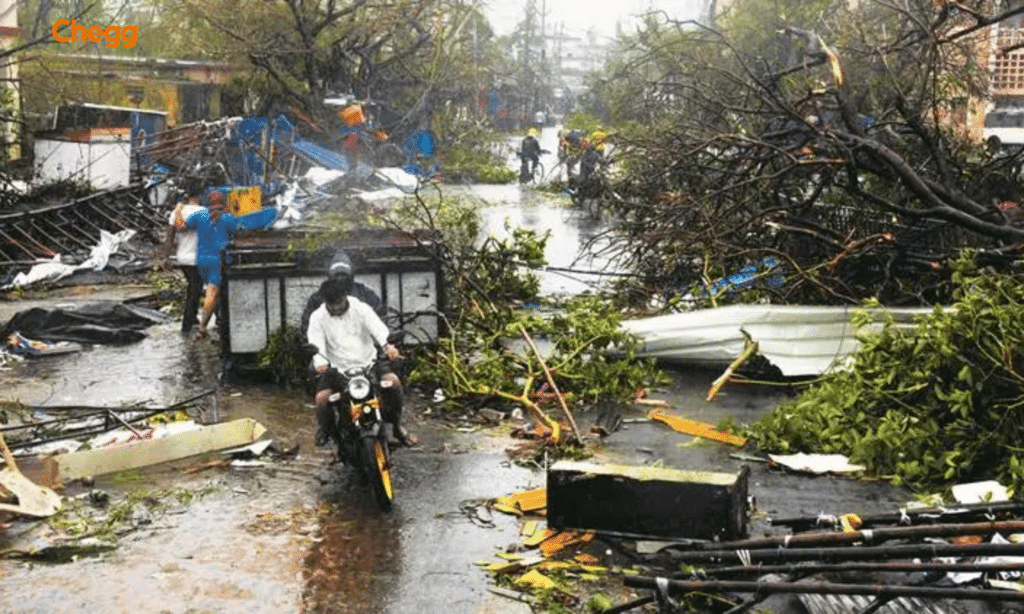
Cyclone in India. Regarding meteorological data, this cyclone peaked with winds roaring at 160 miles per hour, earning it the title of a “super cyclone.” The storm’s central pressure dropped to 912 millibars, making it exceptionally intense. Cyclone in India. The cyclone brought about extensive damage, including storm surges reaching nearly 26 feet in certain areas, causing severe flooding and destruction. It impacted more than 15 million people and led to the loss of thousands of lives.
Cyclones in India have a long and significant history. Every time they occur, they leave a substantial impact on the country. The Odisha Super Cyclone in 1999 was a striking example of how destructive these natural disasters can be. However, it demonstrates how India has become better at dealing with them. Over the years, India has made substantial improvements in preparing for cyclones. Cyclones in India have established systems to warn people early, educated communities on how to stay safe, and constructed special shelters for protection from cyclones.
All these efforts have saved lives and reduced the damage caused by these storms. Although cyclones remain a big challenge, India’s past experiences have made the country more capable of handling them. Cyclone in India: India is determined to keep enhancing its ability to deal with cyclones and protect its citizens.
Read More:-
As of 2025, the most recent cyclone to impact India was Cyclone Dana, which struck parts of Odisha and West Bengal in October 2024. It brought strong winds and heavy rainfall, affecting over 41 lakh people across 166 blocks and causing significant disruptions in daily life, infrastructure, and agriculture.
States in India such as Andhra Pradesh, Odisha, Tamil Nadu, and West Bengal experience the highest frequency of cyclones.
Cyclone Shakti has been predicted (or recently formed) in the Bay of Bengal region, and it is expected to affect parts of Odisha, West Bengal, and possibly Andhra Pradesh. The India Meteorological Department (IMD) has issued alerts for coastal districts, urging residents to stay prepared for strong winds, heavy rainfall, and potential flooding.
A cyclone warning in India is an official alert issued by the India Meteorological Department (IMD) to inform the public about an approaching tropical cyclone. It includes details on the cyclone’s intensity, location, expected landfall, wind speeds, and recommended safety precautions. Warnings are typically issued in four stages:
Pre-Cyclone Watch
Cyclone Alert
Cyclone Warning
Post-Landfall Outlook
These stages help authorities and communities take timely action to minimize damage and save lives.
The largest cyclone to impact India was the 1999 Odisha Super Cyclone, which struck the eastern coast with wind speeds over 260 km/h. It was one of India’s most potent and devastating cyclones.
The largest cyclone recorded in India is Cyclone Amphan (May 2020). It made devastating landfall near the India–Bangladesh border, packing winds up to 165 km/h and affecting over 5 million people with extensive flooding and infrastructural damage.