The Cripps Mission of 1942, led by Sir Stafford Cripps, was a British attempt to gain India’s cooperation in World War II by offering post-war dominion status and a Constituent Assembly.
Major political parties rejected the proposal due to its vague terms, lack of immediate power transfer, continued British control over defence, and the controversial right to secede.
The mission’s failure intensified the independence movement, directly leading to the Quit India Movement and weakening faith in further negotiations.
Table of Contents
The Cripps Mission of 1942 was a significant diplomatic initiative that the British government undertook during World War II to secure India’s support in the global conflict. Led by Sir Stafford Cripps, a member of the British War Cabinet, the mission reached India in March 1942 with a set of constitutional proposals. These included the promise of post-war dominion status and the establishment of a Constituent Assembly to frame India’s future constitution. While it appeared to be a major political concession, the mission was ultimately viewed as inadequate by Indian leaders and failed.
Background: India during World War II
By 1939, India had been dragged into the Second World War without the consent of its leaders, which created widespread political resentment. The Congress Party resigned from provincial ministries in protest, while the Muslim League saw an opportunity to push its demand for a separate Muslim state. At the same time, India faced wartime hardships, shortages, inflation, censorship, and rising unrest. The Japanese advance in Southeast Asia and the fall of Singapore in 1942 brought the war dangerously close to India’s borders, making India’s cooperation vital for the Allies. This tense mix of political discontent and military urgency set the stage for the Cripps Mission.
Why the Mission Was Sent
The British government had three main reasons for dispatching the Cripps Mission:
Secure Indian support for the war effort – With Japanese forces threatening to invade Burma and India, Britain needed political stability at home to ensure military security.
Appease nationalist sentiment—The Congress, the Muslim League, and other political groups demanded clarity on India’s constitutional future. Offering post-war concessions was seen as a way to calm unrest.
Demonstrate goodwill to international allies—Britain also wanted to show the United States and China, sympathetic to India’s independence aspirations, that it was taking steps toward granting Indians self-government.
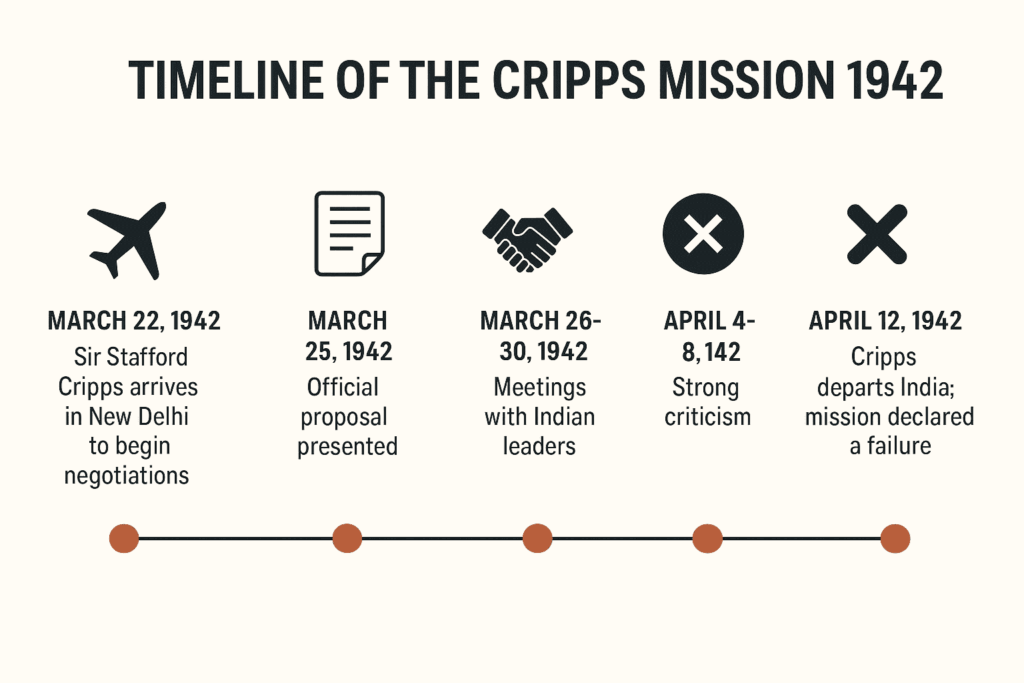
Timeline of the Cripps Mission 1942
Arrival and Departure
Arrival: March 22, 1942
Departure: April 12, 1942
Key Events in Chronological Order
Date
Event
March 22, 1942
Sir Stafford Cripps arrives in New Delhi to begin negotiations.
March 23–24, 1942
Initial meetings with Viceroy Lord Linlithgow and British officials.
March 25, 1942
Official proposal presented: dominion status after war, Constituent Assembly, provinces’ right to opt out.
March 26–30, 1942
Discussions with Indian National Congress leaders (Gandhi, Nehru, Azad).
March 31–April 3, 1942
Meetings with Muslim League (Jinnah) and other minority groups.
April 4–8, 1942
Strong criticism from Congress, Muslim League, Hindu Mahasabha, Sikhs.
April 9, 1942
Cripps makes a final attempt to revise terms; negotiations remain stuck.
April 10–11, 1942
Talks collapse as leaders harden their positions.
April 12, 1942
Cripps departs India; mission declared a failure.
Objectives of the Cripps Mission
The Cripps Mission of 1942 was designed as a wartime initiative to address Britain’s strategic concerns and India’s growing demand for self-rule. Its objectives can be understood from two sides:
British Government’s Intentions
Secure Indian Support for World War II With Japanese forces advancing in Southeast Asia, Britain urgently needed India’s manpower, resources, and political cooperation to strengthen the Allied war effort.
Prevent Political Unrest and Rebellion The Indian political atmosphere was tense after the resignation of Congress ministries in 1939. The mission sought to avoid mass movements or civil disobedience campaigns that could destabilize British control.
Offer a Political Compromise By proposing post-war dominion status and a Constituent Assembly, the British aimed to pacify nationalist leaders without granting immediate independence.
Retain Wartime Authority Britain insisted on maintaining control over defence and military affairs during the war, ensuring uninterrupted strategic command.
Showcase Democratic Intentions to the World The mission was also meant to reassure Allied nations, especially the United States and China, that Britain was working toward granting India self-government.
Indian Expectations
Immediate Transfer of Power Leaders of the Indian National Congress expected a concrete timeline for independence rather than vague post-war promises.
Greater Role in Defence and Governance Indians wanted absolute authority in managing the war effort and governance, not just advisory participation under British supervision.
Clarity on National Unity While Congress demanded a united India, the Muslim League expected recognition of its demand for a separate Muslim state (Pakistan).
End of Colonial Control Beyond wartime adjustments, Indians wanted a clear assurance that colonial dominance would end, making independence inevitable rather than conditional.
The British government viewed the Cripps Mission as a strategic wartime compromise, while Indian leaders saw it as an insufficient half-measure. This fundamental mismatch of intentions and expectations ultimately led to its failure.
Background to the Cripps Mission 1942
By early 1942, both global and domestic conditions had become increasingly volatile. The rapid expansion of World War II, especially Japan’s advances in Asia, directly threatened British interests in India. Simultaneously, political unrest and dissatisfaction with British rule intensified across the country. The failure of earlier initiatives like the August Offer had further alienated Indian leaders. These mounting pressures forced the British government to rethink its strategy, leading to the launch of the Cripps Mission.
Global and Strategic Context
Japanese forces had rapidly advanced through Southeast Asia.
The fall of Burma brought the war dangerously close to India’s eastern borders.
Britain feared that a Japanese invasion of India was imminent.
Indian Political Climate
The failure of the August Offer (1940) led to widespread disillusionment among Indian leaders.
Repressive colonial policies and wartime censorship had intensified political dissatisfaction.
The Indian National Congress was demanding complete independence, not just limited concessions.
Under Muhammad Ali Jinnah, the Muslim League pushed for separate political recognition for Muslims, complicating unity.
British Concerns
The British feared a full-scale rebellion that could threaten their hold over India and compromise the war effort.
Mounting pressure from Allied nations, particularly the United States and China, was on Britain to accommodate Indian aspirations by democratic values.
Decision to Send the Cripps Mission
To prevent political instability and win Indian cooperation, the British War Cabinet sent a high-level delegation.
Sir Stafford Cripps, a senior British politician known for his pro-Indian sympathies, was chosen to lead the mission.
The goal was to offer a constitutional plan promising post-war dominion status and involving Indian leaders in future governance.
Thus, the Cripps Mission 1942 was launched as a diplomatic effort to balance British strategic needs with India’s growing demand for self-rule.
Proposals of the Cripps Mission (1942)
The Cripps Mission Plan, also known as the Cripps Proposal, was announced in March 1942 as a constitutional framework to secure India’s cooperation in World War II. While the proposals appeared to offer future autonomy, they contained several controversial features that fueled disagreement among Indian political groups.
1. Dominion Status after the War
India would be granted Dominion Status once the war ended.
This meant India would become a self-governing nation within the British Commonwealth, similar to Canada or Australia, while still recognizing the British Crown.
However, there was no immediate transfer of power, which made the offer seem like a delayed promise.
2. Constituent Assembly: Composition and Election
A Constituent Assembly would be set up to draft the new Constitution of India.
Provincial legislatures would elect representatives, while the princely states would nominate members.
The Assembly would frame the Constitution subject to Britain’s final approval, raising doubts about absolute sovereignty.
3. Right of Provinces to Secede
Provinces and princely states unwilling to join the Union could choose to remain outside the Indian Union.
They could either continue under British rule or form their own separate unions.
This provision alarmed the Congress, as it opened the door to the fragmentation of India, indirectly supporting the Muslim League’s demand for Pakistan.
4. Interim Government and Defence Control
An interim government would be formed until the new Constitution came into effect.
Indians would be included in the Viceroy’s Executive Council.
However, the Governor-General (on behalf of Britain) would retain complete control over defence and military affairs during the war.
This clause ensured British supremacy in strategic matters, undermining the spirit of self-rule.
5. Safeguards for Minorities
The new Constitution would include special protections for religious and ethnic minorities.
This was aimed at addressing concerns raised by the Muslim League, Sikhs, and other communities.
While the Cripps Mission Proposals promised India self-rule after the war, including provincial secession rights and continued British control over defence made them appear weak and divisive.
Reactions to the Cripps Mission (1942)
The Cripps Mission proposals failed to win the confidence of any major political group in India. Instead of uniting leaders against a common enemy, they deepened existing divisions.
1. Indian National Congress
Rejected the offer because it did not grant immediate independence.
Strongly opposed the right of provinces to secede, which threatened India’s unity.
Criticized continued British control over defence during the war.
Mahatma Gandhi famously dismissed the offer as a “post-dated cheque on a crashing bank.”
Jawaharlal Nehru and Maulana Azad also felt the proposals were vague and inadequate.
2. Muslim League
The League, led by Muhammad Ali Jinnah, also rejected the plan.
The proposals did not guarantee Pakistan or recognize the League’s demand for a separate Muslim state.
Feared that Muslim interests would be overshadowed in a united India under Congress leadership.
3. Hindu Mahasabha & Sikhs
Hindu Mahasabha opposed the right to secede, fearing it would lead to national disintegration.
Sikh leaders worried that partitioning provinces (like Punjab) would endanger Sikh communities.
4. Princely States
Many rulers resisted the plan, fearing that a Constituent Assembly dominated by elected leaders would diminish their traditional autonomy and privileges.
They were wary of being absorbed into a democratic Indian Union.
5. Minorities and Dalits
B.R. Ambedkar welcomed the idea of safeguards for minorities, but remained cautious, noting the lack of clarity in implementation.
Dalit groups felt their concerns were secondary and not adequately addressed.
No major political force supported the Cripps proposals. Congress rejected them as too little, too late; the Muslim League opposed them as not ensuring Pakistan; the Hindu Mahasabha and Sikhs feared disintegration; princely states resisted loss of power; and minorities found the safeguards vague. This universal rejection sealed the failure of the Cripps Mission.
Reactions to the Cripps Mission (1942)
Group
Reaction
Key Reasons for Rejection
Indian National Congress
Rejected outright
No immediate independence; provinces allowed to secede (risk to unity); defence remained under British control; Gandhi called it a “post-dated cheque on a crashing bank.”
Muslim League
Rejected
No assurance of Pakistan; unclear process for constitutional framing; feared Congress dominance in a united India.
Hindu Mahasabha
Rejected
Strongly opposed secession clause; believed it would lead to national fragmentation.
Sikh Leaders
Rejected
Worried secession would divide Punjab and endanger Sikh interests.
Princely States
Rejected
Feared loss of traditional autonomy; opposed being bound by a Constituent Assembly dominated by elected leaders.
Minorities & Dalits
Mixed
Ambedkar appreciated mention of safeguards but found details vague; Dalit groups felt their concerns were secondary.
No major political or social group accepted the Cripps Mission. Each saw flaws that either threatened national unity, ignored community aspirations, or retained too much British control — leading to the mission’s failure.
Reasons for the Failure of the Cripps Mission
The Cripps Mission of 1942 ended in failure because its proposals failed to satisfy Indian aspirations and were internally constrained by British politics. The main reasons include:
1. Lack of Immediate Transfer of Power
The proposals promised Dominion Status only after World War II, not immediate independence.
Indians wanted a clear timeline for freedom and actual participation in governance during wartime.
Gandhi dismissed the offer as meaningless since Britain retained decisive authority over defence and war policies.
2. Internal British Opposition
Prime Minister Winston Churchill and Viceroy Lord Linlithgow were firmly against conceding real power to Indians.
They undermined Stafford Cripps by ensuring the mission offered only limited concessions.
This lack of unity within the British government weakened the credibility of the proposals.
3. Political Divisions within India
The Congress demanded full independence and rejected the secession clause.
The Muslim League opposed the plan because it did not guarantee Pakistan.
Princely states, Sikhs, and Hindu Mahasabha all had their own objections.
With no political consensus possible, the proposals collapsed under conflicting demands.
The Cripps Mission failed because Britain offered too little, too late, while Indian leaders were deeply divided in their responses. This mismatch of expectations made agreement impossible.
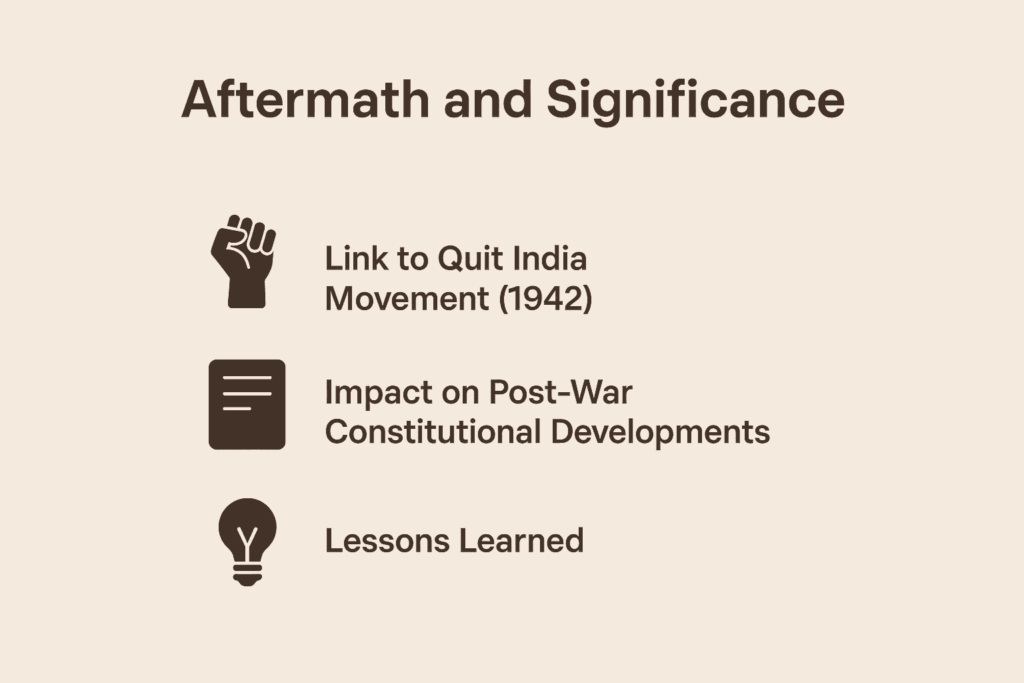
Aftermath and Significance of the Cripps Mission
Although the Cripps Mission (1942) ended in failure, its consequences were far-reaching. It deepened political discontent in India, sharpened nationalist resolve, and influenced the course of the freedom movement.
1. Link to the Quit India Movement (1942)
The collapse of the mission convinced the Indian National Congress that Britain had no genuine plan to transfer power.
In August 1942, just four months later, the Quit India Movement was launched, demanding the immediate withdrawal of the British from India.
The rejection of Cripps’ offer thus acted as the final spark for one of the most powerful and widespread mass movements of the independence struggle.
2. Impact on Post-War Constitutional Developments
Even though the proposals were rejected, several of their ideas resurfaced later:
The Constituent Assembly became a reality in 1946, playing a decisive role in framing the Constitution of independent India.
The concept of granting Dominion Status reappeared in the Indian Independence Act of 1947, under which India became a self-governing dominion before adopting a republican Constitution.
The mission also exposed the limitations of British reforms, proving that only a complete transfer of power would satisfy Indian aspirations.
3. Lessons Learned
For the British, the mission revealed that piecemeal reforms and vague assurances could no longer contain the independence movement.
For Indian leaders, it was a reminder of the urgent need for unity and decisive action which materialized in the Quit India call.
It also highlighted the international dimension of India’s freedom struggle, since Britain’s gesture was partly meant to impress allies like the United States and China.
Most importantly, it showed that colonial rule in India had reached a breaking point, with both Indian and global opinion leaning toward eventual independence.
The Cripps Mission was a diplomatic failure but a political turning point. It triggered the Quit India Movement, shaped the framework of post-war constitutional developments, and proved that the British could no longer suppress India’s demand for freedom with half-hearted concessions.
Cripps Mission Members and Leadership
The Cripps Mission 1942 was spearheaded by Sir Stafford Cripps, a prominent British politician, barrister, and member of Winston Churchill’s War Cabinet. Known for his socialist ideology and previous role as the British Ambassador to the Soviet Union, Cripps was widely regarded as a figure with pro-Indian sympathies. His selection was intended to build trust with Indian leaders and present the mission as a genuine effort at negotiation.
Sir Stafford Cripps – Leader of the mission and chief negotiator.
Advisors from the British War Cabinet and the Indian Civil Service included administrative experts and officials responsible for legal and constitutional affairs.
Cripps discussed key figures such as Mahatma Gandhi, Jawaharlal Nehru, and Muhammad Ali Jinnah. Despite his rapport with some leaders, the mission’s lack of authority to make real-time concessions and its unilateral composition contributed to its failure.
While Sir Stafford Cripps was well-respected, the mission’s structure and composition lacked the inclusivity and flexibility necessary to build consensus across India’s deeply divided political landscape.
In conclusion, the Cripps Mission of 1942 is a turning point in India’s colonial history. Launched to secure Indian support during World War II, it introduced the Cripps Proposal, which promised post-war dominion status and the formation of a Constituent Assembly. However, the mission was undermined by its vague assurances, continued British control over defence, and the controversial right to secede, leading to its rejection by both the Indian National Congress and the Muslim League.
Despite its failure, the mission had far-reaching consequences. It intensified nationalist sentiment and directly contributed to the launch of the Quit India Movement, signaling the beginning of the end of British rule in India. Understanding the Cripps Mission, its members, objectives, and proposals offers valuable insight into the final stages of India’s freedom struggle and the growing irrelevance of colonial negotiation in the face of rising mass resistance.
Frequently Asked Questions(FAQs)
What was the Cripps Mission mission?
The primary purpose of the Cripps Mission was to secure India’s full support for the British war effort during World War II. In return, the British government offered post-war dominion status and constitutional reforms to appease Indian political leaders and prevent internal rebellion against colonial rule.
What was the main objective of the Cripps proposal of 1942?
The main objective of the Cripps Proposal of 1942 was to offer India post-war dominion status and a Constituent Assembly to frame its constitution, in exchange for Indian cooperation in World War II under continued British wartime control.
What is the Cripps Mission?
The Cripps Mission was a British diplomatic effort in 1942, led by Sir Stafford Cripps, to gain Indian support for World War II by promising post-war dominion status and constitutional reforms, which Indian political leaders ultimately rejected.
Who was the viceroy of the Cripps Mission in 1942?
In March 1942, the Cripps Mission led by Stafford Cripps arrived in India under Viceroy Lord Linlithgow. Its primary objective was to gain Indian cooperation for Britain’s World War II efforts by offering constitutional reforms and post-war dominion status.
What was the August offer and Cripps Mission?
The Cripps Mission highlighted the deep divide between Congress and the Muslim League, marked Britain’s shift from unilateral decisions to constitutional dialogue, and its failure directly set the stage for subsequent events like the Quit India Movement of 1942.
Authored by, Muskan Gupta Content Curator
Muskan believes learning should feel like an adventure, not a chore. With years of experience in content creation and strategy, she specializes in educational topics, online earning opportunities, and general knowledge. She enjoys sharing her insights through blogs and articles that inform and inspire her readers. When she’s not writing, you’ll likely find her hopping between bookstores and bakeries, always in search of her next favorite read or treat.