The Constituent Assembly of India was formed in 1946 with representatives chosen through election and nomination to frame the nation’s Constitution. Its first meeting was held on 9 December 1946, and after years of deliberation, the Constitution was adopted on 26 November 1949. The Assembly concluded its work on 24 January 1950, guided by leaders such as Dr. Sachidananda Sinha (initial chairman), Dr. Rajendra Prasad (permanent president), and Dr. B.R. Ambedkar (Drafting Committee chairman).
The concept of a Constituent Assembly was first proposed by C. Rajagopalachari in 1939, and it gained official recognition through the British August Offer of 1940. This institution played a pivotal role in framing the Constitution of India, laying the foundation for the world’s largest democracy.
When a nation needs to create its constitution, it often forms a constituent assembly. This is a temporary group of chosen representatives whose main job is to debate, write, and approve the country’s most important document. This document sets the rules for the government and society. The assembly disbands once its crucial task is complete.
The Constituent Assembly of India was a representative body formed in 1946 with the sole purpose of drafting the country’s Constitution. It was not directly elected by the people but created under the Cabinet Mission Plan. Members were chosen by the Provincial Legislative Assemblies through an indirect election system, while princely states and chief commissioner areas sent nominated representatives.
The Assembly played a historic role between 1946 and 1950, shaping the guiding document that established India as a sovereign, democratic republic. It provided a platform where leaders from diverse regions, communities, and ideologies came together to debate and design the framework of governance, rights, and duties for the new nation.
Total members of Constituent Assembly originally had 389 members:
However, after the partition of India in 1947, the membership was reduced to 299 members, as the seats allocated to Pakistan were withdrawn. These 299 members ultimately worked through eleven sessions over nearly three years to produce the Constitution of India, which was adopted on 26 November 1949 and came into effect on 26 January 1950.
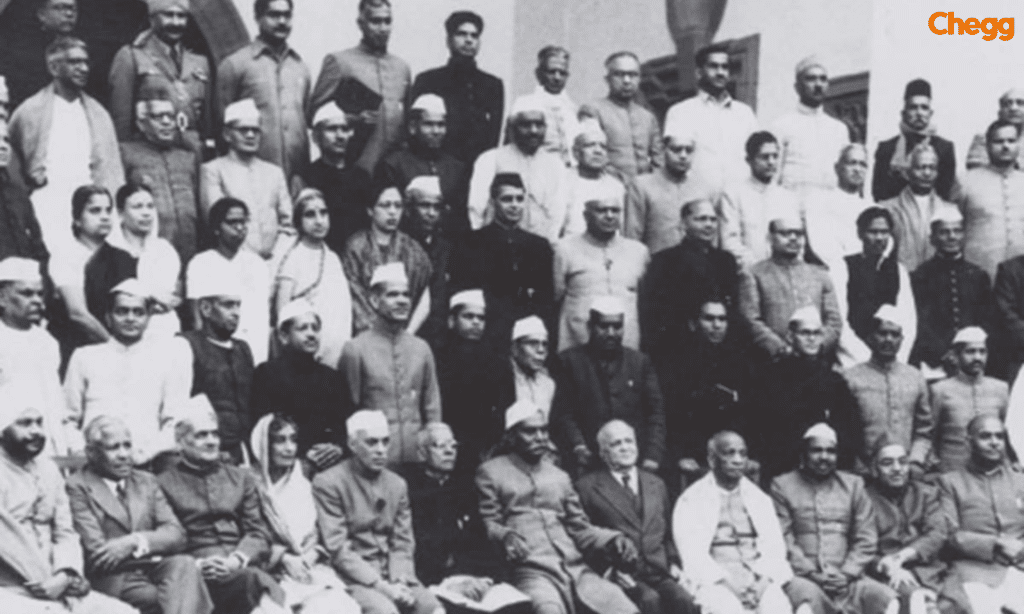
The Constituent Assembly, established as a special body to draft and adopt the Constitution of India, crafted the fundamental laws and principles to govern the nation. Following the Cabinet Mission Plan, the Constituent Assembly of India began its work on December 9, 1946. This date is significant as it marks the completion of the composition of the Constituent Assembly. The Constituent Assembly of India, On August 8, 1940, Viceroy Lord Linlithgow made a statement regarding the development of the Governor-General’s Executive Council and the organization of a War Advisory Council.
Provincial assemblies voted for constituent assembly members using a single-vote system. There were 389 members, 292 of whom were from the provinces. The remaining 93 were from princely states. Four were from the chief commissioner areas of Delhi, Ajmer-Merwara, Coorg, and British Baluchistan.
On 9 December 1946, the Constituent Assembly of India convened for the first time in New Delhi, specifically in the Constitution Hall, now known as the Central Hall of Parliament House. The Constituent Assembly of India atmosphere was vibrant and celebratory, with the chamber elegantly decorated for the occasion. Bright lamps hung from the high ceilings and wall brackets, creating a warm and inviting ambiance.
Key Highlights of the Inaugural Session:
| Committee | Chairperson |
|---|---|
| Major Committees | |
| Drafting Committee | Bhimrao Ramji Ambedkar |
| Union Power Committee | Jawaharlal Nehru |
| Union Constitution Committee | Jawaharlal Nehru |
| Provincial Constitution Committee | Vallabhbhai Patel |
| Advisory Committee on Fundamental Rights, Minorities and Tribal and Excluded Areas | Vallabhbhai Patel |
| — Fundamental Rights Sub-Committee | J. B. Kripalani |
| — Minorities Sub-Committee | Harendra Coomar Mookerjee |
| — North-East Frontier Tribal Areas and Assam Excluded & Partially Excluded Areas Sub-Committee | Gopinath Bordoloi |
| — Excluded and Partially Excluded Areas (Apart from those in Assam) Sub-Committee | A V Thakkar |
| Rules of Procedure Committee | Rajendra Prasad |
| States Committee (Committee for negotiating with states) | Jawaharlal Nehru |
| Steering Committee | Rajendra Prasad |
| Ad hoc Committee on the National Flag | Rajendra Prasad |
| Committee for the Function of the Constitution Assembly | G V Mavlankar |
| House Committee | B Pattabhi Sitaramayya |
| Language Committee | Moturi Satyanarayana |
| Order of Business Committee | K M Munshi |
The Nation’s Constitution was managed by fundamental objectives and goals that drove its key in framing laws.
The main objective was to complete an inclusive constitution that would lay the foundation for a democratic and sovereign India. The Constituent Assembly of India states the nation’s governance structures, rights, and duties.
The Constituent Assembly of India: After forming the constitution, the constituent assembly members played a crucial role in making essential laws. These laws covered various topics, such as who could be a citizen, fundamental rights, how the government would work, and who had the power to enforce these laws.
The group aimed to summarize a vast nation’s plans and hopes within the Constitution. The Constituent Assembly of India aimed to ensure social, economic, and political justice while enabling justice, unbelief, and individual rights.
Constituent Assembly of India, tasked with drafting the nation’s constitution, wasn’t directly elected by the people. Instead, a unique process unfolded:
The Constituent Assembly of India: The remaining members of the Indian Constituent Assembly, numbering around 299 after the reorganization, embarked on a crucial journey. They convened for the first time on December 9th, 1946, and diligently deliberated for over two years, holding eleven sessions. Chaired by B. R. Ambedkar, this dedicated group ultimately crafted the landmark document that would become the Constitution of India.
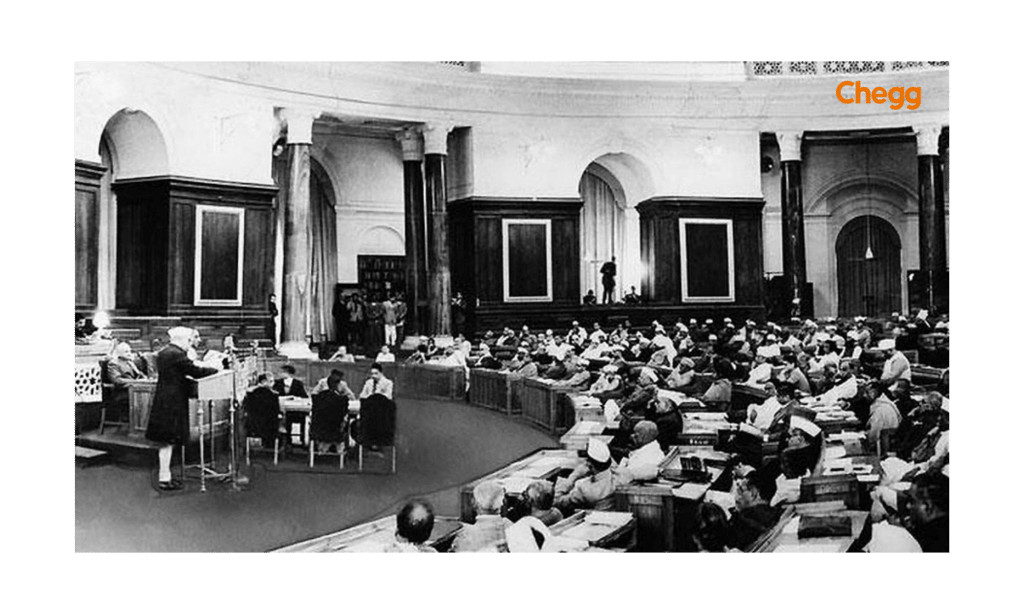
The Constituent Assembly of India conducted a vital meeting that was key in forming the nation’s Constitution.
Between 1946 and 1949, which was almost three years, the members of the constituent assembly of India spent a lot of time talking and thinking carefully about different parts of the constitution they were creating.
Central and state governments often disagreed on fundamental rights, government structure, and power distribution.
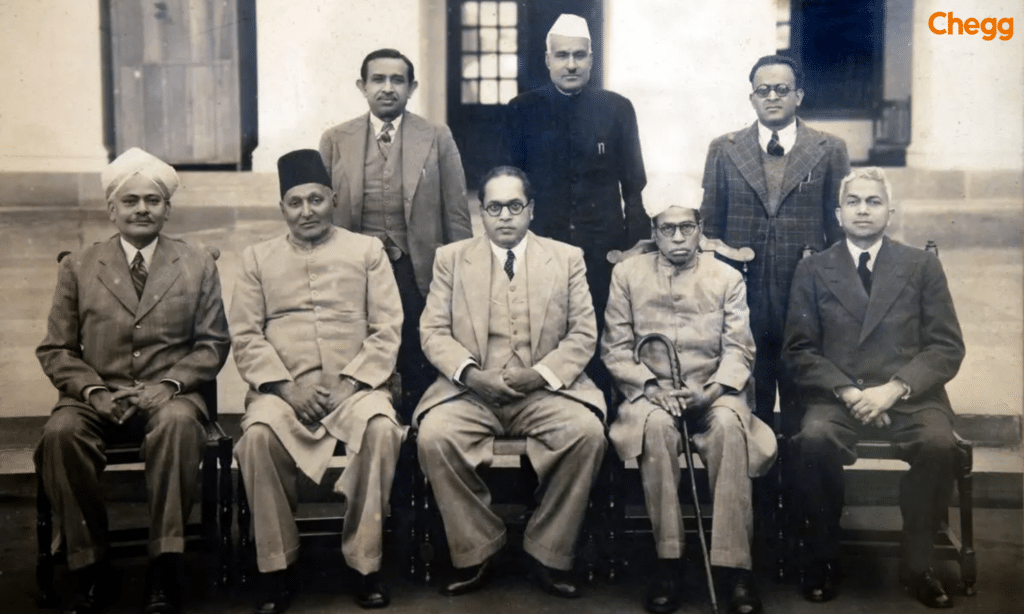
The constituent assembly established various committees and subcommittees to tackle the task’s complexity. Dr. B.R. Ambedkar led the drafting committee significantly. The Constituent Assembly of India was one of the constituent assembly’s central committees.
The members of the Constituent Assembly talked about many different things, like our rights, who gets to make decisions, and how the courts should work. They engaged in long conversations and arguments to ensure everyone’s ideas were heard.
The method was not defined solely by the assembly members. It enabled public participation via panels, talks, and indications, ensuring the Constitution represented the people’s hope.
The Constituent Assembly faced a considerable challenge when it had to harmonize the different opinions from India’s diverse cultures, languages, and regions. They managed to do this by settlements, making deals, and working together to build the nation.
The Method of constitution-making illustrated an elected and advising method. This process produced a document that has stood the test of time and helped India become a democratic country.
The Constituent Assembly of India shaped the nation’s democratic framework. Its significance lies in the following aspects:
The Constituent Assembly of India is a beacon of victory, successfully handling vital issues and crises while preparing the nation’s Constitution.
The people the Provincial Legislative Assemblies chose were like a group of representatives in the Constituent Assembly.
The members of the Constituent Assembly were from various stages, including other religions, castes, and regions. This ensured that the body represented the whole nation.
The Constituent Assembly was supposed to make decisions without external interference.
The proceedings of the constituent assembly are openly recorded, and debates and discussions are published in the official records for the public.
The members of the constituent assembly had enough time to think carefully about all the parts of the constitution, ensuring that It was well-planned and covered all the important things.
The Constituent Assembly was flexible in its approach and could modify and amend the draft body As per the nation’s changing needs.
The constituent assembly members were able to build consensus on the various provisions of the constitution and ensure that all sections of society accepted it.
During its life-changing trip, the Constituent Assembly of India experienced various challenges and discussions, mainly balancing divergent views and draws.
Members hailing from mixed regions, linguistic groups, and principles of the assembly had to guide through an overload of views while framing a coherent and inclusive Constitution.
Handling the deep-seated social and economic differences within the time of the Constitution needed mild negotiations to provide fair indication and safety for all parts of society.
The assembly grappled with clarifying the affinity between the central and state rules, aiming to balance a strong national structure and defend national integrity.
Organizing a safe framework that admires the various religious identities of India’s public while securing similar therapy is verified to be another tough challenge. The assembly’s power to guide these challenges and forge a foundational record that continues to rule India is a testament to its loyalty to unity, justice, and democracy.
Historic Adoption: On Nov 26, 1949, the Constituent Assembly of India passed and adopted the Constitution, illustrating the completion of years of detailed discussions and drafting.
Final Session: This watershed moment captured the nation’s loyalty to democracy and fairness. On January 24, 1950, the constituent assembly held its last meeting and signed and accepted the Constitution, which comprised 395 Articles, 8 Schedules, and 22 Parts. It transformed into the provisional parliament and formed a democratic institution.
Enduring Legacy: The Constitution’s commission has secured India’s democratic foundations and guided its progress. Its provisions have shaped governance, law, and society, fostering a dynamic framework that adapts to the nation’s evolving needs.
The Indian Constituent Assembly was a collective effort shaped by exceptional individuals. Here are some of the prominent members who played a pivotal role:
Beyond these, the Assembly benefitted from the contributions of numerous others, including:
The Constituent Assembly’s legacy stays marked on India’s democratic fabric. Its significant impact increased far above the circle of constitution-making.
The Constituent Assembly of India, the assembly’s tireless efforts to build a democratic and only Constitution paved the path for India’s identity as the world’s biggest democracy. Its loyalty to fundamental rights, representation, and the rule of law laid the groundwork for a vibrant nation.
The Constitution of India continues to strongly impact how the government works. The Constituent Assembly of India sets clear rules for what different institutions can do, separates their responsibilities, and ensures they watch over each other.
The group dedicates itself to social justice and strives to make things equal for communities that have been treated unfairly. These initiatives have brought inclusive growth and positive social change.
The Constitution is the top legal officer, offering citizens safety and cures. It certifies the court to protect individual rights and analyze the law in line with current needs.
The Constituent Assembly’s legacy is active in every part of India’s democratic travel, shaping its deals, institutions, and loyalty to a just and evolved society.
The Constituent Assembly of India included 15 trailblazing women who played a pivotal role in shaping the nation’s Constitution and advocating for gender equality, social justice, and human rights. These remarkable women were: Ammu Swaminathan, Annie Mascarene, Begum Aizaz Rasul, Dakshayani Velayudhan, Durgabai Deshmukh, Hansa Jivraj Mehta, Kamala Chaudhary, Leela Roy, Malti Chaudhary, Poornima Banerji, Rajkumari Amrit Kaur, Renuka Ray, Sarojini Naidu, Sucheta Kriplani, and Vijayalakshmi Pandit.
The Constituent Assembly of India was more than just a law-making body it was the stage where the vision of an independent and democratic nation took shape. Between 1946 and 1950, its members drawn from diverse regions, communities, and ideologies debated, compromised, and collaborated to give India its Constitution, a document that still guides the world’s largest democracy.
By laying down principles of justice, liberty, equality, and fraternity, the Assembly created a framework that balanced unity with diversity, rights with duties, and governance with accountability. Its work not only marked the end of colonial rule but also ensured that independent India began its journey with a strong democratic foundation.
The enduring legacy of the Constituent Assembly reminds us that the Constitution is not just a legal text, but a living promise to every citizen one that continues to evolve with the nation’s aspirations.

Read More:-
This Act was passed on 18th July 1947.
The Elephant
On 11 December 1946, Dr. Rajendra Prasad was elected President of the Constituent Assembly, with Harendra Coomar Mookerjee and V.T. Krishnamachari as Vice Presidents. B.N. Rau was appointed as the Constitutional Advisor.
The Indian Constitution, with 146,385 words, is the world’s longest-written constitution. Monaco’s, at 3,814 words, is the shortest.