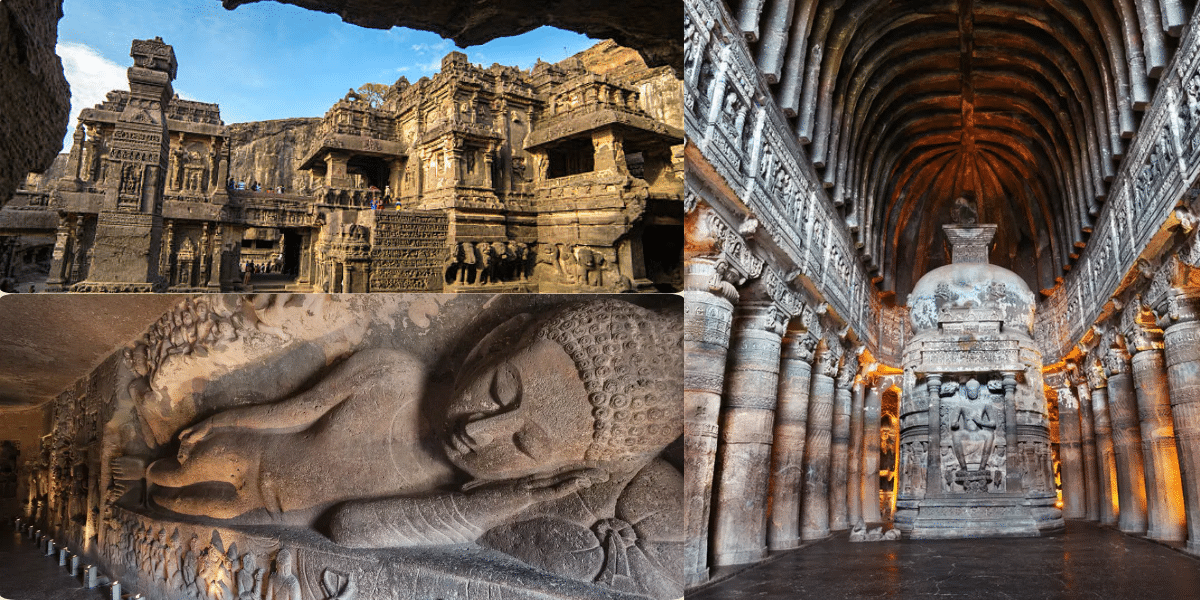
Nestled in a horseshoe-shaped gorge of the Sahyadri Hills in Maharashtra, the Ajanta Caves are not merely a tourist destination; they are a portal to a forgotten era. This breathtaking complex of 30 rock-cut monuments stands as a silent, powerful testament to the zenith of ancient Indian creativity, devotion, and technical prowess. For centuries, these caves lay hidden, shrouded by a dense forest until a chance discovery in 1819 by a British hunting party brought them back into the light of world admiration.
The Ajanta Caves are renowned for their exquisite Buddhist art. The earliest cave monuments date back to the 2nd and 1st centuries BCE, reflecting the Hinayana tradition. During the Gupta period (5th–6th centuries CE), additional caves were constructed, showcasing the Mahayana tradition. These caves feature intricate paintings and sculptures that have significantly influenced Buddhist religious art
Declared a UNESCO World Heritage Site, the caves offer an unparalleled continuum of Buddhist religious art and architecture of Ajanta Caves for over seven centuries. They are a symphony in stone, a gallery of narratives, and a sacred sanctuary that continues to awe historians, artists, and pilgrims alike. This comprehensive guide delves into the profound history, the exquisite Ajanta Caves paintings, and the intricate architecture that make this site a cornerstone of world heritage, while also providing practical information about Ajanta Caves for visitors.
The story of the Ajanta Caves unfolds in two distinct, vibrant phases, separated by a long period of abandonment. Understanding this chronology is key to appreciating the evolution of styles and themes within the caves.
The first chapter of construction began during the Satavahana dynasty, a period of immense prosperity and trade. Buddhism was flourishing, but this era is associated with the Hinayana (Theravada) sect, which emphasized the teachings of the Buddha rather than his physical form. Consequently, the caves from this period (mainly Caves 9, 10, 12, 13, and 15A) are chaityas (prayer halls) and simple viharas (monastic dwellings).
A striking feature of this phase is the aniconic representation of the Buddha. Instead of a human figure, his presence is symbolized by sacred motifs like the stupa (a hemispherical mound reliquary), the Dharma Chakra (wheel of law), footprints, or an empty throne beneath the Bodhi tree. The focus was on the community of monks (the Sangha) and the doctrine (the Dhamma).
For reasons that remain unclear, possibly a shift in trade routes or political instability, the caves were gradually abandoned. The lush forest reclaimed the gorge, and the magnificent art was left to the elements, forgotten by the world outside.
The second and most prolific period of activity was unleashed under the powerful patronage of the Vakataka dynasty, particularly during the reign of Emperor Harishena. This golden age saw the creation of the most elaborate viharas and chaityas, adorned with the world-famous paintings and sculptures. The Mahayana school of Buddhism, which had now gained prominence, advocated for the worship of the Buddha as a deity and the veneration of Bodhisattvas (enlightened beings who delay their own nirvana to help others). This theological shift is vividly reflected in the art.
The caves became a canvas for depicting the life stories (Jatakas) of the Buddha in his previous births, and the walls were filled with majestic, serene icons of the Buddha and compassionate Bodhisattvas. This phase answers the question of who built Ajanta caves in its most magnificent form: it was the work of master craftsmen, sponsored by wealthy patrons including kings, merchants, and monks, under the stable and generous rule of the Vakatakas.
| Period | Key Development |
|---|---|
| 2nd century BCE | Early excavation begins under Satavahana rulers, creation of prayer halls and stupas |
| 1st century BCE – 1st century CE | Completion of major caves, including sculptures like the reclining Buddha in Cave 26 |
| 2nd–3rd century CE | Caves used primarily for monastic residence and prayers |
| 4th–5th century CE | Temporary decline in construction activity |
| Mid 5th century CE | Revival under the Vakataka dynasty during King Harishena’s reign, elaborate paintings were created |
| Late 5th century CE | Artistic peak with detailed frescoes, large vihara halls constructed |
| 6th century CE | Completion of major caves including sculptures like the reclining Buddha in Cave 26 |
| 19th century CE | Rediscovery by British officers, leading to renewed interest and preservation efforts |
The genius of Ajanta lies in the seamless fusion of architecture, sculpture, and painting into a single, harmonious whole. Each element was designed to serve a spiritual purpose, creating an immersive environment for meditation and worship.
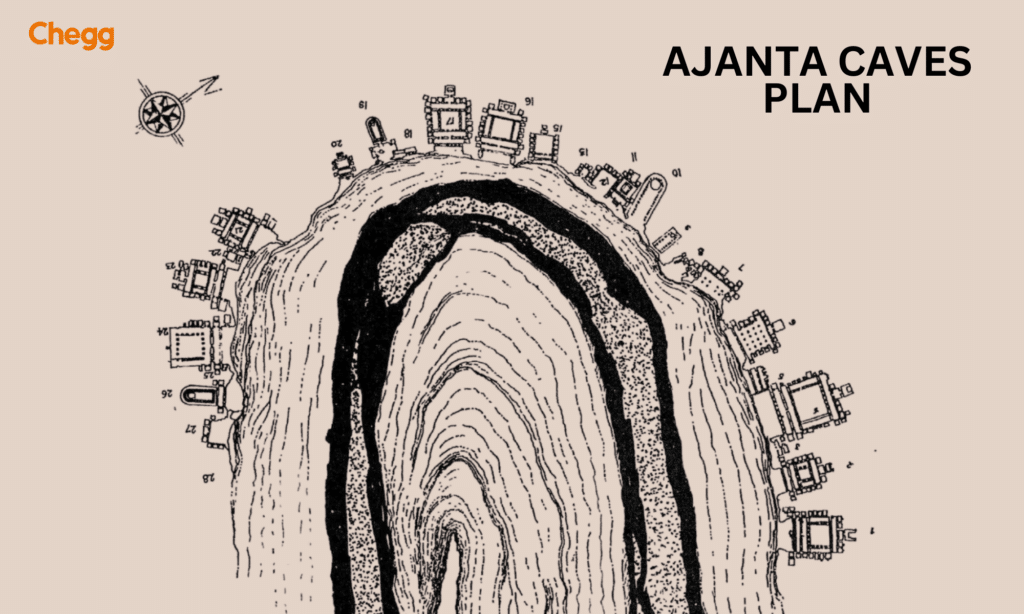
The caves are a stunning example of rock-cut architecture. Instead of building upwards by stacking materials, the artisans carved downwards and inwards from the vertical face of the basalt cliff. This required extraordinary planning, precision, and vision, as any mistake was irreversible.
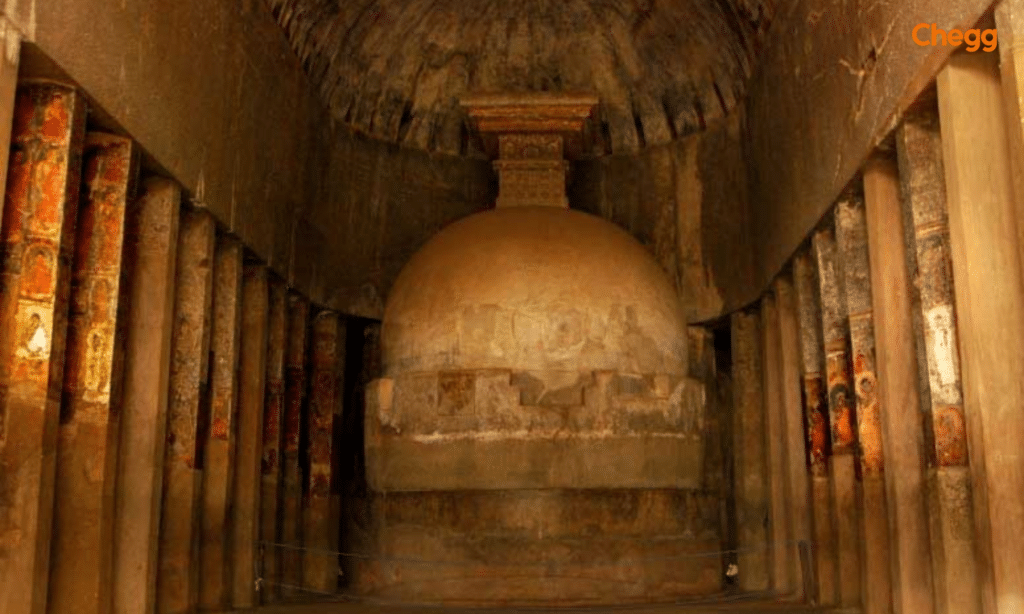
The sculptures at Ajanta are narrative marvels. The artists used the play of light and shadow on the carved figures to bring them to life.

The Ajanta Caves paintings are what truly set this site apart, representing the finest surviving gallery of art from ancient India. Executed on a prepared plaster surface, these frescoes have survived the ravages of time, though many are fragile.
These paintings are renowned for their sophisticated use of perspective, the graceful portrayal of figures, the expressive depiction of emotions, and the ability to create a sense of three-dimensionality through shading.
For over a millennium, the Ajanta Caves slept peacefully, known only to local tribes. Their rediscovery in 1819 by a British officer, Captain John Smith of the 28th Cavalry, who was tiger hunting in the area, is the stuff of legend. Aided by local guides, he stumbled upon the entrance to Cave 10. His act of inscribing his name and date on a sculpture (which is still visible) marked the caves’ re-entry into world history.
The news of this discovery sent shockwaves through the world of archaeology and art. Scholars, artists, and photographers flocked to the site. The detailed copies of the paintings made by artists like Robert Gill (who spent decades at the site) and later by Lady Herringham and her team, and the photographic documentation, were crucial in preserving the record of paintings that were already beginning to fade upon exposure to the elements.
The Ajanta Caves paintings profoundly influenced modern Indian artists like Abanindranath Tagore and Nandalal Bose, who sought to revive Indian artistic traditions. The rediscovery also played a pivotal role in shaping the global understanding of India’s rich ancient past and its sophisticated artistic heritage.
A common point of confusion is the grouping of the Ajanta Ellora Caves. While they are relatively close to each other (about 100 km apart) and both are UNESCO World Heritage Sites, they are distinct in several crucial ways. Understanding the Ajanta Ellora caves history reveals their unique identities.
| Feature | Ajanta Caves | Ellora Caves |
|---|---|---|
| Religion | Exclusively Buddhist | Buddhist, Hindu, and Jain (a symbol of religious harmony) |
| Period of Construction | 2nd Cen. BCE – 6th Cen. CE (circa 800 years) | 6th Cen. CE – 10th Cen. CE (circa 400 years) |
| Famous For | Exquisite paintings and earlier Buddhist architecture | Sculptural magnificence and the monumental Kailasa Temple (Cave 16), carved top-down from a single rock. |
| Setting | Secluded, horseshoe-shaped gorge by the Waghora River | More open setting on an ancient trade route |
| Purpose | Monastic complex focused on meditation and learning | Active religious site for pilgrimage and worship for multiple faiths |
The Ajanta Ellora caves history is not a single narrative but two parallel, magnificent stories of devotion carved into the heart of the Deccan plateau.
| Category | Details |
|---|---|
| Entry Fee (Indians) | ₹35 per person |
| Entry Fee (SAARC Visitors) | ₹35 per person |
| Entry Fee (Foreign Tourists) | ₹550 per person |
| Camera Fee | ₹35 for still/video camera |
| Children (Below 15 Years) | No entry fee |
| Contact Number | +91 240 261 5777 |
| Rating | 4/5 stars (Based on 94 reviews) |
| Address | Near Jalgaon, Aurangabad, Maharashtra, 431117, India |
Planning a visit is key to fully appreciating the grandeur of the caves. Here is essential information about Ajanta caves for a smooth experience.
The Ajanta Caves are located in the Aurangabad district of Maharashtra, India. The nearest major city is Aurangabad (approximately 100 km away), which is well-connected by air, train, and road. The caves themselves are near a small village called Ajintha.
The caves are open to visitors from 9:00 AM to 5:00 PM every day. They are closed on Mondays. It is highly recommended to arrive early to avoid the afternoon heat and the largest crowds.
The ideal time to visit is during the winter months (November to February), when the weather is cool and pleasant. The monsoon season (June to September) makes the surroundings lush green, but the paths can be slippery. Summers (April to June) can be extremely hot.
The very act of rediscovery brought new threats to the caves. Exposure to light, humidity from visitors’ breath, vibrations, and air pollution has taken a toll on the delicate Ajanta Caves paintings. The ASI, along with international bodies, is engaged in continuous conservation efforts, including monitoring environmental conditions, installing barriers, and using advanced scientific techniques to stabilize the rock and plaster. Preserving this priceless heritage is an ongoing global responsibility.
The Ajanta Caves are more than just caves; they are a sublime expression of human aspiration towards the divine. They answer not just the question of who built Ajanta caves, but also the ‘why’, to create a universe of beauty and devotion that would inspire seekers for millennia. From their creation to their rediscovery and their status today as a beacon of world heritage, the journey of the Ajanta Caves is a powerful reminder of India’s profound and enduring cultural legacy. They are an experience, a living lesson in the power of the human spirit and creativity, and a site that every student of history, art, and architecture must endeavor to understand and visit.
Read More:-
One of the greatest accomplishments in ancient Buddhist rock-cut construction is the Ajanta Caves. The creative traditions of Ajanta offer a significant and unique collection of paintings, sculptures, and artifacts related to the sociocultural, religious, and political history of modern India.
The Ajanta Caves are located in the state of Maharashtra, India. Specifically, they are situated near the village of Ajanta, approximately 107 km north of Aurangabad, nestled in a gorge along the Waghora River. This scenic setting enhances the caves’ historical and architectural allure.
According to Walter Spink, the Ajanta Caves were constructed during the period 100 BCE to 100 CE, possibly under the patronage of the Hindu Satavahana dynasty (230 BCE – 220 CE) that ruled the region.
The Ajanta caves were inscribed by the Buddhist monks, under the patronage of the Vakataka kings – Harisena being a prominent one, Satavahanas, and Chalukyas.
It depends on your interest. Ajanta Caves have some of the most outstanding ancient paintings while Ellora Caves are known for their extraordinary architecture. Ellora caves are closer to Aurangabad and more accessible (parts of them are also wheelchair accessible), but they are also more crowded.
Visit early in the morning for the best natural light and fewer crowds. Afternoons can be hot and busy.
Ellora Caves are approximately 100 km southwest of the Ajanta Caves. The journey between these two UNESCO World Heritage Sites typically takes about 1.5 to 2 hours by car, making it feasible to visit both in a single day, depending on your itinerary.
The Ajanta Caves are closed to visitors on Mondays. They are open from 9:00 AM to 5:30 PM on all other days of the week, including weekends. Planning your visit on a Tuesday through Sunday ensures you can explore these ancient marvels without interruption.