
India’s constitutional journey has a distinct chapter reserved for the 42 Amendment of Indian Constitution, enacted in 1976 during the Emergency period led by Prime Minister Indira Gandhi. Often called the “Mini-Constitution,” this amendment brought sweeping changes that altered the balance of power between the central and state governments, the legislature, and the judiciary. It reshaped Indian politics and law during a time of political unrest and has since remained a significant and debated milestone in the country’s democratic evolution.
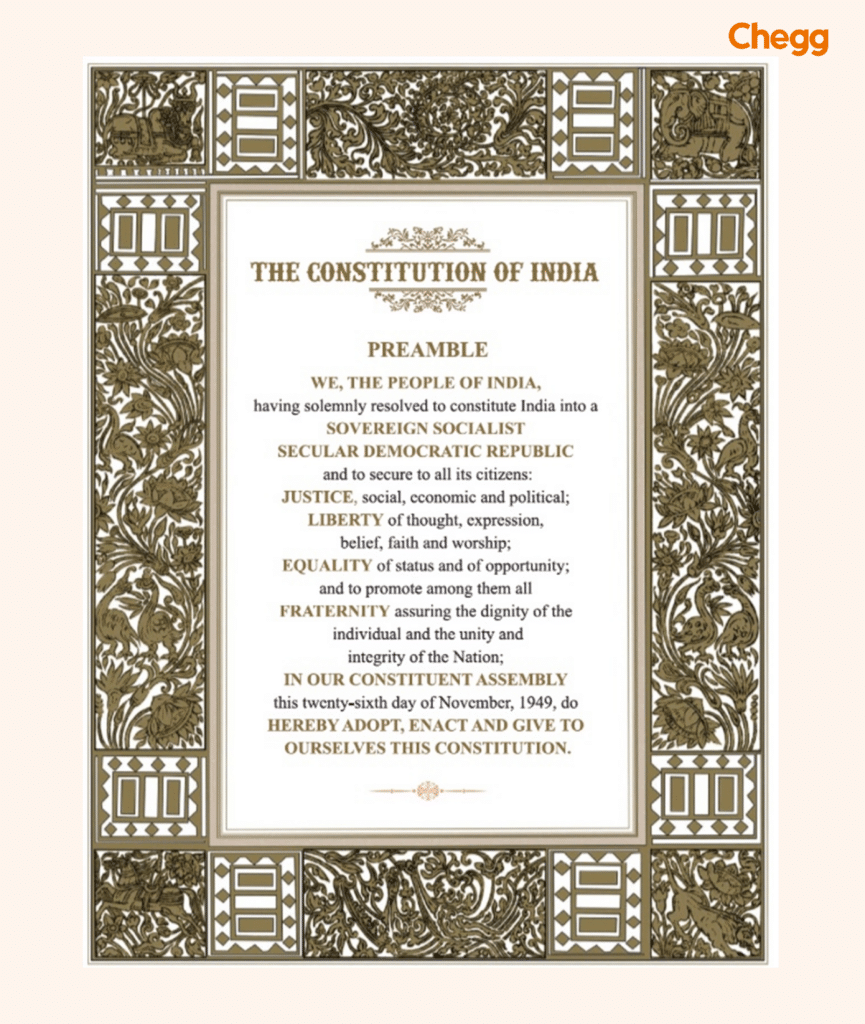
In the mid-1970s, India was politically and socially unstable, prompting this modification. Before the 42 Amendment of the Indian Constitution 1976 happened, India was going through an uncertain period politically. The country faced a declared emergency state with growing concerns about national unity. To strengthen the central government and limit judicial oversight, they brought about this. These included changing the Preamble to reflect India as a socialist and secular country more clearly. Many perceived the 42nd Amendment Act as a move toward centralization and less freedom. In India’s constitutional history, people still consider this chapter controversial.
The amendment primarily aimed to:
In 1975, India faced an unprecedented political crisis. The Allahabad High Court invalidated Indira Gandhi’s 1971 election due to electoral malpractice, casting doubt on her legitimacy as Prime Minister. Faced with widespread political opposition, social unrest, and economic challenges, she advised the President to declare a state of Emergency, which lasted from 1975 to 1977.
The Emergency effectively suspended civil liberties, curtailed judicial review, and ramped up executive power. It was in this environment that the 42nd Amendment was introduced, aiming to strengthen the central government while limiting the judiciary’s influence.
The 42nd Amendment introduced extensive changes across the Constitution. Here are the most significant provisions:
The Mini Constitution is another name for the 42nd Amendment to the Indian Constitution. During the Emergency in 1976, they put it into effect. It was among the most important Constitutional amendments. It altered a lot of significant things, such as:
| Provisions | Modifications |
| Article 32A | refused the Supreme Court the authority to evaluate whether the State law was constitutional. |
| Article 131A | The State Legislative Assemblies and Lok Sabha had six-year terms. It made it possible for the Center to send troops into the state to handle disputes involving law and order (Article 257A). Special discretionary powers were granted to the Prime Minister and the Speaker of the Lok Sabha (Article 329A). The Parliament and state legislatures no longer required a quorum. The power to determine the rights and privileges of its members and committees was granted to the Parliament. |
| Article 144A | To determine whether a Central or State law is constitutional, the Supreme Court sets a minimum of seven judges. A two-thirds majority of the judges had to vote for the law to be declared unconstitutional. The authority of the High Court to grant writs “for any other purpose” was subject to some limitations. |
| Parliament | The following categories were transferred from the State list to the Concurrent list: education, forests, conservation of wild animals and birds, weights and measures, administration of justice, constitution, and organization of all courts, with the exception of the Supreme Court and the High Courts. |
| Executive | The terms of the Lok Sabha and State Legislative Assemblies were for six years. It enabled the Center to address conflicts about law and order by deploying troops into the state (Article 257A). The Speaker of the Lok Sabha and the Prime Minister each have special discretionary powers (Article 329A). A majority of members were no longer necessary for the state legislatures or the Parliament. The Parliament was given the authority to decide what the privileges and rights of its committees and members would be. |
| Judiciary | The judicial review authority of the High Courts was limited. enabled for the All-India Judicial Service to be established. |
| Federalism | Article 257A gave the Center the authority to use any Union armed force in any State to address a serious law and order issue. |
| Preamble | The Preamble was amended to include “Sovereign Socialist Secular Democratic Republic.” |
| Fundamental Rights | All Directive Principles took precedence over the Fundamental Rights mentioned in Articles 14, 19, or 31. |
| Directive Principles of State Policy | Fundamental Rights were subordinated to Directive Principles, and any laws passed by the Parliament in this regard were excluded from the Court’s judicial review. Article 39: To provide chances for kids to develop properly. Article 39A: To advance equitable justice and give the underprivileged free legal assistance.Article 43A: To take action to ensure that employees are involved in industry management.Article 48A: to preserve and enhance the natural environment, as well as to protect wildlife and forests. |
| Fundamental Duties | The government established the Swaran Singh Committee in 1976, and its recommendations are outlined in Article 51-A under Part IV-A, which outlines citizens’ Fundamental Duties. The 11th Fundamental Duty, which states that a parent or guardian must provide educational opportunities for their child or ward between the ages of six and fourteen, was added by the 86th Constitutional Amendment Act. |
| Emergency | Anywhere in the nation, the President could declare an emergency. |
| Seventh Schedule | The following categories were transferred from the State list to the Concurrent list: education, forests, conservation of wild animals and birds, weights and measures, administration of justice, constitution, and organization of all courts, with the exception of the Supreme Court and the High Courts. |
| Tribunals | Education, forests, conservation of wild animals and birds, weights and measures, administration of justice, constitution, and organization of all courts: apart from the Supreme Court and the High Courts- were among the categories that were moved from the State list to the Concurrent list. |
| Amended Article 102 (1)(a) | To disqualify offices vesting in Parliament rather than in State Legislatures, it seeks to provide that an individual will be disqualified if he holds any such profit-making office under the Government of India or the Government of any State as declared by Parliamentary law. |

The 42nd Amendment was largely based on recommendations from the Swaran Singh Committee, constituted in 1976 to review the Constitution. Besides advocating the inclusion of Fundamental Duties, it recommended the supremacy of Directive Principles over Fundamental Rights and enhanced powers of Parliament to amend the Constitution, reflecting the ruling government’s intent to ensure stronger central control and political stability.
The sweeping powers granted by the 42nd Amendment faced a robust challenge in the judiciary. The landmark Minerva Mills Ltd. v. Union of India (1980) judgement reaffirmed the supremacy of the Constitution’s basic structure over parliamentary amendments.
The Supreme Court struck down provisions that:
The case thus reasserted the judiciary’s role in limiting legislative and executive overreach, protecting democracy, and ensuring fundamental rights.
The 42nd Amendment Act of 1976 stands as one of the most far-reaching amendments to the Indian Constitution. Its impact was significant and multifaceted:
Critics argued that these changes tilted the balance of power excessively in favor of the central government and the Prime Minister, potentially undermining the federal structure and democratic principles enshrined in the Constitution.
In contrast to other amendments that focused on specific aspects of the Constitution, the 42nd Amendment aimed for a more comprehensive reshaping of the power structure. However, its approach proved controversial, sparking debate about the appropriate balance between central authority and individual rights in India.
After the Emergency ended, the Janata Party government introduced the 44th Amendment (1978) to restore democratic checks and balances. Key reversals included:
The 42nd Amendment of the Indian Constitution symbolizes a critical juncture where political exigencies shaped constitutional design, tipping the balance of power toward the central government at the cost of judicial oversight and federalism. While it aimed to promote socialism, secularism, and social justice, it also raised fundamental questions about democracy, the rule of law, and constitutional limits.
Its legacy remains a cautionary tale, underlining the need to preserve the constitutional balance between different branches of government and respect for citizens’ fundamental rights, even in times of crisis.
During the Emergency, the Centre passed the 42nd Amendment Act to grant more power to itself. It sought to strengthen the government and minimize judicial oversight.
Many 42nd Amendment Act was studied and revised. The 43rd and 44th Amendments Act of 1978 removed several problematic provisions from it. This aimed to restore fundamental liberties and the center-state balance.
The 42nd Amendment Act changed the Preamble to stress India’s socialist and secular nature. It also restricted fundamental liberties. However, this Amendment increased executive power over the courts and state governments.
This amendment significantly boosted central government authority and weakened state governments.
The 42nd Amendment of the Indian Constitution, enacted in 1976 during Indira Gandhi’s tenure, is one of the most significant constitutional changes in India’s history. It expanded the powers of the central government, curtailed the scope of judicial review, and added the words “Socialist,” “Secular,” and “Integrity” to the Preamble. Often called the “Mini-Constitution,” this amendment aimed to strengthen the Directive Principles and reshape the balance between the legislature, judiciary, and executive.
The 42nd Constitutional Amendment Act reduced the president’s powers by making them bound to the advice of the cabinet and empowered the central government to deploy forces in states during law and order crises.
The 42nd Amendment Act of 1976 added three key words to the Preamble of the Indian Constitution are “Socialist”, “Secular”, and “Integrity”. These additions reflected the government’s intent to emphasize social and economic equality, uphold religious neutrality, and promote national unity.
The 42nd Amendment is called the “Mini-Constitution” because of the sheer volume and significance of the changes it introduced to the Indian Constitution. It did not just tweak a few articles but altered the document’s fundamental character. The amendment modified the Preamble, added a new part on Fundamental Duties, and restructured the relationship between the judiciary, legislature, and executive.