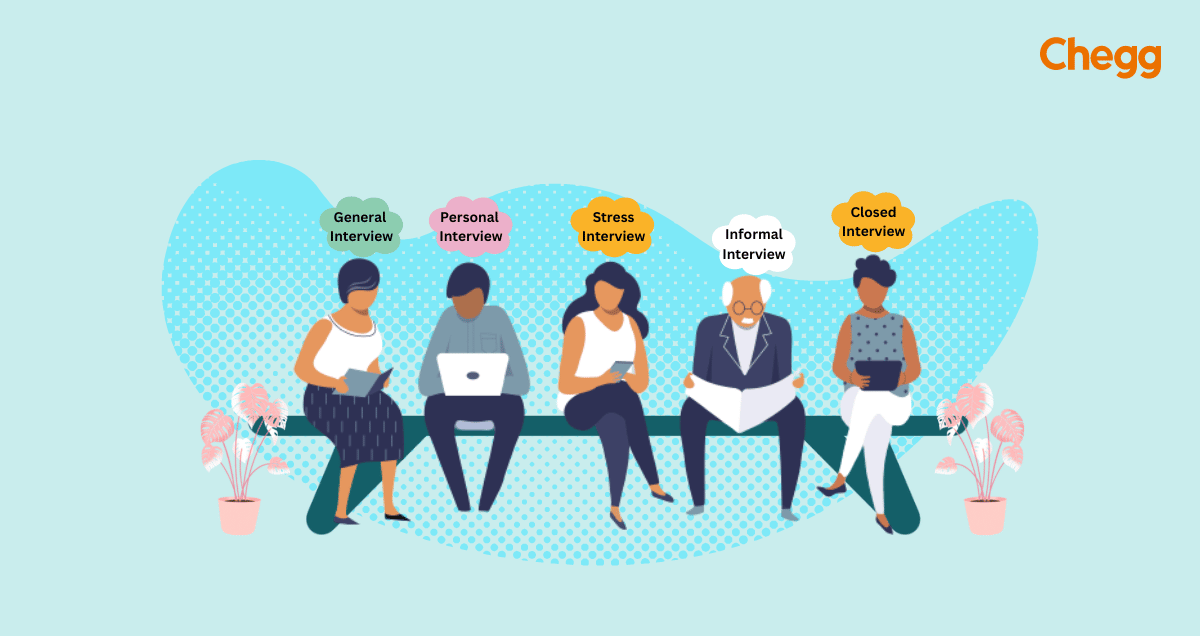

Navigating the job market in 2025 means being ready for different interview formats. Traditional face-to-face interviews, virtual panels, and group discussions each test various skills and qualities. Understanding the main types of interviews and what employers want can help you approach every opportunity confidently and leave a strong impression. This guide outlines the most common interview types and provides tips to help you succeed in any situation.
Additionally, we’ll explore how to handle online interviews, a method becoming increasingly popular in today’s job market. An online interview presents its own set of challenges, but with the right preparation, it can be just as effective as an in-person meeting. We’ll guide you through the specifics of online interview techniques, helping you feel comfortable and confident in a virtual setting.
Whether you are a seasoned professional or someone preparing for your first interview, understanding the types of interview stages and the appropriate techniques for each is key. By familiarizing yourself with different interview methods and preparing for each stage, you can tackle the interview process with poise. This handbook aims to provide you with the tools to approach any interview with confidence and maximize your chances of securing career-defining opportunities.
So, let’s dive in and unlock the secrets to mastering the art of interviewing with behavioral interview questions to ace interviews.
Understanding what is Interview is tricky since there are many types and variations of an Interview. To define an interview formally and precisely, it is a formal process in which an interviewer assesses the qualifications, skills, and suitability of a candidate for a particular job or role. It serves as a crucial stage in the selection process for employers to evaluate candidates’ capabilities, experience, and cultural fit within the organization.
The interview involves two key roles: the interviewer and the interviewee. The interviewer, typically a representative of the hiring company, is responsible for conducting the interview, asking relevant questions, and evaluating the responses. Their goal is to gain insights into the interviewee’s qualifications and determine if they are the right fit for the position.
On the other hand, the interviewee, the job seeker or candidate, participates in the interview to showcase their skills, experience, and suitability for the role. They must effectively communicate their abilities and convince the interviewer of their potential value to the organization.
Read more:- What is a walk-in interview? Tips to Ace it
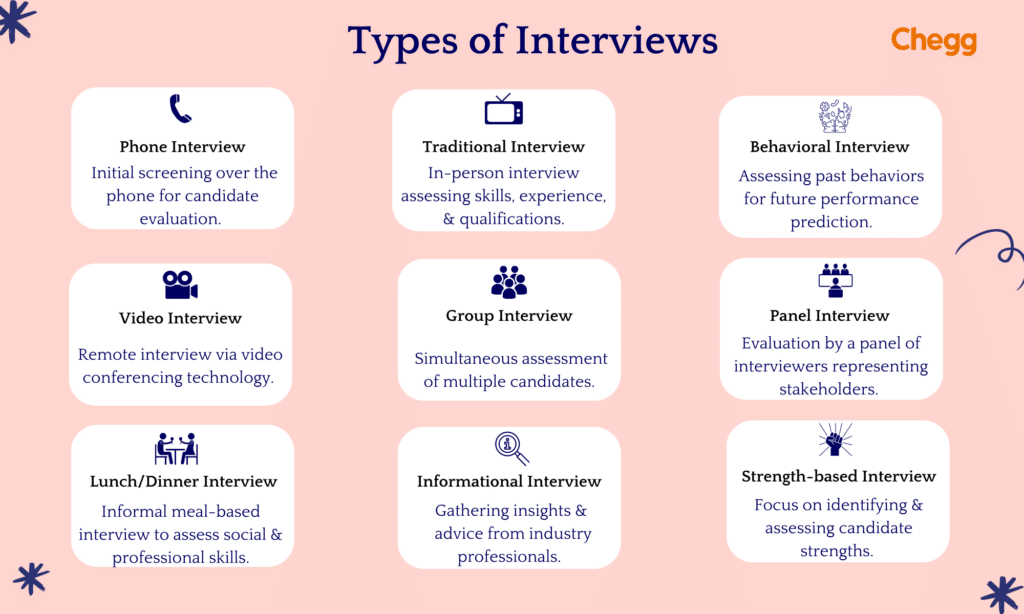
Phone interviews serve as a typical initial phase in the recruitment process, evaluating the qualifications and communication abilities of candidates. They provide a practical method for employers to filter applicants, particularly those located remotely. To succeed in this format, candidates should engage in comprehensive preparation, choose a quiet setting, and articulate their thoughts clearly and with confidence.
A conventional interview consists of a personal meeting between the interviewer and the candidate, where they delve into the candidate’s qualifications and experiences. Usually, this process adheres to a structured approach featuring open-ended questions. This technique is effective in evaluating how well the candidate aligns with the position and the company culture.
A behavioral interview aims to evaluate a candidate’s previous experiences and actions to forecast their future performance. Typically, questions begin with phrases like “Describe a situation where…” and utilize the STAR method (Situation, Task, Action, Result) to guide the answers. This approach enables employers to assess essential skills such as problem-solving, collaboration, and effective communication.
A video interview provides employers with the opportunity to evaluate candidates from a distance, emphasizing their qualifications and ability to communicate effectively. Candidates should set up a quiet, well-lit space and check that their technology is functioning correctly. To succeed, it’s essential to project confidence, communicate clearly, and maintain a professional appearance.
A group interview consists of several candidates being assessed simultaneously, typically to gauge their teamwork and communication abilities. This format may feature group discussions or collaborative activities designed to mimic a team atmosphere. It allows employers to observe how candidates engage with one another and showcase their skills in a collective environment.
A panel interview features several interviewers evaluating one candidate at the same time. This approach provides a variety of viewpoints and a thorough assessment of how well the candidate aligns with the position. Additionally, it challenges the candidate to interact with various stakeholders and manage stress effectively.
A lunch or dinner interview takes place in a public dining setting, offering the interviewer a chance to evaluate a candidate’s social abilities and character. This informal atmosphere fosters open discussions about qualifications and experiences. Candidates are encouraged to uphold professionalism, select suitable conversation topics, and exhibit proper table etiquette.
An informational interview is a conversation designed to help you explore a particular career path, industry, or company by speaking with someone who has firsthand experience. Unlike a job interview, this meeting focuses on gathering valuable insights and expanding your professional network. Engaging in these discussions can empower you to make well-informed career choices and may open doors to future job prospects.
A strength-based interview emphasizes discovering a candidate’s inherent talents and passions instead of merely evaluating their skills and past experiences. This method seeks to reveal what candidates truly enjoy and where they shine, offering a more authentic evaluation. By using this approach, employers can better assess a candidate’s suitability and enthusiasm for the position.
These strategies will enable you to present yourself as a well-prepared, confident, and engaged candidate.
In the realm of Human Resource Management (HRM), various interview techniques are employed to evaluate potential candidates effectively:
These diverse interviewing strategies assist HR professionals in identifying the most suitable candidates for their organizations.
Before attending an interview, thorough preparation is crucial. Begin by researching the company, its mission, values, and recent achievements. Familiarize yourself with the role you are applying for and understand its requirements. This knowledge will enable you to align your skills and experiences with the company’s needs and demonstrate a genuine interest during the interview.
Your resume and cover letter serve as your initial introduction to the employer. Ensure they are well-crafted, highlighting your relevant skills, experiences, and achievements. Tailor your documents to match the job description, showcasing how your qualifications make you an ideal candidate. Use concise language, clear formatting, and professional design to make a strong impression.
Effective communication is paramount during an interview. Practice articulating your thoughts clearly and concisely, using appropriate vocabulary and tone. Pay attention to your body language, maintaining good posture, making eye contact, and displaying confidence. Active listening is equally important, as it shows respect and allows you to respond thoughtfully to the interviewer’s questions. A report by the National Association of Colleges and Employers (NACE) reveals that employers look for candidates with strong communication skills, adaptability, teamwork, problem-solving abilities, and leadership potential.
Prepare for common interview questions by anticipating them in advance. Practice your responses, ensuring they are concise, and relevant, and highlight your skills and experiences. Focus on providing specific examples that demonstrate your abilities and achievements. Maintain a positive and confident demeanor while answering questions, and don’t hesitate to ask for clarification if needed.
|
Common Interview Questions |
Best Possible Answer |
|
Tell me about yourself? |
Start with a brief overview of your professional background and experiences, highlighting relevant achievements and skills. |
|
Why are you interested in this role? |
Explain your genuine interest in the company, the role, and how it aligns with your career goals and passion for the industry. |
|
What are your strengths?
|
Highlight a few key strengths that are relevant to the position and provide specific examples of how you have demonstrated them. |
|
Tell me about a time you faced a challenge and how you overcame it. |
Describe a specific challenge you encountered, the actions you took to address it, and the positive outcome or lessons learned. |
|
How do you handle stress and pressure? |
Discuss strategies you employ to stay calm and focused, such as prioritizing tasks, seeking support from colleagues, or practicing self-care. |
|
Describe a situation where you demonstrated leadership. |
Share a specific example where you took the lead, delegated tasks, motivated a team, and achieved a successful outcome. |
|
Where do you see yourself in 5 years? |
Provide a thoughtful response that demonstrates ambition, growth, and alignment with the company’s long-term goals. |
|
Why should we hire you? |
Summarize your unique qualifications, experiences, and skills that make you the ideal candidate for the role, emphasizing your ability to contribute to the company’s success. |
|
Do you have any questions for us? |
Ask thoughtful questions about the company culture, team dynamics, future projects, or opportunities for professional growth. |
|
What is your salary expectation? |
Research the industry average and provide a range based on your qualifications and experience, while expressing your openness to negotiation. |
During the interview, emphasize your qualifications and experiences that align with the job requirements. Clearly communicate how your skills can benefit the company and contribute to its success. Use the STAR method (Situation, Task, Action, Result) to structure your answers when discussing past experiences. Be authentic, and enthusiastic, and demonstrate a genuine passion for the role.
By following these essential tips and strategies, you can face interviews with confidence and increase your chances of success. Developing strong interview skills, understanding different interview types and stages, and effectively showcasing your qualifications will position you as a strong candidate in the competitive job market. Remember to be well-prepared, stay positive, and leave a lasting impression on the interviewer.
Before the interview, it’s crucial to conduct thorough research about the company, its values, mission, and culture. Familiarize yourself with the job description and requirements. Prepare answers to common interview questions and practice articulating your qualifications and experiences.
During these initial types of interview stage, the interviewer will greet you and initiate a conversation to establish rapport. Offer a firm handshake, maintain eye contact, and display a friendly and professional demeanor. Engage in small talk and find common ground to create a comfortable atmosphere.
In the main interview, the interviewer will ask a series of questions to assess your suitability for the role. Listen attentively to each question, take a moment to gather your thoughts, and provide clear, concise, and relevant answers. Use the STAR method (Situation, Task, Action, Result) to structure your responses and provide specific examples.
Towards the end of the interview, the interviewer may invite you to ask questions. Prepare insightful and well-thought-out questions about the role, the team, or the company’s future plans. Express your gratitude for the opportunity to interview and reiterate your interest in the position.
After the interview, send a personalized thank-you email or note to the interviewer within 24 hours. Express your appreciation for their time and reiterate your interest in the role. Use this opportunity to highlight any key points discussed during the interview. Additionally, connect with the interviewer on professional networking platforms, such as LinkedIn, to stay connected and maintain a professional relationship.
|
Structured Interviews |
|
|
Unstructured Interviews |
|
|
Situational Interviews | Focus on how candidates handle specific situations or challenges. Evaluate problem-solving, decision-making, and adaptability. Candidates are asked to provide examples from past experiences. |
|
Competency Based Interviews |
|
Recommended Reads:
You Must Know These Interview Etiquette Tips
In conclusion, mastering the different types of interviews requires a combination of knowledge, preparation, and practice. By understanding the interview process, honing your interview skills, and adapting to various types of interview methods, you can confidently face any interview situation. Remember, each interview stage is an opportunity to showcase your qualifications, skills, and personality. With this Interview Handbook as your guide, you’ll be well-equipped to succeed in your next interview and land your desired job.
Master the art of job interviews with our comprehensive Interview Tips guide, tailored to help you make a lasting impression and land your dream job.
Being aware of the different types of interviews is important for job seekers who want to stand out in today’s competitive job market. By preparing for each format and practicing your responses, you will improve your confidence and adaptability, which are key traits employers value. Stay informed, practice regularly, and you will be ready to succeed in any interview that comes your way.

The most common 7 types of interviews are:
Traditional One-on-One Interview – A conversation with an interviewer.
Panel Interview – A third-party judgment by a group of interviewers asking questions together.
Behavioral Interview – More conventional interviews are about one-on-one questions related to the job but focus on past experiences related to the work you will be doing someday to predict your future performance.
Group Interview – In a group interview, multiple candidates are interviewed together to frame performance needs in the role as team members.
Case/Problem-Solving Interview – You being presented one scenario or problem to solve.
Phone/Video Interview – Remote, and generally a screening interview or assessment of candidates, not conversations.
Stress Interview – A stress interview is one that is intentionally ambiguous or that is structured to test your ability to deal with pressure or challenging situations.
Example
Ramesh had a panel interview where they were three managers asking him a mix of role-related and behavioral interview questions to assess his problem-solving skills and fit for the team.
Tip
Identify different formats to prepare for by researching different types of interviews done by the company, then preparing and practicing on both the technical and soft-skill based questions for different systems.
The three R’s in a job interview are:
Research – Take time to learn about the company, position, and industry before the job interview.
Respond – Respond to questions with clear and confident answers and include real examples in your responses.
Reflect – After the job interview, reflect on how you answered questions and think of ways to improve for your next job interview.
For example, Meera researched examples of the company’s projects, and she had real-life examples with her when she answered questions about her previous behaviour. Then, afterwards Meera thought about how she responded to the questions during the interview and she would make sure to improve her responses for the next time she was interviewed.
Tip: Always have prepared stories from your experiences – they will make your response more authentic and memorable!
The three golden rules of an interview are:
Be Prepared – Research the company, the role and practice for common questions.
Be Professional – Dress suitably, be on time, and have good body language.
Be Honest – Be capable of giving genuine answers, and emphasize your strengths and experience.
For example, Arjun prepared by researching the company, he arrived 10 minutes early in business formal clothing, and he answered questions honestly, and he left a good impression on the interviewers.
Tip: Confidence comes from preparation; to build your confidence practice doing mock interviews to refine your answers and reduce your neurosis.
Some common interview mistakes include:
Arriving late or unprepared.
Speaking negatively about past employers.
Not researching the company or role.
Talking too much—or too little.
Forgetting to ask thoughtful questions.
For example: Riya didn’t research the company before her interview, so when asked about why she wanted the role, her answer sounded vague—this cost her the opportunity.
Tip: Always prepare and practice—research the company, review your resume, and rehearse answers to common questions to avoid these slip-ups.
There are three main parts of an interview:
Introduction – The introduction is where first impressions are made with greetings, small talk and initial questions from the interviewer.
Core Interview – The core interview is the main interview. This is where your skills, experience and suitability for the role will be evaluated.
Closing – Closing is the end of the interview, where you can also ask questions and clarify any doubts you had, and the interviewer will provide information about what happens next.
For example: Sanya started off her panel interview well with the introduction part of the interview, spoke about her projects during the core interview, and asked some sensible questions during the closing, which left a good impression of her.
Tip
Make sure you treat the closing part of the interview seriously. If you ask the right questions that show you are interested, this will help you stand out.
To define Interview, It is a formal conversation between an interviewer and an interviewee, mainly to evaluate the interviewee’s skills, knowledge, and fit for the position.
Example: A job interview, where an HR manager asks a candidate about their prior experience, strengths, and professional goals.
Tip: Always do your research on the company and role before any interview, so you can provide confident and tailored replies.