how to become a scientist

How to Become a Scientist in India: A Complete Roadmap

Published on September 4, 2025
|
13 Min read time
how to become a scientist

Quick Summary

  • Becoming a scientist requires strong academic performance, higher degrees (M.Sc., Ph.D.), and practical research experience.
  • Key steps include selecting a specialization, developing a research portfolio, and connecting with mentors and experts.
  • Ongoing learning, curiosity, and commitment are vital for a successful scientific career in 2025.

Table of Contents

Are you dreaming of making important discoveries and contributing to the world’s knowledge? Becoming a scientist is a rewarding path for those driven by curiosity, critical thinking, and a passion for solving real-world problems. In 2025, the journey to becoming a scientist in India will involve a mix of academic success, hands-on research, and ongoing learning. Knowing the right educational paths, research opportunities, and necessary skills is key, whether you’re interested in physics, biology, chemistry, or engineering.

This guide covers everything you need to know about how to become a scientist. It includes choosing the right courses and institutes, building research experience, and finding mentors. Unlock your potential and start your journey toward a fulfilling and impactful scientific career.

Who is a Scientist?

A scientist is an individual who learns about the natural world to gain a deeper understanding of various phenomena. They use observation, experimentation, and analysis methods to gather data and test hypotheses. Scientists work in diverse fields, including biology, chemistry, physics, medicine, and environmental science. Their research contributes to advancements in knowledge and technology.

Types of Scientists

Science is a vast field. Different types of scientists have different roles and jobs. Today, scientists are no longer limited to laboratories. There are fields in which scientists are required to work in multiple environments. They may also need certain other skill sets based on their work requirements.  

There are 10 types to become a scientist & these include: 

how to become a scientist in India
  1. Business scientists focus on business and management skills in addition to scientific and technological knowledge. 
  2. Communicator scientists work on communication skills as their areas of expertise. 
  3. Developer scientists develop existing technologies or technologies designed by others and make them usable. 
  4. Entrepreneur scientists focus on innovation in science and technology and make the technology usable. 
  5. Explorer scientists work on furthering or exploring areas that are lesser known and are typically associated with research institutes. 
  6. Investigator scientists delve deep into the subject mapping, observing, and understanding complex data. 
  7. Policy scientists work with the government to draft policies using their scientific and technical knowledge. 
  8. Regulator scientists monitor and regulate norms and work in regulatory bodies such as food and drug standards. 
  9. Teacher scientists have good teaching skills and focus on sharing their knowledge with others. 
  10. Technician scientists work in technical labs such as health clinics or material testing agencies. 
how to become a scientist

What does a Scientist do?

Scientists do important work in labs and the field across many areas like medicine, physics, biology, chemistry, computer science, and environmental science. Here’s a simple breakdown of what they do:

  1. Planning Experiments: Scientists come up with ideas for experiments to test their questions and find answers.
  2. Writing Reports: After finishing their experiments, they write reports and papers to share what they discovered.
  3. Collecting Samples: They often go outside to gather samples, like soil or water, to study in the lab.
  4. Monitoring Experiments: While experiments are happening, scientists watch closely and keep track of the results to understand what’s going on.
  5. Training Others: Experienced scientists help teach and guide newer scientists or students.
  6. Demonstrating Techniques: They show others how to do experiments and use scientific tools.
  7. Keeping Up with Research: Scientists regularly read about discoveries and updates in their fields to stay informed.

These activities are essential for advancing science and understanding the world around us. For more information about what scientists do, check out resources like Indeed and Science Careers.

Earn in Six-figures with chegg

Importance of Scientists

Research scientists are essential for advancing science and technology. Their work leads to important discoveries and innovations that can greatly affect our lives. For example:

  • Medical Research Scientist: They develop new treatments and vaccines that help people stay healthy.
  • Environmental Scientists: They study climate change and its impact on the planet.
  • Computer Scientists: They analyze new technologies and create programming theories that improve processes.

The role of research scientist goes beyond just working in labs. Their findings help shape government policies, promote technological advancements, and boost economic growth. For instance:

  • Research in renewable energy is crucial for fighting climate change and creates new industries and job opportunities.
  • In healthcare, research scientist work on new treatments and technologies that enhance patient care and overall quality of life.

How to Become a Scientist

If you’re interested in becoming a scientist in India, here are some steps to follow:

  1. Complete Higher Secondary Education: Focus on science subjects (like physics, chemistry, and biology) and aim for at least 50% marks to qualify for further studies.
  2. Earn a Bachelor’s Degree: Pursue a Bachelor of Science (BSc) or Bachelor of Technology (BTech) in a relevant field, which typically takes three years.
  3. Pursue a Master’s Degree: Obtain a Master of Science (MSc) or Master of Technology (MTech), usually requiring two years of study.
  4. Obtain a Doctorate Degree (PhD): Many aspiring scientists pursue a PhD in their chosen field, which can take three to four years.
  5. Gain Practical Experience: Working in research labs, universities, or other scientific institutions is crucial for building your skills and enhancing your job prospects.

By following these steps, you can become a scientist and contribute to important advancements in science that benefit society.

How many Types of Scientists are there in India?

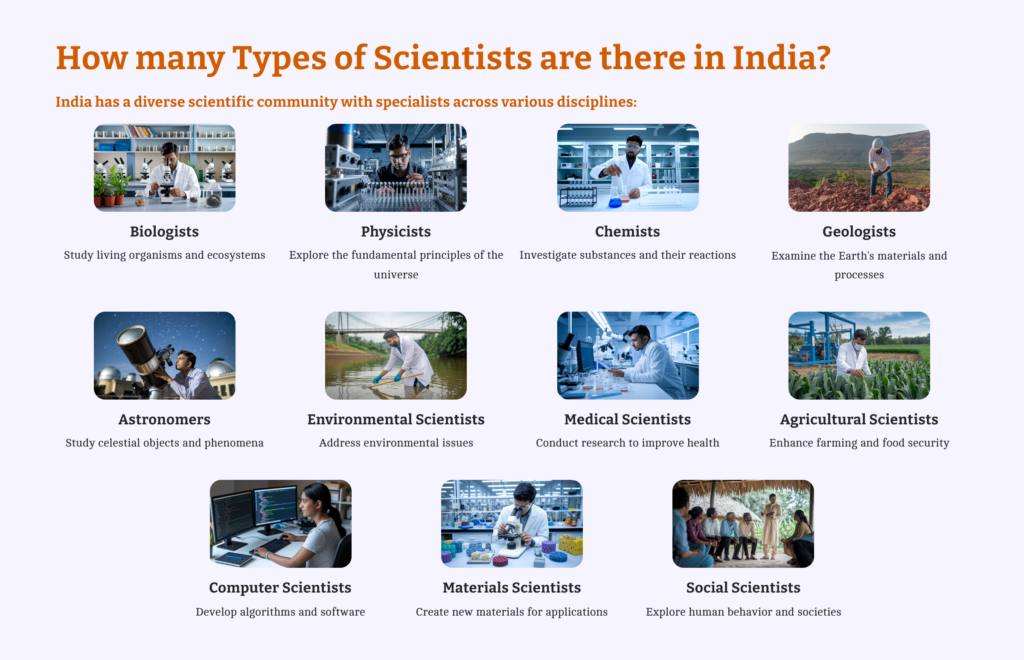
In India, there are various types of scientists, each focusing on different fields of study. Here’s a simple overview of the main categories, along with a brief description of each:
how to become a scientist in India
  1. Biologists: They study living organisms and how they interact with their environment. Their work helps us understand ecosystems and biodiversity.
  2. Physicists: They explore the fundamental principles governing the universe, such as energy, matter, and forces. Their research leads to advancements in technology and our understanding of the cosmos.
  3. Chemists: They investigate substances, their properties, and the reactions they undergo. Chemists play a vital role in developing new materials and medicines.
  4. Geologists: They examine the Earth, including its materials, structures, and processes. Their work helps us understand natural disasters and resource management.
  5. Astronomers: They study celestial objects, such as stars and planets, and phenomena beyond Earth. Astronomy expands our knowledge of the universe and our place within it.
  6. Environmental Scientists: They focus on the environment and work to find solutions to environmental issues. Their efforts are crucial in combating climate change and pollution.
  7. Medical Scientists: They conduct research to improve human health and develop new treatments. Their discoveries can lead to better healthcare and disease prevention.
  8. Agricultural Scientists: They work on enhancing farming practices and increasing crop yields. Their research helps ensure food security and sustainable agriculture.
  9. Computer Scientists: They develop algorithms, software, and computer systems. Their innovations drive advancements in technology and information processing.
  10. Materials Scientists: They study and create new materials with specific properties for various applications. Their work contributes to fields like engineering and nanotechnology.
  11. Social Scientists: They explore human behavior and the dynamics of societies. Their research helps us understand social structures and cultural trends.

These categories represent just a few specializations within the scientific community in India. Each type of scientist plays a crucial role in advancing knowledge and technology in their respective fields.

 Academic Pathways to Becoming a Scientist 

Being a scientist often requires years of hard work and study. You also need to be genuinely fascinated with your chosen subjects. There are many required qualifications to become a scientist. This depends on the nature of the job that you aspire for too.  

Importance of Science Stream in High School Education 

Wondering how to become a scientist after completing the 12th standard? Your high school education lays the foundation for your career as a scientist. At this stage, students gain a general idea of the subjects available to them. This helps them gauge subjects they might wish to pursue further.  

Another important point is to gauge your skill level in your subject of interest. After completing the 10th standard, take up a science stream. 

In India, there are usually two options- PCM or PCB, with Physics and Chemistry being common – Biology or Mathematics. There is also the option of all four subjects. Choose this if your area of interest is something like biotechnology.   

Without having this background in science, students cannot pursue bachelor’s level science courses. This education greatly helps in preparing for competitive exams such as JEE or NEET. Some of the top science institutes in the country select students based on the scores of these exams. 

List of Science Courses to Pursue after High School 

There are four broad categories that students can pursue – Mathematics, Biology, Physics, and Chemistry. Various subjects come under these four subjects. However, students require a basic understanding of all four to prosper in their careers. 

After high school, students can pursue bachelor’s level degrees such as – 

  • B.Tech (Bachelor of Technology) – Students can specialize in various technical disciplines, such as mechanical, electrical, computer science, etc. 
  • B.E (Bachelor of Engineering) – Through this course, students can specialize in different engineering disciplines. 
  • B.Sc (Bachelor of Science) – Specialisations can be done in mathematics, biotechnology, physics, chemistry, agriculture, zoology, radiology, forestry, microbiology, nursing, physiotherapy, bioinformatics, botany, information technology, or computer science. 
  • MBBS (Bachelor of Medicine, Bachelor of Surgery) – To become a doctor, this course is pursued. However, students can also pursue research in the medical field upon completing this course. 
  • B.Pharma (Bachelor of Pharmacy) – This course enables candidates to become a pharmacist in India.  

Upon completing such programs, students gain a better understanding of their skill sets and interests. These scientific career paths can guide you to your goals. 

Importance of Obtaining a Degree in Science 

A degree in science is required to start a career in science. This helps develop a basic skill set to ensure a successful career in science.  

  • Undergraduate degree: Choose a Bachelor’s degree course in science, engineering or technology, medicine, pharma, etc., whichever is in your interest. Be sure to choose a subject that you find intriguing and interesting. This will be a crucial step for advancing your career. 
  • Postgraduate degree: Upon completing a bachelor’s degree, students are eligible to further study in a post-graduate program. From here on, students can begin to research and conduct in-depth studies. A lot of opportunities open up for those with a master’s degree in science streams.

Eligibility Criteria for Pursuing Higher Education in Science 

Students who have a master’s degree in addition to a bachelor’s degree are eligible for doctoral-level programs, like a Ph.D. program. Typically, students pursue research in their areas of interest.  

Some universities also have the option of Ph.D. students acting as guidance counselors. 

However, to enroll in top universities and colleges, aspirants must have a track record of good scores. If studying science is something you genuinely enjoy, this shouldn’t be difficult to achieve. 

Read more: Steps to Becoming a Data Scientist

How long does it take to become a Scientist?

A Bachelor of Science (BSc) typically takes 3 years to complete, while integrated courses may extend to 5 years. A Master’s degree usually requires an additional 2 years, and a PhD can take 3 to 4 years to finish. Additionally, positions in reputable laboratories, research facilities, and teaching roles often expect candidates to have several years of relevant work experience.

Skills and Traits Required to Be a Scientist 

The science field is complex and demanding. You need different skill sets to be able to work with various types of scientists in India.

1. Inquisitive Nature 

If you are inherently inquisitive about science, then research is the best field for you. 

2. Critical Thinking and Problem-Solving 

Scientists have to often think out of the box to solve complex issues. This is one of the most obvious skills required to become a scientist. 

3. Patience 

In science, you rarely get quick results in your work. You must learn to remain patient and determined. This trait is one of the most important skills required to become a scientist. 

4. Open-Minded 

Time and again, scientists come across unexpected results during their research. Being open-minded is one such skill to have to adapt to and accept new ideas. 

5. Communication Skills 

Communication is important in all job types and scientists are no exception. Scientists have to be able to explain their work to their peers, their teams, and other people. Good communication skills can help in improving their careers. 

6. Management Skills 

Good management works wonders. Scientists have to manage their time well to complete their tasks on time. 

Career Path for Becoming a Scientist in India 

Science is a vast field. There are many specializations that you can choose from if you wish to become a scientist. The five basic subjects – mathematics, physics, chemistry, botany, and zoology – further branch into many other disciplines.  

Opportunities in the field of science are never-ending. Whichever subject you choose today, many research institutes and centers cater to various specializations. Based on your skills and interests, opt for your program of choice.  

Work experience is highly valued in the field of science. With a constant need for scientists, you can get exposure. It is also recommended to gain as must work experience as you can.  

Scientists can also work in private companies in research and development teams. Some of the top private companies offer the most competitive salaries to scientists. You can only reach this level through outstanding work. 

Public sector institutions such as ISRO, DRDO, etc., offer lucrative offers to scientists in relevant fields. There are many types of outstanding scientists that you can choose to work with in India. These prestigious institutions offer many perks in addition to good salaries.  

How to Become a Scientist at ISRO (Indian Space Research Organisation)

ISRO hires scientists and engineers to work on space missions, satellite development, and research. Here’s the pathway:

Eligibility Criteria:

  • Educational Qualification:
    • Bachelor’s degree (B.E./B.Tech) in Aerospace, Mechanical, Electrical, Electronics, Computer Science, or related fields from a recognized university.
    • Master’s degree (M.E./M.Tech) in relevant fields is preferred for research roles.
    • PhD in Space Science, Astrophysics, or related subjects for advanced research positions.
  • Entrance Exam: ISRO Centralized Recruitment Board (ICRB) conducts the ISRO Scientist/Engineer Exam for engineering graduates.

Step-by-Step Process:

  1. Complete 10+2 with Science (PCM) – Focus on Physics, Chemistry, and Mathematics in high school.
  2. Pursue a B.E./B.Tech degree from a reputed institute like IITs, NITs, or IIST (Indian Institute of Space Science and Technology).
  3. Apply for ISRO’s Scientist/Engineer ‘SC’ Exam through ISRO’s official website.
  4. Clear the ISRO Exam & Interview – Shortlisted candidates must pass a technical interview.
  5. Higher Studies (Optional but Recommended) – Pursuing an M.Tech or PhD in a specialized field increases the chances of selection.
  6. Gain Relevant Experience – Research internships at ISRO, IISc, or IITs improve your profile.

How to Become a Scientist at DRDO (Defence Research and Development Organisation)

DRDO focuses on defense technology, missiles, radars, and AI-based systems. It recruits scientists in various technical and research roles.

Eligibility Criteria:

  • Educational Qualification:
    • B.E./B.Tech in Mechanical, Electronics, Electrical, Computer Science, Civil, or related fields.
    • M.E./M.Tech or PhD for research positions.
  • Entrance Exam:
    • DRDO recruits through RAC (Recruitment and Assessment Centre) via GATE scores.
    • It also conducts Scientist Entry Test (SET) for direct recruitment.

Step-by-Step Process:

  1. Complete 10+2 with PCM – Focus on science and mathematics.
  2. Pursue B.E./B.Tech in a relevant field from IITs, NITs, or other top institutions.
  3. Crack GATE Exam – DRDO often recruits candidates through GATE scores.
  4. Apply through RAC-DRDO Portal – Eligible candidates can apply for scientist positions.
  5. Clear Interview & Selection Process – A technical and HR interview follows shortlisting.
  6. Pursue M.Tech or PhD (Optional) – Higher education enhances opportunities for senior scientist roles.

How to Become a Scientist at NASA (National Aeronautics and Space Administration)

NASA recruits scientists in various domains, including space research, physics, robotics, and aerospace engineering.

Eligibility Criteria:

  • Educational Qualification:
    • A Bachelor’s degree in Aerospace Engineering, Astrophysics, Computer Science, Mathematics, or related fields.
    • Master’s and PhD degrees are usually required for research positions.
  • Citizenship Requirement:
    • Most NASA scientist roles require U.S. citizenship or permanent residency.
    • International students can work at NASA through collaborations or research fellowships.

Step-by-Step Process:

  1. Complete 10+2 with a Strong Science Background – Physics, Chemistry, and Mathematics are crucial.
  2. Pursue a B.E./B.Tech or B.Sc in a relevant field from a reputed university.
  3. Gain Higher Education (M.S. or PhD) – NASA prioritizes candidates with postgraduate research experience.
  4. Intern at NASA – NASA offers research internships through programs like JPL (Jet Propulsion Laboratory) and NIAC (NASA Innovative Advanced Concepts).
  5. Apply for NASA Job Positions – Visit NASA’s career page and apply for scientist roles.
  6. Gain Work Experience in Related Fields – Working with private space firms (SpaceX, Blue Origin) or organizations like ESA (European Space Agency) increases your chances.

Top Institutes for Pursuing Science Education in India 

India has many top science research institutes today. These institutes offer education and training for scientists across many fields. Some of them are listed below. 

  • Indian Institute of Science (IISc) in Bangalore 
  • Indian Institute of Technology (IIT) in Delhi, Bombay, Chennai, Kanpur, Kharagpur, Roorkee, Hyderabad and more locations 
  • Birla Institute of Technology and Science (BITS) in Pilani, Hyderabad 

Many such private and state universities offer great science courses. Research institutes in India continue to improve and are ranked well across the world. There are more than 20 IITs across the country offering excellent levels of education.  

You can become a scientist by mapping a career path right after the 12th standard. You must have an idea of what you want to study to become a scientist. Shortlist the programs you wish to pursue and the universities that offer them.  

Gauge your skills and interests and compare those with your shortlisted programs. This will help you choose an appropriate institution per your interests. 

Job Prospects and Opportunities for Scientists in India 

As we constantly strive to improve and innovate, every field requires research and development. This makes scientists needed across all sectors. Depending on your level and subject of education, there are numerous job prospects in the field of science in India to become a scientist:

Some of the research institutes that offer jobs in scientific research are – 

  • Tata Institute of Fundamental Research (TIFR) 
  • Defence Research and Development Organization (DRDO) 
  • Council of Scientific and Industrial Research (CSIR) 
  • Indian Space Research Organization (ISRO) 
  • Indian Council of Medical Research (ICMR) 

Almost all of the top companies have research and development divisions. So, there are a lot of job opportunities in the corporate sector as well. 

Scientist Jobs and Salaries

Here’s summarizing some of the highest-paying scientist jobs in India, along with their average salaries to become a scientist:

Job TitleDescriptionAverage Salary (LPA)
Molecular BiologistStudies molecules within cells₹17 LPA to ₹43 LPA
Environmental ScientistFocuses on solving environmental issues₹6 LPA to ₹12 LPA
Research ScientistEngages in academic research₹3 LPA to ₹20 LPA
Data ScientistAnalyzes data to aid decision-making₹8 LPA to ₹25 LPA
BiotechnologistDevelops products and technologies in biotech₹5 LPA to ₹15 LPA

These roles offer not just good salaries but also the chance to make important contributions to science and technology.

For further information, you can explore sources like Internshala and Payscale.

Key Takeaways 

All these steps will help you understand and become a scientist. If you wish to pursue a career in science, you must know that it is a very demanding field. However, the satisfaction that this field offers is incomparable.  

Do you have any experience in the field of science? Would you like to share your knowledge? Become a Q&A expert at Chegg. You can earn money by answering questions from students across the world. Improve your career by meeting academic experts and gaining academic exposure. Sign up right away! 

Evaluate numerous career choices to choose the right career path for yourself. Dive into our guide on Career Advice.

Read more- How to Become A Research Scientist – A Career Guide

Conclusion

Becoming a scientist is a lifelong journey that requires dedication, perseverance, and a passion for inquiry. Pursuing relevant degrees, working on research projects, and keeping up with the latest developments can establish a solid foundation for a successful scientific career. Remember that teamwork, clear communication, and resilience matter as much as technical skills. Look for mentors, attend conferences, and always keep asking questions.

In 2025 and beyond, scientists will drive innovation, tackle global challenges, and shape the future. With the right mindset and dedication, you can turn your curiosity into discoveries and impact society.

Earn in Six-figures with chegg
How to Become a Software Architect: Proven Steps in 2025
by Samiksha Samra
How to Become a Software Architect: P…
by Samiksha Samra
How to Become a Doctor in India: Comprehensive Step-by-Step Guide for 2025
by Aakriti Jain
How to Become a Doctor in India: Comp…
by Aakriti Jain
How to Become Medical Officer in India – 6 Proven Steps to Success (2025)
by Samiksha Samra
How to Become Medical Officer in Indi…
by Samiksha Samra
How to Become a Software Engineer in India – Courses, Skills, Salaries & More
by Shashank Singh
How to Become a Software Engineer in …
by Shashank Singh

Frequently Asked Questions (FAQ’s)

What qualifications are required on how to become a scientist?

To become a scientist, you usually need a bachelor’s degree in science. After that, you typically pursue a master’s or PhD in a specialized field.
Example: A student studies B.Sc. in Physics and then pursues a PhD to become a research scientist.
Tip: Early on, pick a subject you are passionate about to build your expertise.

Can I learn how to become a scientist in india after 12th?

Yes, after 12th with PCM or PCB, you can pursue B.Sc or B.Tech as your first step.
For example, a student takes PCB, earns a B.Sc in Biology, and later works in medical research.
Tip: Focus on research-focused courses instead of just general degrees.

Is a PhD compulsory to become a scientist?

While a PhD is highly preferred for research roles, some jobs in applied sciences accept a master’s degree with strong research experience.
For example, a biotech graduate with an M.Sc. can work in an R&D lab without a PhD.
Tip: If you are aiming for government or top research positions, a PhD is usually necessary.

How long does it take to become a scientist?

It may take 8 to 12 years, including bachelor’s, master’s, and doctoral studies.
Example: A physics student takes 10 years to complete a PhD and begin research.
Tip: Be patient. Scientific careers require dedication and persistence.

What skills are needed to become a scientist?

Critical thinking, problem-solving, data analysis, and strong research writing skills are essential.
Example: A chemist designs experiments and publishes findings in journals.
Tip: Develop coding, statistics, or lab skills along with theory.

Can I learn how to become a scientist in India?

Yes, institutes like ISRO, CSIR, DRDO, and IITs provide research opportunities for aspiring scientists.
For example, a student joins CSIR labs after finishing a PhD in Chemistry.
Tip: To find research positions, take exams like CSIR NET, GATE, or JEST.


Authored by, Gagandeep Khokhar
Career Guidance Expert

Gagandeep is a content writer and strategist focused on creating high-performing, SEO-driven content that bridges the gap between learners and institutions. He crafts compelling narratives across blogs, landing pages, and email campaigns to drive engagement and build trust.

Editor's Recommendations