

Today’s 10th graders ask this question the most. After tenth grade, the majority of students are still unsure about which to pursue: Commerce vs Science. Even though there are a ton of career options and room for advancement in both fields, some considerations need to be made before choosing.
Choose commerce if you are interested in business, finance, and economics. This path includes careers like Chartered Accountant, financial analyst, or manager. Choose science if you enjoy problem-solving and data analysis. If you like subjects such as physics, chemistry, and biology, this could lead to careers in medicine, engineering, or IT. The best choice depends on your interests, skills, and long-term career goals.
Let’s examine the special advantages, employment prospects, and how to choose wisely for your future as we compare science and commerce in detail. After that, we’ll give you a detailed analysis of the pros and cons of science versus business so you can decide what to choose and why.
Let’s start by comprehending the topics covered in each stream.
The study of trade, finance, business operations, and economic systems is the main focus of the Commerce stream. Students interested in financial services, entrepreneurship, or corporate positions would find it ideal. Commerce helps students develop a solid foundation for careers in business, finance, and administration by providing them with real-world knowledge in subjects like accounting, economics, and management.
Investigating the natural world, its components, and the laws governing it is the main goal of the science stream. It provides the groundwork for professions in scientific research, engineering, healthcare, and technical fields. This stream places a strong emphasis on analytical thinking, problem-solving, and a deep understanding of physical and biological systems.
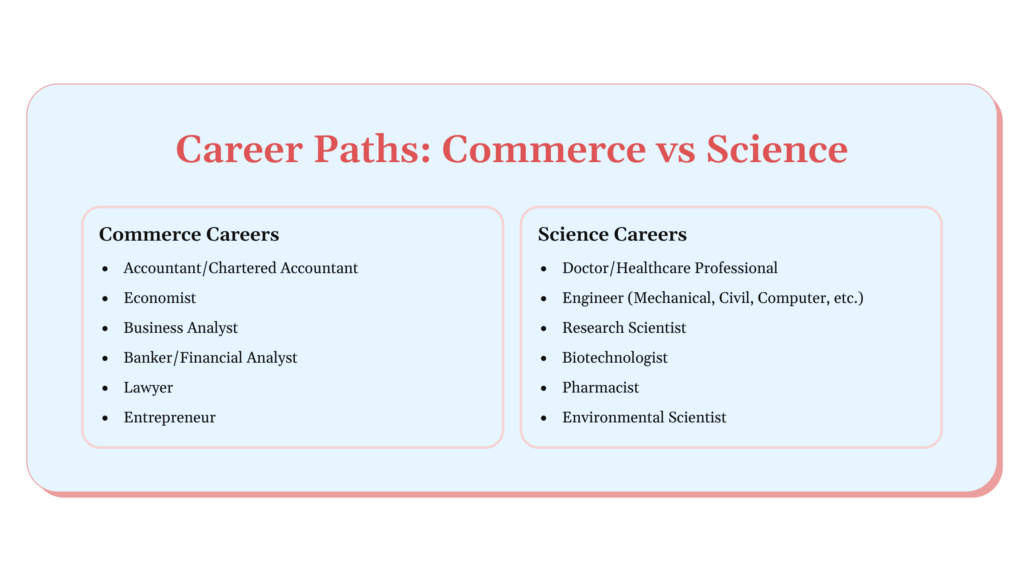
Let us get a brief comparison of the science and commerce stream.
Read More: Best Courses and Careers in Commerce Stream
The science and commerce streams offer specific benefits to students. Each stream offers multiple specialization fields, which helps students develop their careers in their area of interest. Let us now look at the benefits of choosing commerce and science.
Science is one of the eminent disciplines, as it focuses on the natural phenomenon of the functioning of things, their characteristics, etc. This stream involves studies based on experiments and observations. If you are genuinely curious about how things behave, science can be the appropriate option for you. Science offers the following benefits:
Commerce is considered to be the most dynamic field of study. It offers a plethora of career opportunities to students in various corporate sectors. If you are fond of numbers and driven towards business and economy, then choosing commerce can be a suitable option. Following are some of the benefits of choosing commerce:

Numerous courses at the diploma and post-graduate levels. Both the commerce and science stream offers a wide career scope. The courses available after class 12th from the science and commerce stream are:
The science and commerce streams are the most sought-after areas of study among Indian students. While the science stream focuses on the technical and medical aspects, the commerce stream is more inclined towards the corporate world. The following are the prospecting career opportunities offering the highest-paying jobs in the science and commerce field study:
Selecting the science stream requires a combination of practical, analytical, and cognitive abilities. These abilities help students succeed academically and get ready for scientific problems in the real world.
Cognitive Skills
Analytical Skills
Practical Skills
The Commerce stream requires a special combination of business acumen, analytical thinking, and people skills. These abilities support students’ academic success and get them ready for jobs in management, marketing, finance, and business.
Analytical Skills
Interpersonal Skills
Business Acumen
Specialized Skills by Field

| Criteria | Science | Commerce |
|---|---|---|
| Subjects | Includes Physics, Chemistry, Biology, and Mathematics. In higher education, these are divided into various specialized fields. | Includes Accounting, Economics, Business Studies, Mathematics, Taxation, and Finance. |
| Selection Criteria | Students who score well in science and mathematics in their 10th boards are usually eligible to opt for the science stream. | No specific subject requirement, but overall good grades are preferred. Strong performance in math is considered an advantage. |
| Difficulty Level | Considered more challenging, requires greater time, effort, and conceptual understanding. | Comparatively more manageable with a practical and business-focused approach. |
| Change of Stream | Science students can switch to commerce or arts later if desired. | Commerce students can switch to arts, but transitioning to science is generally not permitted. |
| Expenses | Higher education courses like B.Tech, MBBS, or BCA are generally more expensive. | UG/PG courses like B.Com, BBA, and related fields are usually more affordable. |
| Career Options | Opens doors to careers in engineering, medicine, data science, machine learning, research, and technology sectors. | Offers opportunities in banking, accounting, business management, finance, economics, and entrepreneurship. |
Both streams have their challenges, but they vary in each area’s impact in their lifestyle.
| Factor | Science | Commerce |
| Study Pressure | High (theory & practical) | Moderate (focused on concepts) |
| Competitive Exams | NEET and JEE and others, all are competitive exams | CA, CS, UPSC all have another type of challenge |
| Job Workload | Can be demanding in STEM careers | Varies; depending on the role; some have more flexibility and provide more work-life balance |
| Job Flexibility | Less flexibility while studying; More after job | Has a better understanding of flexibility during their college life’s |
Now that we’ve explored both Science and Commerce in detail, it’s clear that each stream offers unique benefits and career opportunities. Science focuses on innovation, research, and technical expertise, leading to professions in medicine, engineering, and technology. On the other hand, Commerce emphasizes business, finance, and management, opening doors to careers in accounting, marketing, banking, and entrepreneurship.
Your decision should ultimately reflect your personal strengths, interests, and long-term goals. There is no definitive answer to which stream is better both play vital roles in driving progress across industries and society. Instead of comparing them based on difficulty or salary alone, consider what aligns best with your aptitude and aspirations.
Use this guide to assess the structure, scope, and subjects of each stream, and make an informed decision that will shape a fulfilling and successful career path.

Commerce is excellent if you like working with money, business, or people.
For example, you could become an accountant or start your own business without heavy math or lab work. It’s often more flexible and practical for many.
Tip: Pick what feels right for you, not just what others say!
It depends on the person. Science can be tough because it involves a lot of math and theory. Commerce is tricky with subjects like accounting and economics. The arts can also be challenging due to their focus on writing and analysis.
Tip: Choose what you enjoy and are good at; that’s what matters!
Science can feel tougher because of the difficult math and experiments. However, commerce has its own challenges, like accounting and economics. It truly depends on what you find easier or enjoy more.
Tip: Focus on what interests you; that makes learning easier!
Yes, if you’re curious about how things work and want engineering, medicine, research, or tech careers. Science opens many doors but requires hard work.
Tip: Choose science only if you enjoy it. Interest is more important than pressure!
Commerce is great if you enjoy business, money, and practical skills. It’s less about difficult math and more about real-life topics like finance and marketing.
Tip: Choose what interests you, you’ll perform better and enjoy it more!